The Nissan That Was Right Three Years Too Early — and Lost Anyway
Here’s a car that in 1992 already knew exactly how the World Rally Championship would be won for the next decade. It knew before Subaru. It knew before Mitsubishi. The recipe was sitting right there under its own bonnet: two litres, turbo, all-wheel drive, light weight, hatchback body. The exact formula that would turn the Impreza and the Lancer into legends three years later.
That car is the Nissan Sunny GTI-R. And it won nothing. Not a single rally. Not one.
Hold onto that, because it’s the whole story. This isn’t the tale of a bad car that flopped. It’s the tale of a car that was right, and was never allowed to prove it. Let me walk you through it.
A GT-R stuffed into a shopping car
Start at the beginning. In the late 1980s, if you wanted to go rallying with the FIA, you first had to build 5,000 road cars. That was the Group A rule. No shortcut. You want a rally car, you swallow 5,000 road cars first.
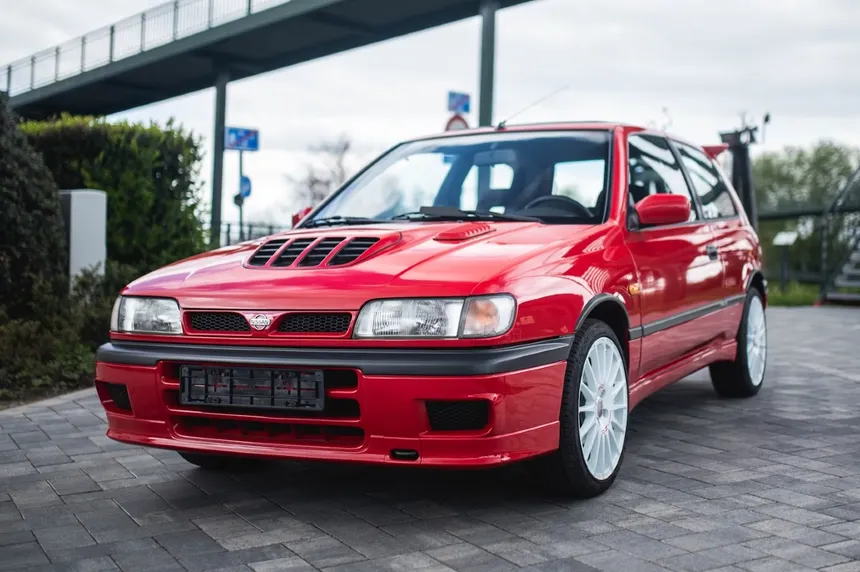
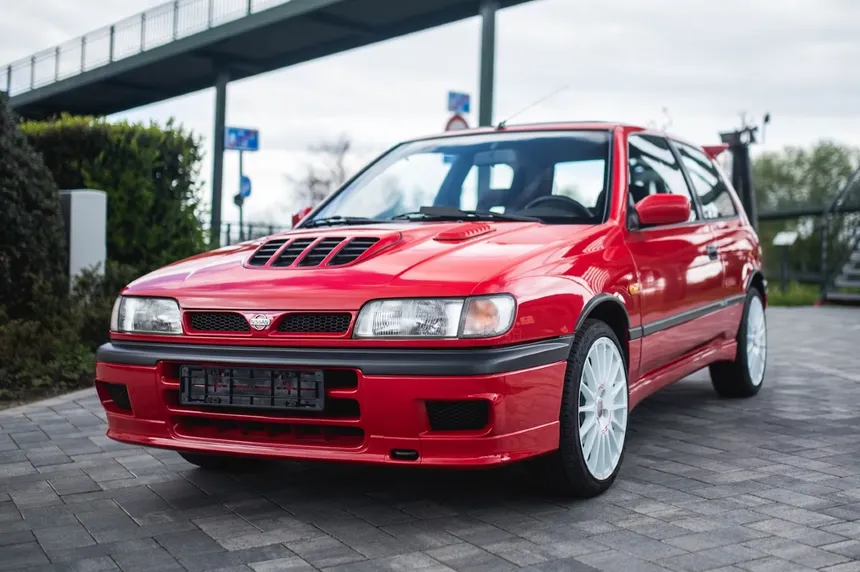
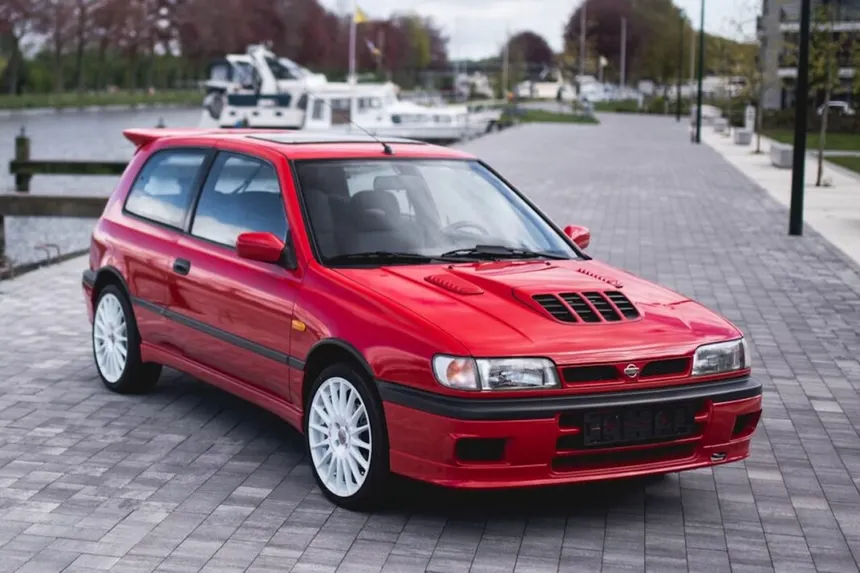
So Nissan took a Sunny. A plain three-door hatch, the kind your auntie used for the school run. And inside it they planted a monster: the SR20DET in a unique 54C specification that no other Nissan ever wore. They added all-wheel drive. And outside they bolted on a vast rear wing and a bonnet bulge so swollen it looks like the engine’s about to burst through the steel.
The result is one of the great sights of the nineties. A car with the face of a budget runaround and the heart of a Skyline. Because that all-wheel-drive system, ATTESA, is from the same family as the one in the R32 Skyline GT-R — the car the whole world calls Godzilla. That’s why they called this the baby GT-R. And it wasn’t marketing.
A British footnote: two names for one car
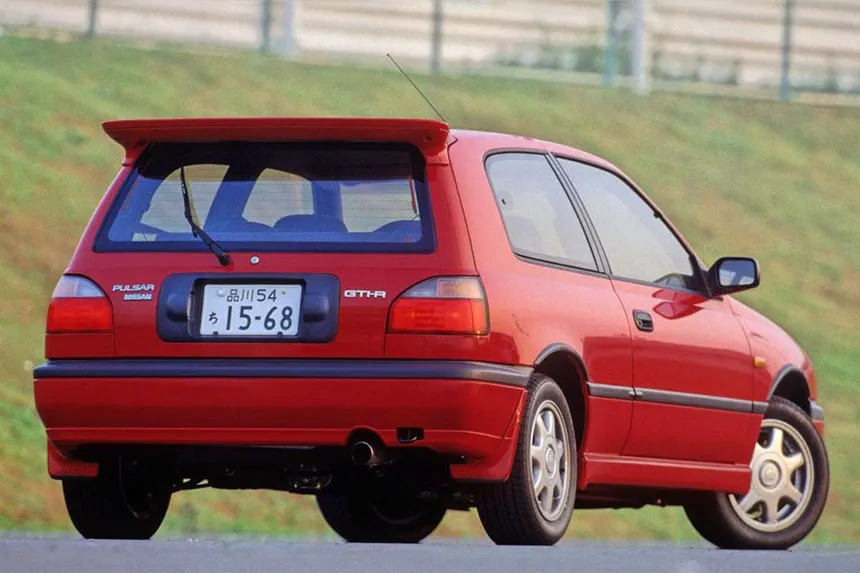
There’s a peculiar British wrinkle worth a paragraph. When Nissan took control of its own UK importing from Octav Botnar’s Automotive Financial Group, the split was acrimonious. The fallout was so messy that for a while AFG kept sourcing and selling the car badged as a Pulsar, right alongside the official Sunny-badged version sold by the newly formed Nissan Motor GB. So in the early nineties a British buyer could, in theory, walk into two different dealers and find what was effectively the same car wearing two different names. A corporate divorce, fought out on the boot lid.
It accelerated like a Porsche and cost like a hatchback
To the numbers, because this is where it gets serious.
The engine is two litres exactly, four cylinders, a Garrett turbo blowing at 0.73 bar. But the good stuff is in the race-car detail: four individual throttle bodies, one per cylinder. Sodium-filled exhaust valves to swallow more heat. A bottom end beefed up because Nissan knew you’d thrash it. This isn’t a hatchback with a turbo glued on. It’s a competition engine with a numberplate.
The Japanese version made 227bhp. The European one — the Sunny — dropped to 217bhp. Why the ten missing horses? The ECU was remapped to cope with the worse fuel we had in Europe back then. Same engine, different brain. Ten horsepower eaten by the petrol pump.
And with that, plus drive to all four wheels and a kerb weight of just over 1,200kg, the car did nought to sixty in 5.4 seconds. In 1992. In a Sunny. That was Porsche 911 pace — for a fraction of the money. There’s the whole car in one line.
The radiator that heated instead of cooled
Now the good part. And the tragic one.
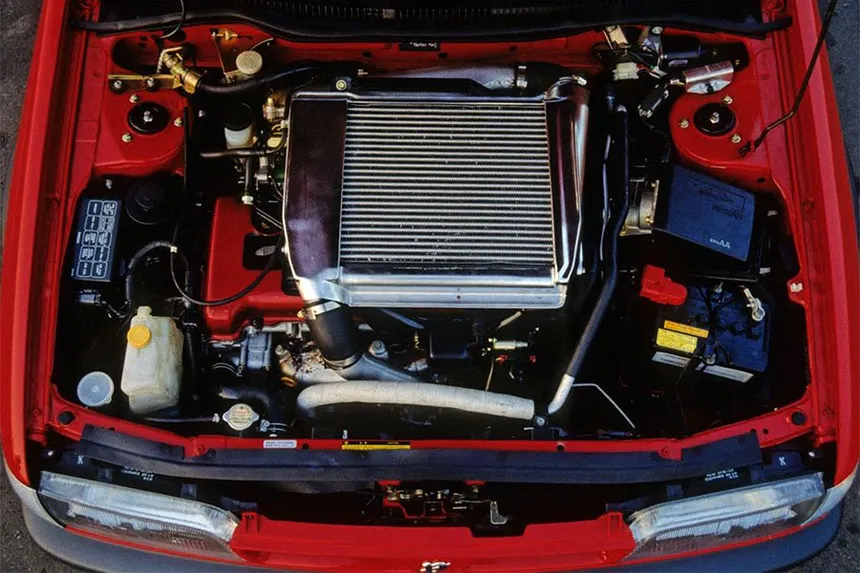
Remember that bonnet bulge? It wasn’t for show. Underneath sat the intercooler — the radiator that cools the turbo’s air. And they’d mounted it on top of the engine. Horizontally. Right above the block and, worse, right above the exhaust manifold, the hottest part of the entire car.
On the road, pressing on, it just about coped. But put that car on a rally stage, wind the engine up to 300bhp, have it breathe fire out of the exhaust for hours. What happens to a radiator sitting directly above that bonfire? Instead of cooling the air, it heats it. It stops doing its job and starts doing the opposite.
The British, who are good at this sort of thing, gave it a nickname. It stopped being an intercooler. It became the interwarmer. Laugh all you like — that’s exactly what it was.
They knew how to fix it. They couldn’t.
And here’s the part that melts your brain. Nissan knew the problem. They knew the fix. Road-car owners were already doing it: move the intercooler upright, in front of the engine, where the air actually hits it. Sorted.
But on the rally car, they couldn’t touch it. Why? The same rule that created the car. Changing the radiator’s position was such a major modification that the FIA would have forced them to homologate it by building another 5,000 road cars. Another 5,000. A fortune.
So Nissan sat trapped in its own cage. Problem pinpointed, solution in hand, unable to apply it. Two full seasons racing a car that drowned in its own heat — knowing precisely why. That’s not bad luck. That’s torture.
Headlights at noon and an intercooler packed in dry ice
What the team did to survive is one of my favourite stories in all of motorsport. Because it’s pure desperate ingenuity.
Unable to move the radiator, they tried to force more air under the bonnet by any means. One trick: driving with the headlights on in broad daylight. Why would you want lights at two in the afternoon? Nothing to do with seeing. They did it because the air tumbling around the headlight units created turbulence that nudged a little more cool air toward the engine. They ran the lights not to look — but to breathe.
There’s a better one. For the Bettega Memorial, they packed the intercooler in dry ice before the start. Froze it, literally. It worked. But only there, because that run lasted only a few minutes and the ice held just long enough. On a real rally, hours long, there isn’t enough dry ice on Earth to save you. It was a sticking plaster on a car that was broken from the factory.
Small wheels and tyres chosen out of loyalty
As if the heat weren’t enough, two more anchors.
The road car wore fourteen-inch wheels, and the rules only let you go up two. So the Nissan ran sixteens while rivals ran seventeens. Less rubber on the ground, less grip, worse braking. You start the race already losing.
Then the tyres. Nissan ran Dunlops. The story goes it was out of brand loyalty, while the rest of the paddock was on faster Michelins or Pirellis. Loyalty. In competition. It’s touching and suicidal in equal measure.
The season that nearly was
In 1991, on its debut at the Safari Rally in Kenya — one of the harshest events there is — the car came home fifth. Not bad at all. But the rest of the year was a trickle of retirements.
1992 didn’t improve. Its best-ever WRC result was third at the Swedish Rally, with veteran Stig Blomqvist driving. And brace yourself, because even that podium has a sting: it only counted toward the drivers’ championship, not the manufacturers’. So the car’s best day didn’t even score where Nissan wanted to score.
The bosses in Japan had seen enough. By mid-1992 they pulled the plug. The money went to Le Mans, to the R390. The works effort itself had been run not from Japan but from Nissan Motorsport Europe’s base in Milton Keynes — and that team read the writing on the wall. They switched to a front-wheel-drive Sunny in a lower class, and there — wouldn’t you know it — they actually won: Alister McRae, Colin’s brother, took the British Rally Championship with it in 1995. The good car was a different car.
The twist that changes everything: near-stock, it cleaned up
Now the turn of the screw. The one that makes this almost a comedy.
While the expensive version, fettled to the hilt for Group A, choked and retired, the near-standard version dominated a different class: Group N. In 1992 the Belgian and Japanese teams took first and second in that class’s world championship. The road car — less fiddled with, less tuned, less roasted — was genuinely competitive.
And why? For the exact reason that sank the rally version. Because running milder, it made less heat, and that wretched radiator coped. When you didn’t stress it, the car worked. When you wrung it out, it killed itself.
Read that again, because it’s the clinching proof: the GTI-R wasn’t a bad car. It was a good car that the rulebook and a badly-placed radiator handcuffed. Let it breathe and it wins. Push it and it drowns.
The quiet Finn who served his apprenticeship here
One gem left, and it’s a goosebumps one.
In 1992, one of the Nissan team’s drivers was a serious, quiet Finn who hadn’t yet won anything that mattered. His name was Tommi Mäkinen. The Sunny GTI-R was his first full factory contract. His first serious taste of all-wheel-drive rallying.
When Nissan shut the programme down, Mäkinen was left high and dry. No team, almost no future in the sport. He said so himself years later: it was a hard year. But he also said something else — that in that time he grew up a lot, that he finally understood things that had escaped him before.
That Finn who learned to tame all-wheel drive in a Sunny that couldn’t even breathe went on to win four straight world titles with Mitsubishi between 1996 and 1999. Four. The failed car was the driver’s finishing school. One man’s torture was another man’s education.
What’s left
Of those sub-15,000 cars, perhaps half survive, and of those, maybe half again still run. For us over here, the 103 right-hand-drive UK Sunnys are the proper unicorns — the rarest factory examples outside Japan. Prices, a joke for years, have started to climb as the cars age into legend and pass the 25-year rule that makes them legal in places like the US, where the GTI-R was never officially sold.
A whole generation met it on a screen before the road, because the GTI-R was one of the kings of the early Gran Turismo games. For a lot of people it was the first Japanese all-wheel-drive car they ever drove, even if only with a controller on the sofa.
And that’s the greatness of this car. It didn’t win. With all that heat, it couldn’t. But it was right. It had the correct recipe three years before anyone knew it was the correct recipe. It crammed supercar tech into a car a working man could afford. And it put a future world champion through his homework while nobody was watching. It lost every battle that gets written down on paper. And still, here we are, thirty years on, talking about it. Sometimes being right doesn’t make you win. But it makes you unforgettable.