Lola T70: the British customer car that handed Roger Penske his first Daytona 24 win
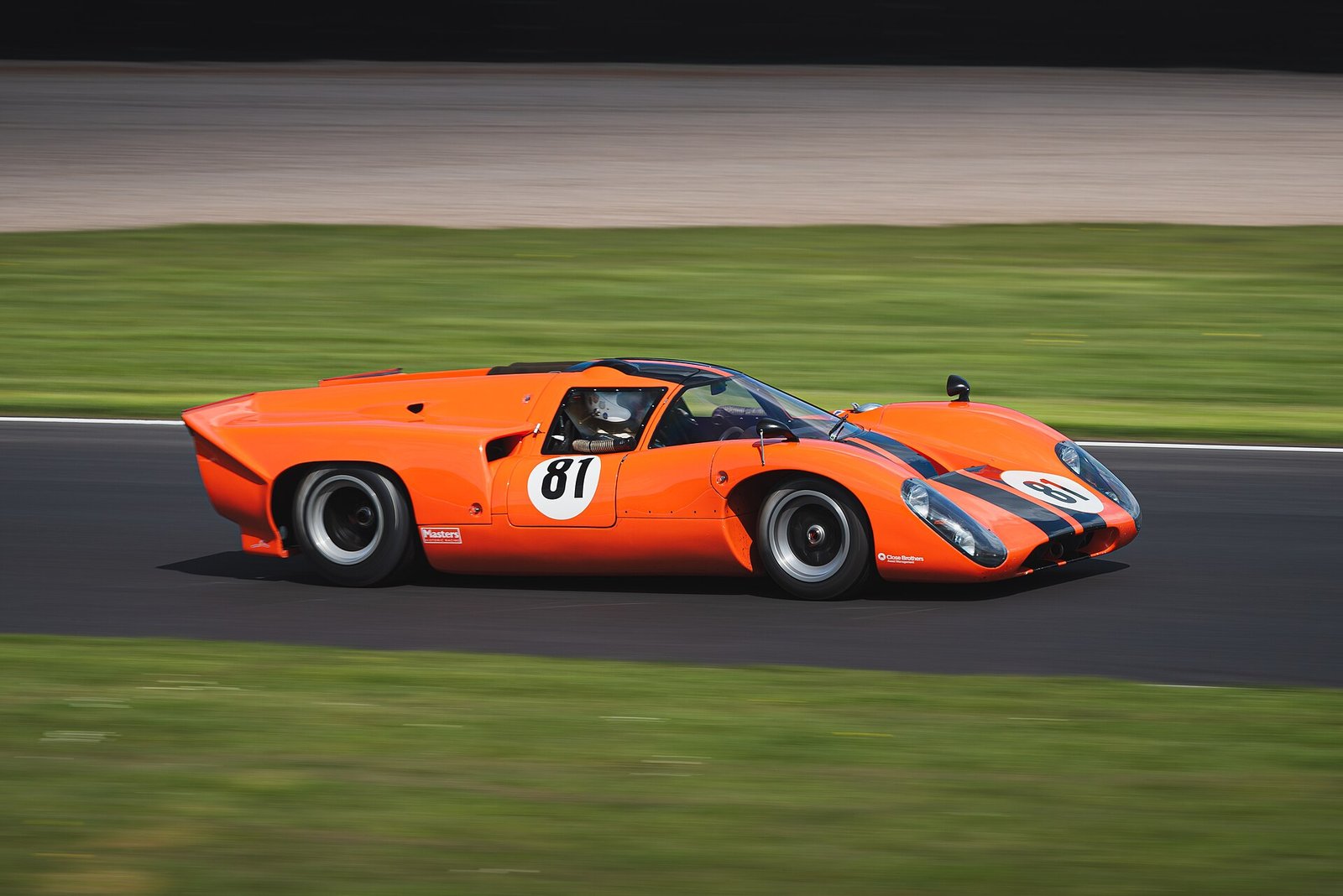
Ask an American race fan who won the 24 Hours of Daytona in 1969 and you’ll hear Ford, Porsche, maybe Ferrari. Wrong on all counts. The winner was a blue-and-yellow Sunoco coupe entered by a young team owner named Roger Penske, driven by Mark Donohue and Chuck Parsons, powered by a Chevrolet small-block and built in a modest shop in Huntingdon, England. The car was a Lola T70, and another T70 finished right behind it. That was the high point of a customer race car that won the first Can-Am championship, gave the only Ford-powered Can-Am win to Dan Gurney, doubled for crashing Porsches in a Steve McQueen movie and played a car of the future for George Lucas.
The man Ford left behind
The Lola T70 starts with a grudge. In 1963 Eric Broadley, Lola’s founder, built the Mk6 GT, a small mid-engine coupe with a Ford V8. Ford was shopping for a shortcut to beat Ferrari at Le Mans, bought into the project and moved it to its new Ford Advanced Vehicles operation at Slough, west of London. Broadley went along. The Mk6 became the starting point of the GT40, the car that would win Le Mans four years running from 1966.
Broadley didn’t stay to see it. Working inside a corporate program where other people redrew his ideas didn’t suit him, and he went back to his own company. His next big car would carry his name and nobody else’s. In 1965 Lola revealed it: the T70.
The Lola T70, a race car you could buy
The T70’s business plan was simple and very American in spirit. Build a fast, tough sports racer, sell it to anyone with the money and let the customer bolt in a big American V8. The chassis was a riveted aluminum monocoque with a fiberglass body, double wishbones at both ends and a rear structure designed from day one to take the torque of a Chevrolet or Ford small-block without twisting itself apart. A Chevy 327 was a common choice.
That made the T70 the perfect car for the booming American sports car scene of the mid-sixties, where privateers raced on weekends at places like Riverside, Laguna Seca and Road America. It was also the right car for John Surtees, the former motorcycle world champion who had won the 1964 Formula 1 title with Ferrari. Surtees became the T70’s development driver and won the Player’s 200 at Mosport in Canada with it in 1965.

That same September, Mosport nearly killed him. Surtees crashed a T70 heavily in practice there and suffered serious injuries that kept him out for months. On October 17, 1965, Walt Hansgen won the Monterey Grand Prix at Laguna Seca in John Mecom’s Ford-powered T70, which put the car on the map in California.
Can-Am 1966: five out of six
In 1966 the Sports Car Club of America launched the Canadian-American Challenge Cup, the Can-Am, a series with almost no rules on engine size and very big prize money. It was made for cars like the T70, now in Mk II form with a Chevrolet V8.

The Lola won five of the six races. Surtees, back from his injuries, took three of them, at Mont-Tremblant, Riverside and the Stardust Grand Prix in Las Vegas, and became the first Can-Am champion. Mark Donohue won at Mosport in a T70 run by Penske. And at Bridgehampton, New York, Dan Gurney won in a T70 with a Ford engine. It’s still the only Can-Am race ever won by a Ford-powered car, a trivia question that stumps most people at the bar. The only race the T70 didn’t win went to Phil Hill in the winged Chaparral 2E.
Then Bruce McLaren arrived
The party lasted one year. In 1967 McLaren showed up with the orange M6A, and Bruce McLaren and Denny Hulme turned the Can-Am into their private series for the next several seasons. The T70 managed a single win in 1967. Customers who had paid for a winner suddenly owned a car that was a step behind.
Broadley’s answer came from the rulebook. For 1968 the FIA, motorsport’s governing body, limited prototypes to three liters, but it left a door open for sports cars up to five liters if at least fifty had been built. Lola was close to that number, and so was Ford with the GT40. That loophole kept both cars alive in endurance racing, and Lola already had the right car for it.
The coupe that looked faster than the GT40
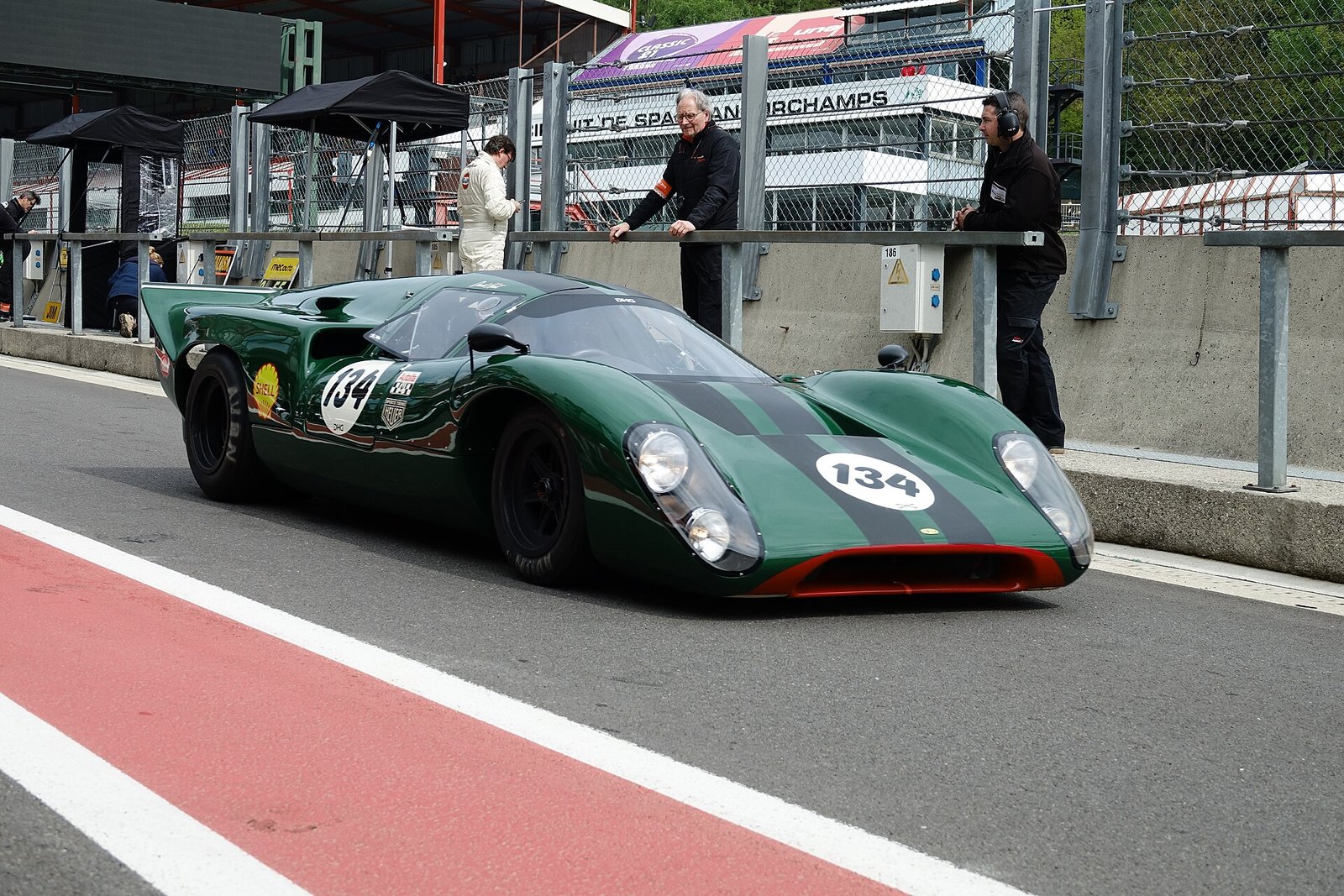
The T70 Mk III Coupé appeared in 1967, with Tony Southgate among the engineers working on it at Lola. Southgate went on to design the Eagle that finished first and second at the 1968 Indianapolis 500 and the Jaguar XJR-9 that won Le Mans in 1988. The coupe was low, smooth and wide, with stacked headlights and a body that was more aerodynamically efficient than the GT40’s. On the Mulsanne straight it went well past 200 mph.

On paper it should have beaten Ford’s car. In practice, it lacked what the GT40 had in abundance: factory money and organization. John Wyer’s Gulf-liveried GT40s were run like a military operation. Most T70 coupes were in the hands of gentleman drivers and small private teams.
There was also a mechanical weakness. The Chevrolet small-block that was so strong in a sprint race had cooling and sealing problems when asked to run hard for 24 hours straight. The T70 took poles and fastest laps in 1968 and led races, only to drop out. It needed a team that could make it last.
Roger Penske’s blue coupe
That team was Penske Racing. Roger Penske, a former racer turned businessman, bought a T70 Mk IIIB for Mark Donohue, his engineer-driver from New Jersey. The Mk IIIB was almost a new car under an old name: a new aluminum monocoque, a lower nose with twin headlights on each side under Perspex covers, a fuel-injected Chevrolet V8 making around 450 hp and a five-speed Hewland gearbox. Broadley had redesigned almost everything, but the FIA accepted it as a development of the Mk III.
Penske’s car was painted in the blue and yellow of Sunoco, the oil company that sponsored the team. At Daytona on February 1 and 2, 1969, Donohue and Chuck Parsons faced Porsche’s new 908s, Wyer’s GT40s, fresh from winning Le Mans in 1968, and other T70s, including one entered by American International Racing for Ed Leslie and Lothar Motschenbacher.
Penske’s T70 won. Leslie and Motschenbacher finished second in their T70. A British customer car with an American V8 took the top two spots in America’s biggest endurance race.
For Penske, it was one of the first big wins for a team that later became the most successful in the history of the Indianapolis 500. For Donohue, it confirmed him as one of the great American drivers of his era, before his death in practice for the 1975 Austrian Grand Prix.
The car Porsche built to finish the job
A month after Daytona, at the Geneva Motor Show in March 1969, Porsche showed the 917. The FIA lowered the minimum production run for five-liter sports cars to 25, which let Porsche and Ferrari build twelve-cylinder monsters designed from scratch for the class. Against Stuttgart’s budget and Ferrari’s 512, a customer car from Huntingdon with a pushrod Chevy had no chance.
The early Porsche 917 was frighteningly unstable. Drivers complained that it lifted at speed and moved around in fast corners. Porsche found its cure in a revised high tail, and there’s a story still told among racing people that the T70 coupe’s tail, shaped a year earlier, showed the way. Porsche’s official histories don’t say so, and we can’t prove it either. What the results do show is how close the old Lola came: at the Austrian 1000 km in 1969, Jo Bonnier and Herbert Müller finished second in a T70, on the same lap and less than two minutes behind the winning 917 of Jo Siffert and Kurt Ahrens.
Steve McQueen’s crash-test dummies
The T70’s best-known role came in Hollywood. In 1970 Steve McQueen’s Solar Productions went to Le Mans to film what became the 1971 movie Le Mans. The story needed crashes, and nobody was going to destroy real 917s and Ferrari 512s. The solution was to buy used Lola T70s, cheaper and plentiful, and dress them in fake 917 and 512 bodies.
When you see a "Porsche 917" smash into the guardrail in that movie, you’re watching a T70 in costume, driven by remote control. According to the stories from the set, the steering control failed after the first hit and the car kept bouncing from barrier to barrier. The footage looked so good it stayed in the final cut. One of those cars, chassis SL76/141, had previously raced for Ulf Norinder and Jo Bonnier. Decades later it turned up in a barn and was restored.
George Lucas wanted one too. In THX 1138, his first feature film, released in 1971, T70 coupes appear as futuristic police cars. A race car from the sixties playing the future, and getting away with it.
A record that lasted twenty years
The T70 also set a national speed record. On January 13, 1968, Mike de Udy took a T70 to a public road between Vredenburg and Hopefield in South Africa’s Western Cape and averaged 191.8 mph over two runs, with a best one-way run of almost 196 mph. That broke David Piper’s Ferrari record and made it South Africa’s absolute land speed record.
According to South African records, it stood until November 1988, when Sarel van der Merwe raised it to 224.3 mph in an Audi 5000 CS backed by Volkswagen South Africa. A secondhand race car on a country road held off the German industry for twenty years.
Lola today and the T70S
Lola Cars went into administration in 2012. The T70 never really went away, though. Continuation Mk IIIB cars built from the original drawings have received FIA historic papers and race in the FIA Masters Historic Sports Car Championship against original T70s, Ferrari 512s and Porsche 917s.

In 2022 businessman and racer Till Bechtolsheimer bought the Lola name, and on March 31, 2026, the company unveiled the T70S and the road-registered T70S GT. Production is limited to 16 cars across both versions, with a 6.2-liter Chevrolet V8 making around 500 hp. The shape is the Mk III coupe almost line for line: low nose, stacked lights, wide hips. Sixty years after Broadley drew it, the T70 is back, this time with license plates.
What the record books leave out
The T70 won hundreds of races in the hands of customers, beat factory teams in Can-Am and at Daytona and helped build the reputation of Roger Penske and Mark Donohue. It came from a man who had seen his earlier design become the GT40 under Ford’s name and decided to show what he could do on his own.
It ran the same small-block Chevy you could find in a Camaro, in a chassis built by a small British company, and for one weekend in February 1969 it was the best endurance car in America. The full racing record is on the Lola T70 page on Wikipedia. The GT40 side of the story is in our piece on the Ford GT40, and the race that defined that era is covered in our history of Le Mans.
Check you’re still alive.
Photos via Wikimedia Commons: Lola T70 Mk IIIB at Donington, Julian Herzog (CC BY 4.0); T70 Mk II Spyder and Mk III engine bay, Akela NDE (CC BY-SA 2.0 FR); T70 Mk IIIB, Yannick Leclercq (CC BY-SA 4.0); T70 Mk3B at Mallory Park, TOM at Picasa (CC BY-SA 3.0); T70 Spyder at Mont-Tremblant, John Chapman (CC BY-SA 3.0).