
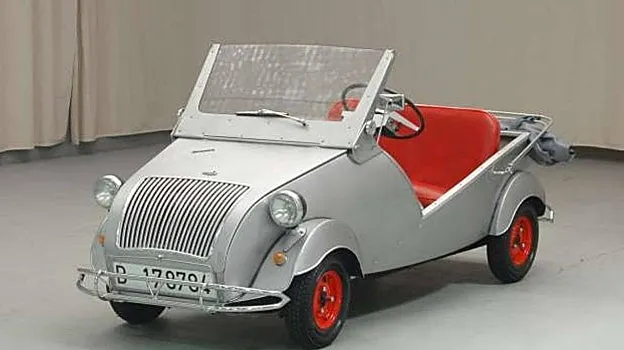
The Genius Who Built Cars Pricier Than a Bugatti — and Ended Up Fathering the Poorest Car in Spain
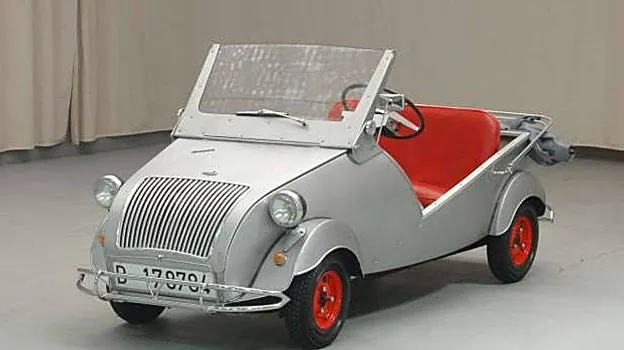
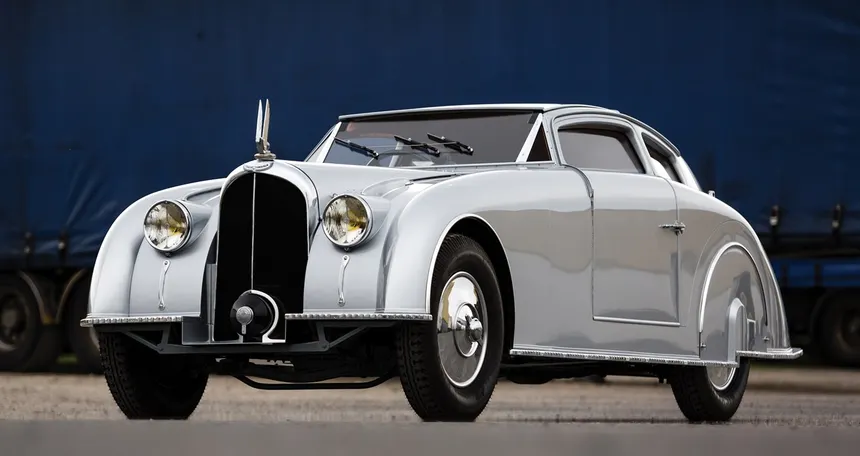
If you’ve ever wandered the lawn at the Pebble Beach Concours d’Elegance, you may have stopped dead in front of an Avions Voisin. They have that effect. Sweeping Art Deco bodywork, aircraft-grade aluminium, aerodynamic rooflines drawn decades before anyone used the word “aerodynamics” in a showroom. Cars more expensive than a Bugatti. Rolling sculpture for the richest people alive.
Now picture the opposite. A tiny tin box with no doors, no windows, no reverse gear, a 9-horsepower motorcycle engine you started by yanking a cord, driving a single wheel. The front-right one. Just the one. A 240-kilo contraption that an entire nation nicknamed, with affectionate mockery, “the Slipper.”
Here’s the part that breaks your brain: the same man designed both. The aristocrat of the concours lawn and the father of the Slipper are one and the same person. And the story of how you travel from one to the other is among the most touching the twentieth-century car world ever produced. Let me tell it.
Gabriel Voisin, the man who taught Europe to fly
To understand the little Spanish runabout, you first have to understand the mind it sprang from. And what a mind it was.
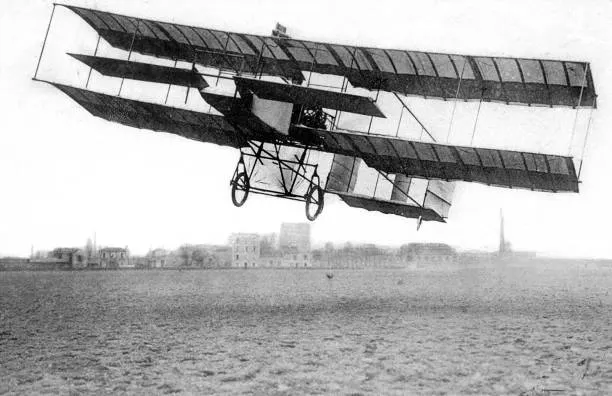
Gabriel Voisin was born in France in 1880. Before he was thirty he’d already done something almost nobody on the continent had managed: in 1908, an aircraft from his workshop, piloted by Henri Farman, achieved the first sustained, controlled, circular flight in Europe. Not a hop. Real flight. Voisin was, quite literally, among the handful of men who taught the old world to leave the ground.
During the First World War, his firm became a major manufacturer of military aircraft, the Voisin III among the key machines of the conflict. When the war ended, Voisin did what restless geniuses do: he changed his toy. He walked away from aeroplanes and, in 1919, founded Avions Voisin to build motor cars. And not just any cars.
Cars that were aeroplanes dressed as jewellery
The interwar Voisins are the kind of cars you stand and stare at. Because they look like nothing else from their era.
Voisin came from aviation and treated cars as aircraft. He used light alloys, aluminium everywhere, construction techniques he’d learned building wings. His designs were radical, fiercely personal, without a single concession to conventional taste. The C28 Aérosport had an aerodynamic line years ahead of its time, a body like a land-bound airship, pure Art Deco geometry rolling down the road. His interiors were laid out like aircraft cockpits.
And they were expensive. Brutally so. Pricier than a Bugatti, which is saying something. So expensive that during the Depression of the 1930s almost nobody could afford them — one of the reasons the company eventually collapsed. Voisin built for a tiny elite who appreciated engineering the way others appreciate fine art. He didn’t care about selling in volume. He cared about getting it perfect. He even insisted on the finest materials and fittings throughout, laying out cabins with the same obsessive logic he’d applied to cockpits, refusing to let cost dictate a single decision.
Hold that thought, because it’s the key to the contrast coming. Voisin was a man obsessed with the best, the finest, the most exclusive. A perfectionist for the wealthy, in an age when the wealthy still demanded the extraordinary.
The world breaks, and the genius changes the question
Then the Second World War arrived and changed everything. Avions Voisin didn’t survive as a luxury marque. The company was absorbed by its creditors, and that entire world of aristocratic cars for a refined elite simply stopped making sense. After a war that had flattened Europe, who was going to buy a rolling palace?
This is where Voisin, now an old man, did something that tells you everything about him. Instead of retreating to mourn the lost world, he looked at the new one and asked himself a different question entirely — the exact opposite of everything he’d ever done. No longer “how do I build the most exquisite car on earth,” but “how do I build the cheapest, most minimal thing capable of moving one human being.”
Europe was in ruins. People had no money, no petrol, no anything. What was needed wasn’t jewellery with wheels. It was dirt-cheap contraptions that simply worked. And Voisin, the aristocrat of aluminium, set about designing precisely that.
The Biscooter: the idea nobody in France wanted
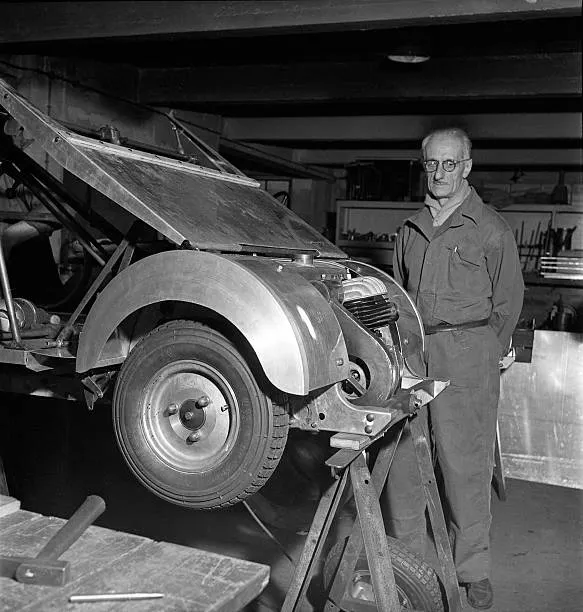
He called it the Biscooter. The name said it all: the idea was something the size of two motor scooters, or a scooter with four wheels. A minimal vehicle, stripped to the bone, built to cost as little and use as little as physically possible. The design was so radical in its austerity it didn’t even allow for paint: if the body was aluminium, why spend money colouring it?
Voisin showed his creation in Paris in the early 1950s. And nothing happened. French manufacturers weren’t interested. The French public wasn’t either. France was recovering, already looking towards proper cars, and this minimalist little thing struck them as too little, too poor, too sad. The genius’s idea found no buyer in its own country.
And that’s where Spain comes in.
Spain, where poverty was the baseline
To understand why the Biscuter triumphed here when it flopped in France, you have to understand the Spain it landed in.
Postwar Spain was another planet. After the Civil War, the country lived isolated, locked inside the autarky of Franco’s regime, its economy broken and cut off from the industrialised world. There were no raw materials. No money. Almost nothing. Industry limped along, and the motor car — that luxury — was within reach of a privileged few.
In that context, what looked too poor in France looked like a miracle in Spain. A dirt-cheap car, using next to nothing, that anyone with a few savings could dream of owning. The lapidary austerity of the Biscooter, which scared off the French, was exactly what Spain needed. The little contraption had found its home.
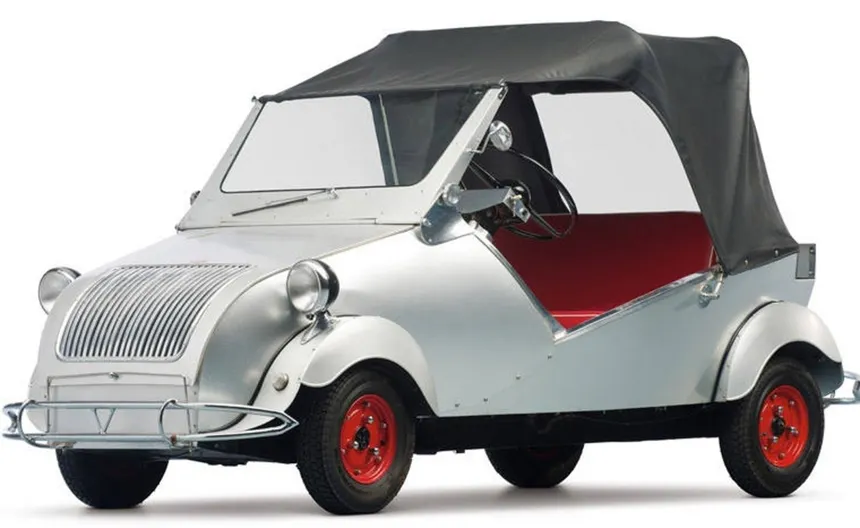
The firm Autonacional S.A., based near Barcelona in Sant Adrià del Besós, bought the licence. And Voisin’s Biscooter became the Spanish Biscuter. They launched it in 1953, at first without a formal name, calling it simply the Series 100. But the public — always faster with nicknames than any marketing department — saw it side-on, decided it resembled a low house slipper, and christened it forever: la Zapatilla. The Slipper.
How far you can strip a car back
I want you to grasp just how minimal this car truly was, because it borders on the unbelievable.
The Biscuter Series 100 had no doors. No windows. No reverse gear. Park it wrong and you got out and pushed. The engine was a Hispano Villiers single-cylinder, two-stroke, 197cc, making 9 horsepower. Nine. You started it by pulling a cord, like a lawnmower. And as if that weren’t enough, the transmission drove a single wheel: the front-right one. Not both fronts. One. The right-hand one.
It weighed around 240 kilos, measured a touch over two and a half metres, and with luck and a downhill stretch would reach 76 km/h. The body was bare, unpainted aluminium, faithful to Voisin’s original refusal to spend a penny more than necessary. It was so ugly, so utterly without pretension, that a saying was born in period: “ugly as a Biscuter.” When your own name becomes a byword for ugliness, you’ve hit aesthetic rock bottom. But here’s the thing — people didn’t care. Because at last they had a car. To a Brit, think of it as Spain’s answer to the bubble car, only stripped back even further than an Isetta ever dared.
The detail that sums up an entire era
And here’s the fact that silences a room when you tell it. Because it captures a whole epoch in a single image.
At first, the Biscuter’s body was aluminium. But there came a point — with the SEAT 600 already looming on the horizon — when the state cut off the aluminium supply. No aluminium, no body. The solution? Switch to steel. But not steel bought on the open market, because there were no means for that either. The steel came from recycling the oil drums of the Marshall Plan, the American aid programme to rebuild Europe — aid that Spain, incidentally, was largely left out of.
Stop and think about that. Spanish cars built from the sheet metal of American aid drums. There’s no image that better portrays what that country was: pure ingenuity born of having absolutely nothing, building mobility out of the richest nations’ metal rubbish. The Biscuter wasn’t just a car. It was a mirror of an entire era.
The Slipper that got a country moving
For a few years, the Biscuter flourished. Autonacional built up to 450 cars a month, wove a dealer network across Spain, and diversified the range: commercial versions, vans, even a little sporting convertible. For a great many Spanish families, that ugly minimal contraption was the first car of their lives. The first time they could move on four wheels instead of on foot or by mule. That’s no small thing.
But the world kept turning. In 1957 the SEAT 600 arrived — a real car, with doors, windows, four proper road wheels and a reverse gear, at a price more and more people could meet. Against a real car, the Slipper stood no chance. The range was stretched too thin, a plastic-bodied version was even tried and flopped, and bit by bit the Biscuter faded. By around 1960, after some twelve thousand built, the Slipper ceased production.
What remains
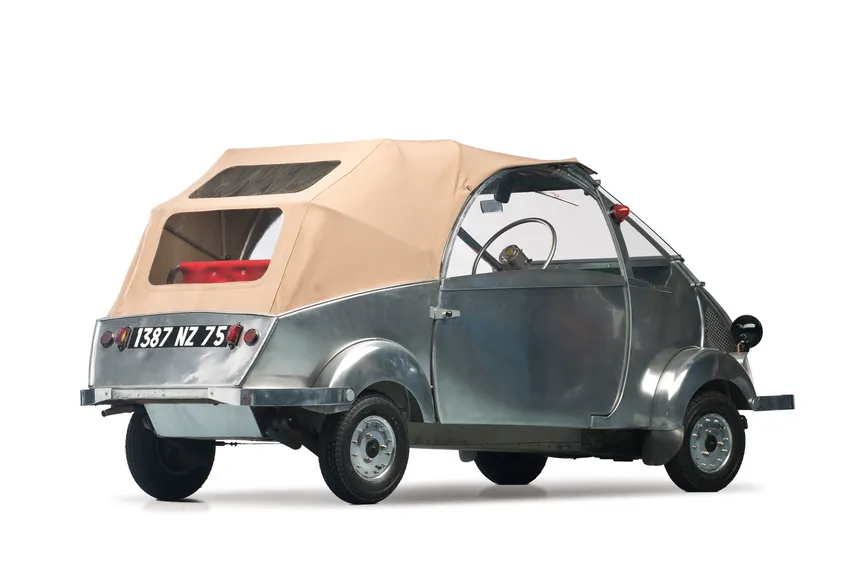
Today a Biscuter is a museum curiosity, an oddity that raises smiles, a collector’s piece that isn’t even worth much money. It’s easy to look at it and see only what it appears to be: an ugly, poor little thing from a poor country. But that would be staying on the surface, and this story deserves more.
Because that little contraption was designed by one of the greatest geniuses the car and the aeroplane ever produced. The same man who built cars more expensive than a Bugatti, who taught Europe to fly, who treated every one of his Voisins as a unique work of art. And when the world broke and there was no longer any room for luxury, that genius didn’t give up or hide. He took all his talent and turned it to the opposite end: getting the humblest people moving. There’s something enormous in that. The same brain that designed rolling palaces for millionaires designed the car that hauled the families of a ruined Spain out of the mud.
Sometimes an engineer’s greatness isn’t measured by the most expensive car he can build. It’s measured by how well he solves the problem in front of him. And the problem in front of 1950s Spain wasn’t luxury. It was simply moving. The Slipper — ugly, minimal and glorious — solved it.