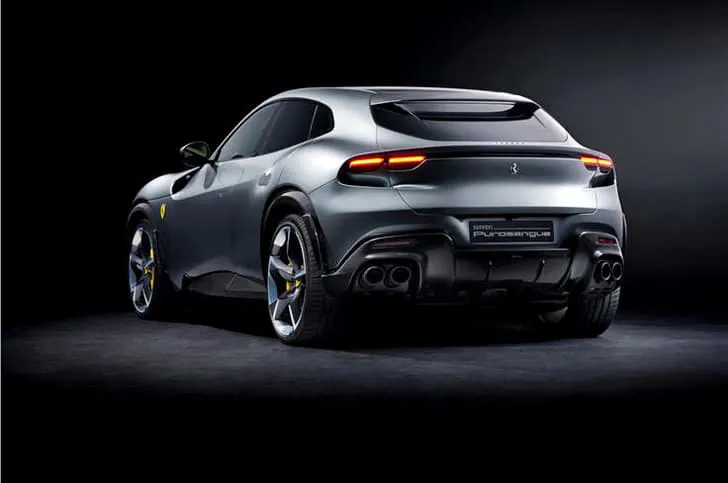
Ferrari built an SUV designed to hide the SUV
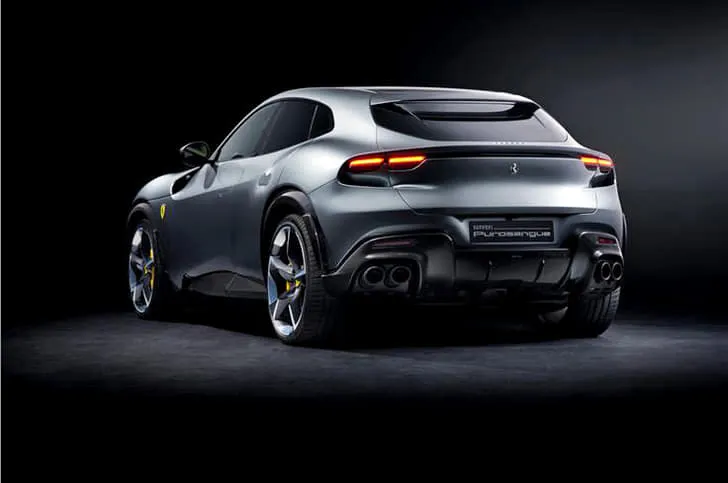
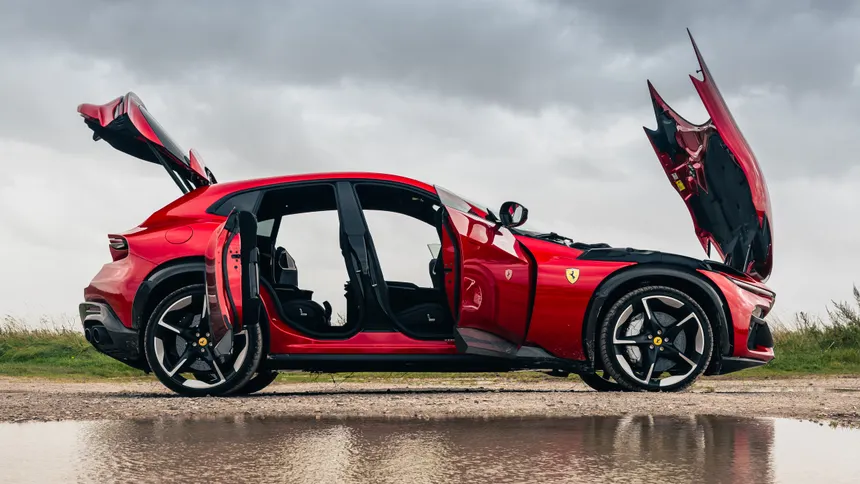
Ferrari spent years swearing it would never build one. Then it built one, refused to call it an SUV, and invented a three-letter acronym rather than say the word out loud. FUV. Ferrari Utility Vehicle.
Easy to laugh at. Marketing departments do this all the time.
Except that when you start pulling the Purosangue apart, the acronym starts making an uncomfortable amount of sense. Because almost every engineering decision in this car was taken against the SUV rulebook, and some of them cost Ferrari real money and real complexity to pull off.
Let me be straight with you: I don’t like SUVs. I don’t like what they’ve done to the market, I don’t like how they drive, I don’t like two and a half tonnes of car hauling one bloke to the office. But if I ever had to own one, and I had the money, it would be this one.
Here’s why, bolt by bolt.
Two gearboxes, not one
Start with the layout, because everything else follows from it.
A conventional four-wheel-drive car has one gearbox, a centre differential, and a propshaft running the length of the car feeding both axles. Land Rover has been doing it for seventy years. It works. It’s also heavy, bulky, and it forces the engine to sit high and forward.
Ferrari refused. The 6.5-litre V12 sits behind the front axle, pushed back into the cabin. The eight-speed dual-clutch gearbox sits at the back, between the rear wheels. That’s a transaxle — the same architecture Ferrari has used on front-engined cars since the 275 GTB in 1966. Weight distribution comes out at 49:51 front to rear.
So how do the front wheels get power? Through the PTU — Power Transfer Unit. It’s a compact gearbox bolted to the nose of the V12, taking drive straight off the crank. And it isn’t a simple transfer case. It’s a two-speed gearbox plus reverse, with parallel wet clutches — one per front wheel.
Here’s the part that should make you sit up. Those two PTU ratios are geared to overlap with the first four ratios of the rear gearbox: PTU first covers the speed range of rear first and second, PTU second covers third and fourth. Once the rear box selects fifth, the PTU clutches open and the front axle checks out entirely. From fifth to eighth, the Purosangue is pure rear-wheel drive.
To be clear, because this gets mangled constantly: the PTU has two gears, not four. Those two simply span the speed range of the main gearbox’s first four.
Why disconnect at all? Because beyond that speed the front axle contributes nothing but parasitic drag and rotating mass. So Ferrari switches it off.
And because each front wheel has its own clutch, the system can deliver up to 800 Nm to each front wheel independently. That’s genuine torque vectoring — not the cheap trick of braking the inside wheel to fake a turn-in, which is what most of the segment does. This car actively drives the outside front wheel to pull the nose into the corner.
No anti-roll bars. None.
This is the centrepiece, and it’s the reason Ferrari filed three new patents.
Here’s the problem every car has. Turn into a corner and the body leans. To stop that, every car in the world runs anti-roll bars — a torsion bar linking both wheels on an axle. One wheel rises, it drags the other up with it. Roll goes down.
The catch is that the bar can’t tell the difference between a corner and a pothole. Hit a bump with one wheel and the bar transmits that hit straight across to the other wheel, which hit nothing at all. Stiffer bar, less roll, worse ride. It’s a compromise with no mechanical way out.
Ferrari’s answer: bin the bars.
The system is called F.A.S.T. — Ferrari Active Suspension Technology — developed with Multimatic, the Canadian outfit that builds the Ford GT and works with F1 teams. At each corner sits an actuator assembly built around a liquid-cooled, 48-volt, three-phase brushless electric motor, driving the damper shaft through a bespoke twin-lead ball screw and gearbox assembly. Inside the damper body itself sit two spool valves — Multimatic’s signature — independently controlling compression and rebound.
In plain English: the motor can push or pull the damper rod whenever it likes, without waiting for the road to tell it to.
A normal damper reacts. This one acts. Each corner can generate up to 6,000 Newtons of force on its own. And each actuator assembly carries an onboard motor control module taking commands straight from the vehicle dynamics controller — the bit Ferrari patented, and the first production active suspension anywhere to marry an electric motor to spool-valve damping.
The result: no anti-roll bars anywhere on the car. Each wheel is genuinely independent of its partner, and roll is controlled electronically by pushing force where it’s needed. Ferrari could program the car to lean into a corner, motorcycle-style, if it wanted. It doesn’t — it would feel deeply strange — but the hardware allows it.
Alfredo Scifo, Ferrari’s head of chassis engineering for GT cars, called it the biggest single leap the company has made in chassis engineering in a decade. During durability testing, engineers put plastic cups on the roof and drove over broken surfaces. The cups stayed put. Switch the system off, and they fell.
The system is complex enough to need its own battery — under the driver’s seat — and its own cooling circuit with two pumps and a dedicated radiator. One of the intakes in that grille-less nose isn’t cooling the engine. It’s cooling the suspension.
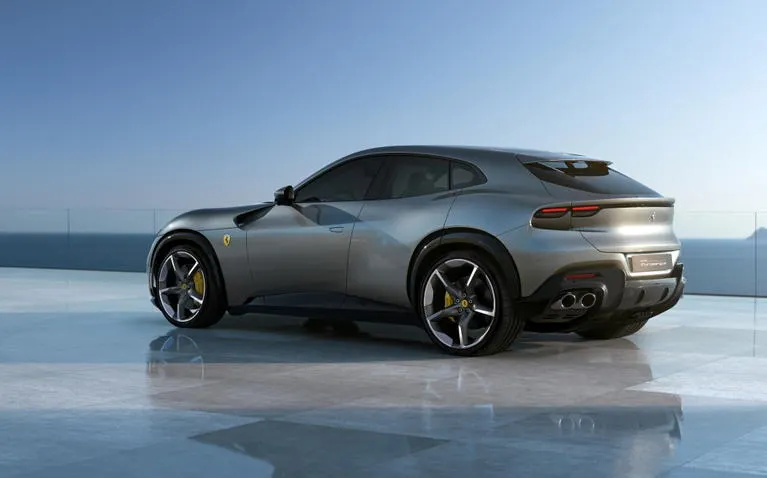
Four-wheel steering — and the rears work separately
Rear-wheel steering isn’t news. Half the performance market has it.
What almost nobody has is rear wheels that steer independently of each other. Each rear wheel on the Purosangue has its own actuator and takes its own command. Conventional systems move both rear wheels in parallel — same angle, same direction. This one doesn’t. It can give one wheel one angle and the other wheel a different one.
That unlocks tricks a parallel system physically cannot do. Toe-in under braking, for instance: both rear wheels angled slightly inward to plant the rear axle when you stand on the pedal. The system is lifted from the 812 Competizione — a 830 hp car built to go fast and do nothing else.
All of it — front torque vectoring, rear e-diff, four-wheel steering, active suspension, brake-by-wire ABS evo — speaks a common language through Side Slip Control 8.0.
The engine ends the argument
6,496 cc. Twelve cylinders, 65-degree vee. Naturally aspirated. 8,250 rpm redline.
The Urus runs a twin-turbo V8 from the Volkswagen Group parts bin. The DBX707 runs a twin-turbo V8 from AMG. Ferrari dropped in a naturally aspirated V12. It is the only one in the class, and it isn’t a hand-me-down: the F140IA runs cylinder heads derived from the 812 Competizione, an all-new intake, new exhaust, new valve timing, 350-bar direct injection and equal-length headers so all twelve cylinders sing in phase.
725 cv at 7,750 rpm. 716 Nm at 6,250. And the number that actually matters for a car people will use daily: 80% of peak torque at just 2,100 rpm.
That’s the hard part. Big naturally aspirated engines always have top end. Extracting real shove down low without flattening the linear delivery is where the engineering hours go.
And while we’re here, let’s puncture something you’ll read everywhere: that the engine “detects fuel octane and adjusts ignition timing.” It does. So does your car. Knock sensors and timing retard have been standard on petrol engines for three decades, and selling that as Maranello sorcery is an insult to your intelligence. What is specific to this V12 is the equal-length exhaust manifolds, the 350-bar direct injection and the Competizione-derived heads. That’s the expensive part. The other thing is a fifty-euro sensor.
The aero is everywhere, and you can’t see any of it
- The nose. Bumper and wheel arch louvre work together to generate an air curtain that aerodynamically seals the front wheels, killing transverse turbulence before it forms. Negative ramps sit ahead of the front wheels, because a taller car exposes more wheel to the airflow.
- The wheels. Forged, with radial elements on the outer channel — the same concept as the SF90 Stradale — pulling hot air out of the wheel arch and feeding it into the flow down the car’s flanks.
- The rear screen. The Purosangue has no rear wiper. That’s not an omission. The underside of the suspended spoiler is curved to accelerate air and aim it at the glass, and it carries two pairs of vortex generators to counteract the turbulence naturally shed by the C-pillar. The airflow cleans the window.
- The nolder. A 7 mm lip on the tailgate edge channelling wake vortices to recompress the flow at the tail.
- The diffuser. Progressive expansion, and it doubles as the extraction path for hot air around the gearbox and exhaust.
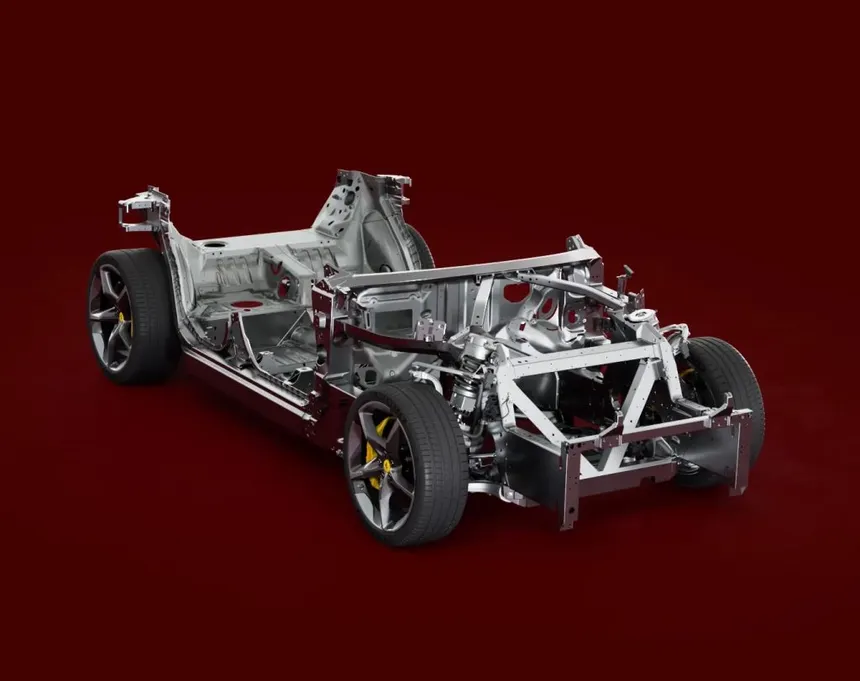
Chassis: a war fought over millimetres
All-new chassis. High-strength aluminium alloy lower structure, spaceframe of closed-section extrusions joined by castings, high-strength steel only where crash structures demand it.
Torsional rigidity up 30%. Beam stiffness up 25% over the GTC4Lusso. Despite being a physically larger car, the chassis weighs less.
The roof is single-shell carbon fibre as standard, with soundproofing integrated, and it’s 20% lighter than the equivalent aluminium roof. Why bother? Centre of gravity. On a tall car, mass removed from the roof is worth double what you save at the floor.
They kept going. The dual-clutch gearbox runs a dry sump and a more compact clutch pack, shaving 15 mm off its installed height. Fifteen millimetres. On a two-tonne car, someone fought for fifteen millimetres of centre of gravity.
The scoreboard: 1,589 mm tall. The Urus stands at 1,640. The DBX at 1,680. Dry weight is 2,033 kg against roughly 2,200 for both rivals.
The Urus comparison, and why it matters
The Urus is a formidable machine and I’m not going to pretend otherwise. But it’s built on the Volkswagen Group MLB platform — shared with the Touareg, Q7, Cayenne and Bentayga. Engine ahead of the axle, centre differential, corporate twin-turbo V8. Brilliantly executed. Executed on top of an SUV.
The Purosangue shares its platform with nothing.
Now the bad news
You can’t buy one.
Ferrari closed the order book two months after the reveal, with two full years of production sold before a single car had been delivered. And CEO Benedetto Vigna publicly committed to capping the Purosangue at no more than 20% of Ferrari’s total sales volume. They will not build more. They could sell double tomorrow and they won’t.
Which means Ferrari chooses who gets one. As ever. If you haven’t bought Ferraris before, join the queue behind everyone who has.
UK and European pricing lands around €430,000 before options, and nobody specs a Ferrari without options — half a million is not hard to reach. The Urus Performante starts at €218,000. The DBX at €224,000. You are paying double.
For the V12? For the V12. And for everything Ferrari bolted around it to make sure that V12 wasn’t sitting in an SUV.
Handling Speciale
Ferrari presented the Handling Speciale configuration from Maranello on 29 April 2026, available on request. The engine is untouched — still 725 cv.
What changes is the active suspension calibration, which cuts body movement by a further 10%, and the transmission strategy, which sharpens up above 5,500 rpm in Race and ESC-Off. The V12 gets louder in the cabin. Outside: bespoke diamond-cut wheels, carbon-fibre side shields, matt black exhaust tips and a black rear Prancing Horse.
They took the car that already didn’t feel like an SUV and removed another 10% of what little was left.
Where I land
If the money appeared tomorrow and life forced a tall car into my garage, this would be it. Not for the badge. For the engine, and for the sheer stubbornness of the engineering underneath it.
The Purosangue is not an SUV with a good engine dropped in. It’s a Ferrari raised by the smallest amount the brief allowed, with every millimetre of height, every kilo and every degree of roll fought over so you’d notice it as little as possible.
And if not this, then a Cullinan — because at least a Cullinan doesn’t pretend. It’s a moving drawing room and it knows it. What I can’t stomach is the middle ground: the SUV selling you sportiness on a chassis born to do the school run.
The Purosangue has the naturally aspirated V12 nobody will be allowed to build again. And it’s mounted behind the front axle, gearbox at the back, no anti-roll bars, front drive switching itself off in fifth.
That’s not an SUV wearing a badge. That’s something else.
Check you’re still alive.