Dymaxion Car: Brilliant and Forgotten
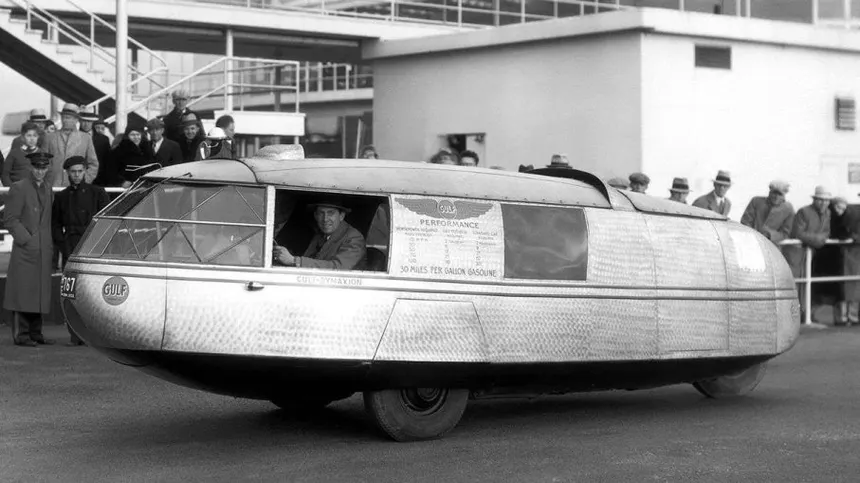
Walter Chrysler wanted in. Henry Ford wanted in. Henry Kaiser wanted in.
Three of the biggest names in American manufacturing looked at Buckminster Fuller’s three-wheeled aluminium teardrop and reached the same conclusion: this thing changes everything. Ford offered him anything in the catalogue at seventy-five percent off. Chrysler believed it would render every car in America obsolete.
Fuller turned all three down, wound up the company, paid his creditors and walked away.
That decision — not the crash, not the press, not the Depression — is what killed the Dymaxion. And to understand why he made it, you have to understand what he thought he was building. Because it was not a car.
Not a car
Fuller said it his whole life and nobody listened. The Dymaxion was the ground-taxiing phase of a flying machine. A wingless aircraft that would rise on steerable jets, fly, land, and rejoin traffic like a bird settling on a wire. He called it the Omni-Medium Transport.
Jet engines were twenty years out. Vertical take-off, thirty. So he built the only piece he could build with 1933 technology — the part that rolls — and set about testing it.
Everything strange about the Dymaxion comes out of that sentence. It is not an eccentric automobile. It is an airplane missing almost all of the airplane.
Bridgeport
Roosevelt had just closed the banks. Fuller bought a $450 used Ford Tudor, stripped it to the bone for its engine, transmission, frame and running gear, and rented the corpse of the old Locomobile plant at Tongue Point, Bridgeport.
For a partner he hired Starling Burgess — America’s Cup yacht designer, aviation man, brilliant, and freshly bankrupted by a string of expensive divorces. Burgess advertised and got a thousand applications for twenty-seven jobs. He took panel men, coachbuilders, cabinetmakers and mechanics who’d come out of Rolls-Royce. In the worst year of the Depression you could assemble a world-class coachbuilding shop out of guys standing on the sidewalk.
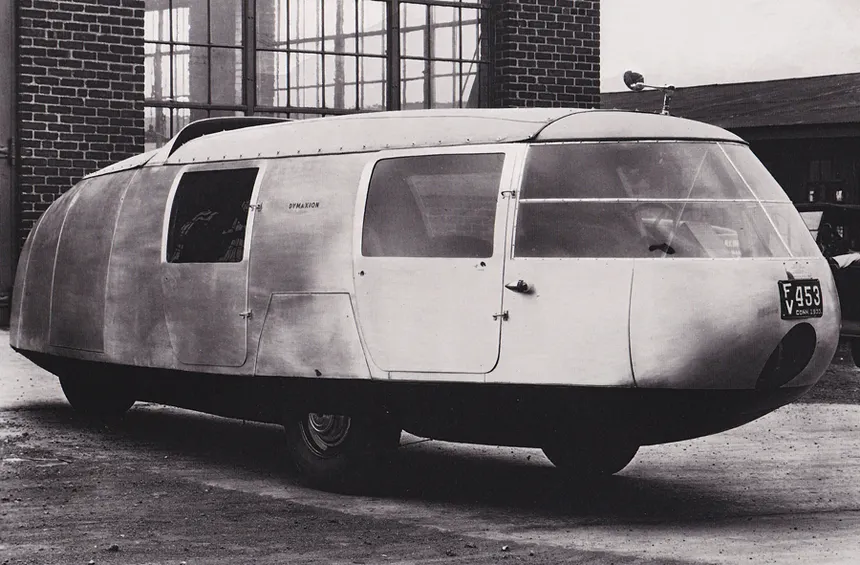
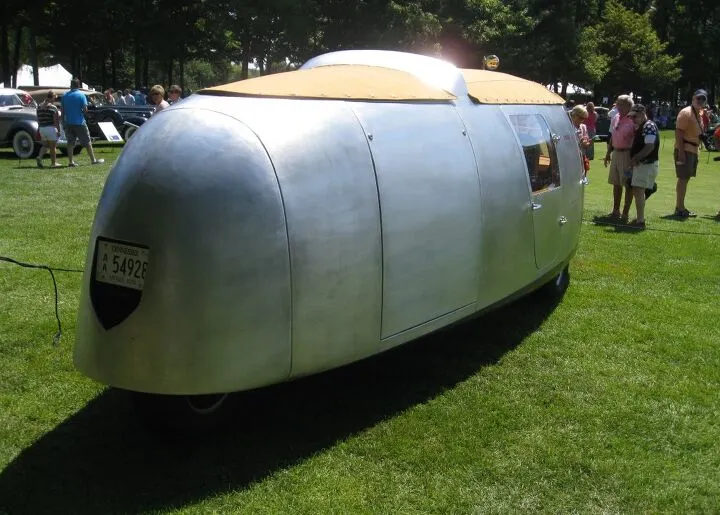
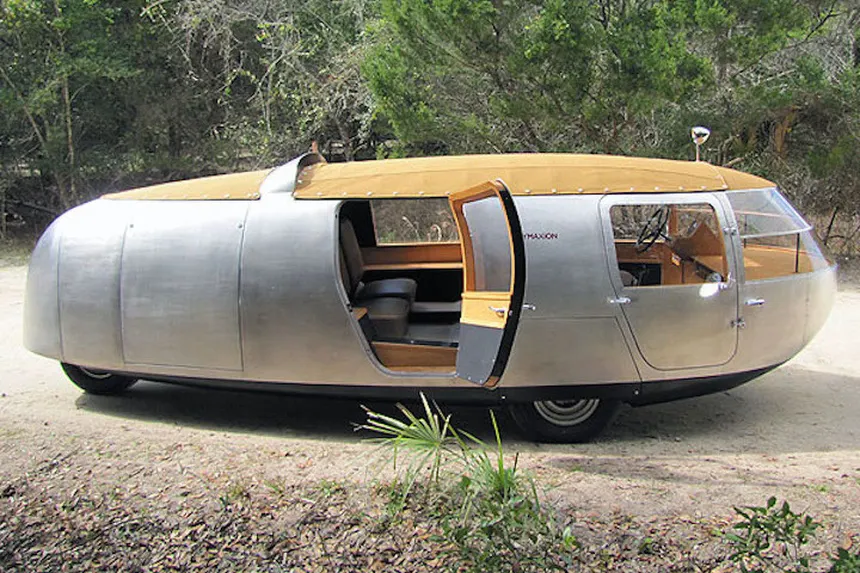
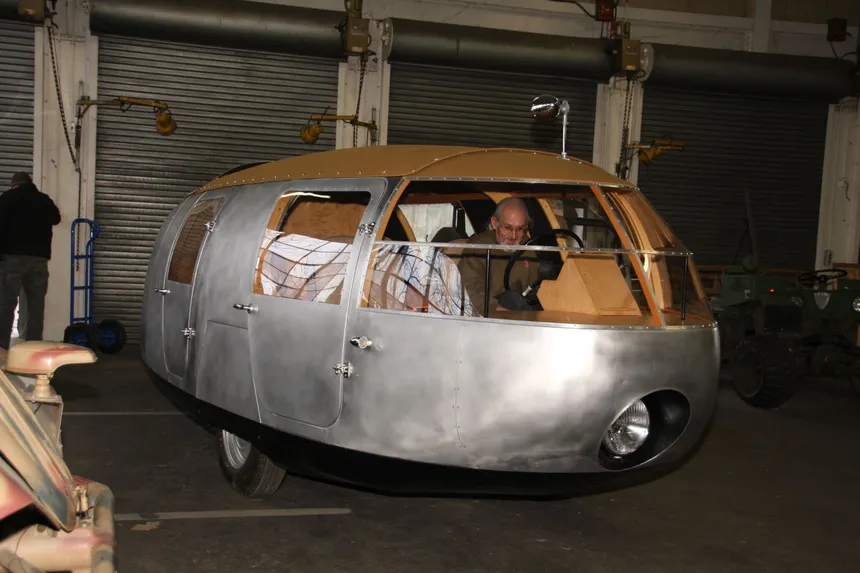
Which produces the oddest thing about the car, and the one you can’t see in photographs. The body isn’t steel over a chassis. It’s an ash-wood lattice carrying aluminum panels, mounted on twin steel frames. Timber, like a boat hull. Burgess built the only thing he knew how to build, and that’s why the Dymaxion looks like nothing that had ever rolled down an American road.
Car number one was finished on July 12, 1933 — Fuller’s thirty-eighth birthday. Three months from an empty shed. Eight thousand dollars.
The numbers, in context
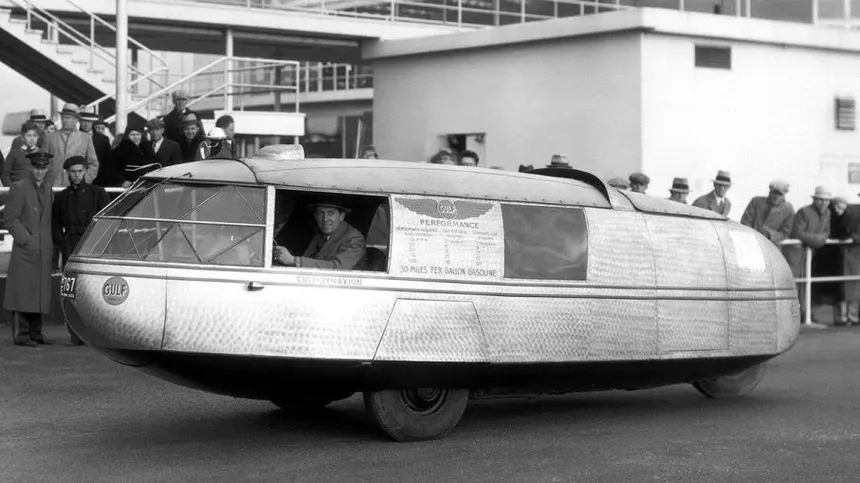
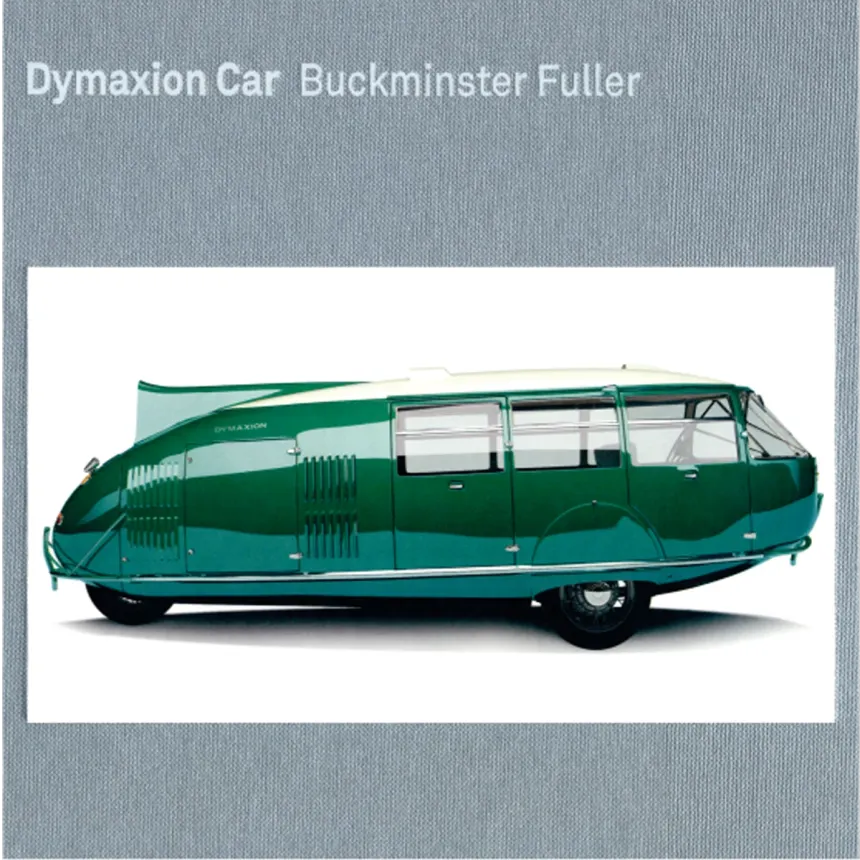
Twenty feet. About 2,700 pounds. Eleven seats. Two driven wheels up front, one steering wheel at the back with a full ninety degrees of lock. An 85-horsepower Ford flathead V8 mounted behind the passengers, driving the wheels in front of them.
Practically nobody uses that architecture now, because getting drive from one end of a car to the other is a packaging nightmare. They chose it because the engine’s mass had to sit in the tail of the teardrop, which is where the aerodynamics wanted it. Shape governed mechanics, not the other way around.
And those figures need a yardstick, because on their own they mean nothing. A stock 1933 Ford V8 ran around 75-80 mph and got roughly 15 miles to the gallon. The Dymaxion, on the same engine, carrying eleven people, went faster and used half the fuel. Fuller claimed 128 mph and up to 36 mpg; the museums that have studied the car put it nearer 90 and 30. Even at the discounted numbers, the one that matters doesn’t move: same engine, twice the people, half the gas.
His own reckoning was that a conventional car would have needed 300 horsepower to do what he was doing on 85. There’s no witchcraft in it. Every wheel, every chassis rail, every mechanical component is faired inside the teardrop. It’s the same math you run for a customer when you explain what the roof rack is costing him on the interstate.
They took it to a racetrack in the Bronx and it beat the lap record by fifty percent. What struck the spectators wasn’t the lap time — it was that the thing didn’t slide or drift through the corners the way the race cars did. It went around flat.
It could also turn inside its own length, park sideways, and slot into gaps that had no business taking it. No rear window: it had a periscope. And air conditioning by dry ice.
That periscope tells you how Fuller’s head worked. There’s no rear window because the tail of the teardrop has to close clean; a window back there breaks the shape, and the shape is the only thing holding those fuel numbers up. So instead of compromising the profile, he sacrifices the mirror and fits a periscope. Every time aerodynamics collides with convention, aerodynamics wins and convention figures it out.
The flaw was in the file by April
On April 19, three months before anyone laid eyes on the car, testing exposed it. The rear wheel was fixed in its plane. In a corner it leaned into the turn while the front pair stayed square to the road. The car wasn’t planting where it needed to plant.
They hinged the rear frame. It improved. It didn’t go away.
The rest follows on its own. You’ve got twenty feet of faired bodywork with an enormous side area, two wheels up front, and one contact patch at the back that’s also doing the steering. Hit it with a crosswind and that body does what any aerodynamic surface does: it goes where the air is thinnest.
Fuller knew. Not in hindsight — the car was built for it. His own published words: he’d watched light aircraft ground-loop on crosswind landings, swinging hard because their own streamlining shoved them, and he set out to study that exact phenomenon on the ground.
The Dymaxion wasn’t a car with a stability problem. It was an instrument built to have one, so it could be measured. Which is why he and Burgess banned high winds and bad weather and restricted the car to a closed list of trained drivers.
A vehicle that’s only safe inside an envelope of trained drivers and calm air isn’t a road car. It’s a test rig. Every manufacturer in Detroit knew the difference: it’s the gap between a prototype that validates a principle and a product that survives a wet Tuesday with a stranger behind the wheel. Fuller had built the first and was being applauded for the second.
Chicago
Meanwhile the car was touring. Gulf Refining ran it around the country pushing aviation fuel. Amelia Earhart asked for a Dymaxion as her official car the day National Geographic handed her their Gold Medal. When Chrysler’s pressure locked Fuller out of the 1934 New York Auto Show, he parked Prototype Two on the sidewalk out front and drew a bigger crowd than the show did.
Enormous publicity. Rapturous crowds. Not one order.
On October 27, 1933, Prototype One rolled almost at the gates of the Chicago World’s Fair. The driver, Gulf employee Francis T. Turner, was killed. The two passengers weren’t nobodies: William Sempill, British aviation pioneer and — as the world found out much later — a paid agent of Japan, and Charles Dollfus, curator of France’s first aviation museum. Both badly hurt.
The papers wrote themselves. Freak car, three wheels, rolled, one dead. International front pages, because the injured were European dignitaries.
And the stubborn fact underneath: there was a second car. A vehicle driven by one Meyer Roth collided with the Dymaxion. The coroner’s inquest laid no blame on the Dymaxion whatsoever. But the hearing was delayed two months so Sempill could recover enough to testify, and by the time the exoneration came down it was stale news and nobody printed it.
Both things are true. The Dymaxion did not cause that crash, and the Dymaxion was unstable. Fuller spent four decades telling only the first half. It’s a perfect alibi precisely because it isn’t a lie.
The money he turned away
So Chrysler, Ford and Kaiser come knocking — after the crash, after the bad press, with the project face-down in the mud. And Fuller says no.
Not purely out of arrogance. He had already admitted in writing that the prototype could never go into series production without serious change: it couldn’t be driven in wind, and the steering was what it was. Taking Chrysler’s money meant handing the car to engineers who would do the obvious thing. Add a fourth wheel. Tame the tail. Make it work.
And a Dymaxion that worked as a car had stopped being an airplane. The Omni-Medium Transport dies the second somebody sensible fixes it.
Meanwhile the partnership was rotting from a direction no engineer plans for. Burgess fell for Anna Biddle, the Philadelphia socialite bankrolling the whole enterprise, and she fell for him. Fuller ended up competing with his own partner for the money and the oxygen in the room.
The third car existed at all only because he sold inherited stock and went into debt to build it. This is not the story of a man who ran out of money. It’s the story of a man who put his own in, then had three industrial empires offering theirs, and shut the doors rather than let the thing become a product.
What’s left
Only number two survives, at the National Automobile Museum in Reno. Number one was rebuilt, sold to the Bureau of Standards, and burned in a garage fire. Number three went to conductor Leopold Stokowski, who worked out fast that he hated driving it, sold it on, and watched it drift through owners until a Wichita junkyard cut it up in the fifties.
Norman Foster — Fuller’s most famous disciple — built himself a replica. Lane Motor Museum built another. The Wall Street Journal’s Dan Neil drove one and came back talking about the wobble.
The verdict
There’s a version of this story that shows up in every book: Fuller the martyr, the visionary crushed by press hysteria and corporate cowardice. It’s the version he told for forty years and it’s the one still in circulation.
It collapses the moment you notice the corporations weren’t cowards. They were lining up.
And what gets me isn’t that Fuller lied about the crash. That’s almost forgivable — a man defending his life’s work. What gets me is what his decision reveals. He had Ford’s money, Chrysler’s money and Kaiser’s money sitting in front of him, and he said no because those engineers would have done the necessary thing: bolted on a fourth wheel, tamed the tail, turned it into something a father of three could drive on a windy Tuesday without dying.
Fuller would rather his idea die pure than live corrected. He chose the myth over the car.
And that disease has never been cured. Silicon Valley is full of it right now — brilliant people so in love with the original vision that they’d rather watch the whole thing crater than let somebody competent touch it and make it work. We call them visionaries. We ought to call them something else.
The most advanced vehicle of its decade went nowhere, and it wasn’t because the world wasn’t ready. That’s the comfortable excuse, the one they print on the museum placard. It’s because the man who built it had no interest whatsoever in going anywhere you could reach by car.
So you tell me: what good is being right forty years before everyone else, if you won’t let anybody prove it?
Check you’re still alive.