CEMA Michelin Almería: The Secret Tire Lab of Europe
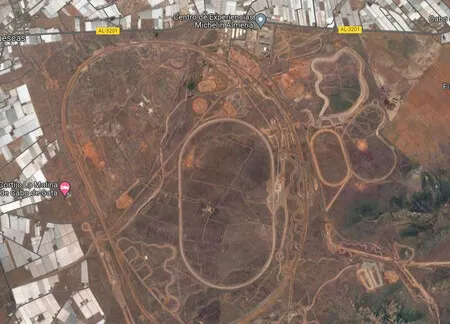
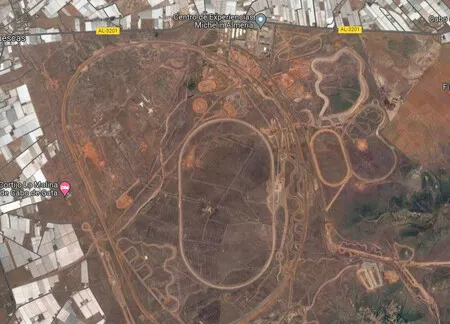
If you drive Michelin tires on your truck, your tractor, your farming rig, your mining equipment, or your everyday sedan, there’s a very real chance those tires were validated in a stretch of Spanish desert most Americans have never heard of. Not in Ohio. Not in Texas. Not in France, even. In Cabo de Gata, on the southeastern tip of Andalusia, an hour’s drive from the Costa del Sol beach resorts, hidden behind fences and confidentiality clauses that would make a Pentagon contractor blush.
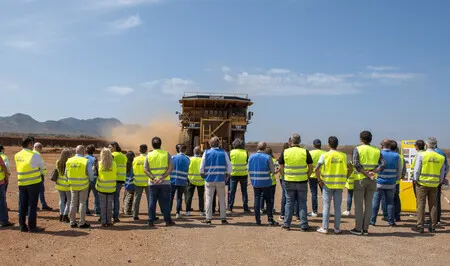
The place is called CEMA (Centro de Experiencias Michelin Almería). It sits on 4,500 hectares (about 11,120 acres) of Spanish semi-desert. It employs 170 highly specialized engineers, physicists, chemists and mathematicians. It runs the two only operational Caterpillar 797F mining dump trucks in all of Europe, each one wearing tires that cost more than most family cars. And it has been doing this quietly for more than half a century while the American automotive press files an occasional story about the Uvalde proving ground in Texas and calls it a day.
This is one of the least-known crown jewels of the global tire industry. And it happens to be Spanish. Sort of.
Why Almería? Because It Almost Never Rains
The origin story starts in late-1960s France. Michelin, then run by François Michelin (the founder’s grandson), needed a bigger test facility for agricultural and civil engineering tires. The existing site at Fos-sur-Mer near Marseille had climate limitations. Too much rain, too many days lost, no consistency across the calendar. Henri Verdier, the company’s head of research, drafted the concept for a new proving ground somewhere in southern Europe. The task of locating the actual land fell to a Spanish scout named Julio Pérez-Cela.
Pérez-Cela ended up in Cabo de Gata, Almería, for one simple reason: it’s the driest place in continental Europe. Average annual rainfall of 200 millimeters (about 8 inches). For scale, Los Angeles gets around 375 mm (15 inches) in a normal year. Phoenix, Arizona, gets around 200 mm. Almería is essentially the Phoenix of Europe, but with Mediterranean coastline and cheaper land. Michelin bought a huge private estate called Finca El Romeral from an Andalusian bourgeois family, the González-Díaz clan (the matriarch was known locally as doña Paquita), and got to work.
The center opened on January 2, 1973, with 59 employees, six test vehicles, and a single 3.5-kilometer test track. That was the whole thing. From that modest start, it grew into what is now, according to Michelin’s own internal ranking, one of nine major R&D centers the company runs worldwide and the most important in Europe.
What Actually Happens Inside the Fence
The specialties are heavy-duty tires: civil engineering, mining, agriculture, and increasingly, aviation. But CEMA also handles passenger car, van, motorcycle and racing tire validation.
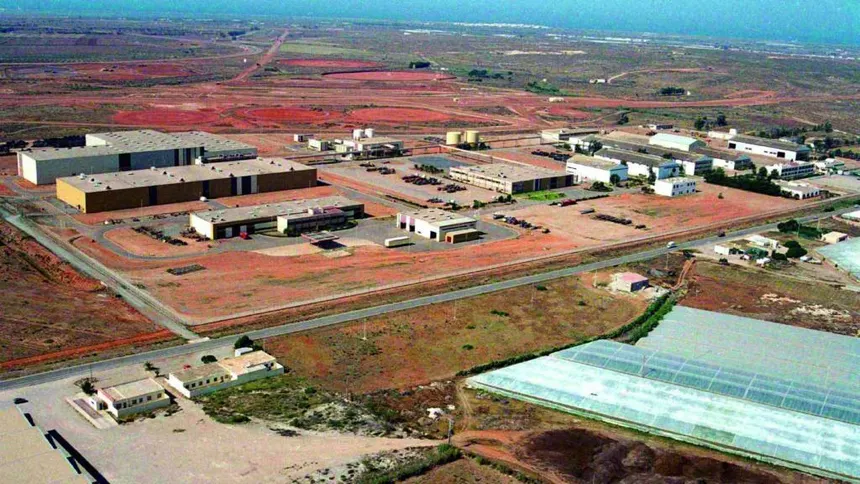
The physical layout: more than 40 tracks according to Michelin’s official website (industry reports covering the 50th anniversary in 2023 cite 55 tracks, depending on how sub-variants are counted). Combined length exceeds 100 kilometers. Surfaces range from smooth asphalt to porphyry stone, dirt, gravel and mixed compositions. There are climate-controlled test cells, workshops equipped for confidential vehicle work, weather stations, a 350 kW power plant, a fuel depot, air-conditioned offices, meeting rooms with high-speed Wi-Fi, permanent medical staff and an on-site fire crew. Around 20 buildings totaling more than 60,000 square meters of covered floor space. More than 250 vehicles rack up around 20 million kilometers per year, running three shifts, weekends included.
Autonomous vehicle testing has been happening here since 1981. Read that year again: 1981. When most of the world had never heard the term “self-driving car,” CEMA was already running unmanned vehicles on closed tracks for tire wear evaluation. In 1982 they added non-destructive analysis via X-ray and ultrasound. In 1993, Michelin invented the C3M manufacturing process, essentially a laser-guided 3D printing method for tires, and unveiled it to the international press at CEMA. The C3M technology is still in use today. It is what manufactures the Michelin Pilot Sport Cup 2 R K1 tire fitted to the Ferrari F80 unveiled in late 2024. And every one of those tires gets validated in Almería before shipping.
The $60,000 Tire
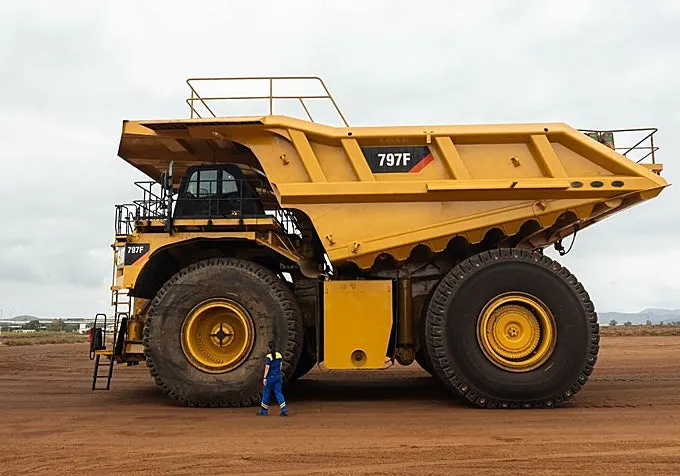
If you had to explain CEMA to somebody who has never seen it, this is the image that does the job. Two Caterpillar 797F mining dump trucks, both operated in-house by Michelin, both fitted with the Michelin XDR 59/80 R63 tire.
Specs on the tire: 3.97 meters (13 feet) in diameter. 5,300 kg (11,680 pounds) per unit. Operating pressure between 5 and 6.8 bar. Approximate current cost per tire, based on trade press estimates during the 2023 anniversary tours: between 40,000 and 60,000 euros ($43,000 to $65,000). Some outlets cited figures as high as 150,000 euros for specific variants. Michelin does not publicly confirm pricing because it varies with client volume and specification.
Specs on the truck: 15 meters long (49 feet), 9.5 meters wide (31 feet), Diesel V20 engine with four turbochargers producing 3,846 horsepower from 106 liters of displacement. Empty chassis weighs 215 tons. Fully loaded operational weight over 600 tons. Two units in the whole of Europe, both delivered to CEMA in 2020, both worth approximately 5 million euros ($5.4 million) apiece.
The standard test protocol: load the truck with 400 tons of ballast, then drive it repeatedly over a porphyry stone surface at operational speed. Objective: confirm that the tires survive the roughest possible surface at maximum operational load. When the world’s largest tire, mounted on the world’s largest mining truck, carrying nearly maximum rated load, comes through the test without damage, the engineers sign off. If it fails, back to the lab.
Beyond mining, CEMA also validates airplane tires by simulating landings on rolling test rigs mounted to specialized trailers. The trailer holds a real aircraft wheel spinning at landing speed. It contacts a stretch of purpose-built asphalt. Data gets recorded. No aircraft required. Just the wheel, the runway, and the impact. Michelin has supplied tires for the US Space Shuttle landing gear and, more recently, the Airbus A380 fleet. Some of that validation work went through Almería.
The motorsport side is equally serious. MotoGP tires, currently produced in Michelin’s Les Gravanches plant in Clermont-Ferrand via the C3M process, get their compound and pattern validation runs done at CEMA. So do the Michelin Pilot Sport slicks used across various racing series. And when Michelin partnered with Ferrari on the F80 hypercar unveiled in October 2024, the Pilot Sport Cup 2 R K1 tire developed for that program (marked K1 because it’s exclusive to the F80) received its final compound validation at Almería before shipping to Maranello. Ferrari-specific engineering, developed in the French-owned lab located in Andalusia. That’s the level at which this place operates.
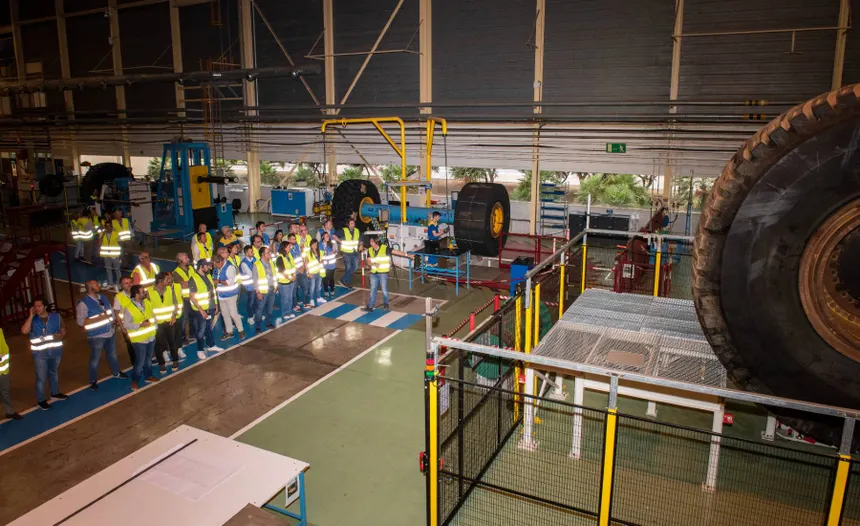
Confidentiality is the price of doing business. When journalists visited during the 50th anniversary tour in 2023, Michelin’s security staff placed three stickers on every visitor’s smartphone: one on each camera lens, plus a third for luck. No photography allowed anywhere inside the perimeter. Every visitor signs a non-disclosure agreement before entering. The confidential vehicle workshops, where third-party clients park their unreleased prototypes for tire evaluation, sit inside a secondary secured perimeter within the main site. Some clients have their own dedicated bays with locked access and blackout curtains.
The National Park Came Fourteen Years Later
Now for the part that sounds impossible until you check the dates. The Cabo de Gata-Níjar Natural Park was officially declared in 1987. Michelin’s proving ground had been operating on the same land since 1973. Fourteen years of continuous industrial testing preceded the environmental protection status. When the park was designated, CEMA was already established, already fenced, already running heavy machinery on multiple track surfaces. The Spanish authorities drew the park boundary in a way that included 1,500 hectares of the Michelin site.
Result: today, a first-tier global industrial testing facility operates inside a protected natural park, with ISO 14001 environmental certification and active protocols for wildlife protection, soil retention and habitat management. When Michelin’s fence first went up in 1973, dozens of sheep and goats belonging to the previous landowners ended up trapped inside the perimeter. Instead of returning them, Michelin created a wholly-owned subsidiary called Agrisa specifically to manage the livestock. Today Agrisa runs a herd of more than 1,000 head, plus two donkeys from an endangered Spanish breed. A French multinational tire company operating a working ranch inside a national park, while a 600-ton mining truck rumbles past on porphyry rock at full load. Try selling that pitch to an American board of directors.
The Comparison Nobody Draws
Here’s the thing. When Americans think about tire proving grounds, the conversation defaults to Uvalde, Texas, where Continental Tire has been running its US test facility since the 1960s. Or Sumitomo in Wilmington, Ohio. Or the Firestone site at Fort Stockton. These are impressive facilities. Uvalde covers around 5,000 acres, roughly half of what CEMA covers. And none of them run the world’s largest mining trucks under real-world load protocols in a semi-desert climate that also happens to be one of Europe’s most fragile ecosystems.
CEMA is not just bigger than most American equivalents. It is a categorically different operation. It combines heavy industrial testing (mining, construction, agriculture) with passenger car development, with aviation validation, with confidential third-party rental for competing manufacturers, with autonomous vehicle protocols that predate the entire modern autonomous conversation by four decades. And it does all this in an area of Europe that gets less annual rainfall than most parts of the American Southwest.
For a country famous for its beaches, ham and paella, Spain is remarkably good at hiding the fact that it hosts some of the most important pieces of the global automotive industry’s supply chain. CEMA is one of them. The Applus IDIADA proving ground in Tarragona, where Porsche, Mercedes, Tesla and BYD validate their production vehicles, is another. And there is at least one more we will get to in a future piece: a Finnish-owned tire proving ground opened in the Toledo province in 2020, which competes directly with CEMA in the passenger car segment.
Three world-class facilities inside the same border. None of them Spanish-owned. All three doing work that ends up on your rims, your dashboards, your cars. And a country that would rather talk about its beach resorts than tell you any of this.
The tourists know Cabo de Gata. The industry knows CEMA. Barely anybody knows both are the same address. That is not a Michelin problem. Michelin is doing its job with French precision and rented sunshine. It is a Spanish storytelling problem, and it is starting to look chronic. If a French tire company can turn a stretch of Almería desert into the most important heavy-tire lab on the continent, the least the country could do is put the sticker on the map.
Check you’re still alive.