Stout Scarab: America Built the First Minivan in 1936 and Priced It Into the Grave
Detroit invented the minivan almost fifty years before Detroit took credit for it. The problem was that the man who did it charged four times too much and died before anyone noticed.
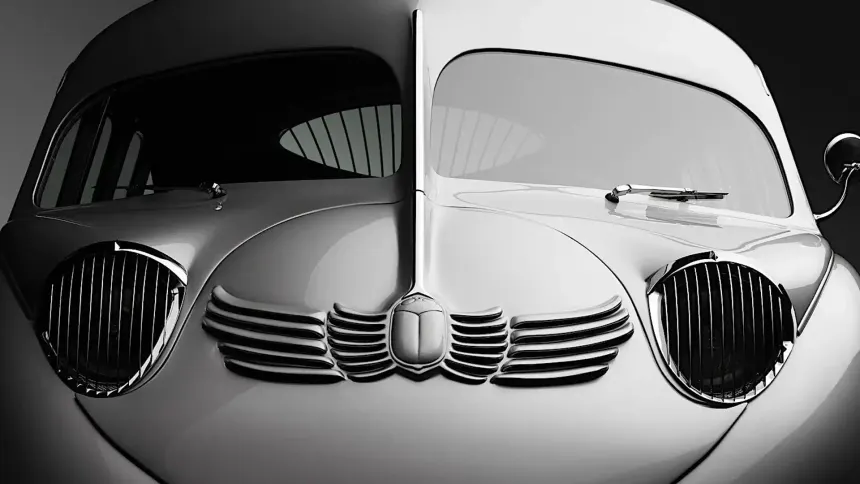
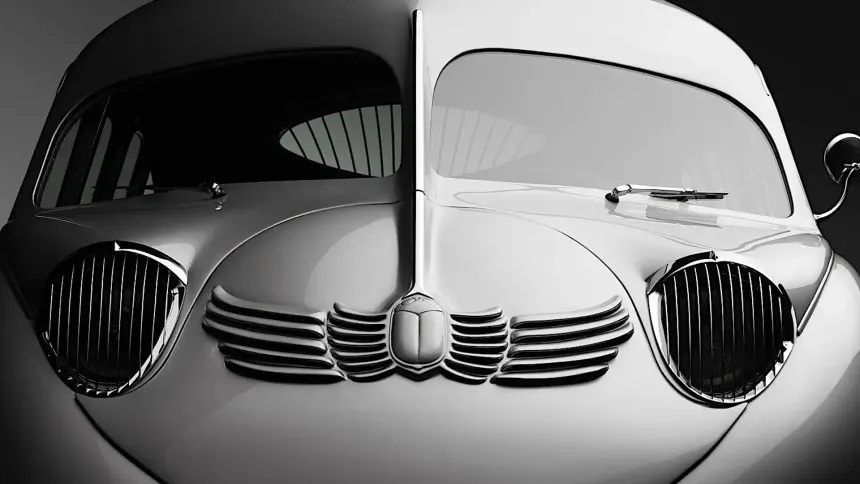
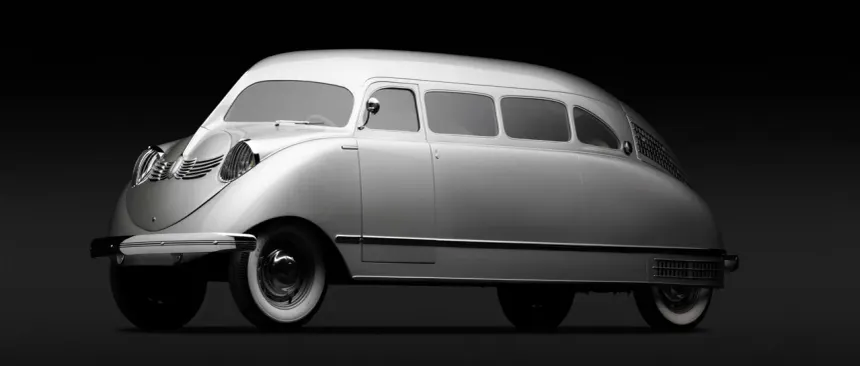
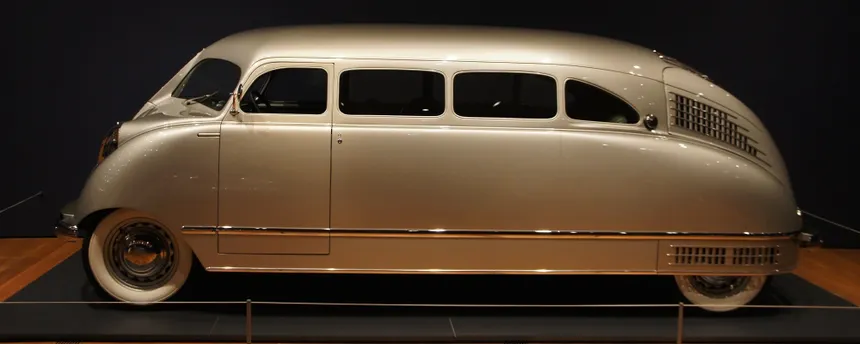
Everyone knows the story the industry likes to tell. In 1983, Chrysler rolled out the Dodge Caravan and the Plymouth Voyager, Lee Iacocca became the patron saint of the suburban family, and the minivan was born. It is a good story. It is also about half a century late. Because in a workshop in Dearborn, Michigan, an aeronautical engineer named William Bushnell Stout had already built a one-box, rear-engine, flat-floored people-mover with reconfigurable seating, a folding table, and swiveling chairs. He called it the Scarab, after the beetle it resembled. That was 1936. Iacocca was eleven years old.
The Scarab is the great “what if” of American automotive history, and it is a very American kind of tragedy: not a failure of engineering, but a failure of price. Everything that would make the minivan the defining vehicle of the American family was already there, hand-built in Michigan, before World War II. Everything except a customer who could afford it.
An airplane man who thought cars were built backwards
To understand the Scarab, forget everything you know about car guys. Stout was not one. Born in Quincy, Illinois, in March 1880, he came from aviation. He was the engineer behind the Ford Trimotor, the legendary “Tin Goose” that taught America to fly commercial. He ran the Society of Automotive Engineers. His personal motto tells you everything you need to know about how his mind worked: “Simplicate, and add lightness.” Decades later, Colin Chapman would build the entire philosophy of Lotus on nearly those exact words. The original was Stout’s.
Stout looked at the American car of the 1930s the way an aircraft engineer looks at dead weight, and he was appalled. A heavy separate frame. A body bolted on top that carried no load. A long hood housing a front engine that shoved the whole cabin backward. A driveshaft running down the middle, forcing the floor up. All that steel, all that mass, and the people inside still rode cramped. Stout believed a car should be built like a fuselage: the body itself carrying the loads, no separate frame, maximum interior room for every inch of exterior.
The spark came when Stout, as SAE president, met Buckminster Fuller at a New York auto show and wrote up Fuller’s Dymaxion Car for the society newsletter. The Dymaxion, shown at the 1933 Chicago World’s Fair, was a three-wheeled, teardrop-shaped fever dream of a vehicle that looked ready to take off. Only three were built. It was brilliant and utterly impractical. Stout took Fuller’s aerodynamic lesson and did something Fuller never managed: he made it drivable every single day. This distinction matters, because someone always confuses the two. The Dymaxion inspired the Scarab. They were not the same car. Fuller’s machine dreamed of flying. Stout’s machine wanted to haul your family and your office at the same time.
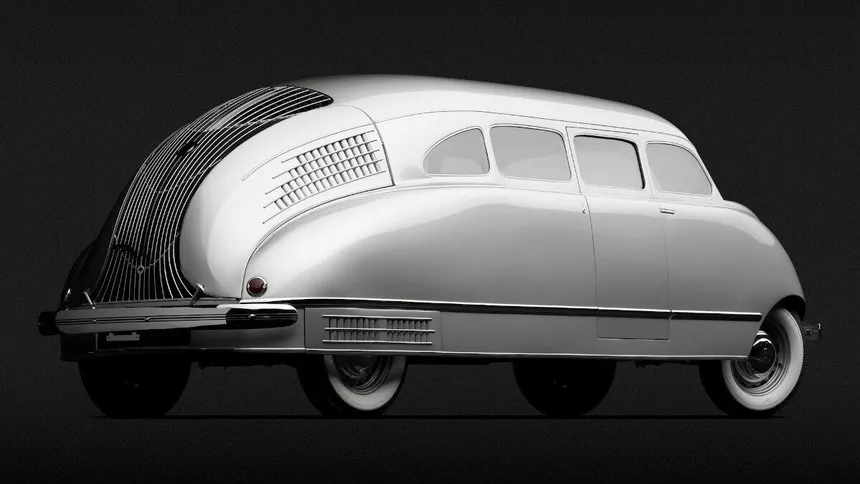
An office on wheels, ninety years before remote work
The vehicle in Stout’s head was never just a family car. It was an “office on wheels,” a rolling workspace where you could hold a meeting, spread papers on a table, and move your people without stacking them like cargo. In 1932, before anyone dreamed of a laptop or a conference call, Stout was designing the mobile office.
The first running prototype was finished in 1932, and here is the detail that should stop any engineer cold: it was probably the first automobile in the world with an aluminum spaceframe unit-construction body, though some frame pieces were steel. Riveted aluminum monocoque construction, like an aircraft, in a car, in 1932, while the rest of Detroit was still nailing bodies onto ladder frames. The body was styled by Dutch designer John Tjaarda, the same man who shaped the Lincoln Zephyr, and whose son Tom would later design the Corvette Rondine prototype. The Tjaarda name is a design dynasty, and part of it starts here.
By deleting the frame and the driveshaft and mounting a Ford V8 in the rear, Stout got exactly what he wanted: a completely flat, low floor and a cavernous interior for the car’s footprint. The engine was a Ford flathead V8 driving the rear wheels through a three-speed transmission Stout built himself. Power figures vary by source and by individual car, somewhere between 85 and 100 horsepower, so anyone quoting you one exact number is rounding from memory. The car stretched a little over sixteen feet, rode on four-wheel independent suspension inspired by aircraft landing gear, and weighed under 3,000 pounds, remarkably light for its size thanks to that aviation thinking.
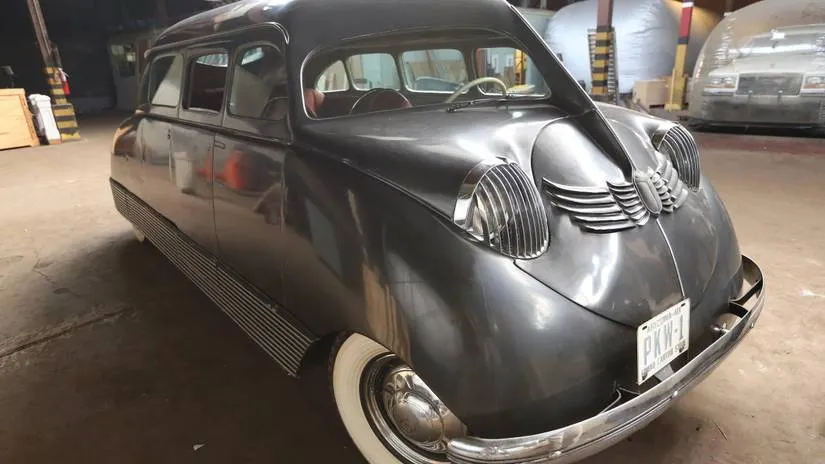
The interior Chrysler would “reinvent” fifty years later
This is where the Scarab stops being a curiosity and becomes a prophecy. The interior had a fixed central seat for the driver and movable seats around it. Some swiveled a full 180 degrees to face the rear. There was a removable table in the middle. Passengers entered through a single side door into an open room. The whole layout reconfigured to whatever the day demanded: hauling people, hauling cargo, holding a meeting, getting work done.
Sit with that 180-degree swiveling seat for a second. More than fifty years later, Chrysler would sell that exact feature in its minivans under the name “Swivel ‘n Go” and market it as an innovation. Stout had it in 1936. The folding center table, the reconfigurable seating, the flat floor you could walk across inside the vehicle: the entire vocabulary of the modern minivan was already written, in riveted aluminum, before Pearl Harbor.
There is a story that says it better than any spec sheet. Years later, restored, one of the surviving Scarabs showed up at a prestigious classic show in Michigan. Two Chrysler executives in suits stopped to study it carefully. As they turned to leave, one said to the other: “So, who’s going to tell Lee he didn’t invent the minivan?” Lee was Iacocca. Two of his own executives, standing in front of a Scarab, knew the truth.
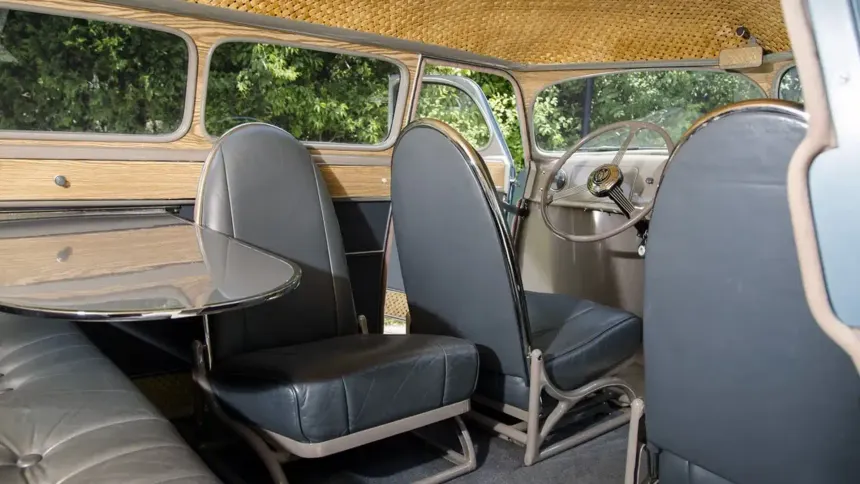
Nine cars, an impossible price, and a market that didn’t exist yet
So why have you never heard of it? For the same reason almost nobody ever drove one: the price.
When the production Scarab arrived in 1936, Stout announced in a famous Fortune magazine ad that production would be limited to 100 cars a year, starting at $5,000. To feel the weight of that number: a Lincoln Zephyr, no bargain itself, cost more than four times less. A luxurious, ultra-modern Chrysler Airflow ran about $1,345. The Scarab asked nearly four times that. In today’s money, roughly $80,000 for a hand-built car from a company with no dealer network, wearing a shape that made people on the street ask which way it was going.
The result was brutal. Instead of the promised hundred a year, only nine production cars were built, plus the original 1932 prototype. And here is the nuance that has to be said precisely, because it flips the whole meaning of the story: the Scarab did sell. It was not a one-off locked in a warehouse, not a concept that died on a show stand. It sold. But nearly all of the cars went to members of the company’s own board and to nearby tycoons, people like chewing-gum magnate Philip Wrigley and tire baron Harvey Firestone. This was not a car a regular person could walk into a showroom and buy. It was a semi-private, built-to-order object for a handful of people who could afford it and happened to know Stout. Series production, yes, but tiny and by invitation only.
Of those nine production cars, five survive today, in private hands. The original 1932 prototype sat rotting in a field behind the company’s facilities until the early 1940s, when it was hauled away and most likely scrapped. A shabby ending for the first running aluminum monocoque in history.
One last shot: fiberglass before anyone else
Stout never fully quit. After the war, in 1946, he built an experimental Scarab, the so-called Project Y or Scarab II, and once again beat the entire industry to the punch: that car had the first fiberglass body shell in automotive history and working air suspension. Another world first. But the projected price was around $10,000, and not a single order came in. The project was abandoned. Stout drove that last Scarab as his family car until 1951 and died in 1956, the same year, as it happens, that a small Italian company across the Atlantic launched a little car that would take his minivan idea somewhere he never could: the street, ordinary people, an actual market. That Project Y survives today at the Gilmore Car Museum in Hickory Corners, Michigan.
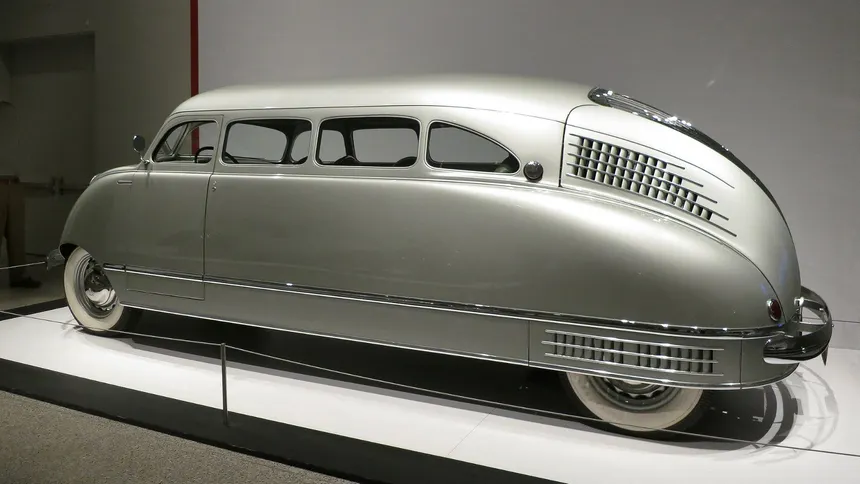
Where the Scarab fits in the minivan bloodline
Let’s put this in order, because the “first minivan” label gets tossed around every few months and claimed for a different car each time. The truth is there is no single first. There is a first of each thing, and the Scarab holds the first rung of a very specific ladder.
The Stout Scarab was the first to exist as a production people-mover. It proved the idea could be built: a one-box car with a rear engine and a flat floor could be manufactured and driven. But it was an expensive, semi-private prophecy, nine cars for board members and millionaires. It was never a market phenomenon.
Twenty years later, in 1956, the Fiat 600 Multipla took that same idea, rear engine, cab pushed forward, many seats in a tiny footprint, and carried it where the Scarab never went: the mass market. Hundreds of thousands of units, cab drivers, big families, ordinary people. The Multipla didn’t invent the concept. It was the first to make it affordable.
And in 1978, Giugiaro‘s Lancia Megagamma locked in the architecture the industry would eventually copy wholesale: front transverse engine, front-wheel drive, two-box shape, tall roof, flat floor by design. That is the formula of the Renault Espace, the Chrysler Voyager, the Nissan Prairie. The Megagamma was the first modern minivan in the strict technical sense.
Three cars, three different firsts. The Scarab invented the existence. The Multipla invented the accessibility. The Megagamma invented the formula. And along the way, don’t forget Fuller’s Dymaxion as the aerodynamic spark that lit Stout, and don’t pretend any of them sprang from nothing. Ideas never spring from nothing. They are inherited, translated, and, with luck and money, sold.
The NEC take
The Scarab didn’t fail for being bad. It failed for being too good too soon and priced so only the inventor’s friends could buy it. And that is a lesson the car industry refuses to learn, over and over: being right early is worthless if nobody can afford your rightness. Stout was completely right in 1936. He was so right, so early, that he died before he could watch Iacocca get rich off his idea in 1983.
Makes you wonder how many brilliant ideas are dying in some workshop right now, entirely correct, waiting for a market that won’t arrive until somebody else signs their name to it two decades later. History doesn’t reward the first. It rewards the first to arrive when the world is finally willing to pay. How many Scarabs have we buried without even noticing?
Check you’re still alive.