
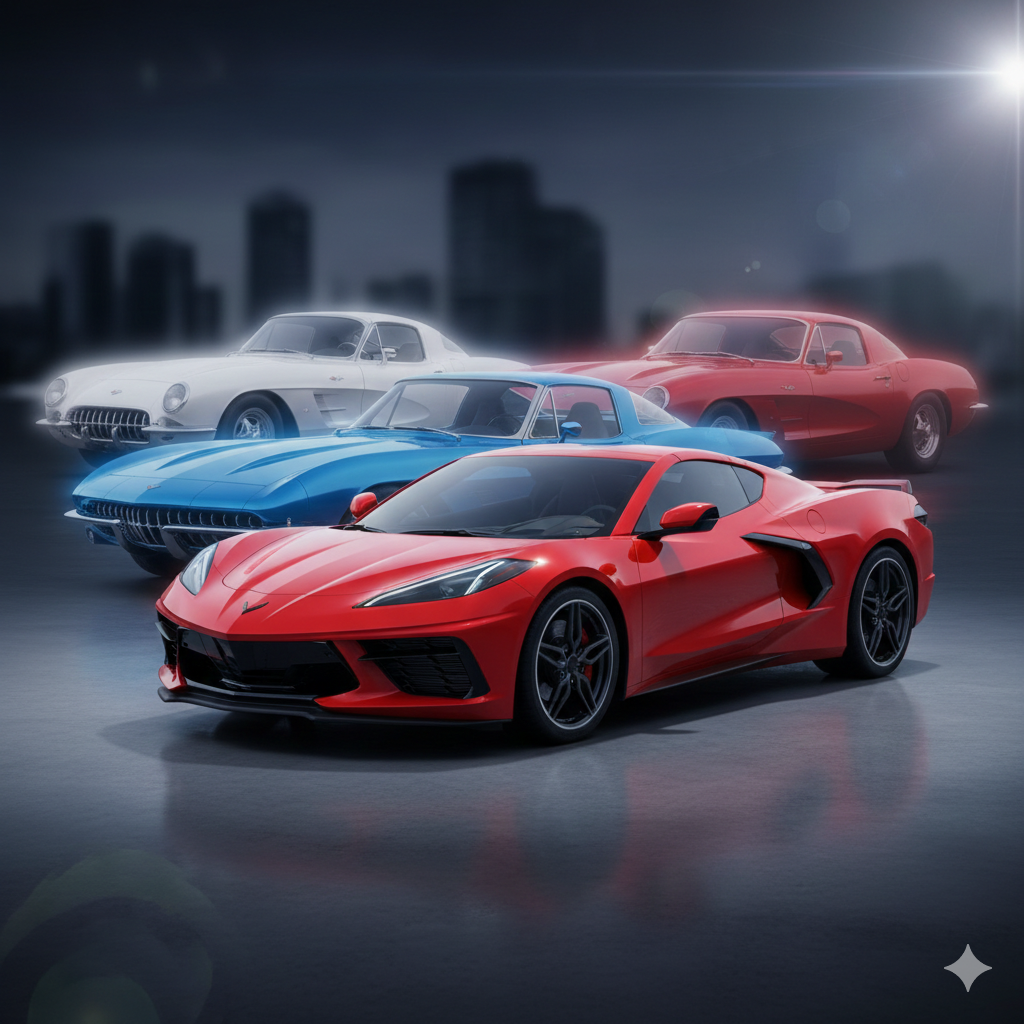
The Chevrolet Corvette: America’s Only True Sports Car

The Car That Almost Never Was
In 1953, Harley Earl did something that would define American automotive culture forever: he convinced General Motors to build a two-seat sports car.
This was, by all accounts, insane.
Americans didn’t buy sports cars. They bought sedans. Wagons. Land yachts with chrome forests and enough interior space to host dinner parties. The idea that GM—the most American of automakers—would build something as impractical as a European roadster seemed like corporate suicide.
They built it anyway.
Seventy years later, the Corvette remains America’s only consistently produced true sports car. Not a muscle car. Not a pony car. An actual, purpose-built sports car that exists solely to go fast and look good doing it.
This is the story of how a fiberglass fever dream became a national institution.
The First Generation: C1 (1953-1962)
Birth Pains
The first Corvette was, objectively, not very good.
It had a six-cylinder engine in an era when horsepower meant everything. It came exclusively with a two-speed automatic transmission—a decision that baffled enthusiasts then and baffles historians now. The fiberglass body was innovative but crude. The side curtains instead of roll-up windows screamed “prototype.”
Only 300 were built in 1953. All were Polo White with red interiors. All leaked in the rain. All had electrical gremlins. Chevrolet was testing whether Americans would actually buy a sports car, and the early results suggested: barely.
The V8 Savior
Everything changed in 1955. The small-block V8 arrived, and suddenly the Corvette made sense.
By 1957, the Corvette had fuel injection, producing 283 horsepower from 283 cubic inches—the legendary “one horsepower per cubic inch” milestone. This wasn’t just competitive with European sports cars. It was faster than almost anything Britain or Italy could produce at the price.
Zora Arkus-Duntov, the Belgian-born engineer who would become known as the “father of the Corvette,” transformed the car from a styling exercise into a legitimate performance machine. His philosophy was simple: the Corvette must win races, or it will die.
The Corvette started winning.
The Second Generation: C2 Sting Ray (1963-1967)
The C2 might be the most beautiful American car ever made.
Designed by Larry Shinoda under Bill Mitchell’s direction, the 1963 Sting Ray took cues from a racing concept car called the XP-87 Stingray (which Mitchell had secretly funded with his own money). The result was aerodynamic, aggressive, and unlike anything else on American roads.
The Split Window Controversy
The 1963 coupe featured a distinctive split rear window—a vertical bar dividing the glass that Mitchell insisted was crucial to the car’s design. Arkus-Duntov hated it. The bar created a massive blind spot that compromised safety and practicality.
Mitchell won the argument for one year. The split window was removed for 1964. Today, the 1963 split-window coupe is the most valuable production Corvette ever made, with pristine examples selling for over $150,000.
Sometimes the impractical choice ages best.
The Big-Block Era
In 1965, the Corvette received the 396 big-block V8, quickly upgraded to the legendary 427. By 1967, the L88—a barely street-legal racing engine rated at 430 horsepower (actual output closer to 560)—turned the Corvette into something approaching automotive weaponry.
The C2 era established the Corvette as a genuine performance threat on the world stage. These cars competed at Le Mans, Sebring, and every road course in America. They were fast, gorgeous, and unreasonably powerful.
They also announced that America wasn’t interested in building “sporty” cars. America was building sports cars. Period.
The Third Generation: C3 (1968-1982)
The C3, with its Mako Shark-inspired styling, is simultaneously the most loved and most maligned Corvette generation.
It launched with incredible promise in 1968—sleek, aggressive, and available with the most powerful engines GM had ever put in a production car. The 1969 ZL1, with its all-aluminum 427, is considered by many to be the ultimate muscle-era Corvette.
Then regulations happened.
The Decline
By the mid-1970s, the Corvette was a shadow of its former self. Emissions standards strangled the engines. Crash requirements added weight. The base engine in 1975 produced just 165 horsepower—less than half what the same displacement made a decade earlier.
Some enthusiasts thought the Corvette was finished. Chevrolet kept building them anyway.
The Survival
Here’s what matters: the Corvette survived. While competitors folded, the Corvette kept existing. It wasn’t great in 1977 or 1978. It wasn’t particularly fast or capable. But it was still there, still a two-seat sports car when everyone else was building bloated pseudo-luxury barges.
This stubbornness would prove crucial. When performance came back in the 1980s, the Corvette had a foundation to build on. Brands that quit during the malaise years never recovered.
The Fourth Generation: C4 (1984-1996)
The C4 was the Corvette’s technological rebirth.
After skipping the 1983 model year (a decision that still confuses collectors), the 1984 Corvette arrived with a completely new chassis, completely new suspension, and a completely new attitude.
It was fast again. The 1984 model could outhandle any production car in America and most cars from Europe. The 1990 ZR-1, with its Lotus-developed LT5 engine producing 375 horsepower, embarrassed Ferraris costing three times as much.
The Digital Age
The C4 embraced technology in ways previous Corvettes hadn’t. Digital dashboards. Computer-controlled suspensions. Electronic fuel injection that actually worked well. The car was finally catching up with the modern era.
More importantly, the C4 restored credibility. After a decade of malaise-era embarrassment, the Corvette was once again a car that enthusiasts could defend without qualifications.
The Fifth Generation: C5 (1997-2004)
The C5 represents, for many enthusiasts, the Corvette’s finest balance.
A completely new chassis was lighter and stiffer than the C4’s. The new LS1 V8 made 345 horsepower with remarkable efficiency. The styling was evolutionary rather than revolutionary—handsome without being dramatic.
The Everyday Supercar
What made the C5 special was usability. Previous Corvettes demanded sacrifices: rough rides, difficult ergonomics, questionable reliability. The C5 could actually be driven every day without punishment.
The C5-R race car won its class at Le Mans three times, proving the platform’s fundamental soundness. Meanwhile, the street car could commute comfortably in traffic.
This democratization of performance—making speed accessible without suffering—would define modern Corvettes going forward.
The Sixth Generation: C6 (2005-2013)
The C6 refined the C5’s formula without dramatically changing it.
Exposed headlights replaced the pop-up units (partly due to pedestrian safety regulations, partly because pop-ups were increasingly dated). The interior improved significantly. The engines gained power and efficiency simultaneously.
The Z06 Returns
The C6 Z06 was the first regular-production Corvette to exceed 500 horsepower. Built with lightweight aluminum frame construction and the 7.0-liter LS7 engine, it could embarrass exotic cars costing five times its price.
The ZR1 went even further: 638 supercharged horsepower, Brembo carbon-ceramic brakes, and a top speed exceeding 200 mph. For roughly $100,000, you could own a car that matched or beat the Bugatti Veyron in most measurable performance metrics.
The Seventh Generation: C7 (2014-2019)
The C7 represented a dramatic visual departure while maintaining evolutionary engineering.
Angular, aggressive, and uncompromising, the C7’s styling polarized audiences. But nobody disputed its performance. The base Stingray produced 455 horsepower. The Z06 made 650. The ZR1 reached 755.
These were supercar numbers from a car starting under $60,000.
The Last Front-Engine Corvette
The C7 would prove to be the final front-engine Corvette (for now). Sixty-six years of tradition ended when Chevrolet moved the engine behind the driver for the eighth generation.
Looking back, the C7 represented the logical conclusion of the front-engine philosophy. There was simply nothing more to extract from the layout. The C7 ZR1 was perfect in ways that left no room for improvement.
The Eighth Generation: C8 (2020-Present)
For the first time in its history, the Corvette has its engine behind the driver.
This single change—debated internally at GM for decades—transformed everything. The C8 looks like a Ferrari. It accelerates like a Ferrari. It handles like a Ferrari. And it costs roughly one-third what a comparable Ferrari costs.
The Democratization Complete
The base C8 produces 495 horsepower and can sprint to 60 mph in under three seconds. The Z06 version, with its flat-plane crank V8, revs to 8,600 RPM and produces 670 horsepower.
These are genuine exotic car specifications available to ordinary buyers at prices that, while significant, remain achievable.
The Corvette has completed its journey from “American sports car” to “world-class supercar that happens to be American.”
Why the Corvette Matters
The Corvette matters because it stubbornly exists.
When everyone said Americans don’t want sports cars, the Corvette survived. When regulations threatened to kill it, the Corvette adapted. When competitors gave up, the Corvette kept going.
Other American performance cars come and go. The Corvette remains, generation after generation, continuously proving that America can build a sports car as good as anyone else in the world—and often better.
The Corvette isn’t just a car. It’s a 70-year argument that American engineering belongs on the world stage. And for 70 years, that argument has been winning.
Which Corvette generation is your favorite? The raw C2, the technological C4, the balanced C5, or the revolutionary C8? Let the generational warfare commence in the comments.
18 thoughts on “CHEVROLET CORVETTE”