
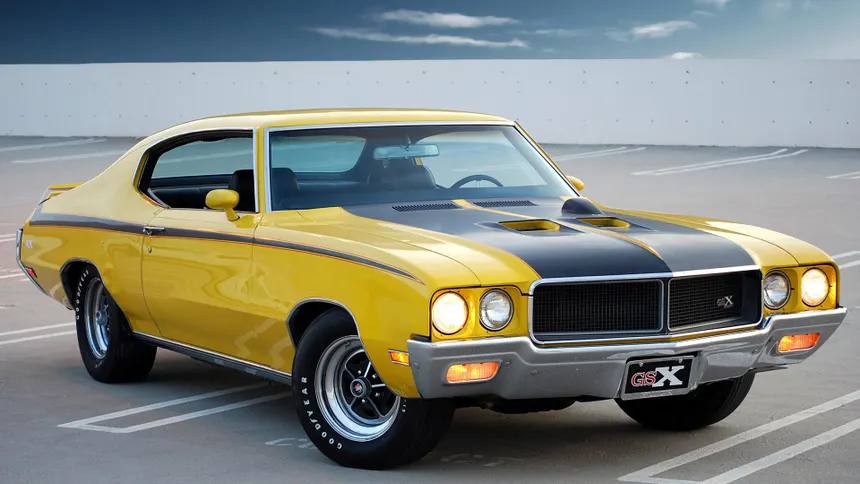
Buick GSX: the muscle car that won the war and never made the highlight reel
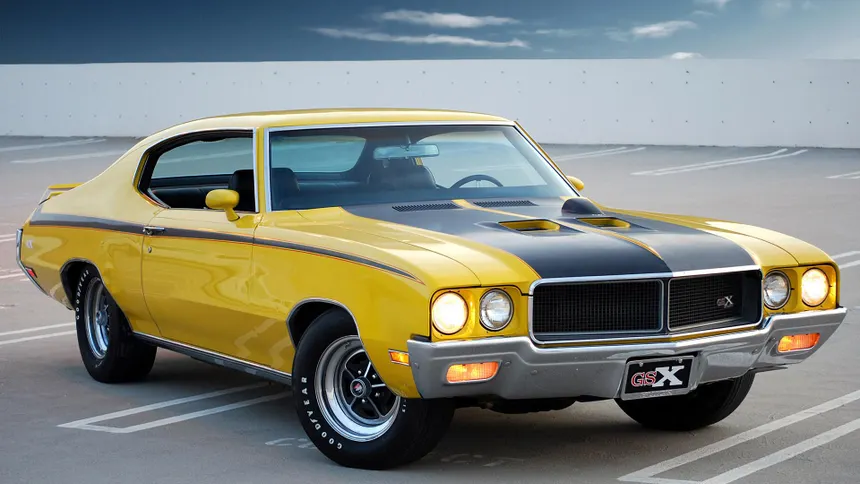
Picture Chris Harris stood next to a 1970 muscle car for a vintage shootout. He’d reach for the Hemi Cuda. He’d reach for the LS6 Chevelle. He’d absolutely reach for the 1970 Boss 429 because the entire Anglo motoring brain has a soft spot for big American iron with stupid names and louder advertising. Chris Harris would not, under any circumstance, walk over to the Buick parked at the end of the row.
That’s the problem. That’s been the problem for fifty-six years. Buick is the brand your grandfather drove to church. Buick is leather seats and chrome bumpers and a slow waltz back to the country club. Buick is the brand that puts ten-cent insurance premiums in their advertising copy because “performance” was a word reserved for other GM divisions.
Except in 1970. Except for five months between March and May. Except for 678 cars that nobody outside a four-page leaflet ever heard about. Because in 1970, Buick built the angriest A-body General Motors ever produced and dressed it up like a piece of farm equipment. The Buick GSX. Yellow paint. Black stripes. A 7.4-litre V8 that broke a torque record nothing American touched again until the second Bush administration.
If Top Gear had got hold of one in period, the British motoring press would have lost its mind. They didn’t. The Buick GSX never crossed the Atlantic in any meaningful way. It was a domestic-only mythology that even America forgot.
A car you had to know existed before you could buy one
The GSX wasn’t in Buick’s main 1970 catalogue. To find out it existed, a customer had to ask the dealer for a separate four-page brochure. Four pages. For a car designed to humiliate everything else on the street. While Pontiac was running double-page colour spreads with race drivers leaning on bonnets and exclamation marks everywhere, Buick was treating its halo car like a private banking product. Word of mouth among informed buyers. Print runs measured in hundreds, not thousands.
Production: a single window from late February to late May 1970, with a handful of stragglers built in June. Three months at the line. Six hundred and seventy-eight units total. The GSX badge cost an additional 1,195 dollars on top of a Gran Sport 455 — roughly a third of the base car’s price for what amounted to decals, two spoilers, a hood-mounted tachometer, beefier suspension, and front disc brakes. Add another 113 dollars for the Stage 1 engine package and you were looking at the most expensive way to buy a Buick in 1970 short of going full Riviera.
The colour palette: Saturn Yellow or Apollo White. That’s it. No black. No red. No blue. Anything other than tractor yellow or fridge white meant waiting until 1971, by which point the moment had passed. Of the 678 units, 491 left the line in Saturn Yellow and 187 in Apollo White.
The whole thing read like a deliberate attempt to bury the car. It probably was, actually — accidentally rather than on purpose. Buick’s marketing people had been selling near-luxury for two decades. They had no language for what their engineers had just built.
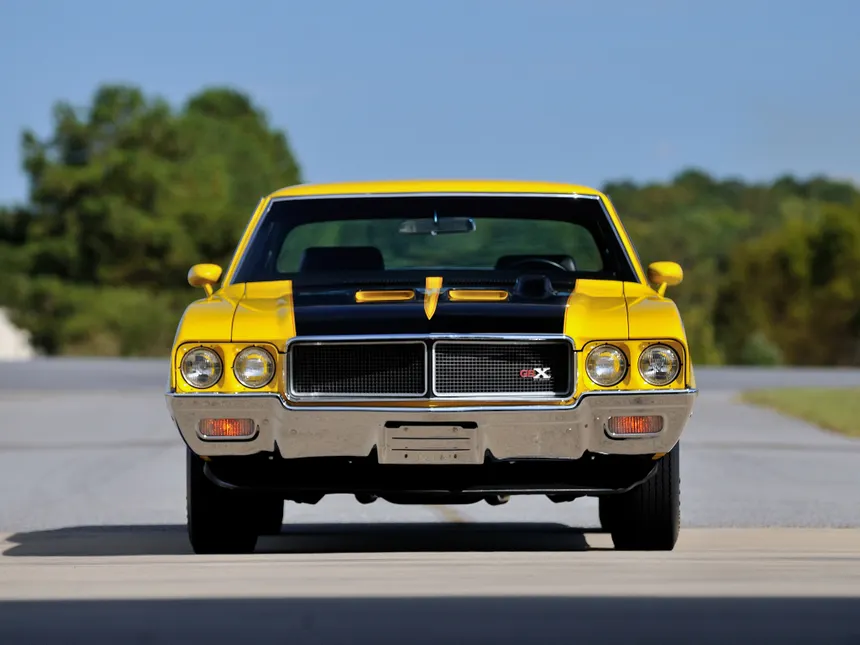
What the engineers built
This is where Buick stops being your grandfather’s church car and starts being something else entirely. The 455 cubic inch V8 — 7.4 litres in real money — was a thin-wall casting designed in Flint. The cleverness was structural. By the time you’ve finished comparing it to its rivals, the Buick block weighs roughly 150 pounds — about 68 kilograms — less than a Chrysler 426 Hemi or a Chevrolet 454 LS6 of equivalent displacement.
In a muscle car, that’s not a footnote. Less weight on the front axle means less weight transfer at launch, better balance, better traction off the line. It means the nose doesn’t get stupid the moment the throttle pedal hits the carpet. It means you’re not asking the rear bias-ply tyres to do impossible work. The Hemi made noise and headlines. The Buick made progress.
Anyone who has spent time pulling big-block American iron out of a chassis knows what 68 kilograms feels like at the end of a hoist chain. It’s the difference between a two-man job and a one-man job. It’s the difference between a chassis that turns into a corner and one that pushes through it. Buick’s engineers didn’t get there by accident. Thin-wall casting in the late sixties was still close to the bleeding edge of foundry practice — you push the cylinder walls thinner, you save weight, you risk core shift, you risk porosity, you risk every block on the line going to scrap. They did it anyway. And it worked.
Output: 350 horsepower for the standard 455, 360 for the Stage 1 package. Torque, identical on both: 510 pound-feet at 2,800 rpm. That last figure matters more than the headline horsepower. It was the highest factory torque rating ever applied to an American production car at the point of release. And it stayed there. Untouched. For 33 years. The Dodge Viper SRT-10 of 2003 finally took the title with 525 pound-feet from its 8.3-litre V10. A grandfather’s car held the all-American torque record until George W. Bush’s second term.
The Stage 1 paperwork was a lie. Buick claimed 360 horsepower because the insurance industry had started weaponising horsepower-per-cubic-inch ratios as an excuse to hike premiums on anything resembling a performance car. So Buick lied. On the brochure. With a wink. Engineers later admitted that the lowest of fifteen production-line Stage 1 dyno tests still produced 376 gross horsepower. Modern restorations to original spec routinely exceed 400. Apply the standard quarter-mile trap-speed formula to the actual recorded times, and the working figure is closer to 420.
The Stage 1 package added recalibrated heads with bigger valves, a hotter cam profile, a redesigned Quadrajet, and revised distributor curves for 113 dollars. That’s American capitalism doing exactly what it was meant to do: hiding a properly built engine behind a paperwork shrug.
The Motor Trend test that should have ended the conversation
January 1970. Motor Trend takes a Stage 1-equipped Buick to a quarter-mile strip. Same engine as the GSX Stage 1, same Turbo Hydra-Matic 400 transmission, same 3.42 posi-traction rear end. Mechanically identical, badge different.
Numbers: zero to sixty in 5.5 seconds. Quarter-mile in 13.38 seconds at 105.5 mph trap speed.
The magazine wrote, in print, that this was the quickest American production car they had ever tested. Not just for that model year. The fastest car they’d ever measured up to that point in the magazine’s history. The Hemi Cuda needed every advantage to match it. The LS6 Chevelle ran 13.4 in identical conditions. The GTO Judge with the Ram Air IV had run 13.6 the previous year and Pontiac had spent the next twelve months bragging about it. The Buick beat them all by margins large enough to register on a stopwatch and small enough to register in pride.
In 1984, Car Review magazine compiled a definitive ranking of the fifty quickest muscle cars ever produced. The Buick made the top three. Only the 1965 Shelby Cobra 427 — a 2,529-pound homologation racer barely qualifying as street legal — and the 1966 Corvette 427 finished ahead. Here’s the part that matters: both of those cars were two-seat sports cars, not muscle cars in the strict sense. Strip out the technicality and the Buick GSX Stage 1 becomes, on that list, the fastest mid-sized American muscle car ever produced. Faster than every Hemi Cuda. Faster than every LS6 Chevelle. Faster than every Boss 429 Mustang and every GTO Judge. The Hemi Cuda, by the way, slotted in at fourth on that same list. The Buick beat it.
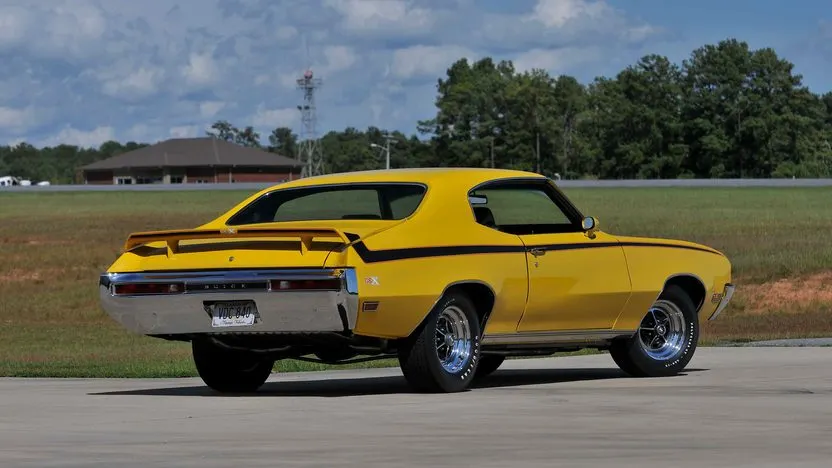
Why nobody remembers it
This is the bit nobody at Buick wants to discuss. The bit that, in the language we use at NEC, gets told without dressing.
The GTO got Beach Boys lyrics. The Mustang got Steve McQueen and a dark green Highland fastback chasing a Charger through San Francisco. The Charger itself got Dukes of Hazzard and forty Fast and Furious sequels. The Chevelle got every American garage poster between 1971 and the Reagan inauguration. What did the Buick GSX get? A four-page brochure that prospective buyers had to know to ask for. Tractor yellow paint. Five months of production. Buick’s own marketing department refusing, essentially, to sell it like a halo car.
It’s not the engineers’ fault. The engineers were running. The marketing department was sitting in the boardroom counting insurance discounts. The two halves of Buick in 1970 were operating on different planets, and the GSX is the artefact left over from that disconnect. A car too good for the brand that built it.
Cultural relevance follows narrative. Narrative follows marketing. Marketing follows commitment. Buick committed to nothing. So the cultural memory of the muscle car era went to the brands that were loudest, not the brand that was fastest. Half a century later, the bill keeps coming due. When somebody mentions American muscle cars, the names that surface are Hemi, LS6, Boss, Judge — and the yellow car from Flint that beat all of them stays buried.
What happened next
1971 began the slow death. The emissions noose was tightening. Insurance companies had started flagging anything with a four-barrel carburettor as a moral hazard. Petrol prices were creeping up. Buick opened the GSX to nine additional colours and the smaller 350 V8 in an attempt to spread the cost. They sold 124. The following year, 1972, only 44 found buyers. By the end of 1972, the GSX was gone.
The 1972 Stage 1 still technically existed but with compression dropped to 8.5 to 1 to swallow the new unleaded fuel. Output collapsed to 270 horsepower under the revised SAE net rating system. The era was over. Not just for Buick. For everybody. But the GSX died first because it had never quite been allowed to live.
Today, when a numbers-matching 1970 GSX Stage 1 surfaces at auction, the bidding starts above 200,000 dollars and climbs from there. Hagerty values a concours-condition example at 196,000. There aren’t many left. Of the 678 originally built, attrition through rust, accident, neglect, and parts cannibalisation has reduced the survivor population to a few hundred at best. What remains is collector territory for the kind of buyer who reads the small print on a bill of sale and knows what they’re looking at.
What the car proves
The Buick GSX is the cleanest case study available of a problem that didn’t end in 1970 and hasn’t ended now. The technically better product doesn’t always win the cultural war. Marketing beats engineering. Narrative beats torque curves. A clueless commercial department can erase a brilliant engineering team with the same ease that a sugar lump dissolves in a hot coffee.
Buick had the car. Buick had the engine. Buick had the stopwatch on its side. What Buick didn’t have was anyone capable of telling the country what had just been built in Flint. Half a century later, when the muscle car canon gets recited, the names are Hemi and LS6 and Boss and Judge. The fastest production American car of 1970 doesn’t make the list. The car that held the all-American torque record for 33 consecutive years doesn’t make the list. The car Motor Trend put on the cover of January 1970 with the explicit headline “The Quickest American Production Car” doesn’t make the list.
That’s the GSX. A car that won the war and missed the parade. A torque record nobody applauded. A quarter-mile time nobody quotes because the brand that posted it doesn’t fit the script.
Next time someone runs through American muscle car royalty and forgets the GSX, ask them how much the Buick 455 block weighed. Ask them how much torque it made. Ask them how long that record stood. Watch them go quiet.
Check you’re still alive.