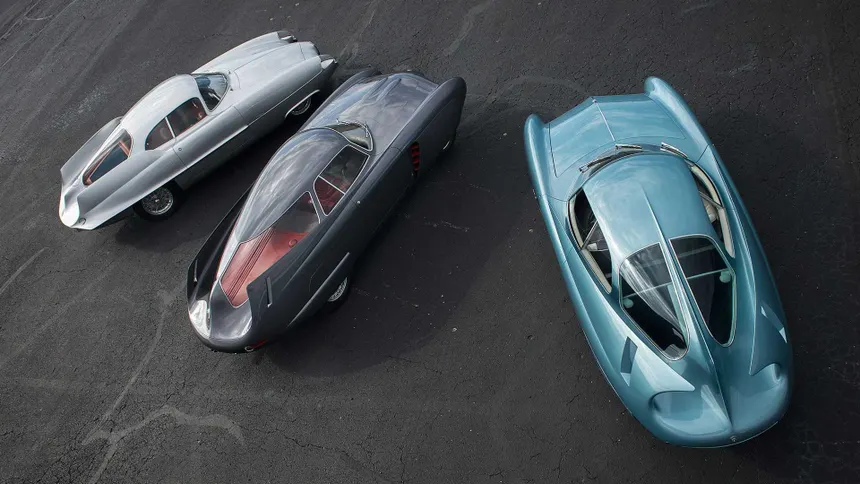
ALFA ROMEO B.A.T. 5, 7 AND 9 — WHEN ITALY INVENTED THE FUTURE WITH WOOL THREAD
Turin, 1953. A man tapes wool threads all over a car’s bodywork. He drives it onto the road. Another car follows alongside, photographing it at speed. When they return to the workshop, the man studies the photos. He looks at where the threads flow smooth and where they thrash wildly. Where they thrash, the air isn’t doing what it should. He adjusts the bodywork. Goes out again. Photographs again. Repeats.
No wind tunnel. No computers. No fluid dynamics simulation software. Just wool thread, an Italian road, and a man who studied aeronautics before designing women’s fashion before coming to cars. His name is Franco Scaglione. And what comes out of those wool threads is a drag coefficient of 0.19 — better than a Porsche Taycan seventy years later.
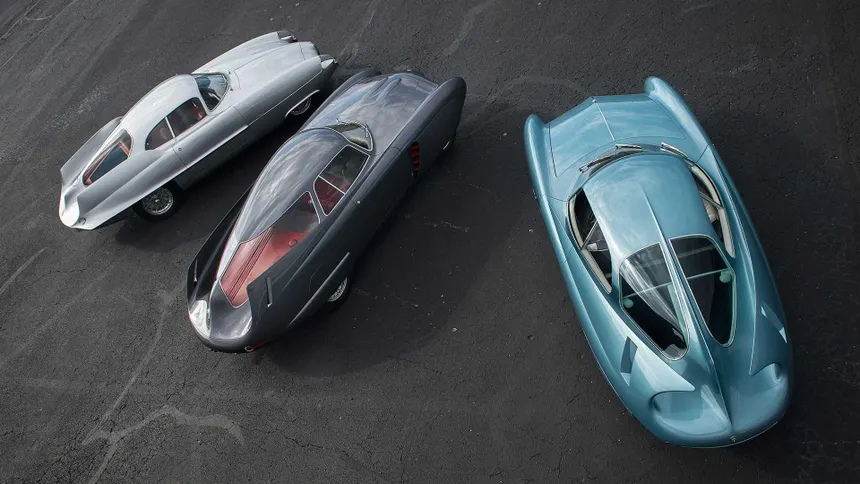
That’s the B.A.T. Berlinetta Aerodinamica Tecnica. Three cars. Three consecutive years. Three appearances at the Turin Motor Show. The exact moment engineering and art stopped being separate things.
The brief that changed the rules
Alfa Romeo contacted Nuccio Bertone with a clear objective: study the effect of drag coefficient on a vehicle. Create cars with the lowest possible aerodynamic resistance. This wasn’t a marketing exercise. It wasn’t a concept car designed to dazzle the public and be forgotten the following month. It was applied research — with the condition that the result had to be spectacular enough to stop people in their tracks.
Bertone assigned the project to Scaglione. The choice was no accident. Scaglione came from studying aeronautics — he understood wing profiles, airflows, principles of lift and drag. He’d designed women’s fashion before entering the car industry, and that combination of mindsets — the engineer’s technical precision and the designer’s visual intuition — was exactly what this required. Nuccio Bertone personally supervised every phase. And the project development and manufacturing chief was Ezio Cingolani, Bertone’s head of projects.
The mechanical base was the Alfa Romeo 1900, Alfa’s most advanced production car at the time. Pressed-steel unitary chassis, four-cylinder twin-cam engine, approximately 90 horsepower, five-speed gearbox. There was no direct financial cooperation from Alfa Romeo — Bertone bought the chassis needed and informed Alfa about the idea. Alfa’s experimental department was too busy with other projects to get involved. That meant total freedom.
B.A.T. 5 — May 1953: the first punch
The name isn’t random. Scaglione built four full-size models before moving to metal on the fifth — hence “BAT 5.” There was no extensive sketching phase. Very few lines on paper. Everything was resolved directly at the modelling stage, with Scaglione working the full-size model and Nuccio Bertone reviewing it continuously. From sketch to metal without the intermediate bureaucracy that today turns any concept into an exercise in compromise.
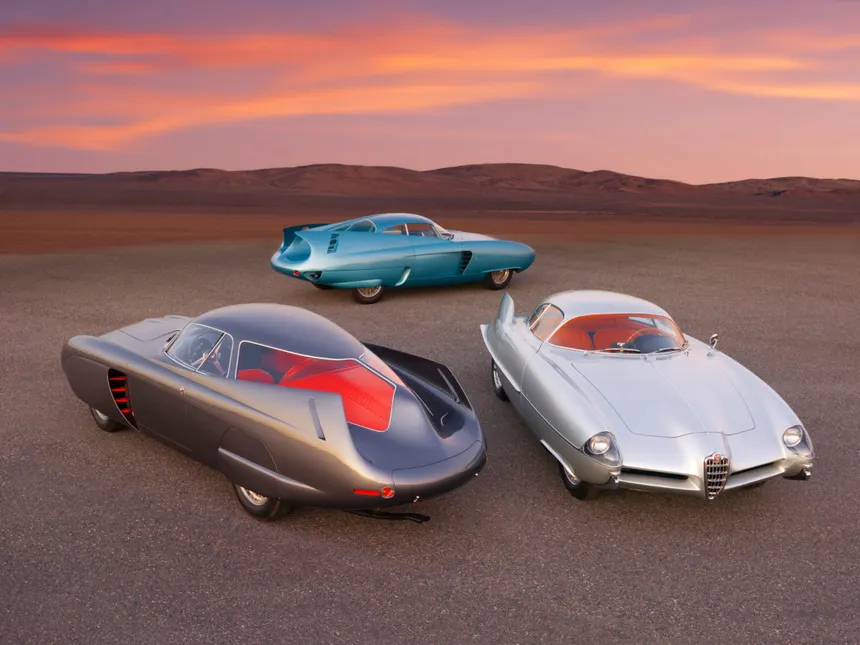
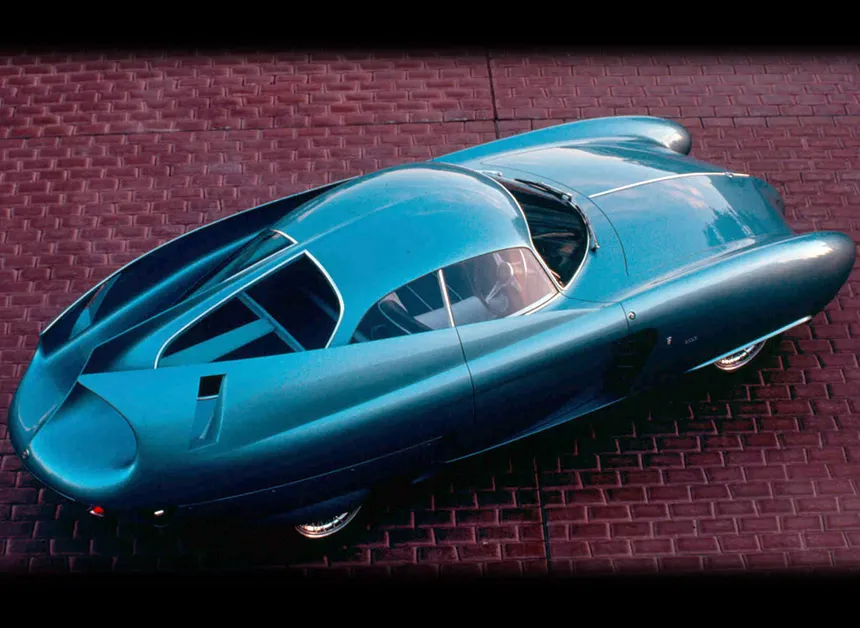
The result paralysed the Turin Motor Show in May 1953. Rear fins curving inward. Wheels partially covered to eliminate drag generated by their rotation. Side windows angled at 45 degrees to the car’s body. An enormous windscreen blending seamlessly into the nearly flat roof. Weight: 1,100 kilograms. Drag coefficient: 0.23. Top speed: approximately 200 km/h with just 90 horsepower — over 30 km/h more than the Alfa Romeo 1900 C SS it borrowed its mechanicals from.
To put that in context: in 1953, a Cx of 0.23 was a figure most manufacturers weren’t even trying to measure. The industry was obsessed with power, not aerodynamics. Scaglione proved that a 90-horsepower car could reach 200 km/h if the air flowed correctly — and he proved it with wool threads.
BAT 5 was purchased by Stanley “Wacky” Arnolt, director and shareholder of Bertone, and Italian car importer in the United States. From Turin to America in a matter of months.
B.A.T. 7 — April 1954: obsession taken to the limit
After BAT 5’s impact, Scaglione received a clear instruction: go further. Emphasise the characteristics of the original. Lower the coefficient. BAT 7 was built on a short-wheelbase 1900C chassis, and Scaglione applied everything the wool threads from BAT 5 had taught him.
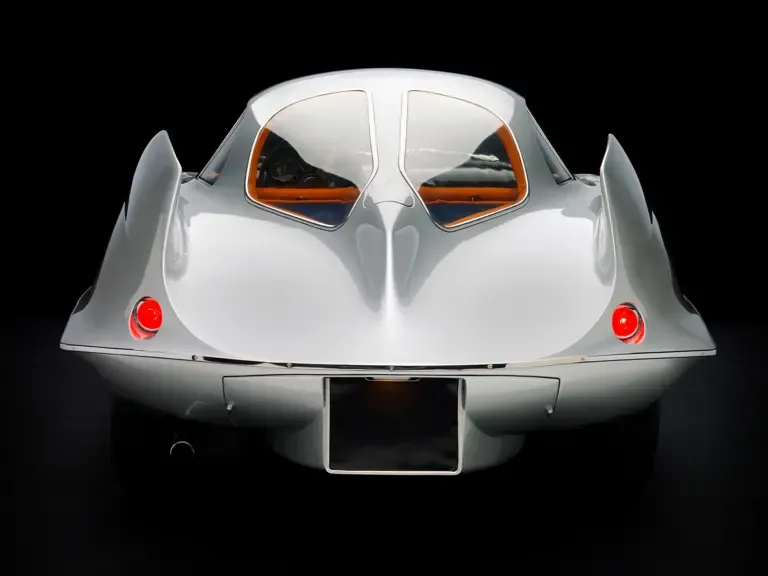
The nose dropped over two inches compared to BAT 5. The front air intakes narrowed. The headlights relocated to the sides of the nose and retracted when not in use. And the rear fins — the rear fins became something that had never existed on any car in the world. They sprang from the windscreen pillars, formed an arch like a flying buttress on a Gothic cathedral running the full length of the roofline, and curved inward at the tail until they nearly touched. The central roof spine created a dorsal profile that guided airflow over the cabin and channelled it toward the car’s rear.
Result: Cx 0.19. The lowest of the trilogy. A figure that a current Porsche Taycan — Cx 0.22 — doesn’t match. Achieved in 1954. Without a wind tunnel. Without computers. With wool threads.
They finished it so late that Scaglione and Nuccio Bertone had to drive it themselves to the Turin Motor Show to get there on time. The BAT 7 you see in the exhibition photos had been on Italian roads the night before with its two creators at the wheel, taking turns. It’s the kind of detail that tells you everything you need to know about how things were done in 1950s Italy.
Many consider BAT 7 the most dramatic of the three. It’s hard to disagree. If BAT 5 was a statement of intent, BAT 7 was the definitive statement. The car that proved one man’s empirical aerodynamics with wool threads could surpass what most manufacturers would achieve with wind tunnels decades later.
The parallel lives of BAT 7
After the show, BAT 7 was sold to Alfa Romeo, who shipped it to the United States through Stanley Arnolt. It was exhibited repainted in red at the Chicago Auto Show. And from there began a life that deserves its own novel.
Al Williams, one of the first American owners, removed the side fins. The reason: they obstructed rear visibility and made it impossible to drive on the street safely. It’s a decision that today seems like a crime against art, but if you think about it for five seconds, it makes sense. The same fins that made BAT 7 an aerodynamic masterpiece turned it into a car where you couldn’t change lanes without praying.
Colonel James Sorrell brought it to the shop of Salvatore di Natale in Van Nuys, Los Angeles. Di Natale was at that time the most respected Italian car specialist on the West Coast. Sorrell commissioned a restoration. Di Natale did the work. Sorrell didn’t pay. Sorrell never came back for the car. In 1969, di Natale claimed legal ownership and kept BAT 7 for 17 years. A Turin concept car wandering through California garages for decades, waiting for someone to remember what it was.
Di Natale lost the car in 1986 — according to multiple sources, sold by his own son without his consent, reportedly for somewhere between $14,000 and $17,000. The buyer resold it to a Japanese collector for around $1.3 million. Di Natale never spoke of it again. His friends knew not to bring it up.
The fins were reinstated during a subsequent restoration and the car was returned to its original specification. But the story of those lost years — the most aerodynamic car in the world forgotten in a Los Angeles workshop — says as much about the B.A.T.s as their drag coefficient does.
B.A.T. 9 — April 1955: the return to the possible
For the third instalment, the brief changed. Alfa Romeo wanted something closer to production. More practical, more visible, more usable. Not further out — closer to reality.
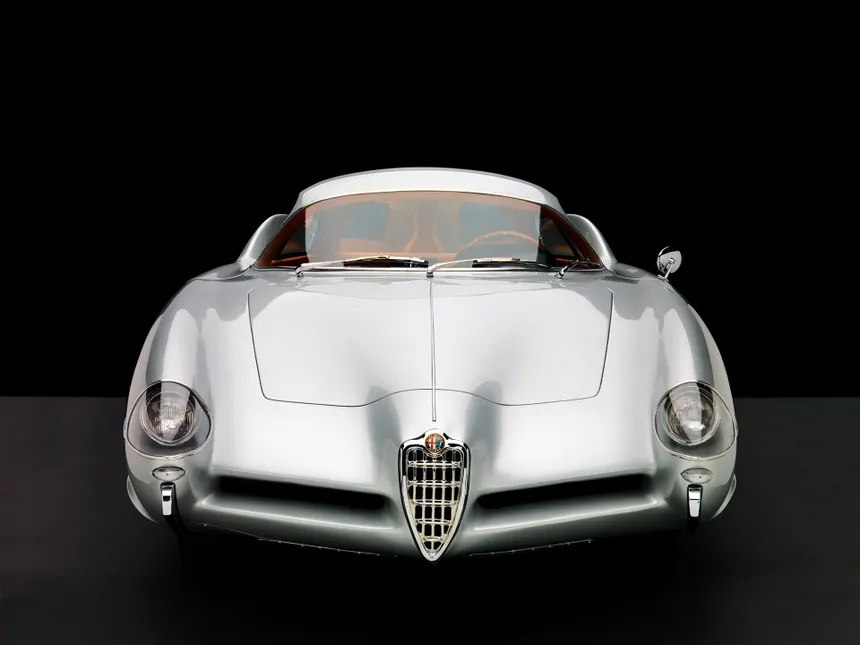
Scaglione softened the lines. Trimmed the fins down to two small metal plates, like the tail fins on American and some European production cars of the period. Integrated the Alfa Romeo Giulietta grille into the front end — a direct nod to real-world production. The rear wheels were left exposed, not covered as on the previous two. The result was the most conventional of the three, but it was still a car that looked like nothing in production in 1955.
BAT 9 is the one that most clearly anticipates what came next: the Alfa Romeo Giulietta Sprint Speciale that Scaglione would design for production. The lines of BAT 9, simplified and domesticated, are recognisable in the Sprint Speciale as a direct echo. The B.A.T.s weren’t just styling exercises — they were the laboratory from which a production car emerged.
BAT 9 reached the United States through Arnolt. In March 1956, it turned up parked in the car park at the Sebring circuit. Harry Woodnorth, a Chicago dealer, discovered it there and bought it together with Tom Barrett. It was repainted red at some point in its history. It changed hands several times over decades before being reunited with its siblings.
The reunion and the auction among Giacometti and Fontana
In 1989, a single collector managed to bring all three B.A.T.s together for the first time since they stopped being exhibited in the 1950s. For years they sat together at the Blackhawk Automotive Museum in Danville, California. Three cars that were never shown together in their own era — because they appeared in consecutive years — finally united under one roof.
On October 28, 2020, RM Sotheby’s sold them as a single lot. But not at a car auction. At Sotheby’s Contemporary Art Evening Auction in New York. The three B.A.T.s were offered among works by Giacometti and Fontana. Cars among sculptures. Engineering among art. The boundary that Scaglione had erased seventy years earlier was definitively gone.
Sale price: $14,840,000. A new record as the most valuable post-war Alfa Romeo sold as a single lot at auction. Nearly one million viewers watched the auction live via streaming. Auctioneer Oliver Barker called it from London, with specialists taking simultaneous bids from New York, London, and Hong Kong.
What they mean
The B.A.T.s aren’t three concept cars. They’re a three-part conversation about what happens when you give a man trained in aeronautics and women’s fashion the freedom to do whatever he wants with a chassis and a body. They’re proof that empirical aerodynamics — wool threads, roads, and photographs — can produce results that simulation technology took decades to match.
They directly influenced the 1959 Giulietta Sprint Speciale. They established Bertone as Italy’s most radical design studio. And they’re the direct precedent for everything that followed in Italian design: the Carabo, the Stratos Zero, the Countach, the Modulo. The line from Scaglione’s wool threads on an Italian road to the wind tunnels of Maranello and Sant’Agata Bolognese is direct and unbroken.
And they were sold at a contemporary art auction. Because that’s what they are. Contemporary art that does 200 km/h on 90 horsepower.
Franco Scaglione taped wool thread to an Alfa Romeo and drove it onto the road. From that came a Cx of 0.19. From that came the language that defined Italian design for thirty years. Some things can only be done when nobody has told you yet that they’re impossible.
Check you’re still alive.