Alfa Romeo GTV 916: How to Build a Special Car with Parts That Weren’t
Some cars feel special because everything underneath them was engineered exclusively for the job. And then there is the Alfa Romeo GTV Type 916.
The Italian coupé of the 1990s did not sit on a from-scratch dedicated sports platform. Chunks of its architecture came from the Fiat Group’s Tipo Due family, the same modular base that carried the Fiat Tipo, the Tempra, the Lancia Dedra, the Fiat Coupé, and the Alfa Romeo 155 saloon. It was not the lightest car in its segment. It did not send drive to the rear wheels. The front wheels did all the traction work. Several of its technical solutions were, to put it plainly, not exotic.
But one look at the car parked on a Milan side street, or one earshot of a 3.0 24V Busso rolling past a café terrace, was enough to understand that Alfa Romeo had achieved something industrial accountancy usually does not allow: turning a shared base into an object with its own identity. The question is not whether the GTV 916 was perfect. It wasn’t. The question is how it managed to look so uncommon when much of its origin was so common. This pack is about that.
Alfa Romeo needed a sports car, and could not afford one
Industrial context of the late 1980s. Fiat bought Alfa Romeo from the IRI in August 1986. The Milanese brand arrived in Turin as a precarious acquisition: aging range, sporting image half-faded after the end of GTV6 Alfetta production the same year, books strained by decades of complicated state management. One of the first mandates of the new Fiat leadership was to reactivate the Alfa Romeo sporting range with a new coupé. The internal project received the codename 916.
The industrial objective was twofold: a 2+2 coupé (GTV) and a two-seater roadster (Spider) on a shared platform, drawing on Fiat catalogue components to spread development costs. This was not a luxury situation. Alfa Romeo, within the 1987 Fiat org chart, did not have the money to design and homologate an exclusive platform from scratch. That was Ferrari’s job, and Maserati’s when Maserati was still independent. Alfa Romeo, within the group, was a premium brand but not a pure luxury one. The industrial math was different.
The decision was to build a sports coupé on the Tipo Due family. And here starts the contradiction that makes the 916 interesting.

A shared platform is not an equivalent platform
Sharing architecture with the Fiat Tipo does not mean the GTV 916 was a Fiat Tipo with different bodywork. That is a misunderstanding that circulates in forums and needs dismantling without falling into blind defence. The Tipo Due platform was modular by design. Fiat had conceived it in the second half of the 1980s as a flexible base on which cars in different segments could be built with very different specifications: compact saloons, sports coupés, family estates, premium sedans. Each derivative model adjusted wheelbase, track widths, front and rear subframes, torsional reinforcements, and suspension geometry to fit its needs.
The 916 used some base elements of the Tipo Due and substantially modified the rest. Its own wheelbase (2,540 mm), its own rear track, reinforced subframe, specific torsional reinforcements. Front suspension kept the MacPherson layout but with proprietary tuning. Rear suspension started from a semi-independent configuration but was redesigned in 1996 under direct order from Fiat Auto CEO Paolo Cantarella, who judged the first approach insufficient for a car being sold as a sports coupé. It was redesigned by project chief engineer Bruno Cena, and the result was the specific multilink axle that reached production in 1998 with Phase 2.
The industrial balance is what matters here. Alfa Romeo took an economical base that let it reach market without going broke, and then invested the money saved into the pieces where a car’s behaviour is truly decided: suspension, steering, engine, and tuning. The platform is shared. The tuning is not. And in the tuning is where a car becomes an Alfa Romeo or stays a Fiat Tipo with pretensions.
Pininfarina changes the rules of the game
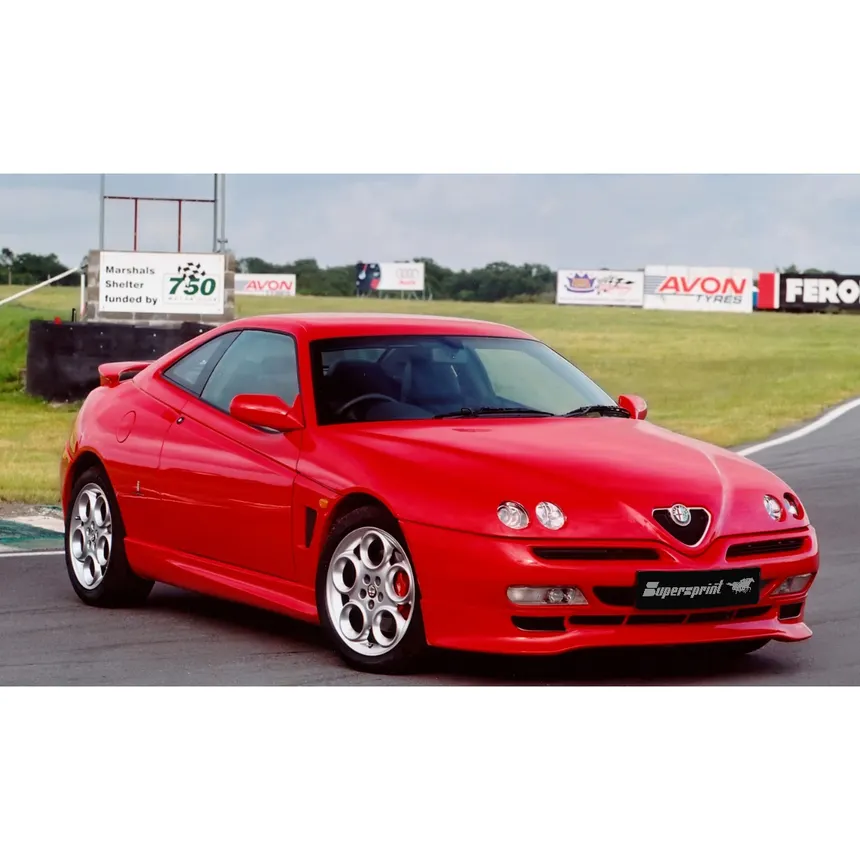
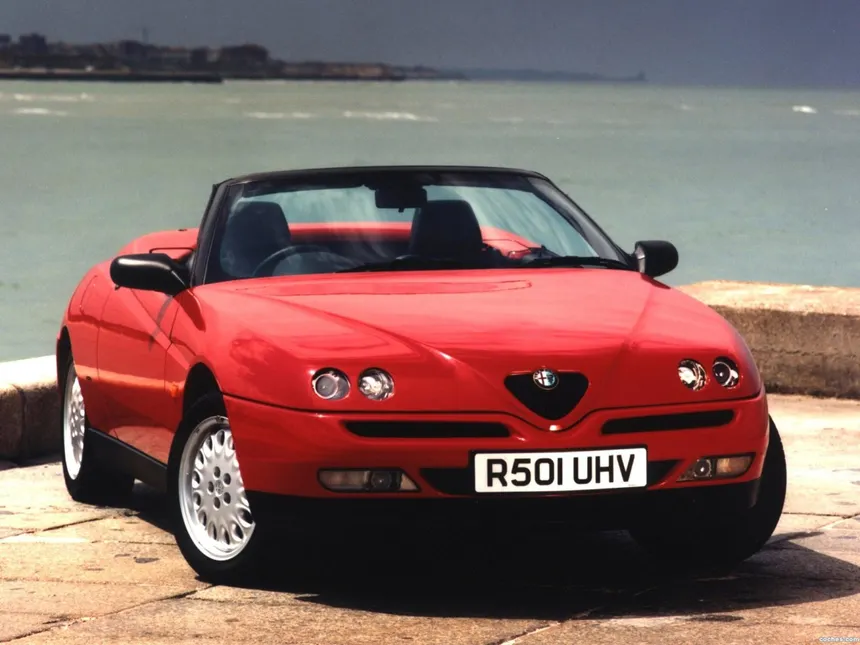
Enrico Fumia started the first 916 sketches at Pininfarina in September 1987. The first 1:1 clay models were completed in July 1988. Fumia was a Turin-born designer with a career inside Pininfarina and with the Lancia Y10 and the Lancia Dedra on his CV. For the 916 he received a demanding brief: design two differentiated cars (coupé and roadster) on a shared platform, with distinct visual personality for each but sharing the front end.
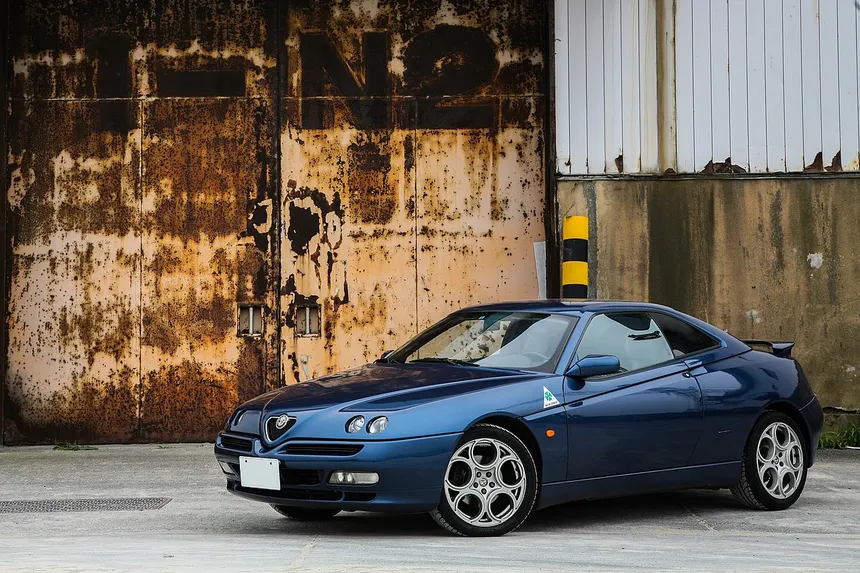
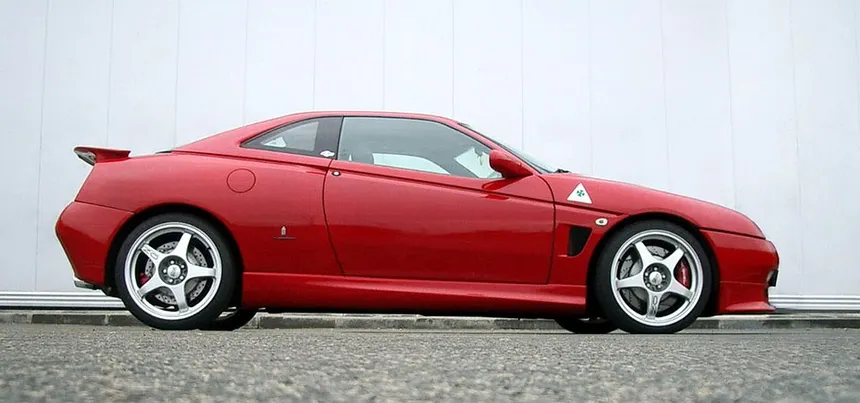
Fumia’s exterior work defined several elements that became recognisable signatures of the car:
Low wedge nose, with body-hugging bumper and no aero overhangs.
High ascending waistline, thin glasshouse, and a side profile marked by a rising crease running from the front bumper up toward the rear wheel arch. A new element in late-1980s European coupé language.
Twin round headlights per side, circular optics sunk into the wedge nose.
Trilobo grille, the triple central air intake recovered from the early-1950s Alfa Romeo 156 Sprint, modernised for the 916.
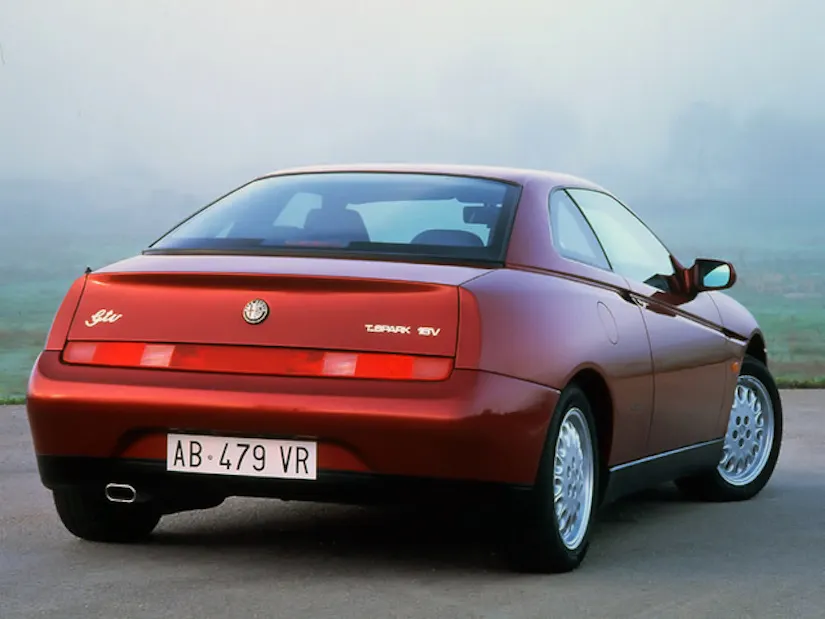
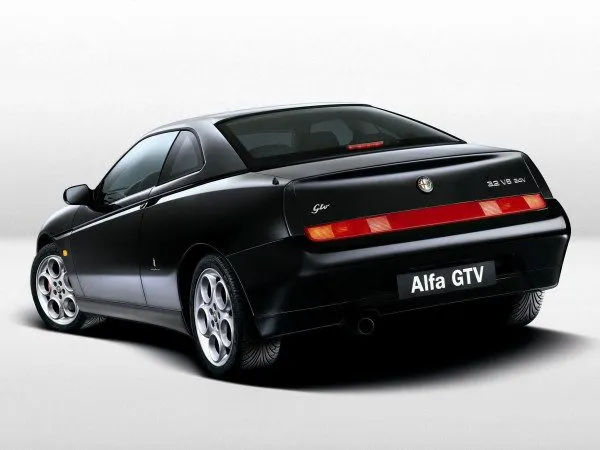
Short rear with near-vertical cut on the GTV coupé, and descending tail on the Spider as a visual reference to the original 1966 Duetto 105-series.
Worked side surface with a high shoulder, thin glass area, and proportions that visually lower the car without sacrificing interior habitability. Classic Italian sports coupé recipe.
Fumia managed, with two cars on the same technical base, to produce two emotionally distinct silhouettes: the GTV as tight and aggressive fixed-roof coupé, the Spider as elegant tourer roadster. It is the design that separates the 916 from its platform siblings. No Fiat Tipo, no Tempra, no Lancia Dedra, no Fiat Coupé looks visually like the 916. The mechanical sharing stays invisible beneath the Pininfarina line.
What Alfa actually changed
Beyond the exterior design, Alfa Romeo did four specific things on the Tipo Due base that separated the 916 from the rest of the family:
One: the specific rear multilink suspension. The first 1994 configuration was abandoned as insufficient. The definitive 1996-1998 version used a rear multi-arm setup with proprietary geometry, capable of absorbing the reaction torque of the 3.0 Busso V6 and holding high cornering speeds without the rear axle losing composure. This piece is probably what most differentiates the 916’s behaviour from a contemporary Fiat Coupé.
Two: the steering and brakes tuning. Steering was refined with a more direct ratio than the Fiat Tipo, faster centre return, and cleaner feedback through the wheel. Front brakes moved to specific large-diameter vented discs with larger-bite callipers.
Three: bodyshell torsional stiffness. The 916 subframe received reinforcements not present on the Fiat Tipo. Chief engineer Bruno Cena documented in later interviews that the objective was to hold 3.0 V6 torque without appreciable chassis flex, something the base platform could not sustain in original configuration.
Four: limited-slip differential on V6 versions. The 2.0 V6 Turbo and the 3.0 V6 variants carried a Torsen limited-slip differential as standard on many configurations. Without that Torsen, V6 power on front-wheel drive would spin loose on corner exit. With the Torsen, the car stayed traceable even in the rain.
The V6 turbo Alfa Romeo built to dodge Italian taxes
Here comes the most curious engine in the 916 catalogue, and probably one of the most singular commercial engines built in Europe in the 1990s. The 2.0 V6 Turbo.
Italy applied, throughout the 916 production period, a superbollo surcharge on vehicles with displacement above 2 litres. Fiscal logic was to hit luxury and big engines. But Italian buyers wanted performance. Buying a 3.0 V6 Busso meant paying the surcharge every year. And in the Italian market, that surcharge weighed on purchase decisions.
Alfa Romeo solved the problem with an almost absurd but elegantly effective industrial fix. It took the 3.0 V6 Busso block (2,959 cc original displacement), sleeved it internally with narrower cylinders while keeping the external dimensions of the 3.0 block, and brought actual displacement down to 1,996 cc, just below the fiscal threshold. Then added a turbocharger to recover the lost power. Result: 200 hp with fiscal displacement under 2 litres.
The Italian buyer paid the surcharge of the lower band but took home a coupé with performance equivalent or superior to the 3.0 V6 atmospheric. This is engineering forced by taxation, not by pure technical criteria. An engine that exists because the Italian tax system made it commercially necessary. Without that superbollo, the 2.0 V6 Turbo would never have existed.
It was discontinued in 2000 because it could not meet the Euro 3 standards then coming into force. Today it is one of the most sought-after 916 variants in the Italian collector market, precisely because of its rarity and because of what it represents as an extreme case of industrial adaptation to a local fiscal context.
The Busso as emotional argument, not just as sound
The V6 Busso engines in the 916 were offered in three displacements: 3.0 12V (192 hp, Phase 1), 3.0 24V (217-220 hp, Phase 2), and 3.2 24V (240 hp, Phase 3). All derived from the block designed by Giuseppe Busso in the late 1970s that had debuted in the 1979 Alfa 6.
The sound of the Busso is a trope every European magazine has repeated for decades. It is real. The Busso V6 has an acoustic signature recognisable from several metres away, mid-bass timbre climbing to treble past 5,500 rpm, ending in a dry bark near the fuel cutoff. But reducing the Busso to “the sound” sells it short.
The Busso changes the car’s overall feel for reasons that go beyond the noise. It changes front-axle weight (the Busso V6 is heavier than the Twin Spark four-cylinder, shifting the centre of gravity forward, which demands the specific subframe tuning). It changes throttle response (the V6 delivers torque more linearly and elastically than the VVT Twin Spark, allowing low-rev manoeuvres the four-cylinder rejects). It changes how you drive the car (with the Busso you do not need to drop as many gears in corners; sustained torque keeps the line; with the Twin Spark you have to wring the engine and plan shifts).
That set of differences is what makes a Busso 916 feel and drive like an Alfa Romeo, while a Twin Spark 916, though a competent car, feels closer to a generic European coupé. The Busso is not the ornament of the 916. It is the element that separates the car from its platform siblings more clearly than any other component.
The front-wheel-drive fight
Here is where the defect deserves acceptance without defence. The GTV 916 sends drive to the front wheels. A late-1990s European sports coupé aspiring to fight the BMW 3 Series Coupé (E36 and E46), the Mercedes CLK, or the Porsche Boxster carried a conceptual handicap with front-wheel drive. European sports-car puritanism dictated rear. The 916 broke that rule for industrial reasons, not by ideal technical choice.
Torque steer with V6 power was and remains perceptible under hard acceleration. On corner exit in the wet, the Torsen limited-slip differential contains most of the problem but does not fully eliminate it. The steering feel is different from a rear-drive sports car. Less communicative at the front axle (which does traction and guidance work at once), more forgiving at the rear.
That said. Front-wheel drive does not preclude a car having sporting character. Peugeot proved it with the 205 GTi and 306 GTi 16v. Volkswagen with the Golf GTI. Honda with the Integra Type R. Renault with the Clio Williams. The question is not whether a sports car should be rear or front. The question is whether the chassis has been worked seriously enough that the traction concept functions in the context of the car.
In the 916, the chassis is worked. Rear multilink suspension, direct steering, V6 Torsen differential, large vented brakes. It all indicates that Alfa Romeo accepted the industrial constraint of front-wheel drive and then did what it could to make the car function within that constraint. Did not apologise for the choice. Owned it and worked with it. That is the real merit.
Three lives for the same GTV
The 916 had three clearly distinct phases across its eleven years of commercial production:
Phase 1 (1995-1998): original launch. Black plastic front grille. Dark cabin tones. Engines 2.0 Twin Spark 16V (150 hp), 2.0 V6 Turbo (200 hp), and 3.0 V6 12V Busso (192 hp). Production entirely at the Alfa Romeo Arese plant north-west of Milan.
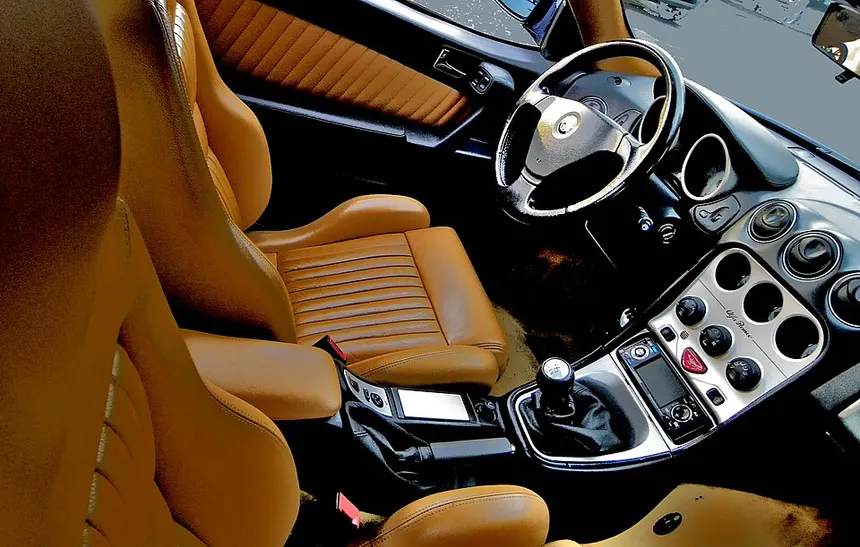
Phase 2 (1998-2003): major update. Chrome frame around the grille. New central console in silver-grey plastic to lift the cabin. The 1.8 Twin Spark 16V (144 hp) is added as entry engine. The 3.0 V6 24V Busso (217-220 hp) replaces the 12V at the top. The 2.0 V6 Turbo and 1.8 Twin Spark are discontinued in 2000 for not meeting Euro 3. In October 2000, GTV/Spider production is transferred from Arese to the Pininfarina San Giorgio Canavese plant near Turin. Arese closed as an Alfa Romeo production plant with this transfer.
Phase 3 (2003-2004): final restyle. Exterior design by Pininfarina without Enrico Fumia, who had left the house years earlier. New headlights with improved lenses. The 3.2 V6 24V Busso (240 hp) is added as flagship engine. The 3.2 V6 was shared with the contemporary 147 GTA, 156 GTA, and Bertone GT. Production ends in 2004 for the GTV and in 2005 for the Spider.
Combined total: 81,828 units across eleven years. Respectable figure for a segment (mid-market European sports coupé) undergoing global commercial decline during the period.
The car that arrived late
The 916 launched at Geneva in March 1995. It received immediate critical acclaim: Autocar Car of the Year 1995, Car Magazine Best Designed Car, Jeremy Clarkson called it in 1998 “one of the best sports cars of its time”, Top 100 Cars 2001 ranked it at number 29. Critical success and decent commercial reception in the early years. Then the market started shifting under it.
Second half of the 1990s: demand for hot compact hatchbacks (Golf GTI, Peugeot 206 RC, Renault Clio Williams, Honda Civic Type R) grew while demand for two-door sport coupés eroded. Early 2000s: demand shifted toward premium sedans (BMW 3 Series, Mercedes C-Class, Audi A4) and compact SUVs (BMW X3, Mercedes ML, Audi Q5). Mid-market sport coupés stopped being a commercially prosperous segment. The 916 got caught between two eras: it arrived as traditional European sports coupé volume was starting to drop, and it left market just as SUVs were starting to dominate.
Alfa Romeo launched the Brera by Giorgetto Giugiaro in 2005 for the practical coupé segment (successor to the Bertone GT), not for the 916 segment. The 4C of 2013 was an entirely different car (mid-engine, two-seat, carbon monocoque). The specific 916 segment, classic 2+2 sport coupé with Pininfarina signature, was left vacant in 2004 and remains vacant in 2026.
Not the perfect sports car. Something harder: personality
The Alfa Romeo GTV 916 was not the last great Italian sports car nor the most efficient car of its era. It weighed more than it should (between 1,365 and 1,415 kg depending on engine). It had front-wheel drive when European sports orthodoxy demanded rear. It shared platform with Fiat catalogue cars costing half as much. Its rust problems in the underbody and wheel arches are known to any specialist mechanic. Busso V6 maintenance costs are high. Gearbox reliability on V6 24V versions is debatable depending on year and specific unit.
It was harder to build than a perfect car: it was a car with personality inside an industry with less and less room for it. Alfa Romeo could not give it an exclusive platform, but it did give it a shape nobody confused with anything else, a rear suspension not there by accident, a Busso V6 engine that separated the car from its platform siblings more clearly than any other element, and a chassis tuning that accepted front-wheel drive and worked with it rather than trying to hide it.
That is why the 916 is not remembered as a Fiat in disguise. It is remembered as an Alfa Romeo that, for a few years, made identity feel more important than the origin of the parts. And in the European car industry at the turn of the millennium, that was exactly the opposite of what industrial accountancy was imposing on every other segment.
Check you’re still alive.