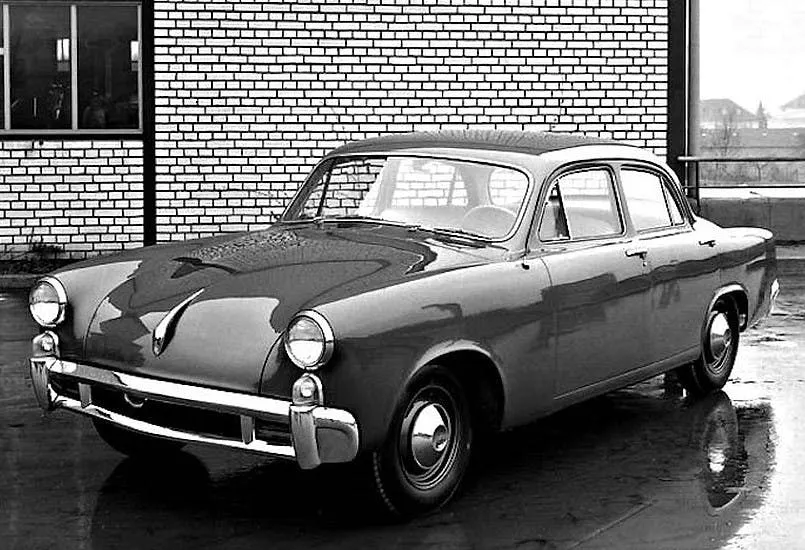
Porsche 542: The Car Studebaker Paid For And Never Built
Studebaker wrote Porsche a check for roughly half a million 1952 dollars and got nothing out of it. Porsche used that money to build the assembly hall in Zuffenhausen that still turns out 911s today. The dying American company paid for the German company’s factory.
That much has been told before. What almost nobody puts up front is the fine print: Porsche delivered a car that blew the one contract term you could actually verify with a scale. And got paid anyway.
This is a South Bend story, and it is not the one you think.
The man who turned down the Volkswagen factory
Forget Max Hoffman for a second. The man who set this in motion was Richard Hutchinson, Studebaker’s head of export operations, a genuine internationalist inside a company that mostly wasn’t. He built the Hamilton, Ontario plant. He set up overseas assembly deals. He wanted Studebaker to be a global name.
He is also the reason this story starts with the single worst decision in American independent auto history.
After World War II, the British occupation authorities running the Wolfsburg area offered Studebaker the Volkswagen factory. Outright. As a gift. Studebaker passed. Hutchinson, who could smell what the Beetle was going to become, had one shipped to South Bend to try to talk his own management into distributing it in America. Company president Harold Vance would not even walk out to look at the car.
Hold that image, because everything else follows from it. Studebaker turned down the factory that built the best-selling car of the twentieth century, for free, and then a few years later paid a fortune to a small German engineering shop for a sedan that ended up in a scrapyard. That wasn’t bad luck. That was judgment.
Hoffman — the Austrian importer in New York who put Porsche, BMW, and Mercedes into American showrooms — is the one who suggested that Ferry Porsche’s outfit could fix what ailed Studebaker. The development agreement was signed on May 16, 1952.
Two companies in trouble, in opposite directions
Studebaker was the oldest independent automaker in America, tracing back to a wagon blacksmith shop founded in 1852. By the early fifties, the arithmetic had turned against it. GM, Ford, and Chrysler could amortize a full model change across millions of units. Studebaker had to do it across a few hundred thousand, out of aging South Bend plants, carrying labor costs that would eventually help kill it.
Porsche’s problem was the opposite kind. In 1952 the company had been building the 356 for two years, renting space inside the Reutter body works in Zuffenhausen, with the engineering staff working out of wooden sheds. Demand was climbing. They needed a real plant. The banks wouldn’t lend — a company that young with no track record wasn’t a credit risk anyone wanted.
Contract engineering paid the bills. Studebaker was the biggest client that had ever walked in.
The brief: more power, less weight, 85 mph
The spec sheet is where this whole story turns, so let’s be exact about it.
Studebaker asked for a front-engine, rear-drive sedan with an air-cooled six, a three-speed transmission, and a top speed of 85 mph. And it wrote in two comparative requirements measured against the 1952 Studebaker Champion: more power, and less weight.
Porsche’s opening pitch was a stretched 356 — the Type 530, longer wheelbase, bigger doors, taller roof. Ferry Porsche, chief designer Karl Rabe, chassis engineer Leopold Schmid, and body man Erwin Komenda showed up in South Bend with a 356 and the 530. Indiana hated it. Ferry himself later told historian Karl Ludvigsen the 530 was a terrible car. Studebaker didn’t sell sports cars and had no interest in a four-door Porsche. It wanted an American sedan with German engineering underneath.
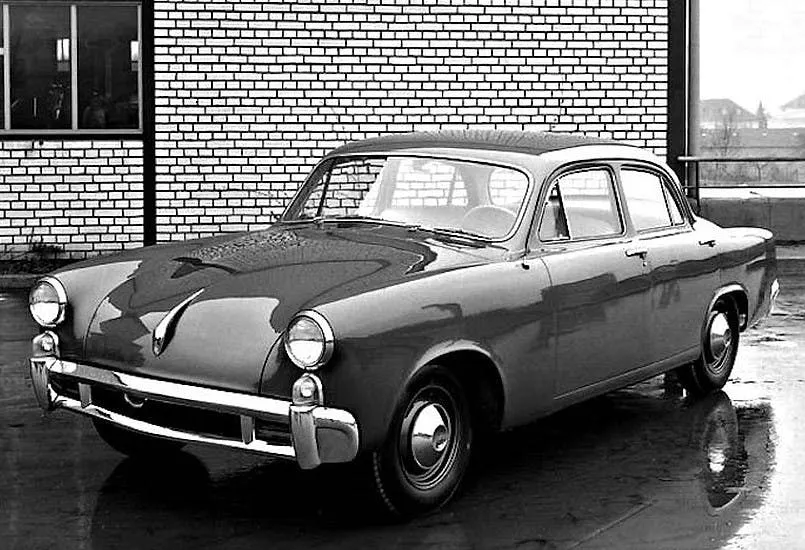
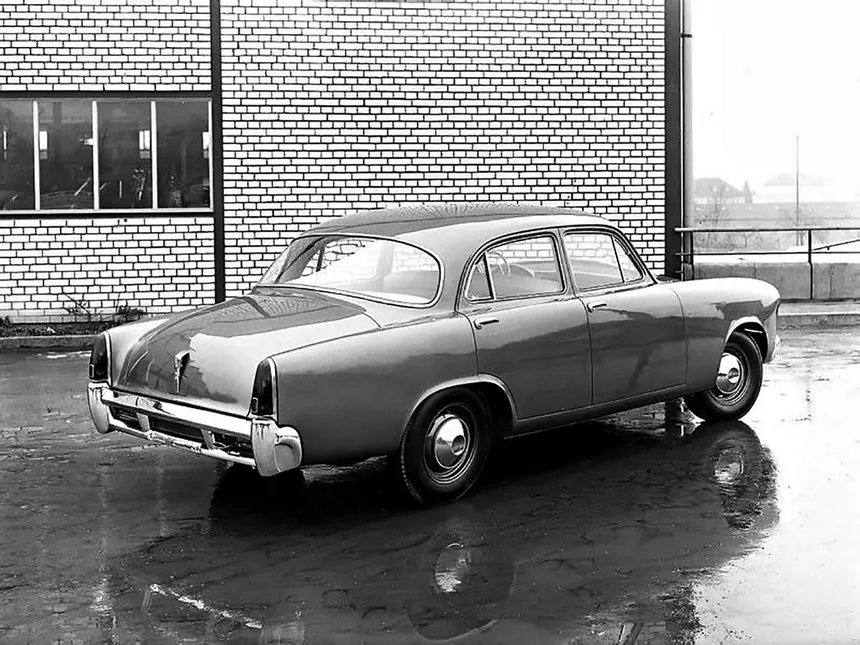
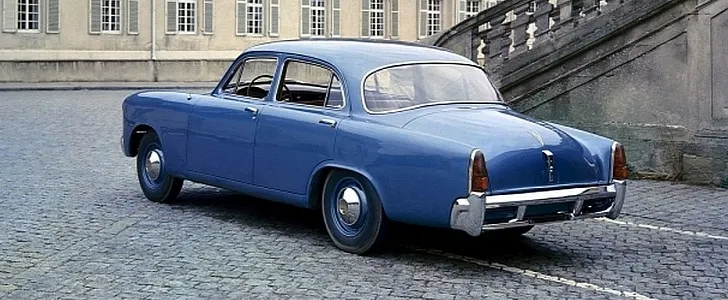
Back to the drawing board. What came out of it was Porsche’s Type 542, known inside Studebaker as the Z-87.
A 120-degree V6, before that was a thing
The engine is the best part of the whole affair. Porsche drew up a 186-cubic-inch V6 — about 3.0 liters — with a 120-degree included angle between the banks. Ludvigsen reckoned it may have been the first 120-degree V6 ever built. In 1952 the production V6 barely existed at all: Lancia’s Aurelia had introduced one in 1950 at 60 degrees, and that was the outlier of the entire industry.
The 120-degree layout wasn’t styling. A six-cylinder vee opened that wide gets evenly spaced firing intervals, which buys you inherent balance a narrow V6 can’t get without counterweights. The trade is a very wide block that’s a nightmare to package. Porsche took the balance and ate the width.
Cooling turned into its own argument. Porsche brought drawings and 1:5 scale models to South Bend in the fall of 1952 with a very Porsche solution: air-cooled cylinder heads, water-cooled cylinders, with a small radiator sitting inside the head’s own ductwork. The upside was real — liquid around the cylinders gave you a dependable heat source for the cabin, which air-cooled cars were always bad at. Studebaker approved the car but didn’t trust the hybrid, and ordered both pure versions developed as well.
That left the 542L, for Luft, and the 542W, for Wasser. The air-cooled engine made 98 hp at 3,700 rpm. The water-cooled made 106 at 3,500. Water won: more power, quieter, lighter. Fuel came through a single Stromberg carburetor on a six-armed manifold spanning that enormous vee, though at least one test engine ran dual carbs.
Context for those numbers: the 1952 Champion’s flathead straight-six was good for around 85 hp. The 542W made twenty more from half a liter less. On power, Porsche cleared the bar with room to spare.
The number nobody leads with: 550 pounds over
On weight, it didn’t.
The 542 came in 550 pounds heavier than target. Not 550 pounds over some internal estimate — 550 pounds heavier than a Champion, which is precisely the figure the contract said to come in under. Porsche didn’t miss by a hair. It missed completely, in the wrong direction, on the only requirement in the brief you could settle with a scale.
That reframes everything. For seventy years the 542 has been sold as the perfect victim: a brilliant car murdered by bad timing and American parochialism. There was bad timing, and there was parochialism. There was also a deliverable that didn’t meet spec. When your client asks for more power and less mass, and you hand back more power and a quarter ton, you’ve done half the job.
The car had genuine merit and it’s worth saying so. Four-wheel independent suspension, which was close to unheard of in a mainstream 1953 sedan when the American default was a live axle on leaf springs. And a removable front clip, designed to cut shipping cost and collision repair bills — that’s a manufacturer’s idea, not a dreamer’s.
Aluminum and unibodies: what South Bend couldn’t do
Ferry Porsche wanted an aluminum block. Studebaker said no. Not out of stubbornness — out of industrial incapacity. The South Bend operation, starved of capital for years, had neither the experience nor the tooling to cast aluminum blocks in volume. Aluminum pistons and heads were fine. The block came out in cast iron.
Same story with the body. Porsche proposed a unibody. Studebaker couldn’t build one, so the 542 was body-on-frame, the American way.
Those two refusals say more than any memo. Studebaker didn’t reject modern engineering because it didn’t understand it. It rejected modern engineering because it couldn’t afford the machinery that made it. That’s the difference between won’t and can’t, and by 1952 Studebaker was firmly on the can’t side.
Under the German suit, half the car was Indiana anyway: drum brakes, electrical system, steering, and transmissions came straight from Studebaker’s parts bins. That wasn’t Porsche cutting corners — it was the assignment. The car had to be buildable on the lines Studebaker already owned. That same good sense is part of what later made it look ordinary.
The DeLorean report, and why money wasn’t the whole story
The 542 was tested hard across Europe through 1954. Ferry Porsche took a finished prototype to Geneva that August — it was never actually shown at the salon — and drove it on to St. Moritz with Studebaker engineering VP Harold Churchill and chief engineer Klaus von Rücker along for the ride. Churchill, as Ludvigsen recorded it, thought the work was first-rate. Studebaker’s proving grounds director liked the car too.
Then the prototypes crossed the Atlantic and sat. The Packard merger closed on October 1, 1954, and the combined company went into survival mode: every future product would be a rework of an existing platform. A clean-sheet car with an exotic engine and independent suspension had no place in that.
Nobody looked at it seriously until 1956. And here’s where the romantic version needs dismantling, because by then Studebaker-Packard actually had some breathing room — selling the Packard plant in Detroit and the financial support and management agreements with Curtiss-Wright had eased the cash squeeze enough that a 542 launch was arguable, if the car had sold itself.
It didn’t. The report was signed off by John Z. DeLorean, head of advanced engineering, the same man who would later build a gullwing sports car and star in one of the industry’s loudest scandals. His objections were specific: too much vibration, cornering behavior he didn’t care for, styling he thought Americans wouldn’t buy, and a design that by 1956 simply looked old. Accounts agree his report carried a broad skepticism toward anything not engineered in America.
There’s no clean villain here. There’s a broke automaker that ordered a car, an engineering firm that delivered something impressive but out of spec, and a young engineer with a bias who signed the death warrant. All three own a piece of it.
Porsche took one more swing. Studebaker‘s own customer research was saying Americans wanted an American Volkswagen — rear-engine, air-cooled, two doors. Exactly what Ferry had proposed at the start. Porsche came back with the Type 633 on that recipe, and Studebaker couldn’t fund it. Four years later Chevrolet launched the Corvair on that layout and sold them by the trainload.
The money that unlocked the banks
On the payment: Hagerty puts it at roughly $500,000 in period dollars. Other accounts cite about two million Deutschmarks, which squares with the exchange rate of the day. Neither figure comes from a published Porsche account, so treat them as the widely accepted number rather than an audited one.
The factory itself is documented by Porsche. Werk 2 in Zuffenhausen, designed by Stuttgart architect Rolf Gutbrod, went up on land Reutter sold to Porsche and entered service in 1952, with an expansion already underway by 1954. Porsche built its first real assembly plant there, across the street from Reutter, and moved in during early 1953.
The link between the Studebaker money and that move rests on solid secondary sources rather than a company document: the contract is what made the move possible, and what changed the mind of banks that until then wouldn’t lend Porsche a mark. The distinction matters. Studebaker didn’t lay the bricks. Studebaker was the collateral.
Three more tries before the Panamera
You’ll read constantly that Porsche didn’t attempt a sedan again until the 2009 Panamera. That’s wrong twice over.
In the early eighties Porsche built a four-door 928 prototype. Then from 1988 to 1991 came the 989, the serious attempt: a clean-sheet front-engine, rear-drive platform on a 2,826 mm wheelbase, an all-aluminum 80-degree 3.6-liter V8 making better than 300 hp at 7,000 rpm and stretchable to 4.2 liters and around 344, styled by Harm Lagaay under Ulrich Bez. Development mules ran the 989 powertrain inside a Mercedes 300 CE body for cover.
Bez left Porsche in September 1991. With 928 sales collapsing, cost overruns out of control, and the company having its worst financial years in memory, the 989 stalled and was killed in January 1992. Porsche tried to sell that V8 to other manufacturers and found no takers. Its lines fed into the 993 and the 996.
Four doors in 1952. Four doors in the early eighties. Four doors in 1988. Then nothing until 2009. Porsche didn’t take fifty-seven years to have the idea. It took fifty-seven years to work up the nerve to sell it.
What each company has left
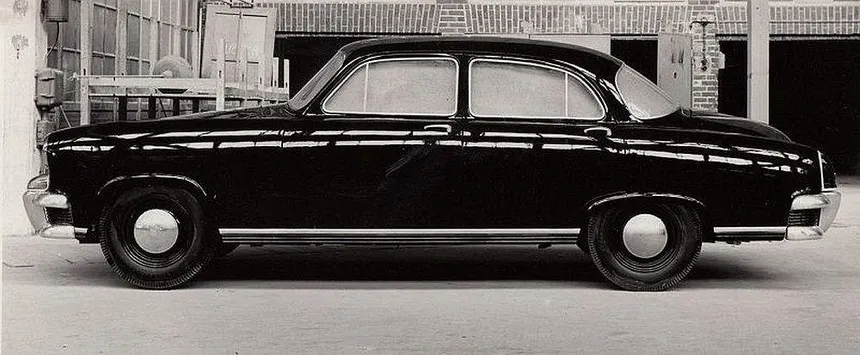
Nothing survives of the 542. The cars and the spare engines were scrapped in 1964, right after Studebaker stopped building cars in the United States. Photographs and project records exist; the car does not. Nobody is ever going to restore one.
The 989 prototype, on the other hand, is still here. Porsche said at first that it had been destroyed, then admitted it had been in storage all along.
That’s both companies in one sentence. Studebaker closed South Bend in 1963 and Hamilton in 1966, and all that’s left of its Porsche is a handful of photos. Porsche kept its own dead prototype under lock and key and rolls it out when the story suits. The survivor is the one with the archive.
What grates about this story isn’t the irony of the money. It’s the alibi. For seventy years we’ve told the 542 as though Studebaker were an enlightened victim surrounded by rubes, and it doesn’t hold. Studebaker turned down the Volkswagen factory for free, couldn’t fund the aluminum, couldn’t fund the unibody, couldn’t fund the Type 633, and when Curtiss-Wright finally bought it some air, said no all over again. Porsche, meanwhile, collected half a million for a car a quarter ton over spec and walked away with a factory. One of these two made a great deal, and it wasn’t the one that ordered the car. Still think Studebaker got robbed?
Check you’re still alive.