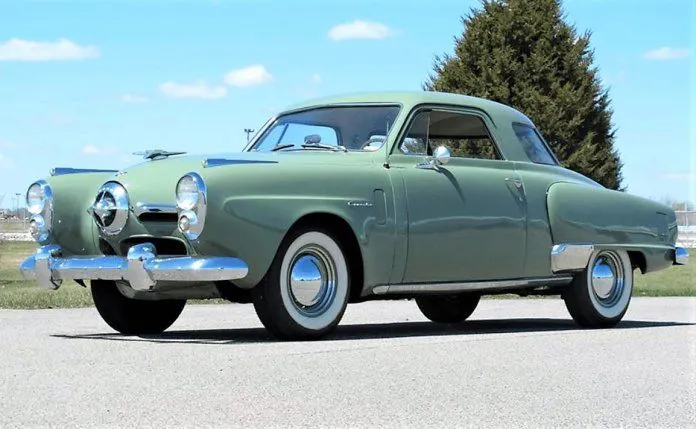
Studebaker: the last independent Detroit couldn’t let live
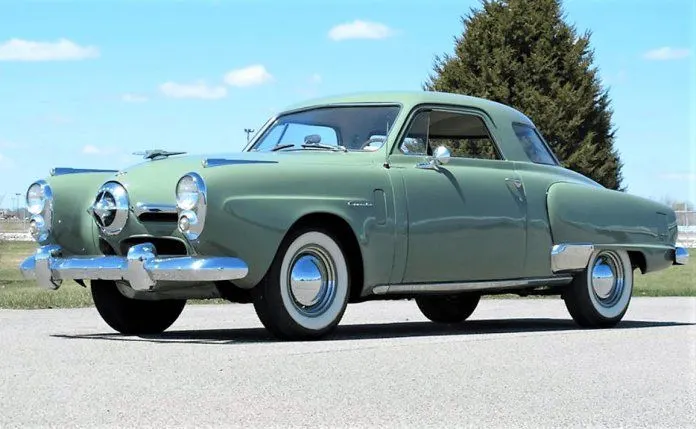
There’s a grove of 5,000 trees near South Bend, Indiana, planted back in 1937 so that from the air they spell out a single word: STUDEBAKER. You can still find it on Google Earth today. A whole automaker reduced to a piece of landscape gardening you have to look down from space to read. That’s about the size of what America lost when the last independent went under.
Because that’s what this story really is. Not the tale of a pretty coupe. The tale of the last real independent automaker slugging it out against GM, Ford and Chrysler — and the man who was hired to shut it down, and refused.
From Union Army wagons to a corner nobody could get out of
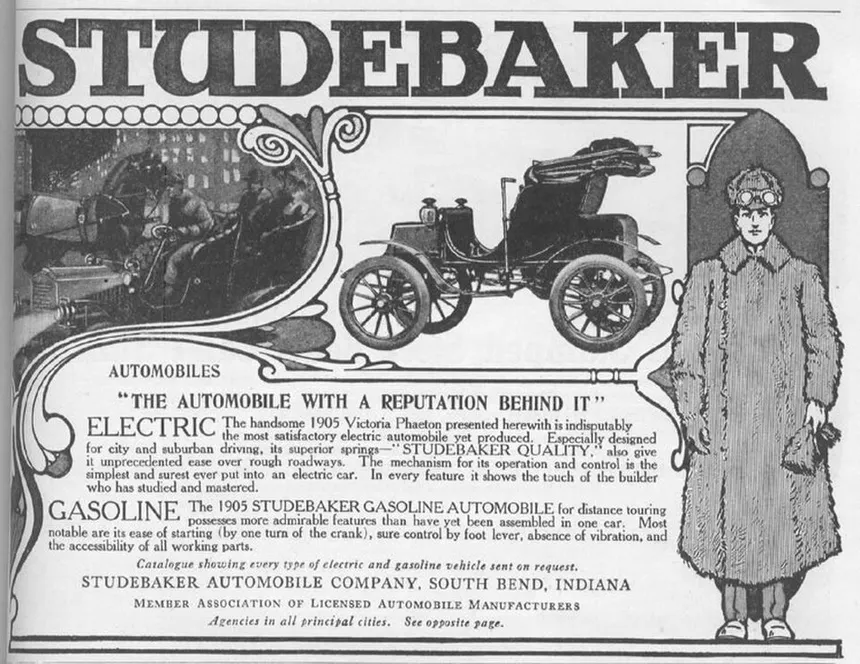
South Bend didn’t build cars first. It built wagons. Henry and Clement Studebaker opened a blacksmith shop in 1852, and when the Civil War came the Union Army bought their wagons by the thousand. By the end of the 1800s Studebaker was the largest maker of horse-drawn vehicles on the planet. When every other wagon builder froze at the sight of the automobile, Studebaker jumped: electrics in 1902, gasoline soon after. A hundred and fourteen years would pass between that first anvil and the last car. Hold onto that number.
Here’s the trap Studebaker was in, and it’s pure math. By the 1950s the American market belonged to three heavyweights: General Motors, Ford, Chrysler. The Big Three had something no independent could ever match — scale. They could spread the cost of a redesign across millions of units, undercut anybody smaller on price, and still book a profit. Studebaker built cars in a patchwork of 1920s-era factories, paid the highest labor costs in the entire industry, and spent more to build each car than Detroit did. A more expensive product for a customer who wanted to pay less. That equation doesn’t balance anywhere.
The 1954 merger with Packard was supposed to be the life raft. A UAW rep called it two drunks helping each other across the street. It didn’t bring financial muscle, it brought more debt. By 1962 the Packard name was dead and the company was plain Studebaker Corporation again.
Hired to kill it, fell in love instead
Enter Sherwood Egbert. Six-foot-four ex-Marine, came over from McCulloch — chainsaws and Paxton superchargers — with zero experience in the car business. And that was exactly the point. The board picked an outsider with no sentimental attachment to automobiles, someone who could execute the shutdown without flinching. The real mandate, spelled out in plain language: diversify, buy up profitable companies, absorb Studebaker’s $94 million in accumulated tax-loss credits, and get out of the car business with the lights off.
Egbert moved into the lodge at Studebaker’s proving grounds. Fell head over heels for the cars. And decided he wasn’t burying anything.
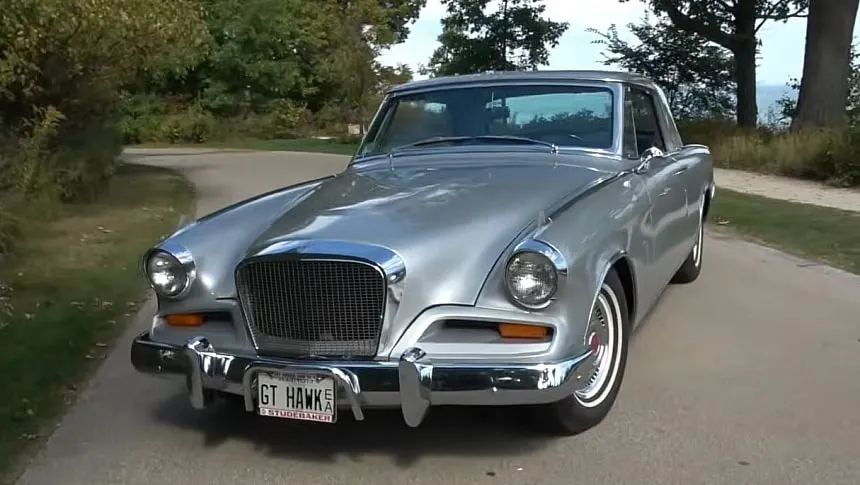
On a shoestring he brought in Milwaukee designer Brooks Stevens to freshen the ancient lineup. What Stevens pulled off with the Hawk was close to a magic trick. He took a body that dated back to the 1953 Starliner — a platform already reeking of mothballs — and reskinned it into a clean European grand tourer. The Gran Turismo Hawk. Thunderbird-style roofline, a grille winking at Mercedes-Benz (Studebaker distributed Mercedes in the States at the time), bucket seats, a modern dash. Hawk sales more than doubled over 1961. And one detail tells you everything about the state of things: the GT Hawk’s body was so clean, so stripped of chrome, that it cost $28 less per car to build than the old one. Saving twenty-eight bucks a unit was cause for celebration. That’s how tight the noose was.
Loewy, for the record, blew a gasket. When he first laid eyes on Stevens’ GT Hawk at the 1961 Paris show he ran to a phone to chew out South Bend — how dare they let someone else touch his 1953 Starliner, a car Fortune had named one of the hundred best designs of the modern era. Two enormous egos scrapping over the corpse of a nine-year-old platform. Very Studebaker.
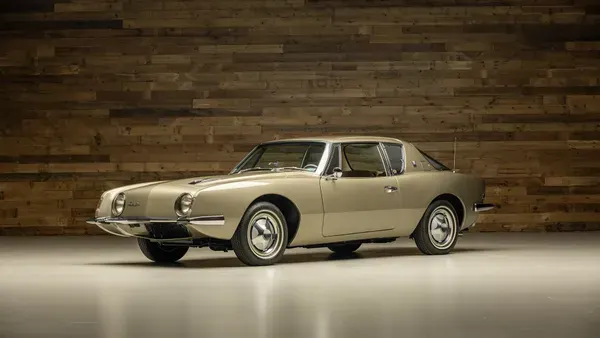
The Avanti: a rocket out of the desert in 40 days
But Egbert’s real play, the card meant to electrify the American buying public, was something else. A halo car. An impossible machine to turn every head on the street and drag people into showrooms. The same move that worked for GM with the ’53 Corvette and Ford with the Thunderbird.
He called Raymond Loewy. The father of American industrial design, the man behind the Shell logo, the Lucky Strike pack, JFK’s Air Force One livery, the Frenchman who’d landed in New York in 1919 with forty dollars in his pocket. Loewy took the job on one condition: he wouldn’t work in South Bend with executives breathing down his neck. He took his team — Bob Andrews, Tom Kellogg, John Ebstein — to a rented bungalow outside Palm Springs and locked the door.
Forty days later, out came the Avanti. Italian for “forward.” A low fiberglass body, long hood and short deck, no front grille — it breathed air from under the bumper, one of the first cars to do it — with a wasp waist pulled toward the tail like a supersonic jet. Underneath, a modified Lark convertible chassis and the Hawk’s 289 V8. With the optional Paxton supercharger (Paxton being, yes, another Studebaker division) the thing flew. A modified R3 Avanti cracked 170 mph at Bonneville and set 29 speed records. Dunlop-designed front disc brakes built under license by Bendix — the first American production car to offer them. A dash lit red at night. A spec sheet running ahead of half of Detroit.
The Avanti debuted at the New York show in April 1962 and stole the whole event. Orders poured in. Egbert wanted to move 20,000 a year.
He built 1,200.
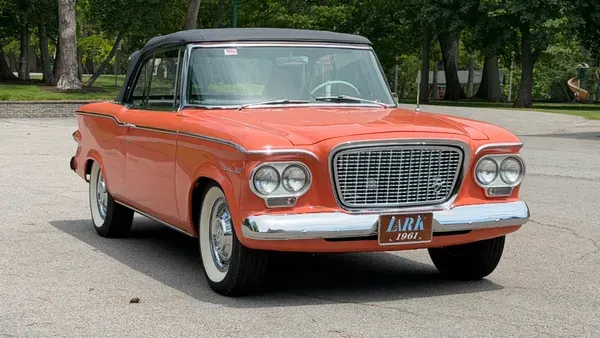
The desert sends its invoice
This is where fiberglass flipped from asset to curse. Body production was farmed out to Molded Fiberglass Body in Ashtabula, Ohio — the same outfit that molded Corvette panels — but when Studebaker’s quality inspectors showed up they were stunned to find no assembly jigs. The designers hadn’t accounted for fiberglass shrinking as it cured. Nothing fit. Rear windows had a nasty habit of popping out at speed. Panels didn’t line up. Delivery schedules collapsed. Those eager April orders cooled off month by month while the freshest design on the market sat gathering dust, waiting for a body that arrived square.
And here’s the part almost everyone gets backwards. The legend says the Avanti’s quality disaster sank Studebaker. That’s wrong. Upside down, at best.
The Avanti sank nothing. Studebaker was already at the bottom of the well when the Avanti was born. Look at the real numbers. The company’s breakeven point, per the Wall Street Journal of the day, sat around 120,000 units a year. In 1963 Studebaker built fewer than 84,000 cars total. The Hawk and Avanti combined came to roughly 8,500 — barely ten percent of production. The car that actually had to carry the company, the one paying the bills, was the Lark compact. And the Lark was losing altitude every year. Egbert compounded it by shoving the Lark up into the mid-size field, where its family body was too small and too old to fight a Dodge Dart.
The Avanti and the GT Hawk were fireworks launched off a ship already going down. Gorgeous. Spectacular. Useless for bailing water.
The board was right, and that’s the part that stings
By 1962, thanks to the acquisitions Egbert did make — an airline, refrigerators, tractors — car sales were down to just 55 percent of Studebaker’s revenue, from 74 percent two years earlier. Diversification was working. The board’s plan, the cold one, the one with no heart, the kill-the-lights plan, was the one that penciled out.
Egbert was diagnosed with cancer in 1962. The surgeries and long absences handed the board its excuse to ease him out. He resigned November 24, 1963. Exactly one month later, December 20, 1963, Studebaker shut South Bend. The last Larks and Hawks rolled off that day; the last Avanti, a high-output R3, a few days after. South Bend was the largest employer in St. Joseph County. Nearly a quarter of the workforce was Black. All of them, out on the street before Christmas.
Production limped up to the Canadian plant in Hamilton, Ontario, which had always turned a profit. For a stretch Studebaker was, officially, a Canadian automaker — the ads actually read “Canada’s Own Car.” The engines were now Chevrolet units bought from McKinnon. The survival target was 20,000 cars a year. They came close in 1965, then built just 8,947 in 1966 before folding. The final Studebaker, a Timberline Turquoise Cruiser four-door with a 283 V8, left Hamilton on March 17, 1966. It sits today in the Studebaker National Museum in South Bend.
What dies and what just changes its name
Careful here, because it’s easy to get lyrical. Studebaker the carmaker died in 1966. But Studebaker Corporation didn’t vanish — it merged with Wagner Electric, then Worthington, became Studebaker-Worthington and rolled on as an industrial company for years. The defense-products division ended up with Kaiser, then AMC, and it’s still alive under a name you might know: AM General, the folks who build the Humvee. The proving grounds with those 5,000 trees are still legible from orbit.
Physical death and paper death aren’t the same thing. The cars stopped. The brand went dark. But the corporate skeleton kept walking — transformed, absorbed, recycled. Exactly what the board had wanted from day one.
The Avanti, for its part, flat refused to die. A dealer named Nate Altman bought the name and rights and kept building it by hand in tiny batches on Chevy running gear. The Avanti II survived owner to owner — Blake, Kelly, Cafaro — deep into the 2000s. A handsome ghost of a company that no longer existed.
What Studebaker leaves behind
Here’s what gets under my skin about this one. Studebaker didn’t fall for building bad cars. The GT Hawk and the Avanti sit among the most beautiful shapes American industry ever produced. It fell because an independent, however clever, simply could not out-scale three giants playing a different game with a different deck. Egbert knew it. The board knew it. And still, a man hired to close a factory decided he’d rather go down swinging a fiberglass rocket than switch off the lights with a calculator in his hand.
Was he a fool? Mathematically, yes. The board was right down to the last decimal. But ask yourself this: out of everything Studebaker did across 114 years — the Union wagons, the electrics, the millions of honest compacts — what does anyone remember now? The Avanti. The impossible car a guy built in a desert bungalow in forty days, disobeying a direct order, knowing full well it probably wouldn’t matter.
Sometimes the thing the calculator calls a mistake is the only thing left standing when time swallows the rest.
Check you’re still alive.