Fiat 8V: the Italian V8 Fiat almost built by accident
In 1948, Vittorio Valletta calls Dante Giacosa into his office and hands him a brief that makes Giacosa frown: a six-cylinder engine for a large luxury saloon with which Fiat wants to take on Alfa Romeo in the Italian premium segment. The project code is Tipo 106.
Giacosa starts drawing. He designs the engine base. And somewhere in the process, instead of a V6, a V8 comes out. 70-degree bank angle instead of the usual 60 — a packaging question, to fit under the saloon’s low bonnet. Two litres of displacement. Alloy block. Overhead valves. A clean, modern engine with proper character.
And then Valletta cancels the saloon project.
The engine is orphaned. Fiat has a two-litre V8 with no car to put it in. Industrial IP sitting in a filing cabinet. And here’s where an Austrian engineer with an unusual name enters the story to rescue that V8 from oblivion and, in the process, create the one and only sports car Fiat ever designed with its own V8 engine.
Rudolf Hruska: the forgotten man
Rudolf Hruska is one of those engineers Italian historiography rarely credits, because he wasn’t Italian. Austrian, trained at Steyr, he had worked with Ferdinand Porsche on the KdF-Wagen. After the war, he moved to Italy. Fiat hired him as a consultant and posted him to SIATA (Società Italiana Auto Trasformazioni Accessori) in Turin. A small engine-tuning workshop inside the Fiat orbit without officially being Fiat.
When the saloon project dies, someone at Fiat — no one is quite sure who, probably Valletta himself with Giacosa’s nod — decides that the V8 shouldn’t gather dust. They hand it to Hruska with a very Fiat-of-the-period instruction: “build a car around it, in secret, without bothering the experimental department”. Translation: you do it, at SIATA, and if it works out, we’ll see.
Hruska mounts the engine in a new chassis. Independent suspension all round — Fiat almost never fitted independent rear on their production cars at the time, this was already a technical luxury. Alfin drum brakes on all four wheels (finned alloy drums for better heat dissipation). Semi-monocoque construction: body welded to chassis for stiffness. Final kerb weight: 997 kg.
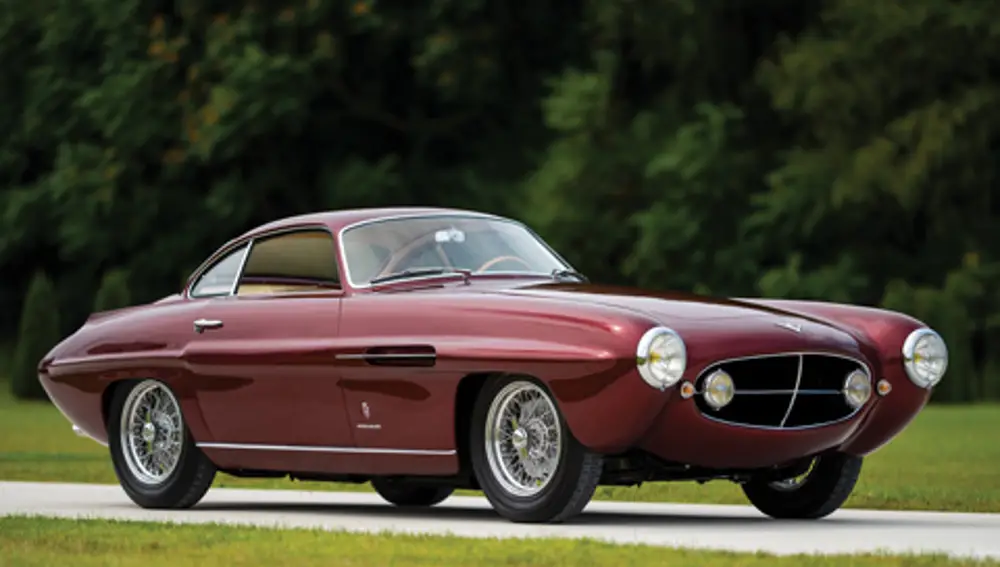
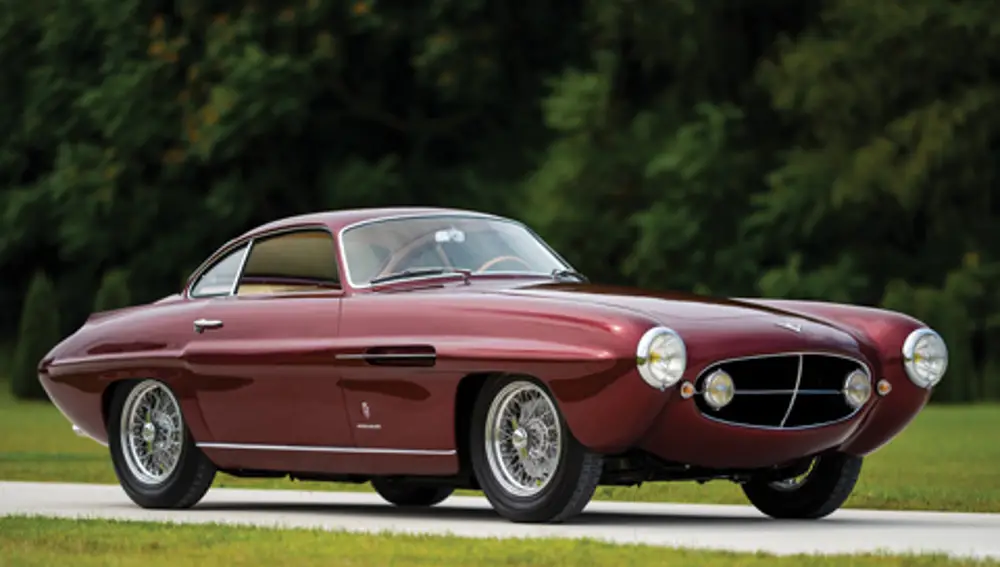
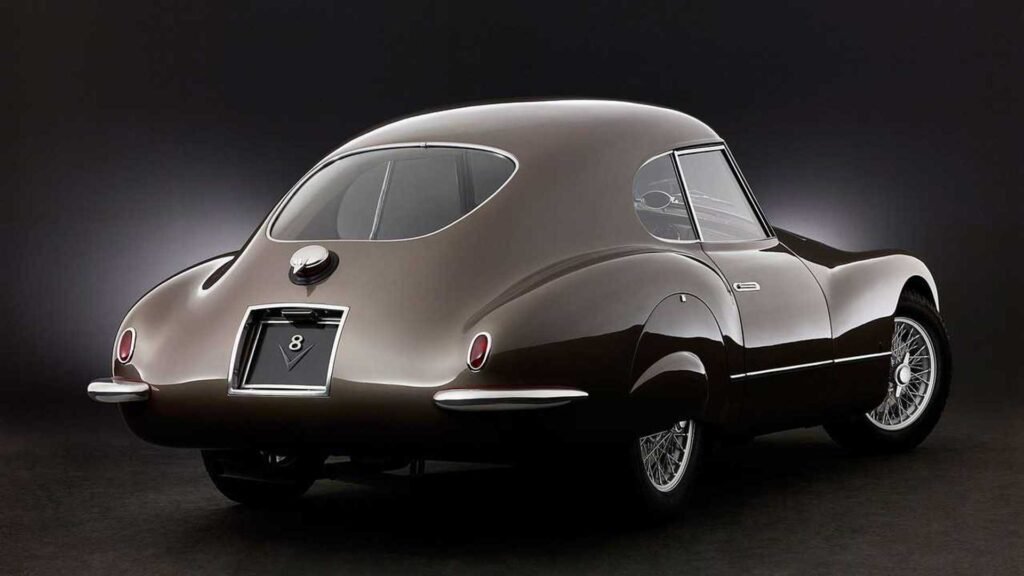
Fabio Luigi Rapi — formerly of Isotta Fraschini, then head of Fiat’s Carrozzeria Speciali — draws the body. A low, aerodynamic coupé with two round headlights sunk into the front grille on the first series. Nothing revolutionary about the line, but clean, elegant, unmistakably Italian.
Then comes the ridiculous naming story.
Why it isn’t called V8
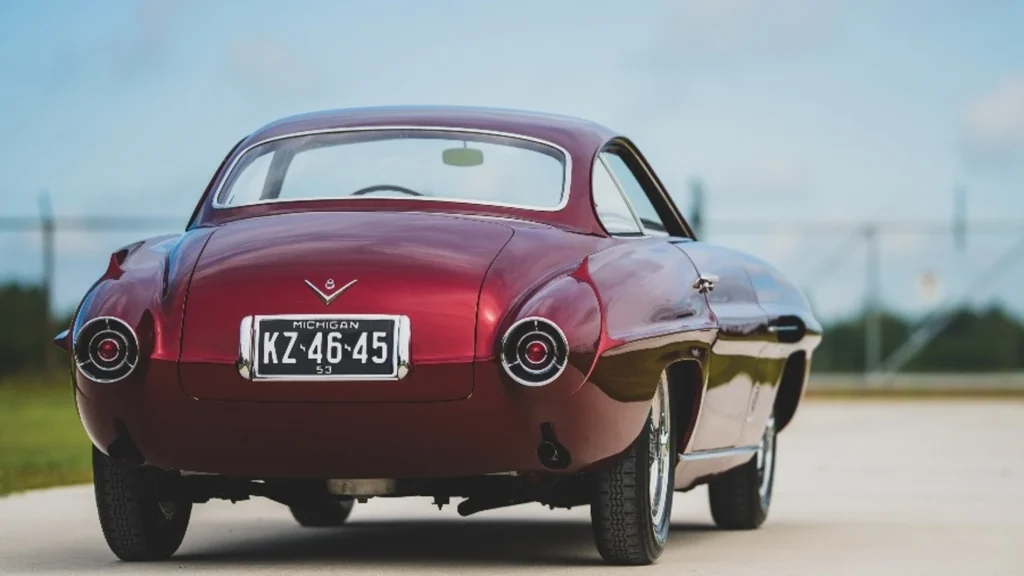
In 1952, as Fiat prepares to launch the car at the Geneva Motor Show, someone in the legal department raises a hand. Ford, they claim, has trademarked “V8” internationally in several jurisdictions. If Fiat launches something called V8, there could be a trademark problem.
Later verification would show Ford held no such trademark. It was a misunderstanding. But Fiat, cautious, doesn’t want to risk it. Boardroom solution: reverse the characters. Instead of V8, 8V.
That’s the name. Fiat 8V. “Otto Vù”, as Italians say it. The V8 Fiat sports car that’s named backwards because the legal team thought Ford held a copyright it didn’t hold. Italian engineering at its most Italian: a car name decided out of fear of a lawyer’s letter that would never have come.
Geneva, March 1952
Official reveal: Geneva Motor Show, March 1952. Fiat 8V with first-series Rapi body. Public reaction: surprise. Fiat was the small-car company. A two-litre V8 sports coupé didn’t fit what the market expected from the brand. Price: 2,850,000 lire. Context: a Fiat 1100 cost 1,100,000 lire. The 8V was nearly three times more expensive. It was, in 1952, the most expensive Fiat ever sold.
Performance: 105 hp at 5,600 rpm in standard trim, with twin twin-choke Weber 36 DCS carburettors. Top speed 190 km/h. With the upgraded 104.004 spec (revised cylinder head, higher compression, twin four-choke Webers), output rose to 125 hp. Some 8V Elaborata reached 127 hp.
Total built: 114 units between 1952 and 1954. Two and a half years of production. Of those 114, 64 wore official Fiat Carrozzeria Speciali bodies by Rapi — 34 first series (headlights sunk in the grille) and 30 second series (headlights integrated into the front wings, 1954 restyle). The remaining 50 units left the factory as rolling chassis and went to external coachbuilders.
And this is where the 8V gets genuinely interesting.
The car the others built
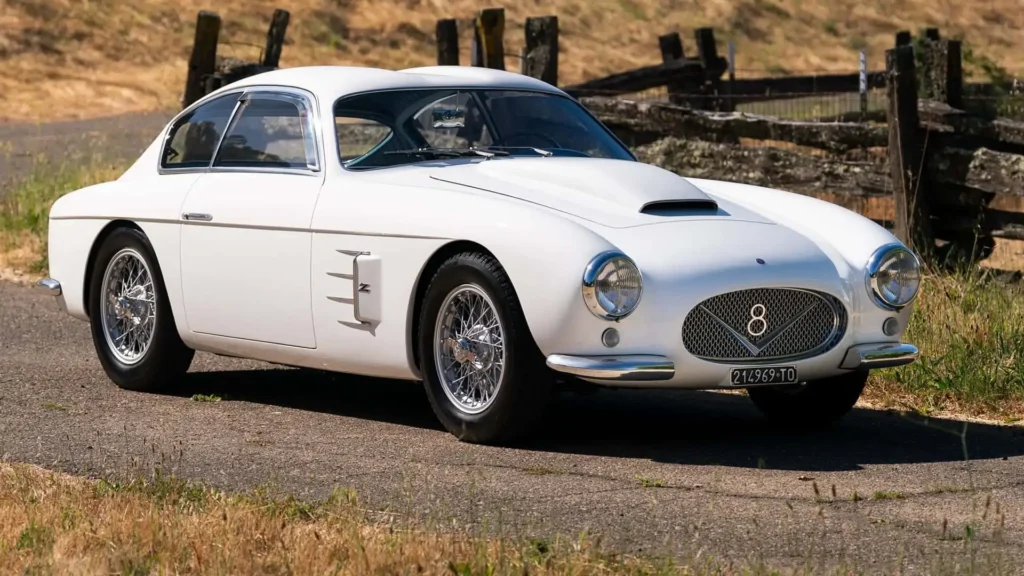
Of those 50 rolling chassis, out came the rarest and today most valuable 8Vs. A small club of Italian coachbuilders took turns with the platform:
Zagato built around 30 8Vs with proprietary bodywork. Elio Zagato, Ugo’s son, raced one personally in 1954. The Zagato treatment introduced on the 8V what would become the marque’s signature: the double-bubble roof — two bumps in the roofline to give helmet clearance for driver and passenger without raising the whole cabin height. That detail was born right here, on the 8V. It has since been copied on countless other cars (Aston Martin DB4 GT Zagato, Alfa Romeo TZ, and a long list of others).
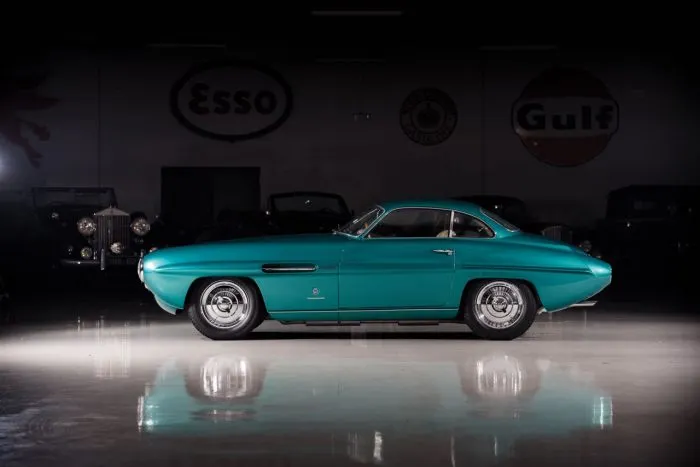
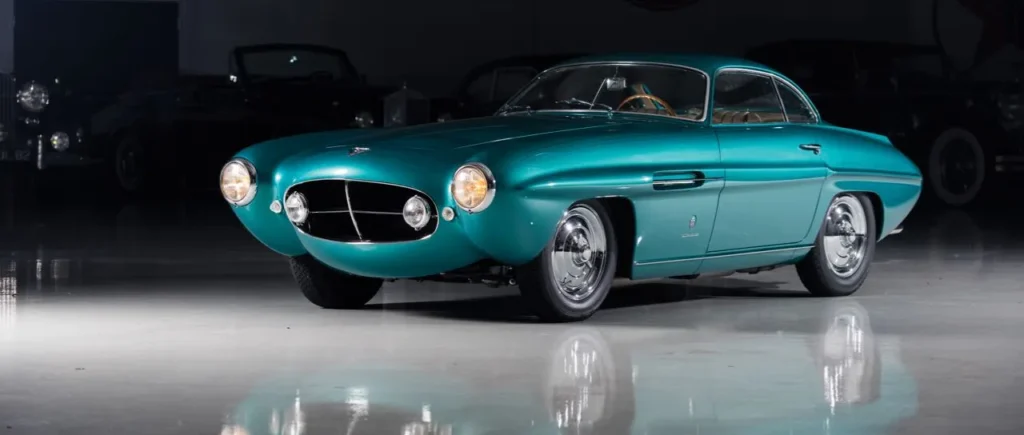
Ghia, with Giovanni Savonuzzi leading the design, built the most famous 8V of all: the Supersonic. Eight units on 8V chassis, plus other versions on Aston Martin and Jaguar bases. A car that looked like a jet fighter on wheels. One of those Supersonics sold at auction in 2015 for USD 1,815,000. Another has gone for close to two million. Savonuzzi’s Supersonic design is one of those rare cases in coachbuilding where the body designer becomes historically bigger than the chassis manufacturer.
Vignale, with Michelotti drawing, built a single 8V Cabriolet. One-off. Sold at auction in 2013 for EUR 1,120,000. Michelotti at the pen was a guarantee of cleaner, more bourgeois lines.
Pinin Farina delivered at least one unit as well.
And a fibreglass body, built in-house at Fiat as an experiment, weighing just 48 kg. One-off. Never went into production. But it’s arguably the first serious fibreglass-body experiment by a major European car maker — eight years before Chevrolet launched the Corvette C1 in fibreglass in 1953. Fiat was testing the material before almost anyone else. And then let it go.
On the track
The 8V was conceived from the start as a competition car sold to gentleman drivers. The results list in the Italian two-litre GT class is short but telling:
- Won the Italian GT Championship in the two-litre class in 1954, 1955, 1956, 1957, 1958 and 1959. Six consecutive years.
- Raced at Le Mans, at the Mille Miglia, at the Targa Florio.
- Was the car to beat in its category throughout the second half of the fifties.
At the 1954 Mille Miglia, an 8V Zagato driven by Ovidio Capelli (the Milan Fiat dealer who had commissioned Zagato’s first double-bubble body) finished ahead of several Ferrari 250 MMs and Maserati A6GCSs. A Fiat beating Ferraris in the Mille Miglia. In 1954. Read it twice.
Gas turbine: the odd footnote
In 1954, an 8V chassis is used as a test bed for something unusual: a gas turbine engine. Fiat was studying the possibility of turbine-powered cars — just as Rover in England was doing with the JET1 and Chrysler in America would with their later experiments. The 8V-turbine ran a few tests and then got archived. Nothing came of it. But the fact that Fiat was running that kind of experiment on the 8V platform in 1954 tells you something about the free-experimentation atmosphere around that car. It was the brand’s rolling laboratory. Nothing later at Fiat was ever that free again.
Why the 8V didn’t continue
Here comes the painful part. The 8V went out of production in 1954. Just two and a half years. 114 units. Why didn’t Fiat carry on with it?
The official answer: low sales. At almost triple the price of the Fiat 1100, finding 114 buyers over two and a half years in the Italy of 1952-54 was already respectable. Fiat wasn’t Ferrari — it didn’t have a commercial network geared to selling high-end GTs to European high society. Collectors of the era preferred a Ferrari with legend-grade emotion or an Alfa Romeo with sporting pedigree. A Fiat with a V8, however good technically, had a brand perception problem.
The real answer is duller: Fiat’s commercial management didn’t want to continue. Valletta and his team saw the industrial future in the 600 (launched 1955) and the 500 (arriving in 1957). An expensive sports car was a distraction. Engineering resources needed to go into the small cars that would motorise Italy. The 8V was a toy. And toys, in Valletta’s Fiat, didn’t last.
Giacosa relates this with a certain bitterness in his autobiography. He was the internal champion for the 8V. He wanted Fiat to keep developing sports cars with its own engines. He lost that fight, as he lost so many against the commercial side. Fiat wouldn’t build another sports car with its own engine until the Dino Coupé of 1966 — and the Dino didn’t even carry a Fiat engine, it carried a Ferrari V6 built under licence by Fiat. Twelve years of Fiat sporting silence with its own hardware.
Without the 8V, there’s no Dino. Without the Dino, there’s no 130 Coupé. Without the 130 Coupé, there’s no X1/9. The 8V’s list of indirect descendants is long. But the 8V itself got cut in bloom.
SIATA 208: the twin brother
There’s a final footnote well known inside Italy and almost nowhere else: SIATA, the workshop where Hruska developed the 8V, built its own version using the same Fiat V8. It was called the SIATA 208 S, and mechanically it was almost identical to the 8V but with Balbo or Bertone bodywork and a lower price. Around 50 units were built. They shared the engine with the 8V, and today serious collectors look for both.
It’s a rare case in the industry: two different cars sharing the same engine, built by two different companies that were actually working together. Official Fiat and unofficial SIATA. The upshot: two extremely rare sports cars, both commercially marginal, both today museum pieces.
What’s left of the 8V
Current prices: an 8V with official Rapi body auctions today between USD 400,000 and 800,000. An 8V Zagato Elaborata, between USD 1 and 1.5 million. An 8V Supersonic by Ghia, close to USD 2 million. The 8V Vignale Cabriolet, a good million-plus in euros.
Fiat built 114 cars in two years. Sixty-five years later, each one is worth what Fiat received in 1952 for eight hundred 1100s. The market takes a while, but it corrects.
An 8V Rapi sits in the Museo Nazionale dell’Automobile in Turin. Zagato 8Vs are in the Zagato collection at Terrazzano. Supersonics are in the Gooding collection and at the Petersen Museum in Los Angeles. At every major concours d’elegance in the world — Pebble Beach, Villa d’Este, Amelia Island — at least one 8V shows up each year. They win prizes. Judges get emotional. Nobody remembers anymore that Fiat wanted to call it V8 and couldn’t because of a legal misunderstanding.
The link Fiat broke
The 8V isn’t an industrial masterpiece like the 500. It didn’t motorise Italy. It didn’t invent an architecture copied by half the planet. It’s a rare car, built in small numbers, kept in collectors’ safes, admired at concours.
But it’s the only time Fiat, with its own engine, its own engineers, its own Italian coachbuilders, built a proper ground-up sports car. It’s the branch of the tree that Fiat cut voluntarily because it didn’t fit the industrial plan for small cars. And that decision — perfectly rational in 1954 from an accountant’s point of view — deprived all of us of a Fiat sports lineage running parallel to the Fiat popular lineage. There never was a Fiat Sport in its own range. There never was a factory rival to the Alfa Giulietta Sprint. Ferrari took the space for good, and Fiat resigned itself to being the small-car brand.
The 8V is the “what if” of Italian Fiat sports cars. The branch of the tree that got pruned before it grew.
And that’s why, among collectors, it’s so prized. Not just for rarity. For what it stands for: Fiat when it wanted to be a different Fiat.
And it never wanted to be again.
Check you’re still alive.