Humvee: The World-Beater Born From a Lamborghini That Almost Died
Here is a fact the U.S. Army would rather you forgot. The most recognisable military vehicle on Earth — the one that rolled across Iraqi sand live on CNN, the one Schwarzenegger turned into a driveway trophy — owes its existence to a borrowed blueprint, a lawsuit, and an Italian supercar maker that nearly went bankrupt building it. Before it was the Humvee, it was a Lamborghini. And the Lamborghini was a copy.
The Humvee did not arrive fully formed from some Pentagon brainwave. It crawled out of a decade of dead ends, lifted designs and industrial desperation that began in 1970. Pull on that thread and you eventually arrive at a half-million-dollar armoured Lamborghini Urus parked in a Beverly Hills garage. It is all one story. Let us tell it properly, because the truth beats the legend every time.
The forgotten grandfather: the FMC XR311
In 1970, FMC Corporation — a U.S. military supplier of amphibious and armoured vehicles since 1941 — built a prototype called the XR311. Low-slung, rear-engined, four-wheel drive, it was a fast attack 4×4 meant to do everything: scouting, convoy escort, TOW anti-tank missile carrier, military police, medevac. The Army bought roughly ten between 1970 and 1971 to assess them.
With its 187-horsepower V8 the XR311 ran 0–60 mph in about twelve seconds and topped 80 to 90 mph on tarmac. Quick numbers for a tactical vehicle of the era. The Army evaluated those handful of examples in a striking range of roles — scout and patrol duties, machine guns, automatic grenade launchers, recoilless rifles, TOW missiles, even the 30mm cannon then being developed for the AH-64 Apache gunship. A low, fast, lightly armed buggy that could be configured for almost anything. On paper, exactly what the brass said they wanted.
And yet they passed on a larger contract, and the XR311 was shelved after roughly a dozen examples. The vehicle itself barely matters. What matters is what happened next: someone decided that design deserved a second life, and didn’t bother asking permission.
Enter Lamborghini, exit dignity
By the mid-1970s Lamborghini was on its knees. The 1973 oil crisis had drained the coffers, Ferruccio had sold his controlling stake to Swiss industrialists René Leimer and Georges-Henri Rossetti, and the Sant’Agata factory was running far below capacity. The Italian government had stepped in with a loan to protect jobs. When you are drowning, any contract looks like a lifeline.
That lifeline came dressed as a Californian outfit called Mobility Technology International (MTI), run by one Rodney Pharis. MTI had been tasked with designing a new military off-roader and, rather than start from a clean sheet, lifted most of the design straight from FMC’s XR311. It needed an outside builder to develop and assemble the production versions, and it picked Lamborghini. A supercar maker building war machines — absurd on paper, but Sant’Agata needed the invoices.
The result was the Lamborghini Cheetah, unveiled at the Geneva Motor Show in March 1977. Working from blueprints shipped over from the States, the Italians built a fibreglass body over a reinforced tubular steel cage, with fully independent suspension — double wishbones up front, multi-link at the rear — torsion bars and ventilated disc brakes. At the back sat a waterproofed 5.9-litre Chrysler V8 mated to a three-speed automatic, with room for a driver and three fully kitted soldiers.
It looked the part. It drove like a disaster. That rear-mounted engine gave the two-tonne machine dreadful weight distribution and twitchy handling, and 180 bhp was laughably little for the mass it had to haul. Worse still, the resemblance to the XR311 was so blatant that FMC sued MTI and Lamborghini for intellectual property infringement the moment it appeared in Geneva. It later emerged that several ex-FMC engineers had worked on the Cheetah for MTI. The plagiarism wrote its own punchline.
The Cheetah programme also swallowed much of the money Lamborghini had earmarked for the BMW M1 it had been contracted to develop. Fed up with the delays, BMW reclaimed the M1 in April 1978. That October, Automobili Lamborghini filed for bankruptcy. The Cheetah won no contract at all — it nearly buried the company that built it.
Teledyne, then AM General: the real deal
MTI flogged the Cheetah project to Teledyne Continental Motors, which built three more prototypes, moved the engine to the front to fix the balance, and tried a string of diesels. No buyer materialised, in the U.S. or the Middle East. But the rights to the XR311 lineage eventually landed with AM General, a subsidiary of American Motors Corporation — and from there the Humvee would emerge. The whole chain — XR311, Cheetah, Teledyne — was the conceptual test bed for what came next.
In 1979 the U.S. Army drafted final specifications for a High Mobility Multipurpose Wheeled Vehicle, the HMMWV, to replace the M151 jeep, the M561 Gama Goat and the entire light fleet in the quarter-tonne to 1.25-tonne band. One jack-of-all-trades: ambulance, missile carrier, troop transport, weapons platform. Sixty-one companies expressed interest. When the prototype deadline hit, only three delivered: Chrysler Defense, Teledyne Continental and AM General.
AM General began preliminary design of the M998 in July 1979 and had a prototype running in under a year. The three finalists built eleven prototypes that were flogged across rocky hills, deep sand, five-foot water crossings, desert heat and Arctic snow over hundreds of thousands of miles. In 1981 the Army awarded AM General a contract for more prototypes, and in 1983 the big one landed: 55,000 vehicles, 39,000 for the Army and the rest split between the Navy, Marines and Air Force. The first production contract was worth $1.2 billion.
Why the HMMWV worked where the Cheetah flopped
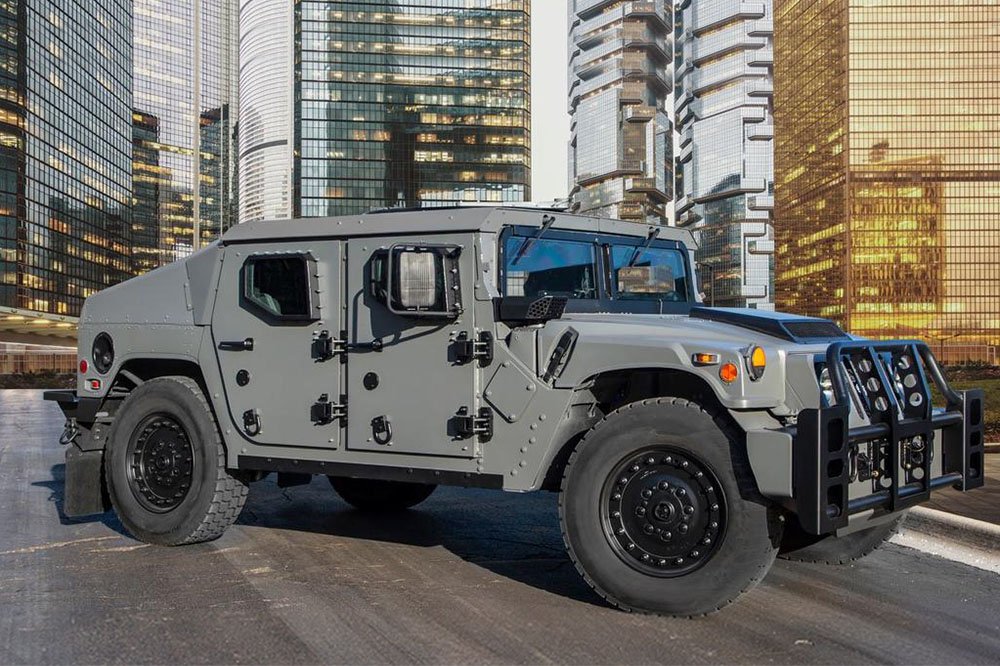
The gulf between Lamborghini’s toy and AM General’s HMMWV comes down to philosophy. The Cheetah was an auto-show prop with its engine in the wrong place. The HMMWV was engineered to survive the abuse of war.
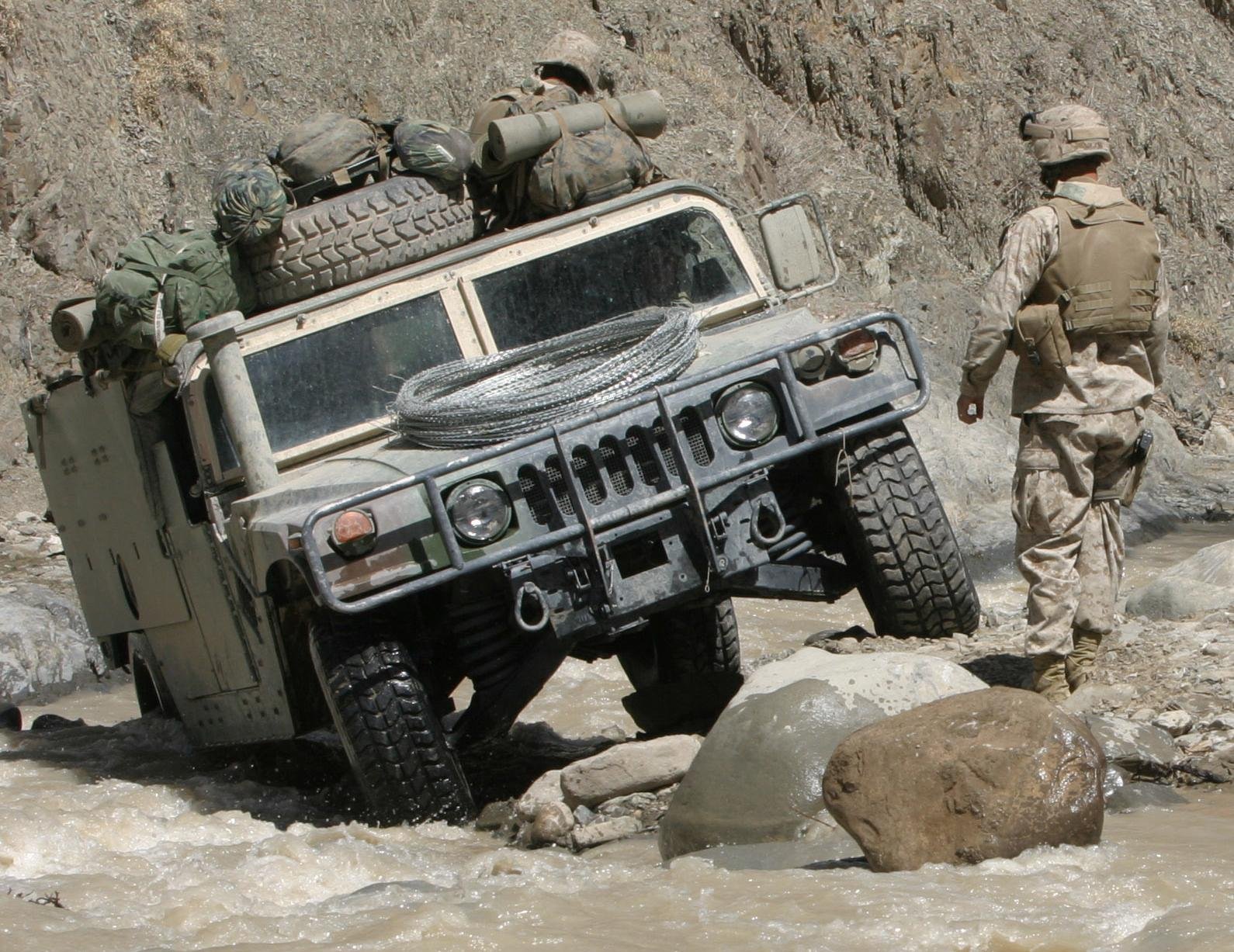
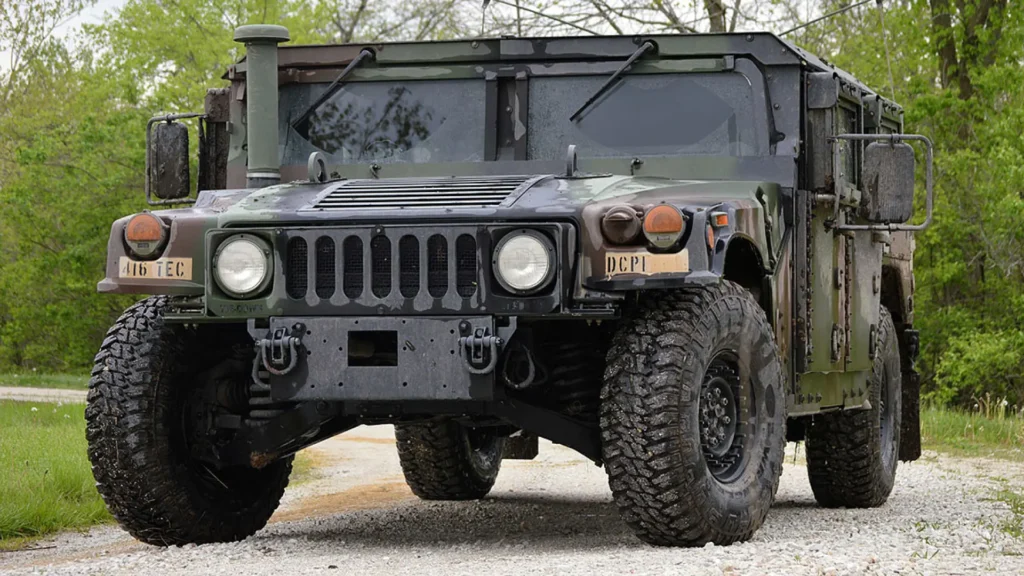
The stock Humvee runs permanent four-wheel drive, independent suspension, 16 inches of ground clearance — double most SUVs — and a 72-inch track that hands it enormous stability. It climbs 60 percent grades, holds a 40 percent side slope and fords five feet of water. The original M998 weighed about 5,200 lb empty with a 2,500 lb payload, powered by a 6.2-litre V8 diesel and three-speed auto. None of those numbers dazzle. The point was that a field mechanic could fix it, and the same base could carry an ambulance body, a TOW launcher or a .50-cal on the roof ring.
Modularity was everything. Swap the configuration, keep the base — so logistics and maintenance stayed sane. There was more to it than that, too. The Humvee was built to be air-transportable, air-droppable and sling-loaded beneath helicopters; a C-130 Hercules swallows three, a C-5 Galaxy fifteen. A stuck Humvee could be recovered by a tow bar from another in the convoy or self-recover with its own winch, so a unit didn’t need dedicated recovery assets trailing behind it. That was the lesson the Cheetah never learned, and the one Spain’s VAMTAC, developed fifteen years later on the same concept, would refine in its own way. The Humvee saw combat in 1989 during the invasion of Panama, but its coronation came in the 1991 Gulf War, beamed into living rooms worldwide. By its tenth anniversary in 1995, 100,000 had been built. More than fifty nations operate it today.
Hitting the street: the icon of excess is born
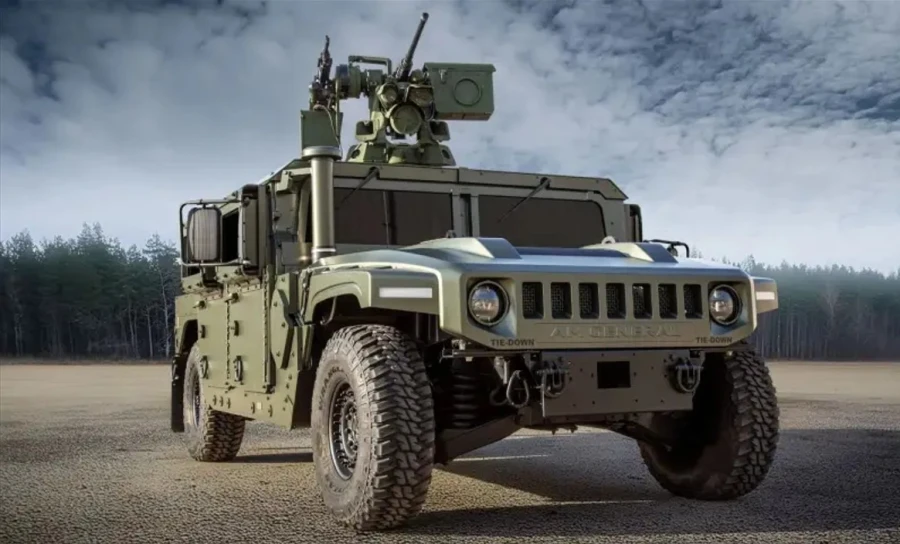
Those Desert Storm images created demand nobody had planned for. People wanted one. And one man pushed hard: Arnold Schwarzenegger lobbied AM General to build a civilian version and bought the first two sold to the public. In 1992 the civilian Hummer was born.
It was a behemoth. A 6.5-litre turbo-diesel V8 making 205 bhp, 16 inches of clearance, optional locking diffs, a 12,000 lb winch. Expensive, slow, crudely built by road-car standards and weirdly cramped inside for something so vast. None of it mattered. The Hummer became a status symbol, somehow bridging the gap between war zones and rap videos. Mike Tyson owned eight. Tupac bought a custom black one a month before he died. Chris Harris would later sneer at what it represented; the buyers never cared.
In 1999 General Motors bought the Hummer marque. The original became the H1, and GM expanded the range: the H2 in 2002, riding on Chevrolet Tahoe architecture and built by AM General; the H3 in 2006, designed and built entirely by GM on Chevrolet Colorado underpinnings — the pocket Hummer. The brand exploded. Fewer than 12,000 H1s sold across fifteen years, but the H2 managed over 153,000 and the H3 nearly 159,000.
The fall: petrol, shame and recession
The success came with an expiry date. The Hummer became the favourite punchbag of environmentalists, the mirror held up to America’s appetite for waste. The Sierra Club ran an entire website mocking it — Hummerdinger — and its director delivered the line that defined the moment: it’s one thing if it’s carrying soldiers to a fight, quite another if it’s hauling lattes home from Starbucks. The diesel H1 managed around 16 mpg; the H2 hovered near 10 to 12. Both weighed over 8,500 lb gross — heavy enough to dodge fuel-economy disclosure entirely.
GM announced the end of the H1 in May 2006. The official reason was new diesel emissions rules taking effect in 2007, not pump prices, though sales had collapsed to a few hundred a year. In its final year every H1 left as an Alpha, re-engineered with the 6.6-litre Duramax and five-speed Allison auto: 300 bhp and 520 lb-ft, the truck the H1 should always have been — finished off the moment it finally got good.
Then came 2008. Petrol spiked, the Great Recession dragged GM into bankruptcy, and the restructuring axed Pontiac, Saab and, inevitably, Hummer. A 2009 attempt to sell the brand to China’s Tengzhong collapsed in 2010 when Chinese regulators withheld approval. The marque went dark. The symbol of excess died of excess.
The circle closes
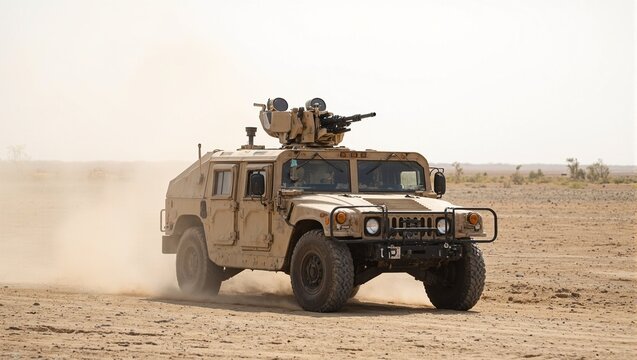
While the civilian Hummer expired, the military Humvee soldiered on. Today the U.S. Army is gradually retiring it in favour of the Oshkosh JLTV, winner of the Joint Light Tactical Vehicle programme — more protection, more armour, smarter suspension. But that is a separate story, and it deserves its own telling.
One detail ties the whole thing together. That catastrophic Cheetah, the one that nearly killed Lamborghini, was not forgotten. When new owners reviewed the company in the early 1980s, they decided the idea was sound — only the execution had been wrong. Out came the LM001, then the front-engined LMA002, and finally the production LM002 in 1986, with the Countach’s V12 stuffed up its nose. The Rambo Lambo. And the LM002 is the conceptual grandfather of the Lamborghini Urus, Sant’Agata’s best-selling vehicle ever, the same machine tuners like Rezvani now armour into half-million-dollar monsters.
From the stolen XR311 to the Cheetah, from the Cheetah to the Humvee, from the Humvee to the fallen icon — and from the Cheetah to the Urus. The entire circle, nearly half a century of it, growing from one blueprint that passed through Sant’Agata and came home as a lawsuit. Next time you see a Humvee, remember its family tree has an Italian branch nobody wants to claim.
Check you’re still alive.
1 thought on “HUMVEE”