
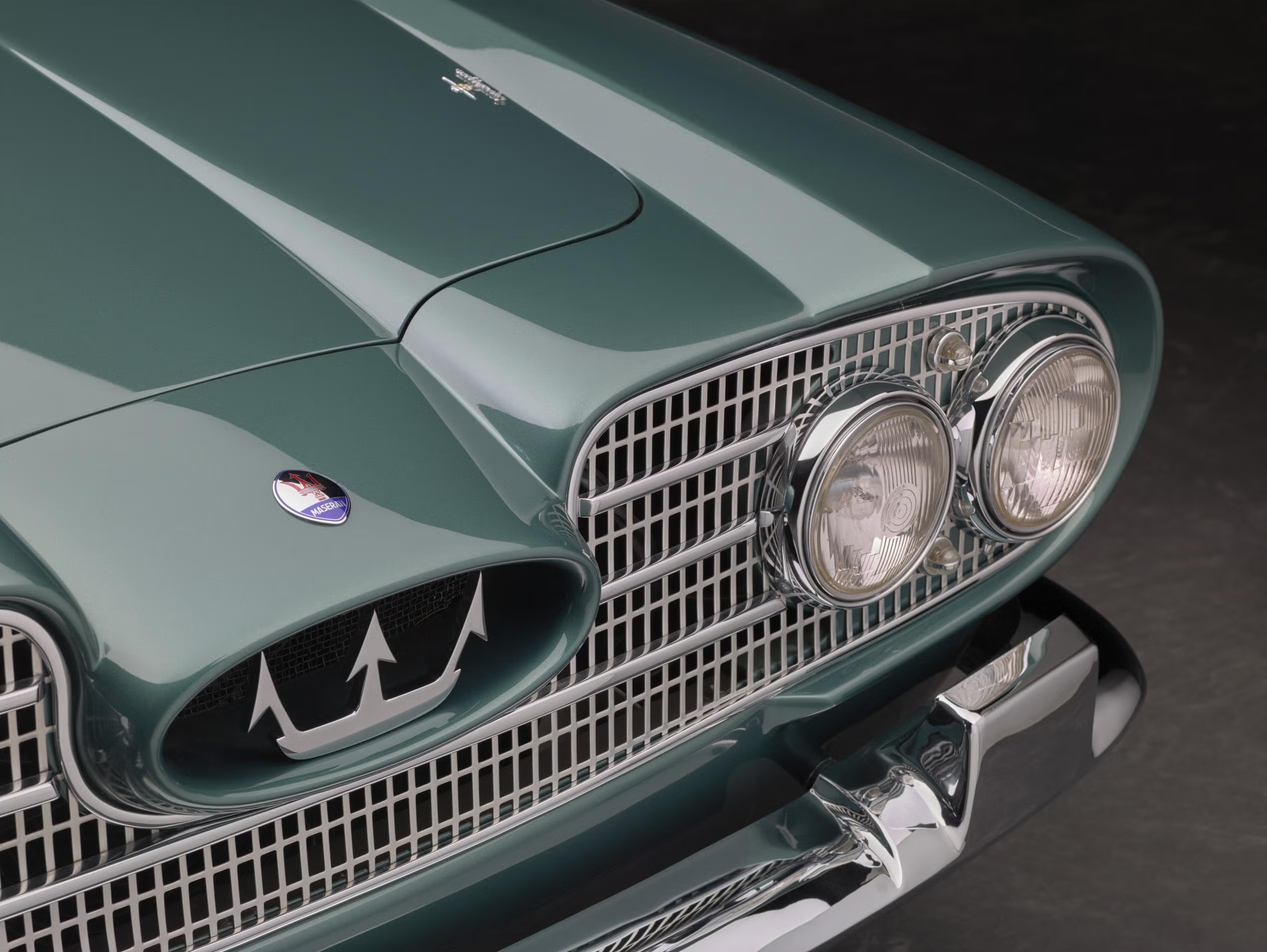
Maserati 5000 GT: The Supercar a King Paid For Because Maserati Couldn’t
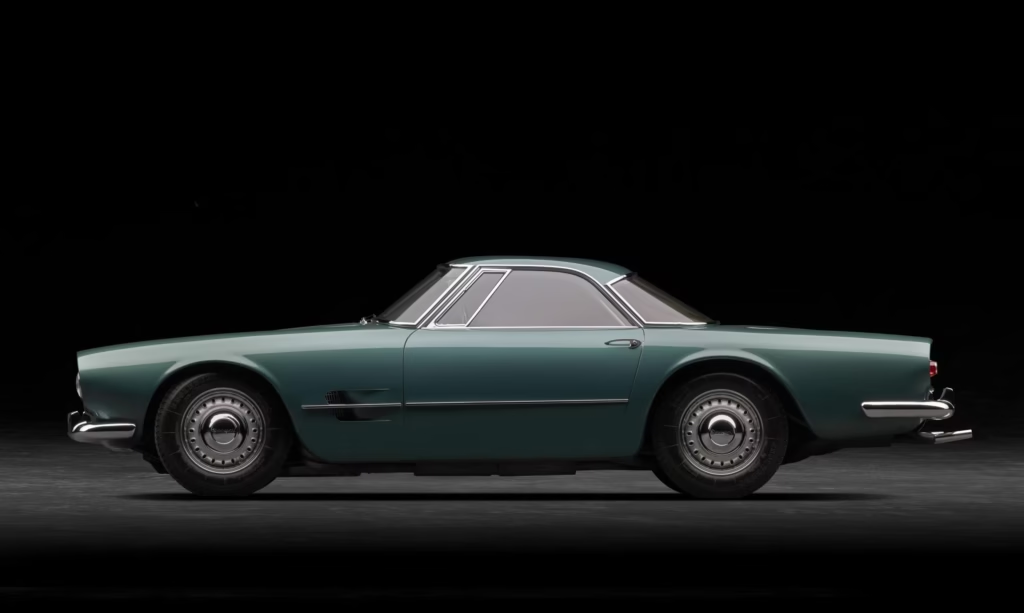
In January 1962, Sports Car Graphic ran a road test that should have made the Maserati 5000 GT a household name in America. Bernard Cahier had been handed a one-off Ghia-bodied car before its owner took delivery, and he came back describing acceleration he had only ever felt in racing cars.
The car never became a household name. Thirty-four were built. Most Americans have never seen one move.
What almost nobody knows on this side of the Atlantic is why it exists at all: the Shah of Iran paid for its development because Maserati was broke and couldn’t. This is not a colorful embellishment. It is the documented origin of the model.
A mailing list, an embassy, and a Sunday in November
By the late 1950s, Maserati had pulled out of factory racing not out of strategy but out of insolvency. Argentina had defaulted on a $3 million machine-tool order, Spain had defaulted on a smaller one, and in April 1958 the state-owned Credito Italiano had petitioned to have Adolfo Orsi declared bankrupt over a bounced check for $15,600.
Omer Orsi, Adolfo’s son, was trying to move metal the low-tech way: mailing brochures for the 3500 GT and the 450S racer to wealthy and titled prospects. One of those envelopes reached Mohammad Reza Pahlavi.
Not long after, the Iranian embassy in Rome was instructed to call Modena and set a meeting. On a Sunday in November 1958, the Shah asked engineer Giulio Alfieri and Orsi for a road car built around the 450S — and offered to fund the development and build costs himself.
Read that again in American terms. A foreign head of state effectively wrote the R&D budget for a bankrupt Italian manufacturer, and got a two-seater out of it. The performance target attached to the commission, per Mick Walsh’s account in Classic & Sports Car, was a guaranteed 280 km/h — 174 mph. In 1958.
Sebring’s V8, detuned just enough
The engine is the whole point, and it has an American connection built in. The 450S had scored a famous 1-2 for Maserati at the 12 Hours of Sebring in 1957, and it is that four-cam, all-alloy V8 that Alfieri lifted into the road car.
The concessions to street use were minimal: displacement went up to 4,937 cc and the compression ratio came down to 8.5:1. Everything that made it a race engine stayed — the gear-train camshaft drive, twin Marelli distributors, sixteen spark plugs, four twin-choke Weber 45s.
Underneath, though, it was still a 3500 GT. Independent front suspension, a live rear axle, power-assisted Girling discs up front and big drums at the back, with the chassis substantially reinforced to cope. Compare that to what Detroit was doing with big-inch V8s in the same window and the picture gets sharper: Maserati was putting a Sebring-winning engine into a chassis conceived for 220 hp, then bracing it.
There’s a giveaway detail. Because the V8 weighed so much more than the straight-six, Maserati altered the steering box ratios to lighten the wheel. German specialist Robertino Wild, who rebuilt chassis 042 after sorting two 450S racers, is blunt that the result isn’t direct enough for the car’s performance. They made the steering easier and, doing it, insulated the driver from the road in the one car that needed the feedback most.
Bertone was first choice, and lost the job
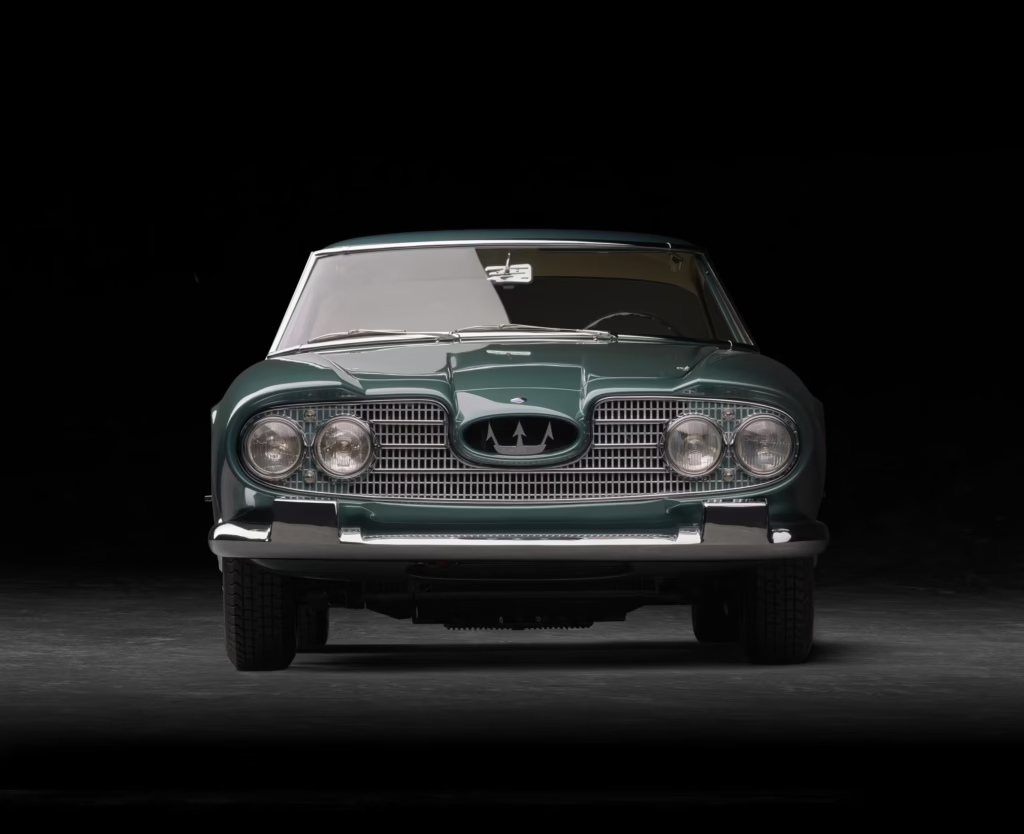
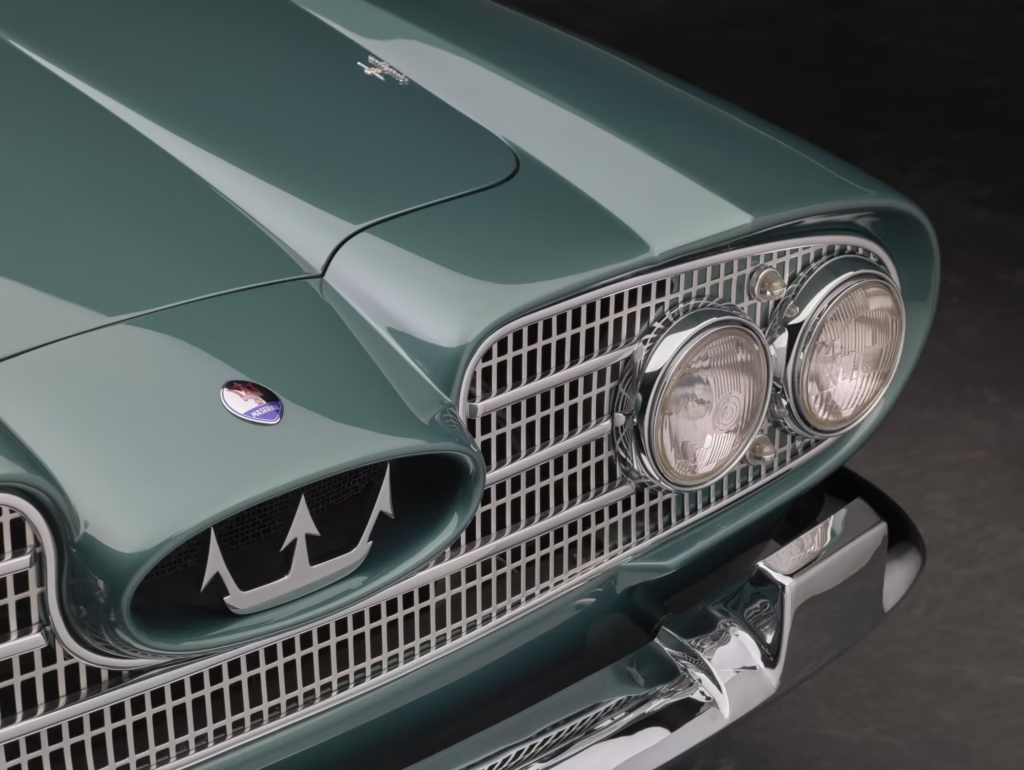
Bertone was originally picked for the bodywork. Orsi handed the contract to Carrozzeria Touring instead, with one instruction: it had to look nothing like the 3500 GT.
Touring’s Carlo Felice Bianchi Anderloni later explained that he drew on Persian baroque architecture for the grille and its oversized trident. The theme carried inside, where the dials and switches were gold-plated.
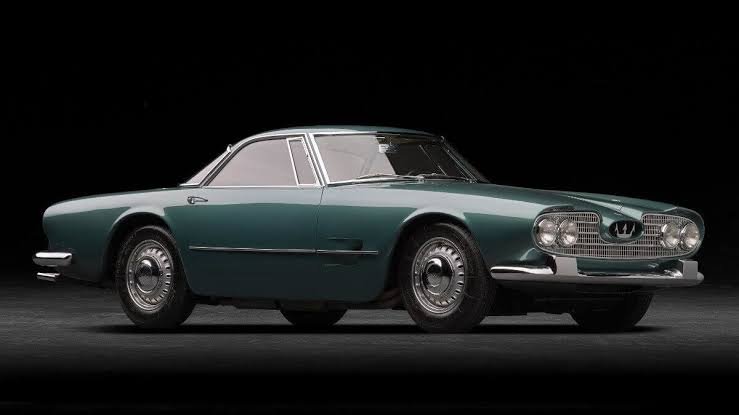
The finished car went straight to the Shah’s garage in Iran with almost no public exposure. A second Touring coupe was shown at the Turin Motor Show in 1959 and bought by South African millionaire Basil Read, who owned the Kyalami circuit.
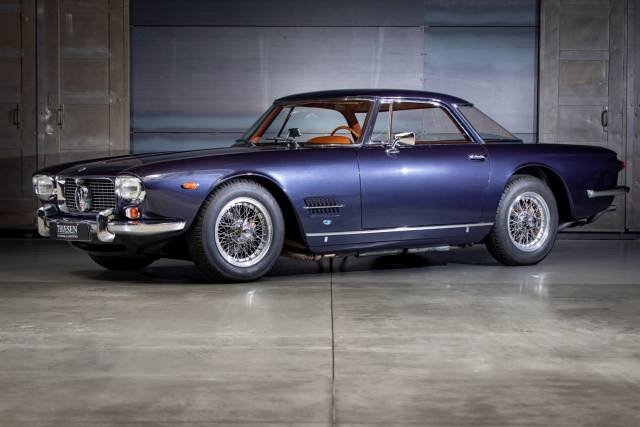
After those, Carrozzeria Allemano became the main body supplier with 22 cars to a Giovanni Michelotti design. Frua built three, Monterosa two, and Pininfarina, Ghia and Bertone one each. Eight coachbuilders, thirty-four cars. There is no such thing as a standard 5000 GT.
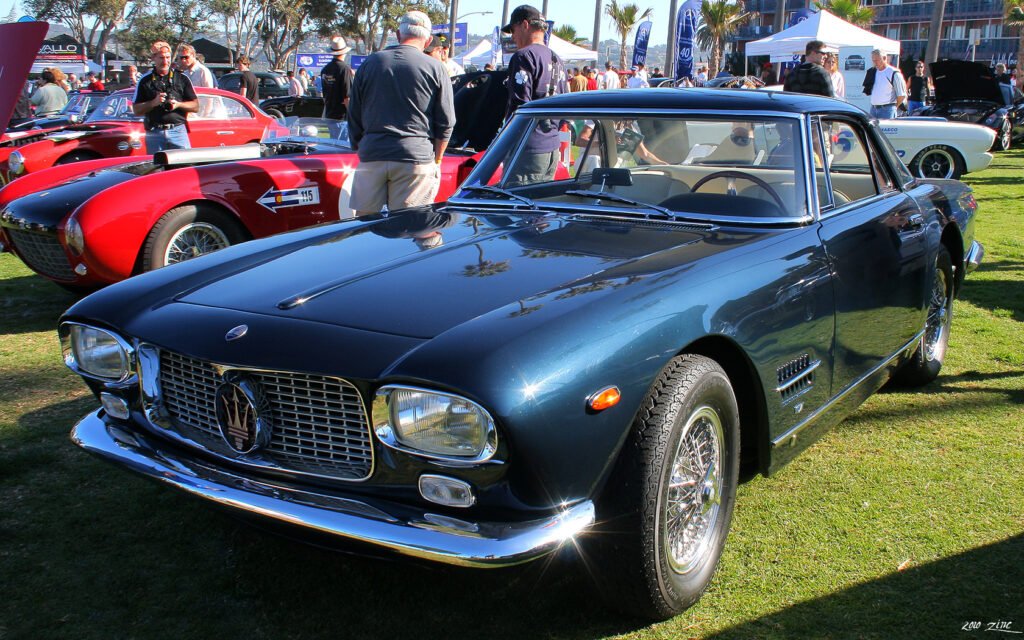
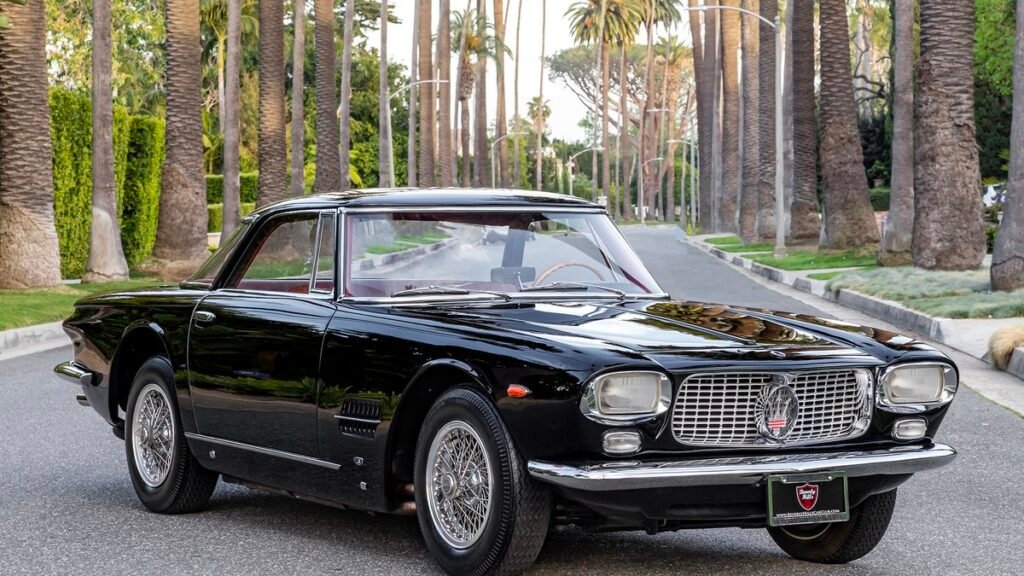
The Allemano cars are the ones Americans are most likely to encounter, and there’s a Detroit fingerprint on them: the steeply raked panoramic rear window is straight out of the Studebaker playbook of the period.
The American owners
Briggs Cunningham took chassis 103.016 — bodied by Michelotti with hidden headlights, one of the strangest of the whole run. Cunningham had won the America’s Cup, had run his own cars at Le Mans in the early 1950s, and at the time was campaigning Maserati’s mid-engined Tipo 63 and front-engined Tipo 151. He was, in other words, precisely the customer this car needed and almost never got: someone with the crew to keep it running.
Joe Walsh owned Allemano-bodied 103.026. He later wrote a song whose most-quoted line credits his Maserati with a top speed the car could not reach, which did more for the model’s mythology in the United States than any advertisement Maserati ever placed.
The rest of the register reads like a passenger list: the Aga Khan, Gianni Agnelli, Lambretta founder Ferdinando Innocenti, actor Stewart Granger, King Saud of Saudi Arabia, Mexican president Adolfo López Mateos, Swiss businessman Otto Nef, Count Giuseppe Comola.
The price was around $17,000, roughly double a 3500 GT, and Maserati wouldn’t start a car without a substantial deposit. For context, a Ferrari 250 GTE would set an American buyer back a fraction of that, and Cadillac’s most expensive 1962 offering didn’t come close.
The Ghia car that vanished into Saudi Arabia
Chassis 103.018 is the single best story in the run.
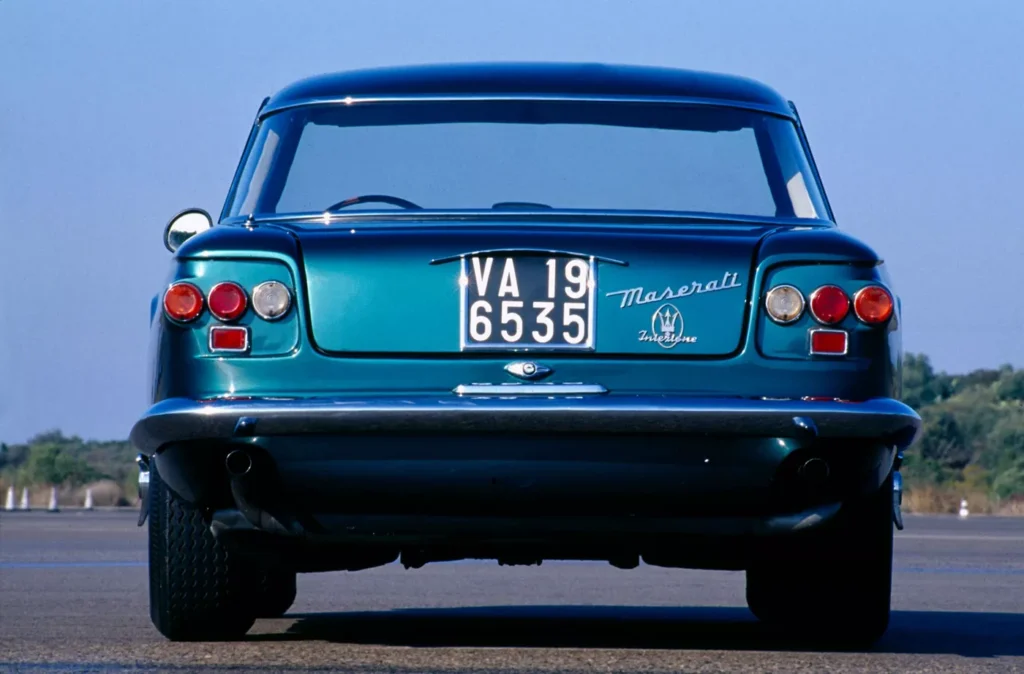
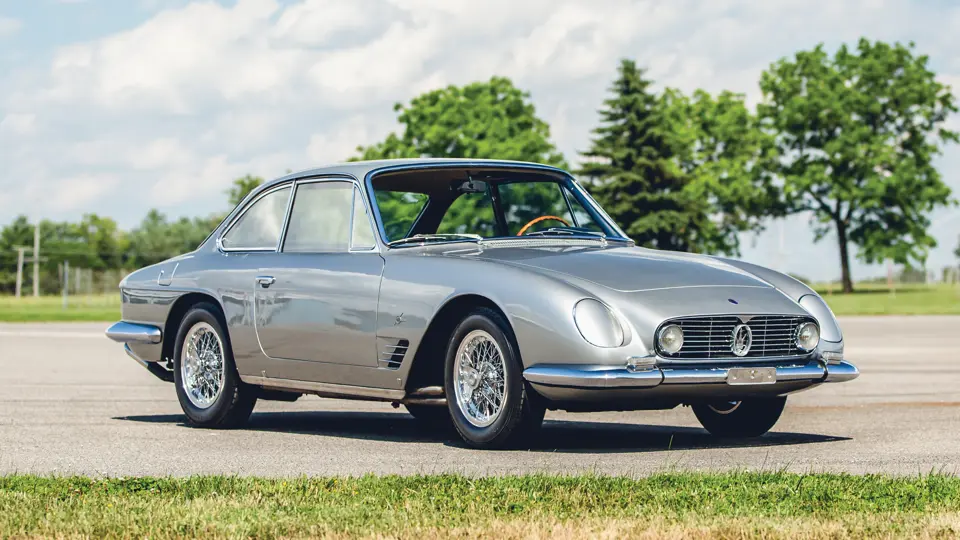
Ferdinando Innocenti, who had built a fortune on the Lambretta scooter after his factories were destroyed in the war, commissioned it from Ghia’s head of prototype styling, Sergio Sartorelli — a designer American readers know better than they realize, since he penned the Karmann Ghia Type 34. Sartorelli produced a five-window coupe with hairline pillars, a full-width oval grille and a rhombic dashboard, finished in silver over black with bespoke fitted luggage.
Before delivery, Maserati loaned it to Cahier for that Sports Car Graphic test. Innocenti kept it under a year. It passed through Italian hands, including a Milanese oil company, was exported to the Middle East in the 1970s, and ended up gifted by a Saudi sheikh to an employee who had no idea what it was.
It sat outside in Saudi Arabia for decades and was written off as lost — the Loch Ness monster of Maserati history, as one specialist put it. It resurfaced in 2017, complete but savagely rusted, and RM Sotheby’s sold it at Monterey in August 2019, still fossilized, for $533,000.
It is not the only one that nearly died of neglect. Chassis 066 was delivered by factory test driver Guerrino Bertocchi to Munich for a sheikh who wasn’t there when it arrived. It sat parked on the street for years until the city moved to scrap it. Somebody rescued it for 50 Deutschmarks.
What was actually inside the engine
Here is the part that never makes the auction catalog copy, and it is the reason this car deserves a second look rather than a pedestal.
When Wild pulled chassis 042’s engine apart for a no-expense-spared rebuild, he found metal crudely welded onto the crankshaft counterweights. His conclusion, as reported by Mick Walsh, is the line that matters: the welding was never a repair, it was how the engine left the factory.
Maserati had balanced the crank statically only, the orientation was wrong, and one pair of counterweights was missing outright. The symptoms match exactly what customers complained about when the cars were new — rough running, unwilling revs, dead torque. German businessman Rolf Helm went as far as demanding Maserati overhaul the engine of chassis 006 in the presence of his own mechanic.
Wild’s fix required redesigning the crankshaft from scratch with lighter rods and pistons, then simplifying the Lucas injection, which Maserati had complicated with a mixture adjustment tied to oil pressure and air density. To get that right he brought in Lee Muir, a former McLaren CanAm engineer who had worked extensively with Lucas systems in Detroit.
It took a German specialist and an American racing engineer to make Maserati’s most expensive car do what the brochure said, half a century after the fact.
Wild is careful to give the Modena engineers their due — the machining of Maserati components is fine work with hundreds of hours in it, done by a company that never had money. What failed wasn’t craftsmanship. It was measurement.
The performance that was real, and the numbers that aren’t settled
Whatever was wrong with the bottom end, the speed was not marketing. American journalist Hans Tanner got a run in the second car with Bertocchi driving and reported 172 mph on the autostrada between Modena and Bologna, plus 158 mph through a long sweeping curve on the way back. His complaint, remarkably, was that the speeds came too easily.
Two figures are genuinely in dispute and this piece is not going to pick a winner. From 1960 the engine was revised to 4,940 cc with a longer stroke, a smaller bore, a triple-strand chain replacing the gear-train cam drive, and Lucas mechanical injection. Reference sources and Artcurial’s own catalog entry for chassis 058 both put that engine at 340 hp, the latter specifying 6,000 rpm. Classic & Sports Car, by contrast, states that output fell by 15 hp to 325 when the racing Webers gave way to injection. Both are published. Both can’t be right.
Production totals are equally unsettled. The commonly cited figure is 34 cars built between 1959 and 1966. The Luigi Orsini and Franco Zagari study, cited by Artcurial, puts it at 31 excluding the Shah’s 103.002.
Everything else about the later cars is consistent: the ZF four-speed became a five-speed, discs went on all four corners, and second-series engines were identified by green-painted heads and cam covers.
The NEC case
Every 5000 GT lost Maserati money. That single fact, reported by Classic & Sports Car, should reframe how this car is sold to collectors.
The story is always told as aristocracy on wheels — kings, an Aga Khan, an Agnelli, gold-plated switchgear. Strip that off and what’s left is a company in court-supervised administration taking a foreign monarch’s money to build thirty-four hand-bodied cars, each one leaving the factory at a loss, on a reinforced version of a chassis designed for an engine with 100 fewer horsepower, with steering deliberately dulled to cope with the nose weight and a crankshaft that had been balanced by eye and finished with a welding torch.
And here’s the part the legend can’t absorb: the myth survived precisely because these cars were barely driven. The Shah’s own example had covered under 4,000 miles by 2005, having followed him into exile at Gstaad. Owners parked them, mechanics avoided them, and nobody opened enough of them for the truth about the bottom end to circulate. It took an obsessive in Mönchengladbach fifty years later.
None of which makes it a bad car. It makes it a far more interesting one than the auction descriptions allow. Promising a reigning monarch 174 mph while your assets are impounded is not decadence. It’s nerve.
If you ever get near one, ignore the baroque grille and the gold dials. Look at the block. There’s a Sebring-winning V8 in there, a crankshaft balanced by feel, and the entire survival of a factory that made it through because a king picked up the check.
Check you’re still alive.