
NILU27: The Hypercar That Switches Off the Set

America has spent the last decade driving inside a soundstage.
That is not a figure of speech. It is a spec sheet. The engine note filling the cabin of half the performance cars on sale comes out of a speaker. The shove you feel between gears in a dual-clutch box was calibrated by an engineer so it would register as a gearshift. The tingle in your seat and your steering wheel rim is generated by actuators. The torque hole left by a small turbocharged engine gets filled by an electric motor before your brain notices there was a hole. And if you brake too late, a radar and a camera nudge the car back into line while you congratulate yourself on your reflexes.
Dodge went further and made the point better than any critic could. The Charger Daytona EV ships with something called a Fratzonic Chambered Exhaust: a box bolted under the rear of the car containing two large transducers, tuned to reproduce the cadence of a Hemi V-8 firing order at up to 126 decibels. Dodge’s own engineers describe it plainly. It is a speaker enclosure. It exists because a muscle car buyer needs to hear something familiar, and there is no longer anything under the hood capable of making that sound. You can also switch it off in the infotainment menu, which tells you everything about what kind of sound it is.
Meanwhile the Corvette, America’s benchmark sports car, hasn’t offered a manual transmission since the C8 arrived. Not as a delete option. Not as a special order. It simply isn’t on the menu anymore, and nobody at Chevrolet is pretending otherwise.
Each of those decisions makes sense on its own. Stack them up and you have built an entire fake town around the driver. Call it Seahaven. A place where the sun comes on with a switch, where it rains on cue, where nobody gets hurt, and where everyone keeps telling you it’s safer in here than out there.
At Monterey Car Week in August 2024, a guy showed up pointing at the painted blue wall.
The man who came from inside the studio
Sasha Selipanov is not an outsider throwing rocks. He came from the center of the machine. He penned the Lamborghini Huracán, the Bugatti Chiron and the Koenigsegg CC850. He has sat in the rooms where a company decides exactly how much synthetic engine note a car gets, and exactly how much electronic correction goes into a chassis so the customer never gets frightened.
Which brings up the detail almost nobody has put on the table. The CC850, one of the most celebrated cars of his Koenigsegg years, hands the driver a gated lever and a clutch pedal sitting on top of a nine-speed transmission managed by software. It is an engineering marvel and by all accounts it works beautifully. It is also, at bottom, a manual gearbox conjured out of code. The finest available re-creation of an experience the industry had already voted to bury.
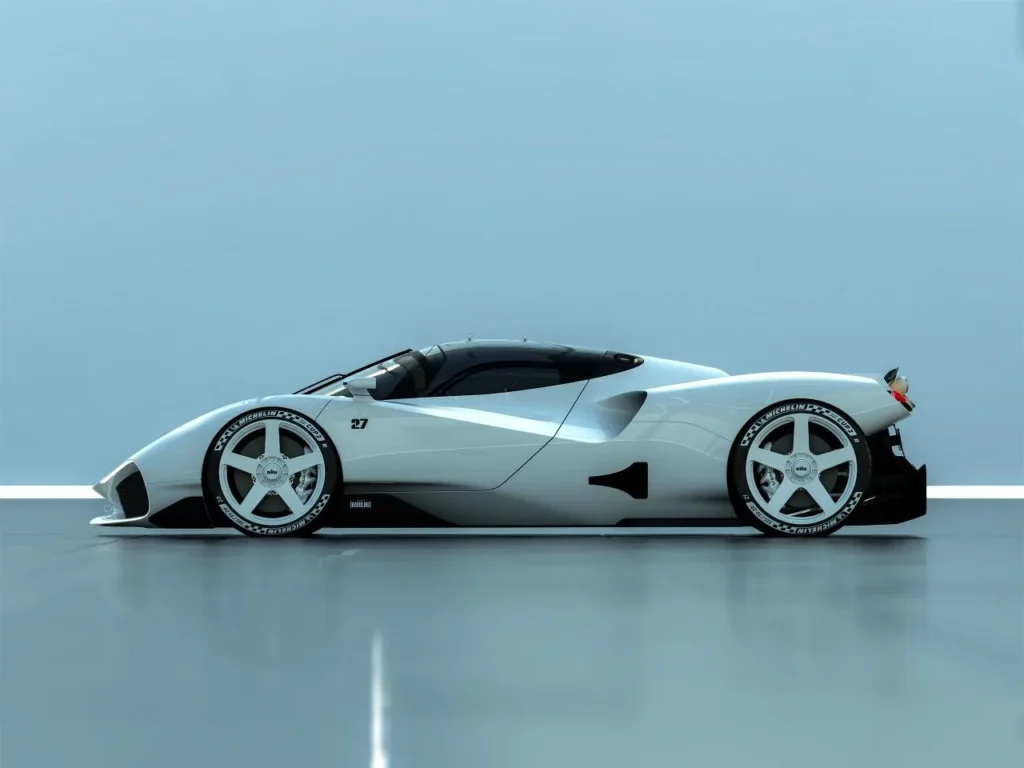
The NILU is Selipanov’s answer to his own back catalog. Nothing here is re-created. The transmission is a seven-speed manual built by Italy’s CIMA, with an exposed metal gate, a long pole of a shifter and a mechanical lockout so you can’t drop it into reverse by accident, Countach style. That’s it. There is no automatic version, no paddle option, no box to tick at order. If you can’t work three pedals, this car is not for you, and the company has no intention of softening that.
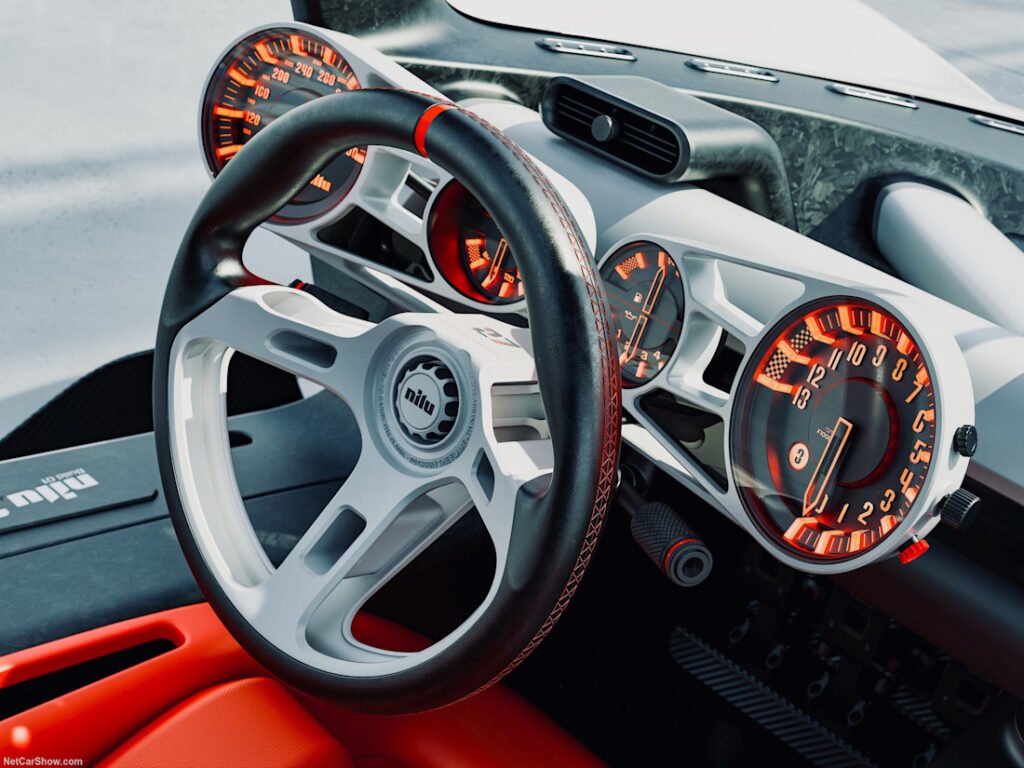
The steering wheel is round. Actually round, not flattened at the bottom to clear a display, and it carries no buttons at all. There are no drive modes. There is no rotary dial for choosing whether today’s car is the comfortable one or the sharp one. The seat doesn’t move on electric motors. Nilu27’s own position is blunt: they have deliberately minimized their reliance on technology because the industry’s obsession with it has desensitized the experience of driving.
That’s the thesis of the whole project, and it is signed by a man who has drawn 1,500-horsepower cars with touchscreens in them.
Building a way out
A speech like that lives or dies on the engineering. This one lives.
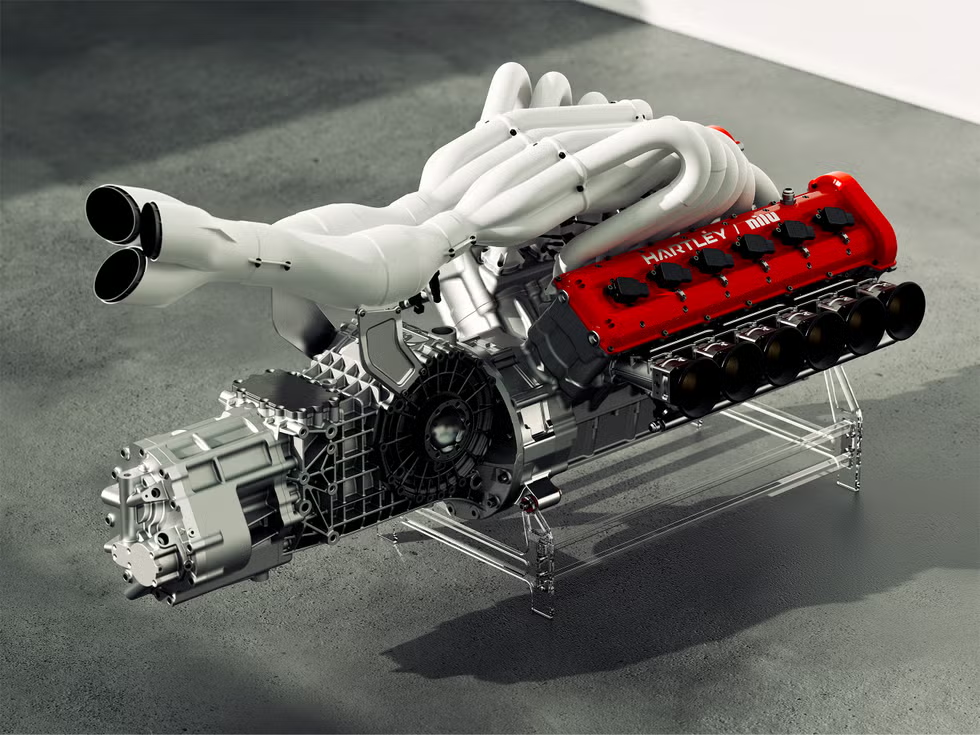
The engine is a 6.5-liter naturally aspirated V12 with an 80-degree bank angle, developed from a blank sheet with Hartley Engines in Palmerston North, New Zealand. Twelve individual throttle bodies, one per cylinder, which is the expensive, complicated route to instant throttle response. An 11,000-rpm redline. A target of 1,070 horsepower and 860 Nm of torque.
The layout is a hot V, and this is where it gets interesting for anyone who likes looking under the skin. In a conventional V12, intake sits inside the vee and the exhausts exit outboard. Nilu27 flipped it. The throttle bodies live outboard and the exhaust headers run up through the middle, between the cylinder heads. The 12-into-1 exhaust is 3D-printed in Inconel, because a geometry like that cannot be bent and welded by hand, and it terminates in a triple center exit.
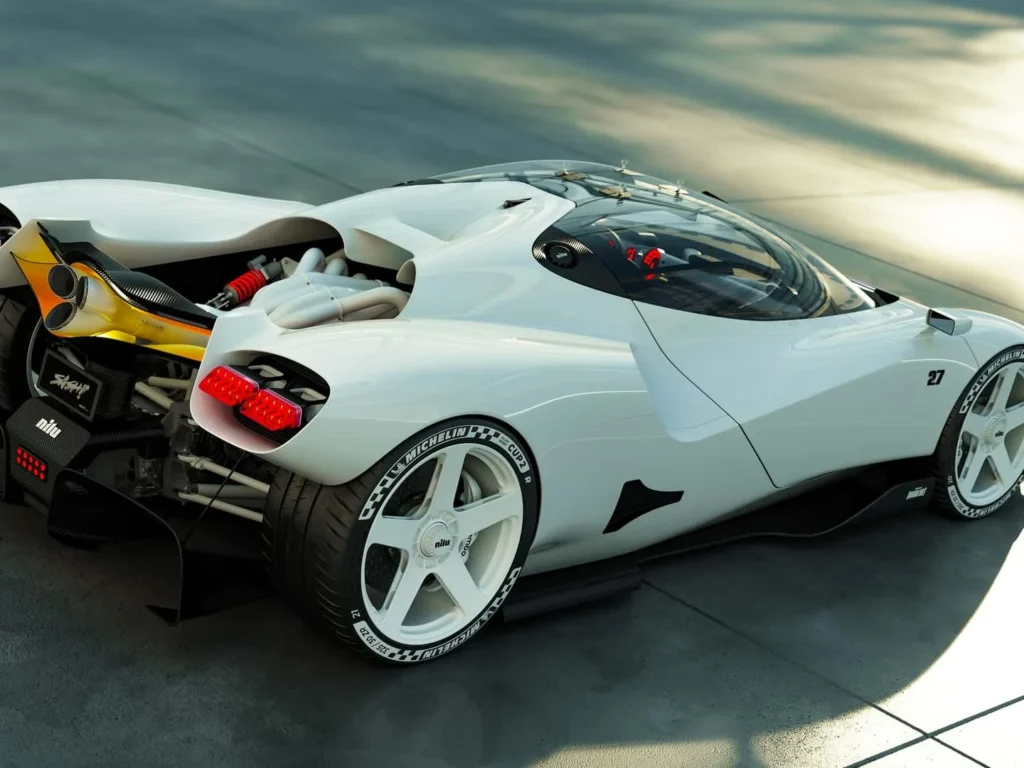
The practical consequence of that inversion isn’t only thermal or packaging-related. It’s that all the heat leaves through the top, into a fully exposed engine bay. The NILU has no engine cover. No molded plastic shroud with a badge pressed into it. The motor sits in the open with the exhaust rising out of the center like a wind instrument.
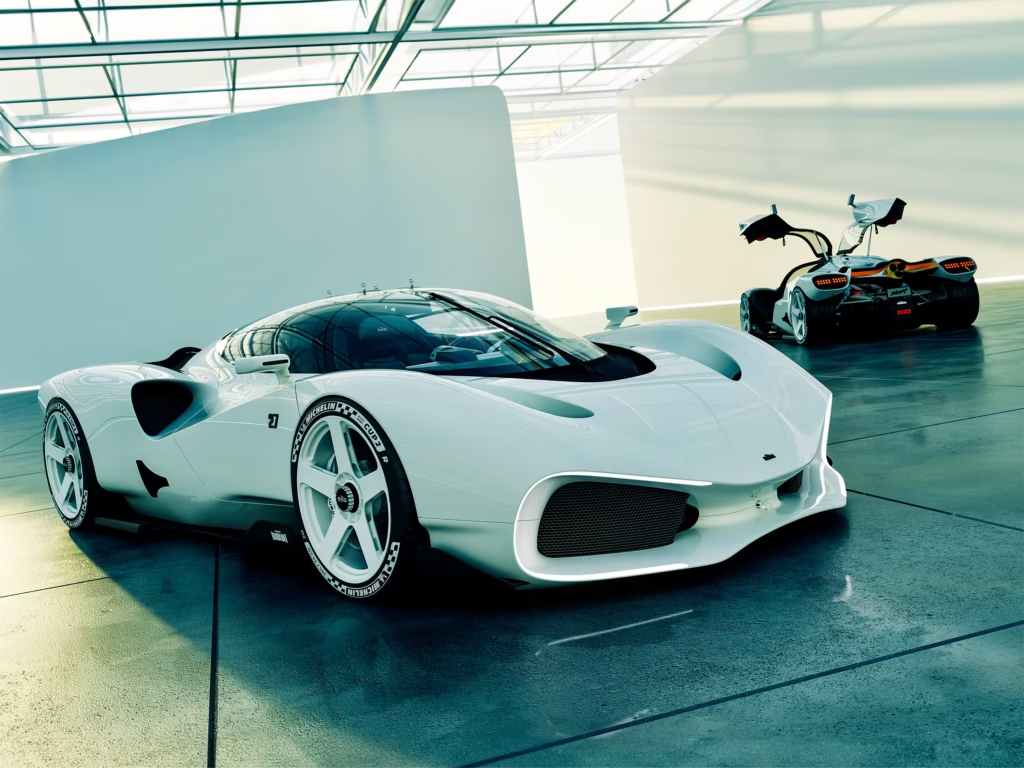
Underneath sits a bespoke carbon fiber monocoque with tubular aluminum-alloy subframes front and rear. That detail isn’t decorative either. A bolt-on tubular subframe lets you drop the back of the car and reach the engine without disassembling the whole machine. That’s endurance-prototype thinking, not the logic of a product engineered so that only the factory can touch it. Double wishbones with pushrod actuation at both ends. Michelin Pilot Sport Cup 2 R rubber, 265/35 R20 front and 325/30 R21 rear, on center-lock wheels from Italy’s AppTech. Gullwing doors. Rear-wheel drive.
Line it up against the field and the gesture reads more clearly. The Aston Martin Valkyrie runs a naturally aspirated V12 of the same displacement that spins even higher, but it needs electric assistance and an automated gearbox to behave the way it does. The Gordon Murray T.50 revs higher still and keeps a manual, but it plays the opposite hand: extreme lightness, a far smaller and less powerful V12. The Pagani Utopia offers a seven-speed manual, and it is the direct precedent that has to be named here, but its V12 is an AMG-derived twin-turbo. The NILU ends up alone at a very specific intersection: naturally aspirated, manual, four figures of horsepower, and no electrical assistance of any kind.
It won’t be the quickest car of its generation. It isn’t trying to be. It’s the only one that doesn’t ask the electronics for permission before giving you everything.
The skeleton was drawn in Madrid
Here’s the part that hasn’t traveled outside Spain.
The architecture of the NILU’s load-bearing structure was defined alongside Managing Composites, a Madrid-based composites engineering outfit with an office on Calle Velázquez. Both sides have said so publicly: Nilu27’s team joined forces with the carbon specialists at Managing Composites to define the car’s load-bearing structure, and from the Spanish side the work has been described as stripping the thing down to what actually matters, with clean load paths and ultra-efficient structures.
This is not a firm that appeared from nowhere. They supplied the carbon fiber platform underpinning the Zenvo Aurora, took part in the Hispano Suiza revival, and have worked with McLaren, Koenigsegg and Williams Advanced Engineering, alongside work in the America’s Cup and aerospace. We know them personally. What we have not been able to confirm, which is why we’re saying it out loud instead of dressing it up, is exactly how far their involvement runs on the production car: defining the architecture of a structure is not the same as laying up the monocoque, and those two things are being blurred in a few places.
What is verified is enough. The most analog hypercar drawn up in twenty years has its skeleton sketched out of Madrid, by a Spanish company most American readers had never heard of until this paragraph.
June 17, 2026
Projects like this die as renderings all the time. The list of brands that showed a gorgeous hypercar at Monterey and never fired an engine is very long.
That Wednesday, Sasha and Inna Selipanov were in New Zealand to watch the V12 start for the first time. It ran cleanly. And on the dyno it beat the 1,070-horsepower figure they had been quoting for two years.
Selipanov framed it when the news went public in July 2026, and the word he chose is worth underlining: firing that engine didn’t just prove their engineering, it delivered the car’s soul. He added that while most of the industry embraces digital and electric sterility, they have doubled down on the visceral drama of a naturally aspirated engine at high rpm.
The engine now leaves Palmerston North for Nilu27’s R&D and production facility in Lahr, Germany, where it goes into the first driving prototype. That is the real exam, and the one that decides whether this car exists or stays a magnificent idea. The reported timing and pricing details in circulation, including customer cars being built by Aria Group in Irvine, California, and sales slipping to 2027, are not confirmed by the company in those terms. The announced run remains 15 track-only Launch Edition cars and 54 road cars.
The door at the far end
And here’s the thread almost nobody has picked up, which is the one that could actually change something.
The Hartley collaboration has drawn interest from other manufacturers looking for road-certified, high-performance combustion engines. Enough interest that the two companies have moved to finalize a joint venture to design and build them for third-party clients.
Read that again. A guy who walked away from the industry to build his own car may end up supplying the last serious naturally aspirated engines to other people’s cars. The way out of the studio wasn’t just for him. He’s cutting copies of the key.
At the end of The Truman Show, when Truman reaches the edge of the set, the director speaks to him from the sky and explains that there’s no deceit inside and plenty of it outside, that he’s safe in here. And the man isn’t wrong. Outside is worse. Outside there’s traffic, there’s risk, there are cars that stall on a hill start, and there are engines that don’t forgive a bad downshift at 9,000 rpm. The industry has spent twenty years protecting us from all of it, and it has built astonishingly fast, astonishingly safe cars. It has also built cars that no longer need you.
So let’s put it where it belongs. The NILU isn’t a better car than a Valkyrie and it isn’t going to beat anyone around a lap, and whoever buys one for several million dollars to brag about numbers has wasted the money. The NILU is something else. It’s proof that everything the industry sold us as inevitable was a commercial decision. There was no law of physics requiring speakers to manufacture the sound of an engine. There was no divine mandate demanding twenty-three buttons on a steering wheel, or seven drive modes so you can choose which of the seven cars you bought you’d like to drive today. It happened because it sold, because it was cheaper, because a customer who can’t work three pedals also wants a sports car, and because a legal department sleeps better next to a car that corrects itself.
That it takes a designer who walked out of the three biggest names in the business, an engine builder at the bottom of the world, a group of engineers in Madrid and a 3D-printed Inconel header to prove it says more about the industry than it does about the car.
Best of all, when that V12 goes past 10,000 rpm with the bay wide open, there will be no way to fake it with an over-the-air update. And in the silence it leaves behind in a few marketing departments, somebody might finally ask out loud why we ever stopped doing this.
Check you’re still alive.