
Lamborghini 350 GT: Born With Bricks Under the Hood
The car that founded Lamborghini went on public display with its hood latched shut and construction bricks inside. No engine. Just masonry, sitting where a V12 was supposed to be.
That happened at the Turin show in late October 1963, days before Automobili Ferruccio Lamborghini S.p.A. was formally incorporated on 30 October of that year. A tractor manufacturer walked into the heart of the Italian motor industry and announced he was going to build grand tourers. His announcement could not move under its own power.
While Detroit spent 1964 inventing the muscle car — Pontiac put the GTO option on the Tempest, Ford unveiled the Mustang at the New York World’s Fair that April — a man from Emilia was quietly putting a four-cam V12 on the road. Americans were arguing about cubic inches. Lamborghini was arguing about camshafts.
Turin 1963: a body with nothing in it
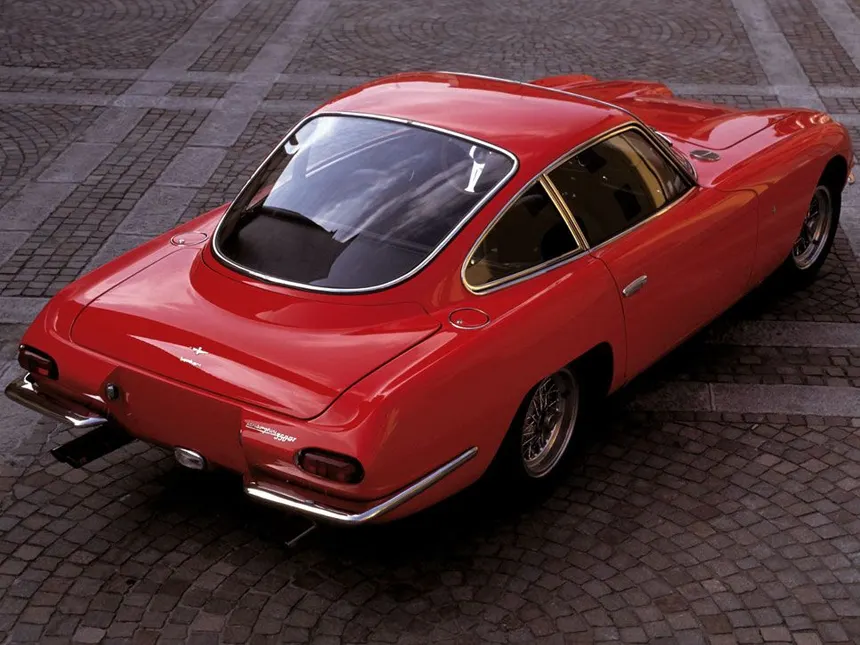
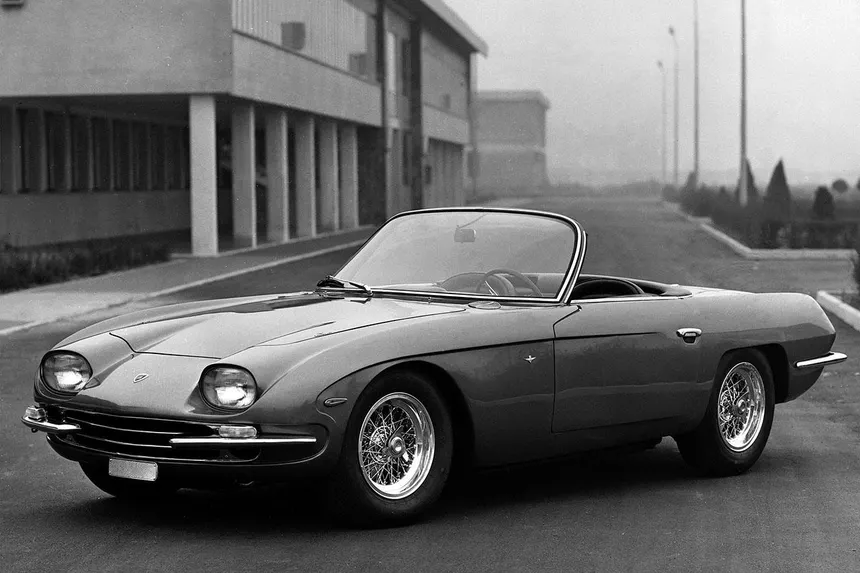
The 350 GTV was styled by Franco Scaglione and bodied by Carrozzeria Sargiotto in Turin. The tubular chassis, conceived by Giotto Bizzarrini, was built by Giorgio Neri and Luciano Bonacini in Modena. Everything was done at speed, with local suppliers, against a show deadline.
It had pop-up headlights, which was aggressive styling for an Italian GT at the time, and an enormous rear window. As a show object it worked. As a car it did not exist. The plain summary is that the 350 GTV was never a complete, driveable car during its period.
The V12 that belonged in it displaced 3,464 cc, ran six downdraft Weber carburetors and dry-sump lubrication, and was credited with anywhere between 342 and 370 horsepower at 8,000 to 9,000 rpm depending on which source you trust. For a 1963 road car that was absurd. That was exactly the problem: it was absurd because it was not a road engine.
The engine Bizzarrini built too well
Ferruccio hired Bizzarrini to design a 3.5-liter V12 with serious output. Lamborghini’s own corporate storytelling today admits the arrangement included a bonus for each additional increment of power he extracted. Sources disagree on the fine print — some describe a bonus for every ten horsepower gained, others a bonus for every horsepower above what Ferrari’s V12 produced — so the exact contract terms are not settled. The incentive itself is documented, and so is what it produced.
Bizzarrini did what any engineer paid by the horsepower does. He raised the rev ceiling, specified dry-sump lubrication, raised compression and delivered a racing engine. On the dyno in July 1963 it cleared 350 horsepower comfortably. As engineering, a triumph. As a product, a disaster: it was a Formula One powerplant destined for a car meant to cross Europe at speed without detonating.
That is where the fight started. Lamborghini’s own history records that Ferruccio refused to pay the agreed fee because the design violated his specification for road use. Bizzarrini never came back. His engine did — it survived, revised and enlarged, for more than half a century.
The bricks: two stories, neither closed
Here is the detail nobody finishes. Everyone repeats that there were bricks under the hood of the 350 GTV in Turin. Almost nobody points out that two separate explanations circulate, both in credible sources, and that they do not fit together.
Version one: during assembly the crew found the body panels would not close around the engine. The vertical carburetors were too tall and the hood would not shut. Since the GTV was only ever going to be a show car, the engine bay was ballasted with bricks to hold the correct ride height and the hood was kept closed.
Version two: the engine was not available in time because of the payment dispute with Bizzarrini, and the bricks were the patch that kept the car sitting at its proper height on the stand.
One story is about packaging. The other is about money. Both get published as fact. Nobody cross-examines them. The factory, which has the car on display in its own museum at Sant’Agata Bolognese, has never settled it.
Touring: the coachbuilder that was already going under
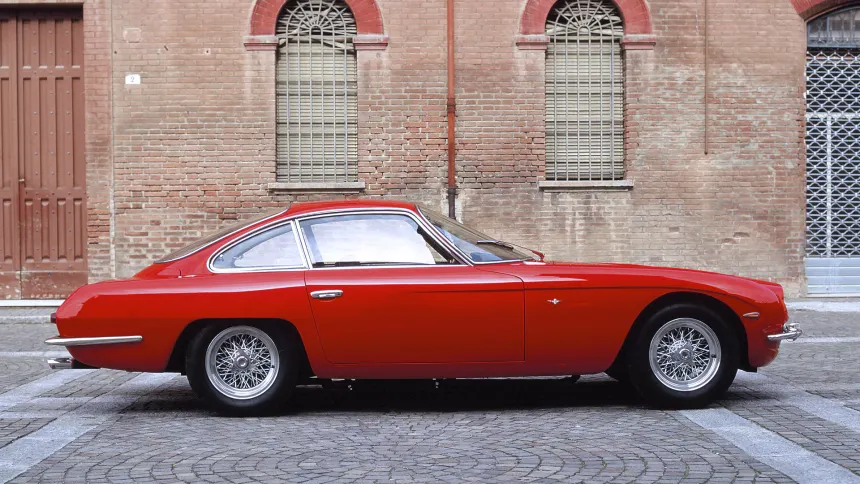
Ferruccio looked at the GTV, understood it could not be manufactured, and handed the redesign to Carrozzeria Touring in Milan. Touring applied its patented Superleggera method: thin aluminum panels over a tubular frame.
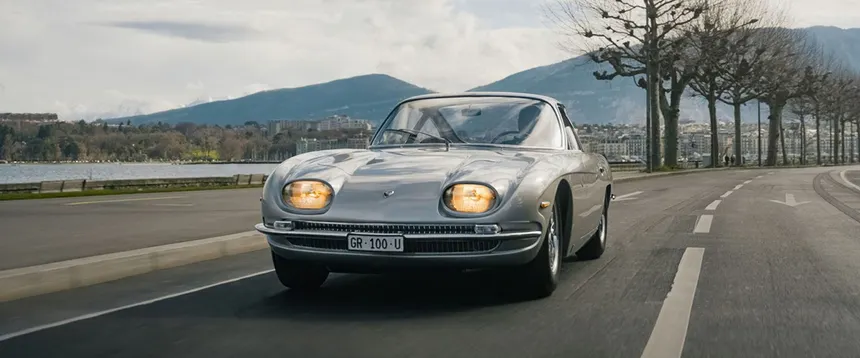
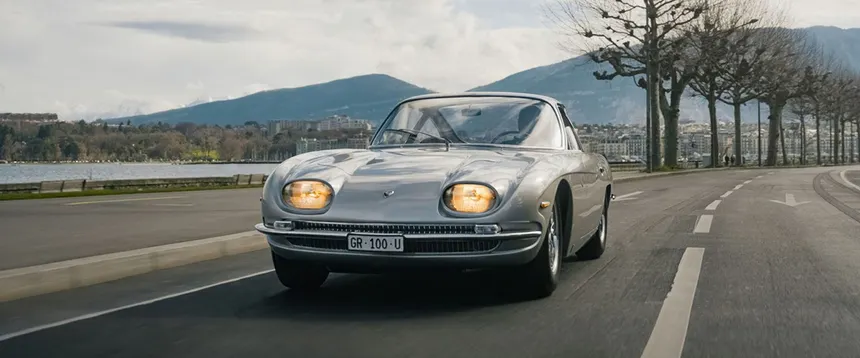
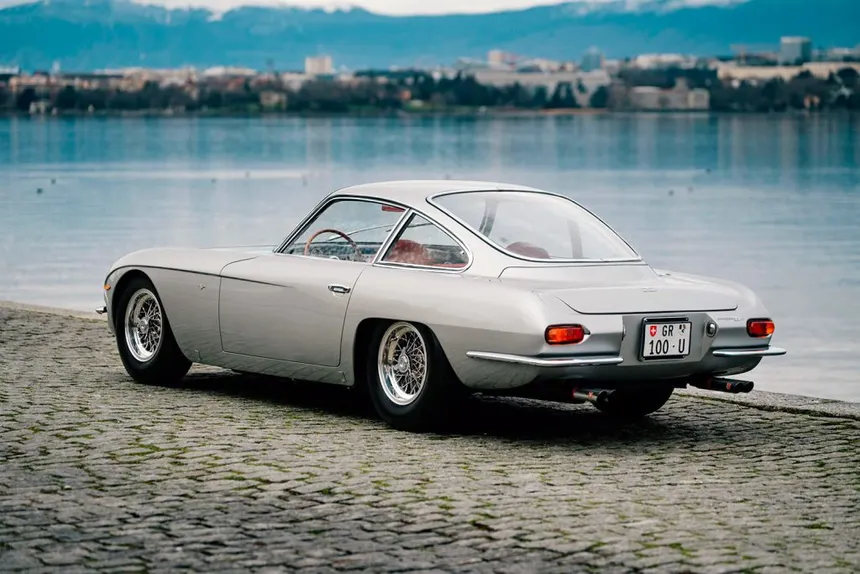
The result was surgical. The pop-up headlights went, replaced by fixed oval units that were cheaper and easier to certify. Scaglione’s hard edges were softened. The huge rear window stayed. Neri & Bonacini reworked the chassis, stretching the wheelbase by 100 mm to 2,550 mm — 100.4 inches — and overall length by 140 mm to 4,640 mm. Frame production later moved to Marchesi.
What almost never gets told is the state of the supplier Ferruccio picked. Touring went into administration in 1964, the same year Geneva saw the finished 350 GT, and wound up its operations in 1966 after forty years in business, without ever formally declaring bankruptcy. Unitary construction and in-house body lines at the major manufacturers had erased the market for independent coachbuilders.
There is one more turn of the screw. During Touring’s liquidation, a fire destroyed roughly 80 percent of the company’s historical archive. Drawings, photographs, build records. Gone. The paperwork belonging to the firm that built the first Lamborghini bodies no longer exists. I am not claiming that explains the numbers mess coming up next. I am saying the one party who could have cleared it up lost its files in a fire.
March 1964: what Ferrari did not have
The production 350 GT was shown at the Geneva motor show in March 1964, with manufacturing starting that May. The first completed chassis, number 101 with Touring body 17001, was finished on 9 March 1964. The first customer car was number 104, delivered on 31 July that year.
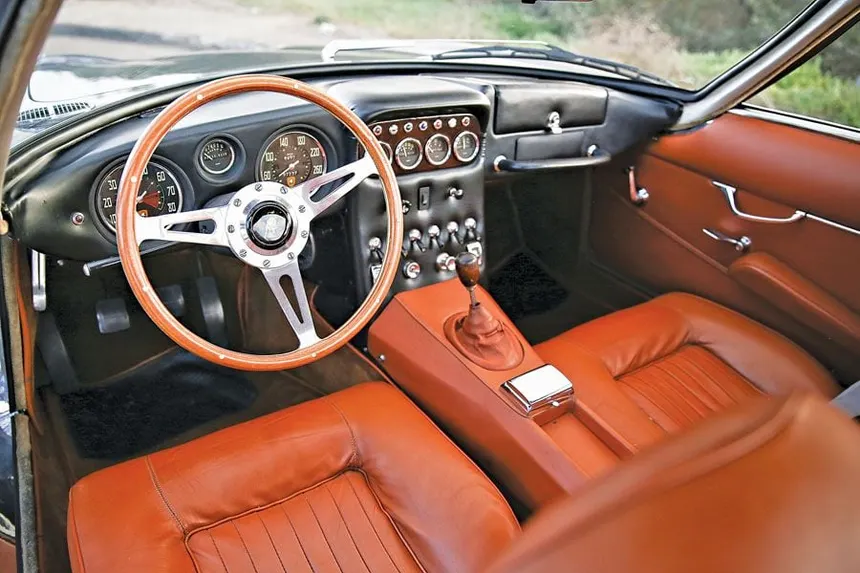
The specification, civilized for production by Gian Paolo Dallara with Paolo Stanzani alongside him: an all-aluminum 3,464 cc V12, twin overhead camshafts per bank, six side-draft Weber 40 DCOE carburetors, wet-sump lubrication, compression dropped to 9.4:1, and 280 horsepower at 6,500 rpm with 325 Nm at 4,500. ZF five-speed gearbox. Salisbury limited-slip differential. Fully independent suspension at all four corners with unequal-length wishbones and coilovers, anti-roll bars front and rear. Girling servo-assisted discs all round. Pirelli Cinturato HS tires. Every engine ran 24 hours on a dynamometer before installation. Top speed 158 mph, with 0-100 mph in 16.3 seconds.
One hire from that period deserves a line of his own. A New Zealander named Bob Wallace, born in Auckland in October 1938, joined the company after the 1963 racing season. He arrived to help build the 350 GT as a mechanic and, in his own words, a trouble-shooter, having worked in European racing outfits including Camoradi USA and Scuderia Serenissima. His feel for a car was obvious fast enough that he became Lamborghini’s test chief and, in practice, its road development engineer. Every legend Sant’Agata built in the following decade passed through his hands first.
Now the context, which is where this gets serious.
Its natural rival was the Ferrari 330 GT 2+2, launched in January 1964. A 3,967 cc V12 with a single overhead camshaft per bank, 300 horsepower at 6,600 rpm, Dunlop dual-circuit disc brakes — and a live rear axle on semi-elliptic leaf springs. Early cars used a four-speed with overdrive.
Translated: in March 1964 the newcomer offered four camshafts, independent suspension at all four wheels and five speeds. Maranello offered two camshafts, a solid rear axle and four gears plus overdrive.
Ferrari took years to match it. Its first road car with independent rear suspension and a five-speed transaxle was the 275 GTB, which arrived in the fall of 1964, six months after Geneva. Its first four-cam road car was the 275 GTB/4, unveiled at the Paris show in October 1966 — two and a half years after the 350 GT.
The tractor manufacturer showed up with better engineering homework than the racing-car manufacturer. That is the real 1964 headline, and it has been buried under the Miura for sixty years.
How many were built: the factory says one thing, the registries another
This is where the documentation falls apart. The 350 GT may be the Lamborghini that Lamborghini itself records worst.
Marque histories and chassis registries settle on 120 cars built between 1964 and 1966. The factory’s own official page says 150 standard units. That same official page credits the 350 GT with 320 horsepower, when the production 3.5-liter figure is 280; the 320 belongs to the 3,929 cc engine fitted from 1965 in the transitional cars that led to the 400 GT.
Weight is no better: some sources list 3,197 lb kerb weight, others 2,315 lb. Top speed floats between 155 and 158 mph. Deliveries in 1964 are reported as 13 cars by some and fewer than 25 by others.
And a detail that breaks the cliché: RM Sotheby’s catalog entry for chassis 0114 states that of roughly 120 cars built, around 50 carried aluminum bodywork. The textbook all-aluminum Superleggera was not universal across production.
That same chassis 0114 is the twelfth Lamborghini ever built and the first strict two-seater 350 GT — earlier cars left the factory with a single central rear seat. It was sold new on 15 January 1965 to Garage Foitek in Zurich. At RM’s Miami sale in 2024 it changed hands for $566,000.
The rare ones, and the prototype’s homecoming
Two 350 GTS spiders were bodied by Touring in 1965 and shown at Turin that November: chassis 0325, gold over brown, and chassis 0328, black over emerald green. Zagato built two 3500 GTZ coupés on chassis 0310 and 0320.
The brick car got its ending too. The 350 GTV sat in factory storage until the mid-1980s, then went to Romano Bernardoni and Stefano Pasini, and from there to a Japanese collector. Today it is on display at the Lamborghini museum in Sant’Agata Bolognese. The car that debuted without an engine is now the foundation piece of the house.
One more note, because it fits the man: the raging bull emblem was drawn by Paolo Rambaldi to Ferruccio’s instructions — he saw himself as a fighting bull — and his friendship with the Sevillian bull breeder Eduardo Miura is acknowledged by the factory itself. Lamborghini’s Spanish identity predates any of its cars being genuinely fast.
The case
Lamborghini sells its history as a product. Anniversary editions, revivals, tributes to the glorious past. Fine. But the company making millions from its own myth has the founding car’s spec sheet wrong: production numbers that contradict the registries, a power figure belonging to a different engine, and a bricks-in-the-engine-bay episode that has been told two incompatible ways for decades without anyone at Sant’Agata raising a hand.
The 350 GT does not need mythology. It arrived in Geneva in 1964 with four camshafts, four independent corners, five speeds and four disc brakes, while Maranello was still selling a live axle and an overdrive. That fact alone justifies the entire car. Everything else is decoration.
And here is the part that should worry collectors: if a first run of 120 cars cannot produce agreement on how many were built or how many were aluminum, with the coachbuilder’s archive burned to ash, how much faith should anyone put in the neat, complete spec sheets published today for any other sixties classic?
Check you’re still alive.