
Alfa Romeo 6C 2500 Competizione: The Car Whose Name Got Stolen
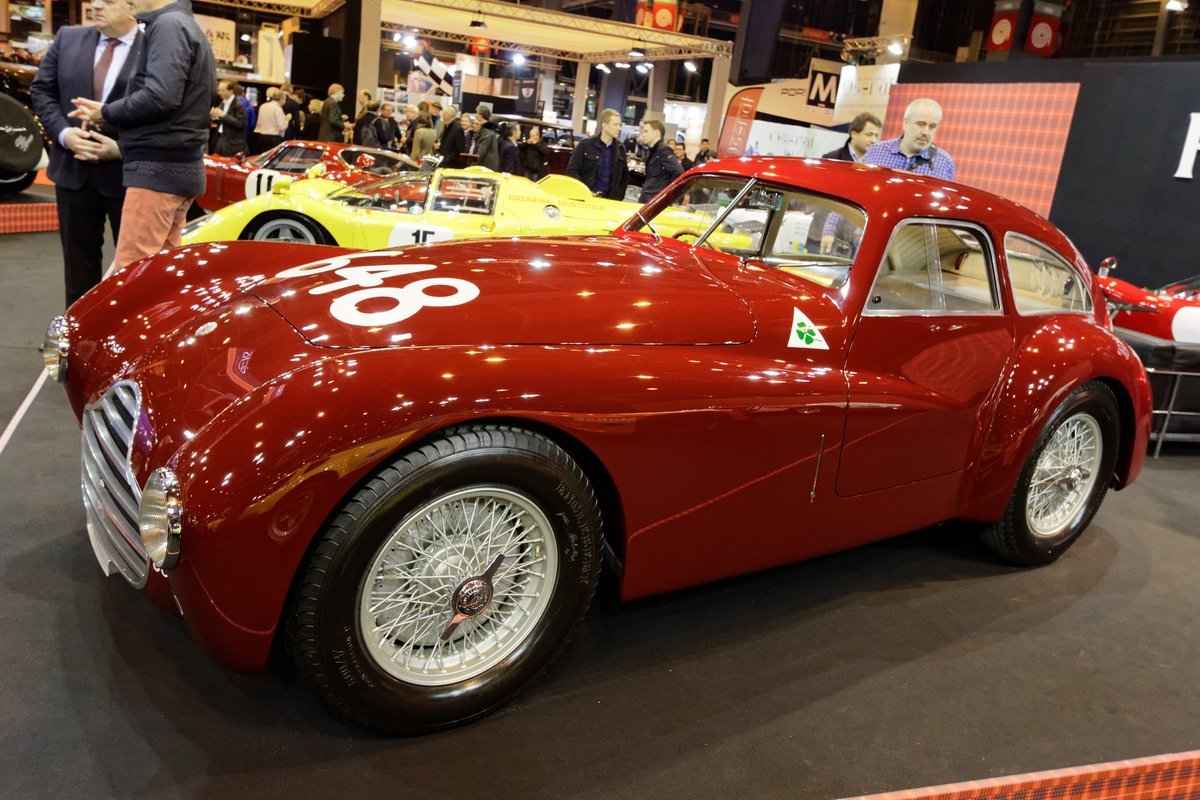
Alfa Romeo’s best post-war sports racer spent thirty years parked in a wine critic’s backyard outside Paris, and the man who left it there was one of the judges who told the French that California had beaten them.
That is where this story ends up. It starts with three cars, a factory that had been bombed flat, and a pile of pre-war chassis too good to throw away.
Three cars, two engines, one budget: zero
Alfa Corse built the 6C 2500 Competizione by hand between 1946 and 1948. There were three of them, chassis 920001, 920002 and 920003, internally called Tipo 46. Nobody at Portello drew a new frame for them. There was no money for that. What the company did have was a stock of 8C 2900B chassis left over from the late thirties.
If the 8C 2900B means nothing to you, think of it as Alfa’s answer to a Duesenberg SJ: a supercharged straight-eight road car, designed by Vittorio Jano, and the fastest thing the company sold before the war. Its grandfather was the 8C 2300 that won Le Mans four years running.
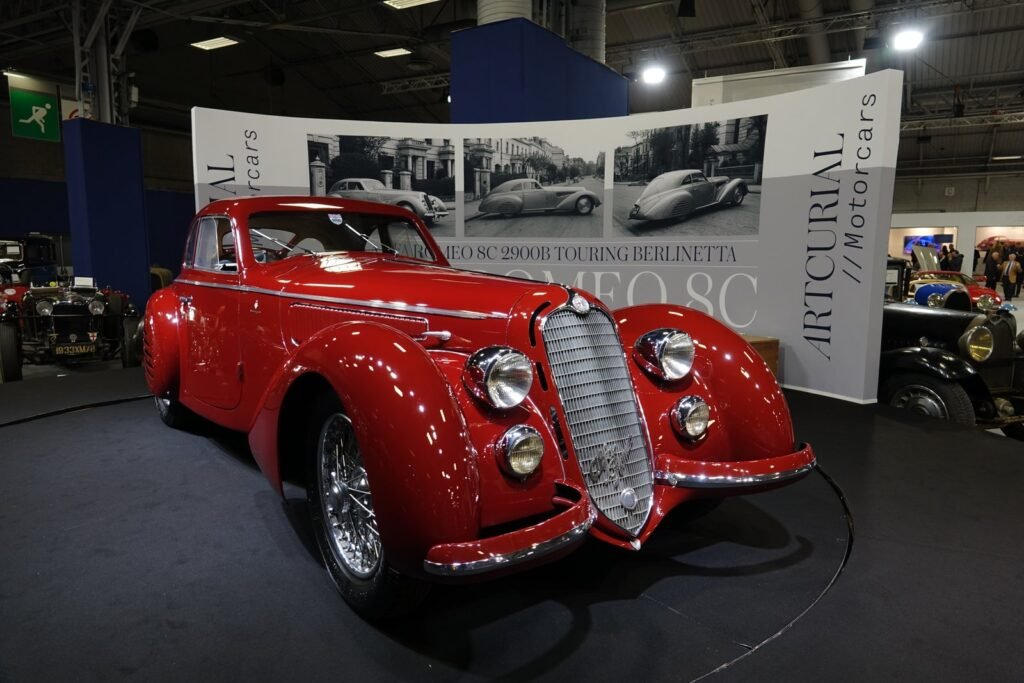
Alfa Corse cut those frames ahead of the rear wheels, drilled holes through the crossmembers to shed weight, kept the suspension pickup points and the 2900’s transverse rear leaf spring, and dropped a closed berlinetta body on top. Closed, because by then everyone in Italy had worked out that a roof cheats the wind better than an open cockpit at 100 mph-plus.
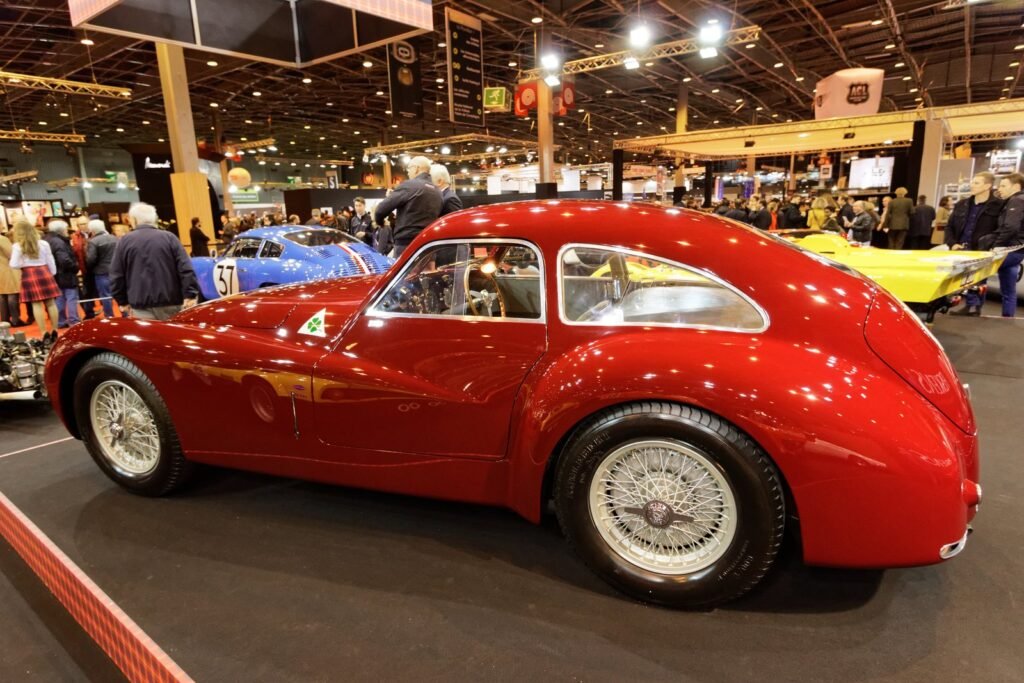
Under the hood went the double-overhead-cam six from the 6C family. The badge says 2500; the real displacement was 2,443 cc. Three Weber 35 DCO carburetors, bigger valves, a racing head and dry-sump oiling. That last bit matters on a road race: a normal engine keeps its oil in a pan underneath, and in a long, fast corner the oil sloshes to one side and the pump gulps air. A dry sump keeps the oil in a separate tank and pumps it in, so the bearings stay fed at full lateral load. Auction catalogs quote about 160 hp at 5,500 rpm. That figure is an estimate, not a factory number, and nobody should repeat it as gospel. Brakes were hydraulic drums at all four corners.
Hold on to one detail: there was real 8C steel under a car called 6C. It comes back later, upside down.
The Spaniard who showed Enzo the door
To understand who Alfa was racing against, you need a name most American readers have never heard: Wifredo Ricart.
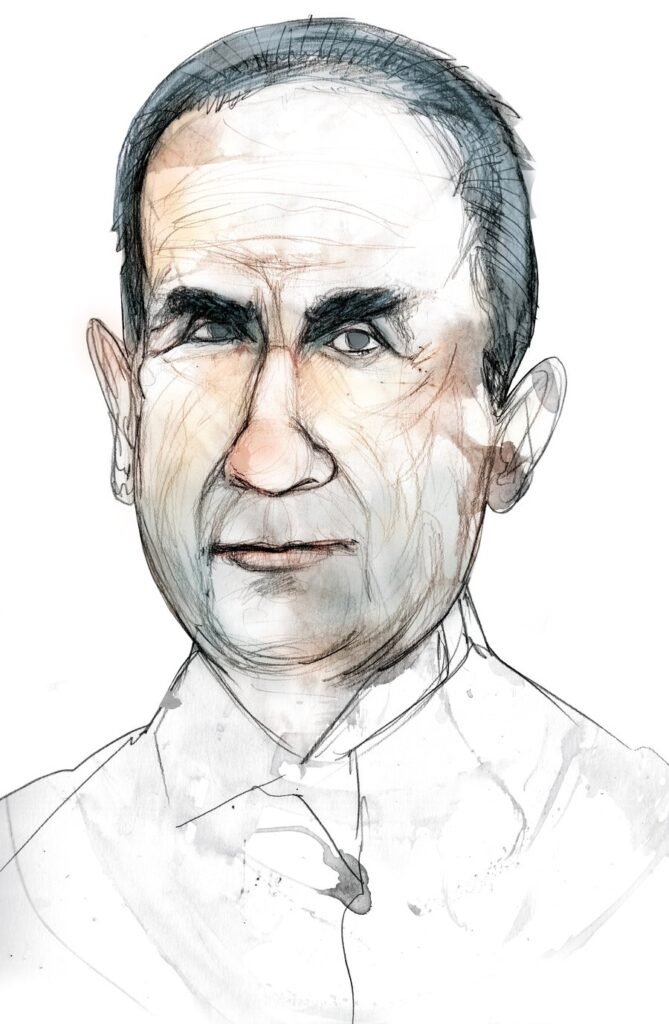
Through the early thirties, Alfa Romeo’s racing was run from Modena by Scuderia Ferrari, with Enzo calling the shots. In 1938 Alfa pulled racing back in-house as Alfa Corse, and the engineering side ended up under Ricart, a sharp, multilingual engineer from Barcelona. Enzo Ferrari hated him on sight. He later mocked Ricart’s slicked hair and his absurdly thick rubber soles in print. In 1939 Enzo was out.
By 1947 he was building cars with his own name on them, starting with the Ferrari 125 S. Ricart left Milan in 1945 and went home to Spain to build trucks and, eventually, the Pegaso.
So the rival that made Alfa’s post-war life miserable was born inside Alfa’s own house, and a Spaniard held the door.
1949: more engine, more car, less result
The 6C 2500 Competizione’s real enemy was the Ferrari 166 MM. Gioachino Colombo’s 1,995 cc V12, 140 hp, and 650 kg dry under a Touring Superleggera aluminum skin. That is about 1,430 lb, less than a Volkswagen Beetle.
At the 1949 Mille Miglia, the thousand-mile road race from Brescia to Rome and back, Clemente Biondetti and Ettore Salani won in a 166 MM. Felice Bonetto and Carpani made it a Ferrari one-two in another. Third, 44 minutes behind the winner, came Franco Rol and Richiero in 6C 2500 Competizione 920002, race number 648. The car still wears that number today.
The Alfa had the bigger engine. The Ferrari had less of everything else, and it won.
The year Alfa won the world and quit
1950 is the year the whole thing turns strange.
Alfa Romeo had sat out the entire 1949 Grand Prix season. In ten months it had lost three lead drivers: Achille Varzi, killed practicing in a 158 at Bremgarten in July 1948; Jean-Pierre Wimille, killed in Buenos Aires in January 1949; and Carlo Felice Trossi, dead of cancer that May. In 1950 Alfa came back with the same 158, a supercharged straight-eight designed in 1938, and won the first Formula One World Championship ever held. Nino Farina took the title. Juan Manuel Fangio finished second.
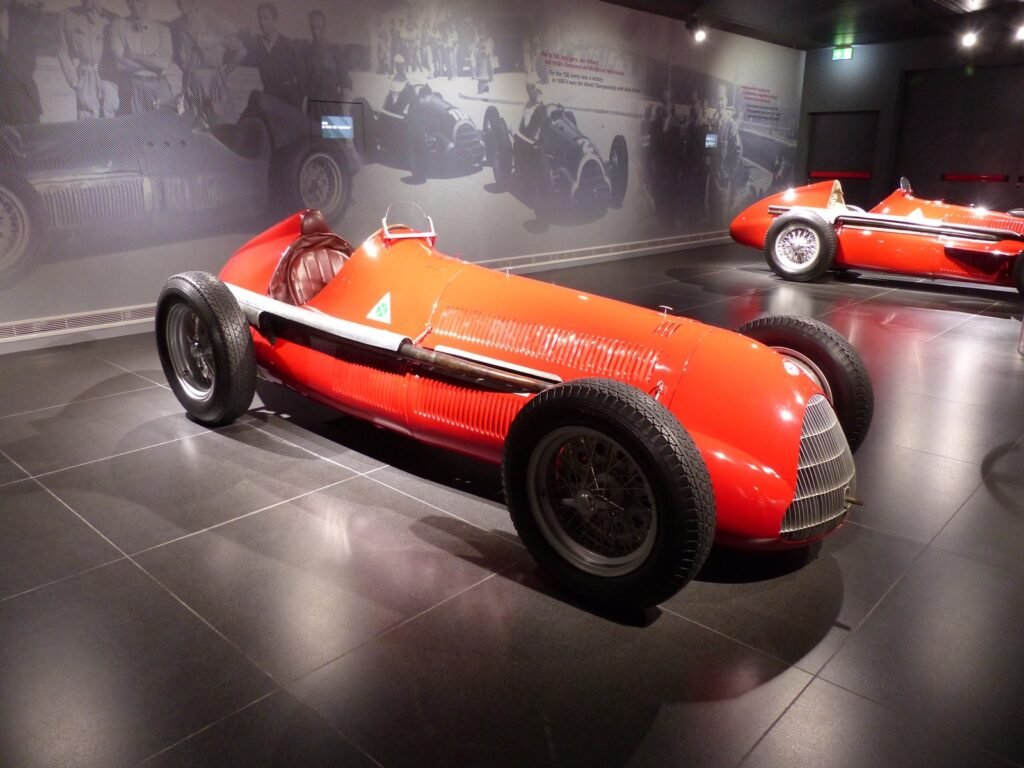
That April, Fangio also ran his first Mille Miglia. Number 730, chassis 920001, Augusto Zanardi in the passenger seat. He reached the Rome checkpoint third, the only car able to live with the leaders, and finished third in Brescia, 23 minutes behind the Ferrari 195 S of Giannino Marzotto and Marco Crosara, with Dorino Serafini’s Ferrari second. Another Ferrari one-two.
Run those two results together. The same company, the same year, the same driver: world champion in Formula One with a pre-war single-seater, and third on open roads in a hand-built coupe on a recycled frame. Within months Alfa would be pouring everything into the 1900, its first true mass-production sedan, because selling sedans was the only way the company was going to survive.
The other two Competiziones started that 1950 Mille Miglia entered as 6C 3000 C50s, with a three-liter engine. Neither finished. Rol limped into Rome and stopped there. Consalvo Sanesi, with Bianchi, crashed.
Franco Rol ran a lending library
One of the three works cars was never really a works car.
Chassis 920002 was sold in May 1948 to Franco Rol of Turin, an aristocrat who ran a chemical business and raced because he liked it. He debuted it at the 1948 Mille Miglia and didn’t finish. Then came fifth overall and a class win at the Coppa delle Dolomiti, second overall at the 1949 Targa Florio after leading until a fuel line broke, that third at the 1949 Mille Miglia, and a win at the Circuito di Pescara with a Ferrari 166 behind him.
It started four Mille Miglias in a row, 1948 through 1951. None of the other two did that.
When Rol had other plans, his friends got the car. Giovanni Alessi took it to three hillclimbs in 1950: Vittorio Veneto-Cansiglio, Treponti-Castelnuovo and Trieste-Opicina. Mario Bornigia, who had won the 1950 Targa Florio with his brother Franco in chassis 920001, brought it home ninth at the 1951 Coppa d’Oro delle Dolomiti.
One of three factory-built Alfa racers, passed around like a borrowed pickup truck.
Thirty years in Michel Dovaz’s yard
Rol sold 920002 in July 1951 to Denis Spagnol of Lausanne, Switzerland. Spagnol raced it locally and gave it a new grille with wide vertical bars and driving lights. In October 1953 it went to Jean Charles Munger of Thônex, who raced it some more and changed the grille again, this time to a Ferrari-style egg crate. In November 1954 Michel Dovaz bought it.
Dovaz, born in Geneva in 1928, was a wine writer and teacher at the Académie du Vin in Paris. In May 1976 he sat on the panel at the Paris tasting where Stag’s Leap and Chateau Montelena beat the best of Bordeaux and Burgundy blind, the event Americans call the Judgment of Paris. A man whose whole career was telling good from bad.
He also owned more than fifty classic cars, nine Bugattis and nine Lancias among them, kept on his property south of Paris in a leaky barn and out in the open. The Alfa sat there for roughly thirty years. In 1983 a German photographer, Herbert W. Hesselmann, was allowed in to shoot the collection as he found it. His book named it: the Sleeping Beauties.
The car was restored in 1984 in time for that year’s retrospective Mille Miglia, and Dovaz still kept it until 1995. Forty-one years with one owner.
$4.84 million, then $1.3 million less
From France it went to a German collector and then to the US, to an owner in Washington State. It showed up on the lawn at Pebble Beach in 2005, and here the paperwork starts arguing with itself. Gooding & Company’s 2013 catalog calls it a 2005 Pebble Beach class award winner. Bonhams’ 2018 catalog says it scored 100 points and missed the class award because a brake light switch failed at the wrong moment.
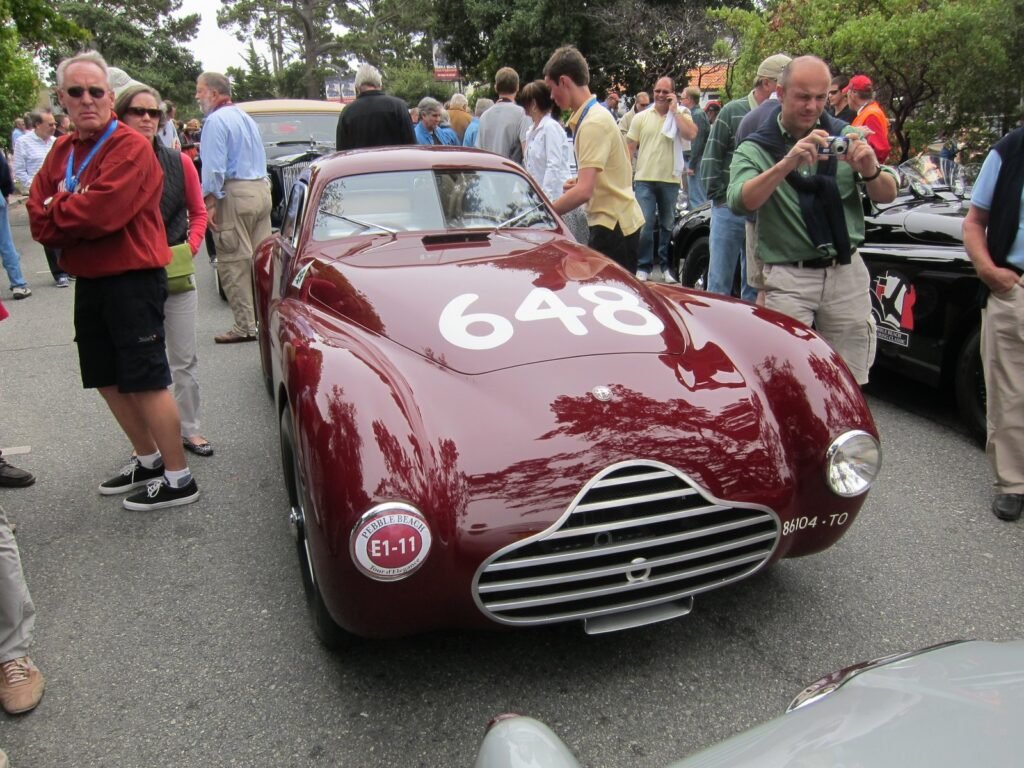
At Gooding’s Pebble Beach sale in August 2013 it sold for $4,840,000, a world auction record for a post-war Alfa Romeo. Five years later, at Bonhams’ Quail Lodge sale in Carmel, it went for $3,525,000. Same car, same Monterey week, $1,315,000 lighter.
The file nobody has closed
A car this valuable should have a clean record. It doesn’t.
How many were built. Three, according to almost everyone. “One of only two built,” according to the 2013 auction catalog. Someone probably didn’t count 920003 because of its bigger engine, but the catalog doesn’t say so.
What happened to 920003. You’ll read that it was built in 1950 with the 6C 3000’s three-liter engine and raced once as a 6C 3000 C50, and elsewhere that it was destroyed in the 1950 race. These are usually presented as rival versions. They aren’t. The 1950 Mille Miglia entry list has Sanesi and Bianchi in a 6C 3000 C50, number 740, and Bonhams records 920003’s crash in that race as so bad the car was judged beyond rebuilding. One race, one wreck, the end.
Fangio’s finish. Third in the official 1950 results, 14 hours, 2 minutes, 5 seconds. Second in several published car profiles. Wrong, and endlessly copied.
The rear end. Bonhams describes a live rear axle with a transverse spring and trailing arms. The 8C 2900B the frame came from used independent swing axles at the back. If the 2900’s spring stayed, what hung off it? I haven’t found a technical source that settles it.
The dry sump. Said to be unique to 920001 among post-war Alfas, apart from the three-liter D150. I found no independent confirmation.
The numbers themselves. 920001, 92001, 920.001 or just “001”, depending on who typed it.
And 920001 itself? Consalvo Sanesi had crashed it in the 1948 Mille Miglia hard enough to tear the roof off, so it was rebodied to look like 920002. 920003 ended in a ditch. Of the three, only Rol’s car still wears the body Alfa Corse built.
Barcelona, October 1951
Ricart had nothing to do with these cars, but the story keeps running into him.
On October 28, 1951, Fangio won the Spanish Grand Prix on the Pedralbes street circuit in Barcelona, in an Alfa Romeo 159, and clinched his first world title. Straight after, Alfa announced it couldn’t afford to race in 1952. It was the company’s last Formula One race for almost thirty years.
A few miles across town, in the old Hispano-Suiza works at La Sagrera, Ricart was building Pegaso trucks, and earlier that month he had shown the Pegaso Z-102 at the Paris Motor Show: a quad-cam V8 sports car aimed squarely at Ferrari. Alfa Romeo quit racing in the hometown of the man who had pushed Enzo out of Portello, while that man was getting ready to take on Ferrari himself.
How “Competizione” ended up on a Maserati
In 2007 Alfa Romeo went back into the drawer for that word and hung it on the 8C Competizione: a 1,585 kg coupe assembled by Maserati in Modena, on a shortened Maserati floorpan, with a 4.7-liter V8 built in Maranello. The 8C part pointed at Jano’s straight-eights. The Competizione part pointed at this car. Alfa’s own heritage department says so.
In America, where Alfa had no dealer network at the time, the 8C was sold and serviced through Maserati stores.
Here is the part that stings. The 6C 2500 Competizione was a six-cylinder car built on real 8C metal. The 8C Competizione was an eight-cylinder car built on somebody else’s. In fifty-nine years Alfa Romeo went from recycling its own greatness to borrowing the neighbor’s.
Alfa can mine its archive all it likes. Just don’t flip through it like a sticker book. These three coupes were what the company could afford when it could afford nothing, and they still came home with two Mille Miglia podiums and a Targa Florio on drum brakes and a pre-war engine. That is how a word gets earned.
Check you’re still alive.
Photos: 6C 2500 Competizione at Rétromobile, Thesupermat (CC BY-SA 4.0); 8C 2900B, Y. Leclercq (CC BY-SA 4.0); 158 and 159, azrhey (CC BY-SA 2.0); 6C 2500 Competizione at Pebble Beach, Jay Cross (CC BY 2.0); Wifredo Ricart, Eulogia Merle / FECYT (CC BY-SA 4.0). Via Wikimedia Commons.
1 thought on “Alfa Romeo 6C 2500 Competizione: The Car Whose Name Got Stolen”