
CITROËN DS “TIBURÓN” (1955–1975)
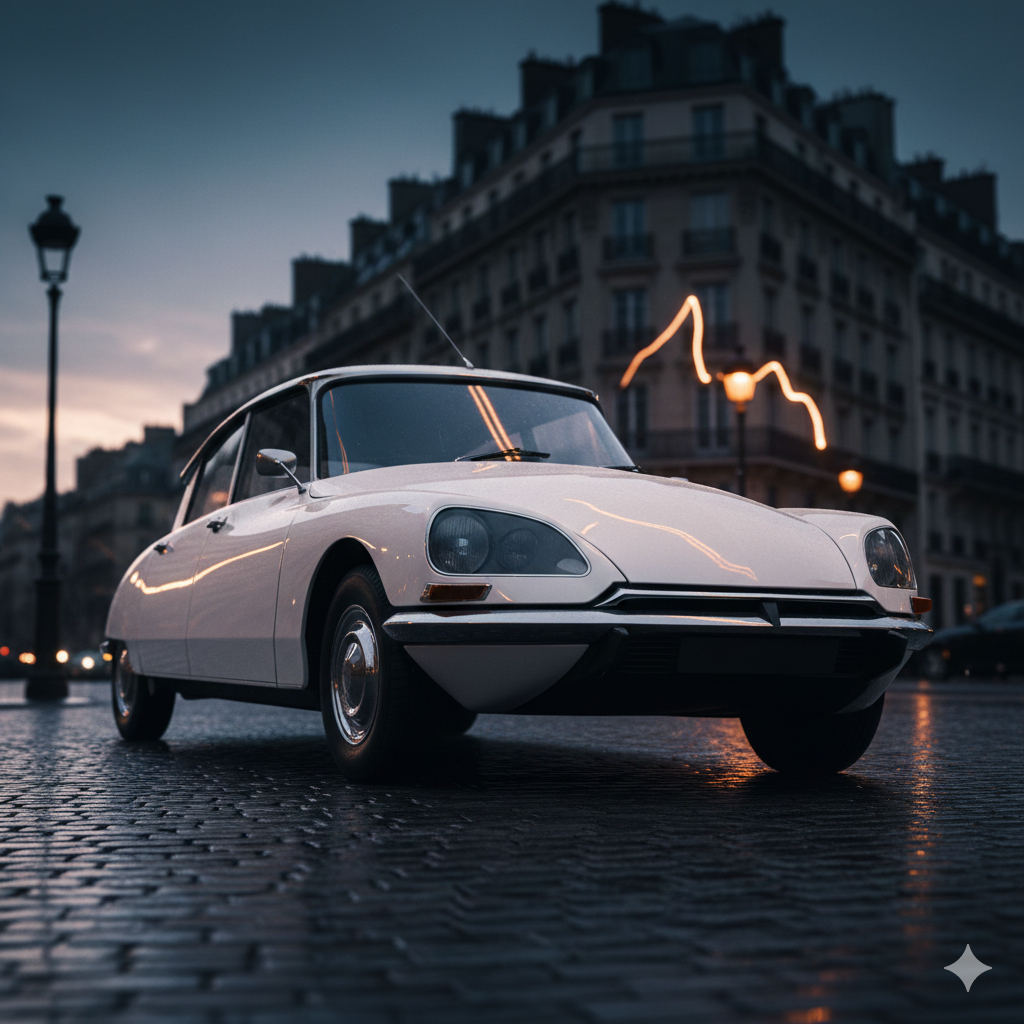
The Citroën DS “Shark”: How France Invented the Future of the Automobile (And No One Copied It)
In 1955, something extraordinary happened at the Paris Motor Show that shattered every existing convention. The Citroën stand drew a crowd that simply could not look away from an impossible silhouette — aerodynamic, almost alien. Within hours, the company had received 12,000 reservation orders in a single day. The model was called the Citroën DS, although in Spain, everyone would come to know it by a much more evocative nickname: the Shark (“Tiburón”).
Because that is exactly what it looked like. A silver shark frozen in time, ready to cruise the asphalt with the same predatory elegance its marine namesake uses to cross the ocean. The Citroën DS was not a car. It was a statement of intent about what the automobile could become, if engineers were simply allowed to dream without restraint.
Design From Another Planet
The DS was designed primarily by Italian sculptor Flaminio Bertoni, who had previously worked on the Citroën Traction Avant and the 2CV. He was not a conventional engineer — he was an artist who understood form before function, although in the DS, both coincided in a supernatural way. The elongated bodywork, the roofline flowing uninterrupted to the rear, the wheels almost hidden beneath the skirted fenders, and that low, pointed nose created a silhouette that in 1955 looked like it had been ripped from a science fiction film.
Bertoni died in 1964, just as Citroën was preparing an update to the DS. His successor, Robert Opron, was responsible for the 1967 redesign, which introduced double swivelling headlamps that turned with the steering wheel to illuminate corners. Yes — the headlights rotated with the steering input to light up bends in the road. In 1967. While the rest of the industry was still debating whether disc brakes were a sensible idea for production cars.
The Magic No One Else Had: Hydropneumatic Suspension
If the DS’s design was impressive, its engineering was simply incomprehensible to its contemporaries. The most revolutionary system was, without question, the self-levelling hydropneumatic suspension, developed by engineer Paul Magès. This system used pressurised nitrogen and hydraulic fluid to create a suspension that automatically adapted to vehicle load, road surface conditions, and speed. The result was a ride quality that no other manufacturer could match for decades.
The hydropneumatic suspension also had a feature that would go viral on social media today: the car literally rose off the ground when you started the engine. The bodywork lifted several centimetres until it reached its standard ride height, as if the car were stretching after a nap. And it could continue driving, in an emergency, with a rear wheel completely removed — without the hub touching the road surface. This feat was publicly demonstrated on several occasions, leaving witnesses completely speechless.
That same high-pressure hydraulic system — operating at approximately 150 bar — also controlled the brakes, clutch, power steering, and the semi-automatic gearbox in certain variants. Everything connected to a single centralised hydraulic pump. A concept of systems centralisation that the industry would not explore again with such ambition until the arrival of modern electronics.
The Shark That Saved General de Gaulle
The history of the DS is inextricably linked to 20th-century French politics. On 22 August 1962, President Charles de Gaulle survived an assassination attempt in Petit-Clamart. A commando unit from the OAS — a right-wing nationalist organisation opposed to Algerian independence — fired more than 140 bullets at the presidential motorcade. The car transporting De Gaulle was a Citroën DS 19.
The gunmen hit the rear tyres. Any other vehicle of the era would have immediately lost control. But the DS, thanks to its hydropneumatic suspension, continued moving on deflated tyres, allowing De Gaulle’s driver — the highly experienced Francis Marroux — to accelerate and escape the ambush. De Gaulle was completely unharmed. The incident turned the DS into a living legend and a symbol of the French Fifth Republic.
Three Engine Families, Twenty Years, One Myth
The DS was produced between 1955 and 1975, a two-decade period during which the model evolved continuously without losing its essential character. Early versions used a four-cylinder engine of just 1,911 cc producing 63 bhp — a figure that today seems almost absurd for a car of such size and technological ambition. But it was sufficient at the time, thanks to the body’s exceptional aerodynamics (a drag coefficient of 0.31, extraordinary for the mid-1950s) and a relatively moderate weight.
Over the years, the range expanded and the engine grew. The largest version reached 2,347 cc in the DS 23, which in fuel-injected form produced 130 bhp and was capable of 188 km/h (approximately 117 mph). It was no rocket ship, but in the context of a French luxury saloon of the early 1970s, that performance combined with the hydropneumatic suspension’s ride comfort was simply unmatched by competitors.
The DS also came in a convertible version, coachbuilt by Henri Chapron. These low-volume cars, built on the ID platform, are now highly valuable collector pieces. There was even an estate body variant called the Safari, capable of carrying up to eight passengers with van-like cargo capacity.
In total, Citroën manufactured more than 1.45 million DS units between 1955 and 1975, across factories in Paris and other plants in Australia, Portugal, the United Kingdom, South Africa, and Yugoslavia.
A Legacy That Has Never Been Surpassed
The DS took first place on The Daily Telegraph’s list of “the 100 most beautiful cars of all time” in 2008. It was voted the second most important car of the 20th century — behind only the Ford Model T — by a panel of international experts in 1999. Enzo Ferrari, a man not exactly known for lavishing praise on rivals, reportedly called it the absolute masterpiece of automotive design.
And yet, despite all of that, the industry never quite managed — or chose — to learn the lessons the DS was teaching. Hydropneumatic suspension was never adopted widely by other manufacturers. Citroën itself retained it as a defining signature until 2017, when it was discontinued with the second-generation Citroën C5. Today, DS Automobiles — the luxury spin-off of the PSA Group created in 2014 — is reportedly working on a spiritual successor to the Shark in the form of a high-performance electric saloon, recovering the aerodynamic design language and adaptive suspension as key differentiators.
The Shark died in 1975. But its influence has been swimming beneath the surface for decades, waiting for someone with enough courage to truly imitate it.
Conclusion (With a Sharp Edge)
The Citroën DS demonstrated in 1955 that it was possible to build a production car with cutting-edge technology, revolutionary design, and a price accessible to the French middle class. It did so without asking permission from anyone, without following market trends, and without listening to the conservative engineers who said it was too complex for the average buyer.
And seventy years later, we are still surrounded by bloated SUVs with prehistoric suspension and designs seemingly calculated by committee to offend absolutely no one. The industry had the best possible instruction manual with the DS and chose not to read it. That does not say much for the courage of today’s manufacturers, does it?