
Flush Door Handles Are Killing People — And Automakers Keep Using Them
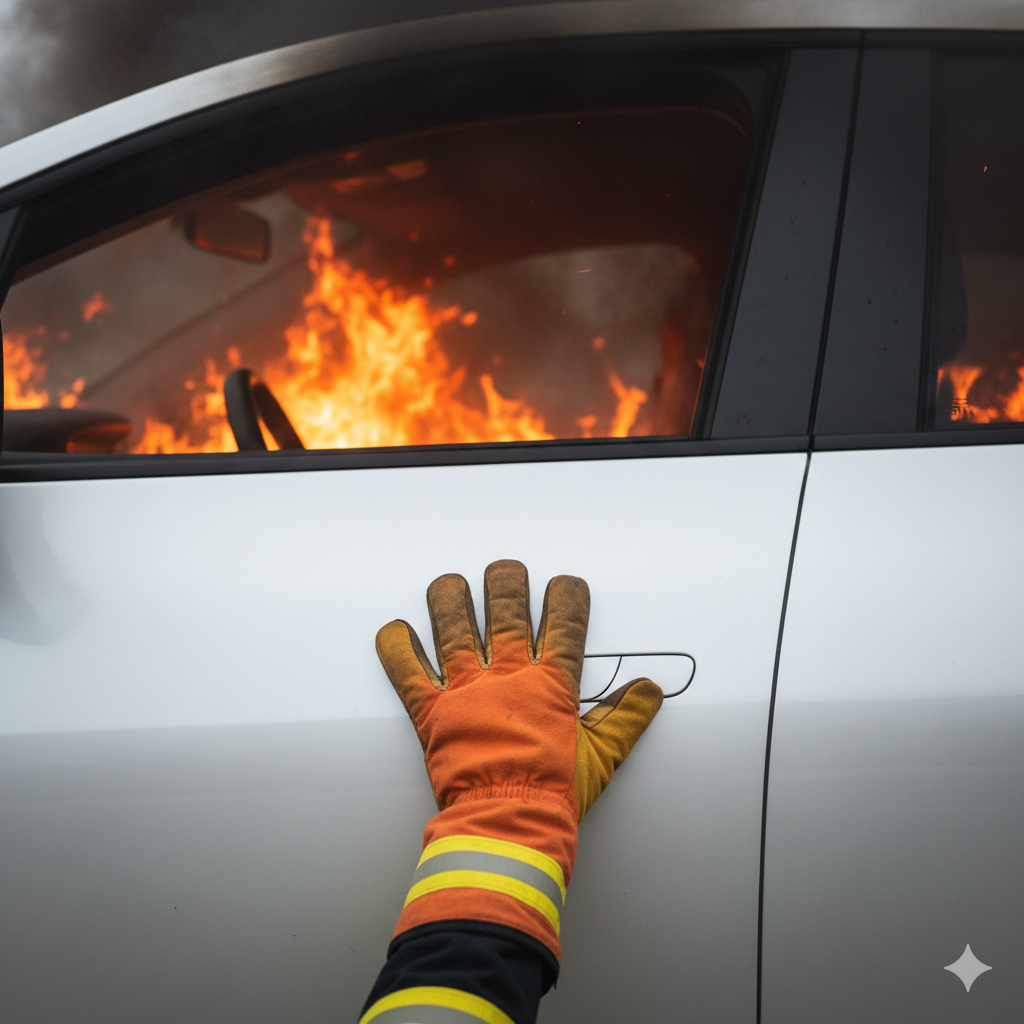
Your car earned five stars in crash tests. Great. But can you actually get out when it matters most?
Let me ask you a question that should be embarrassingly simple: What is the primary function of a door handle?
To open the damn door.
It’s not to look pretty. It’s not to save 0.003 in drag coefficient. It’s not to make your car look like it was designed during a Jony Ive creative fever dream. It’s to open the door. That’s it. That is the entire job description.
And yet, in their obsessive quest to make cars that look like giant suppositories sliding through the wind, manufacturers have managed to turn one of the most basic mechanisms—solved since 1890—into a death trap.
I’m not exaggerating. People are burning alive inside their cars because nobody can open the doors.
The Numbers Don’t Lie — They Scream
A Bloomberg investigation uncovered 140 documented incidents of people trapped inside vehicles due to electronic handle failures. At least 15 people have died in accidents where the doors simply wouldn’t open. Not because of structural damage. Not because of catastrophic deformation. But because the handle design failed.
NHTSA—the U.S. road safety regulator—has seen complaints about electronically controlled doors and handles surge by 65% in 2024 compared to the previous year. They have opened formal investigations. China has gone even further: it has become the first country in the world to ban fully electronic handles, with regulations set to take effect in 2027.
Let that sink in. China—not exactly known for over-regulating its booming auto industry—looked at the data and said, “This is too dangerous.” Meanwhile, in the U.S. and Europe, we are still debating.
How Did We Get Here?
Somewhere around 2012, when Tesla introduced the Model S with its motorized retractable handles, the auto industry collectively decided that door handles were a design problem that needed solving. They weren’t. But flush, electronically powered handles became the calling card of the electric revolution. Sleek. Futuristic. Premium.
Then everyone copied them. Audi e-tron. BMW iX. Chevrolet Corvette. Fiat 500e. Ford Mustang Mach-E. Genesis G90. Various Lexus models. Lucid Air. Rivian. Range Rover. Mercedes-Benz. Fisker Ocean. Lincoln Continental. Hyundai. Nio. Xiaomi. Virtually every Chinese EV maker.
This is not just a Tesla problem. This is an industry-wide failure of engineering priorities.
The sales pitch was convincing: flush handles reduce aerodynamic drag, which improves EV range. They save weight. They look modern. Some can even prevent a passenger from “dooring” a cyclist.
What no one talked about—or chose to ignore—is what happens when the 12V battery dies, when the car loses power after a crash, or when an electrical short renders the entire system inoperative.
This is the fundamental engineering flaw: unlike mechanical handles that fail in the “open” position, electronic handles fail in the “closed” position. When the power is cut, you are locked in.
The Cases That Should Haunt Every Engineer
- Dr. Omar Awan — Florida, 2019. A 48-year-old anesthesiologist. He lost control of his Tesla Model S and hit a palm tree. A police officer arrived in seconds but couldn’t open the doors because the handles were retracted flush with the body. Witnesses watched helplessly as the car filled with smoke and flames. Dr. Awan had no internal injuries. No broken bones. He died of smoke inhalation because no one could grab a handle that didn’t exist.
- Cybertruck — Piedmont, California, November 2024. Three college students: Krysta Tsukahara (19), Jack Nelson (20), and Soren Dixon (19). The Cybertruck hit a tree and a wall. The coroner determined that at least two died from smoke inhalation and burns, not from impact injuries. A friend in another car tried to open the doors and couldn’t. He had to strike the window ten to fifteen times to break it. The “armored” glass Tesla sells as a feature became part of the problem. They pulled one out alive. Three did not make it.
- Krysta Tsukahara’s family says she survived the impact and was fully conscious, screaming for help. She couldn’t get out. Her parents’ lawsuit describes her suffering “unimaginable” pain as she burned alive, fully aware, trapped by an opening mechanism hidden under a rubber mat in a door pocket.
- Samuel Tremblett — Massachusetts, October 2025. Twenty years old. His Model Y crashed and caught fire. He survived the impact. He called 911. He said the car was burning and he couldn’t open the doors. He died.
- Virginia, 2024. An off-duty firefighter reached a burning Model Y. He knew what he was facing—he had responded to EV fires before. Even he struggled with the electronic doors that failed after the crash.
- Xiaomi Sedan — China, 2024. A fatal accident with three deaths; the driver was trapped by inoperative doors. This triggered the Chinese regulatory response.
- Fisker Ocean — Florida. A total battery failure trapped an owner, his elderly mother, and his young son inside the vehicle for two hours in a supermarket parking lot.
- Ford Mustang Mach-E. Ford recalled 200,000 vehicles (2021–2025) because 12V battery failures left passengers locked inside.
- Volkswagen ID.4. A recall open between September 2024 and January 2025 prevented VW from selling any ID.4s because doors could suddenly fly open if the electronic handles got wet. VW’s customer service response was that “there was nothing unsafe about the vehicle locking people inside the car.”
“Nothing unsafe.” Let that marinate for a moment.
The Crash Test Paradox
This is what keeps me up at night as someone working in rolling stock manufacturing: crash tests are designed to measure survival at impact, not whether the occupants can actually exit the vehicle afterward.
Your car gets five stars. Brilliant. The airbags deployed perfectly. The crumple zones absorbed energy exactly as designed. The survival cell maintained its integrity. The seatbelts pre-tensioned flawlessly. And now the battery pack is compromised, a thermal event is starting, smoke is filling the cabin, and the handles—those precious, aerodynamic, award-winning handles—are as useful as an ashtray on a motorcycle.
As human factors engineer Charles Mauro put it: “Tesla engineers went wildly in the direction of automation and overlooked what happens to the human body after an accident.”
But it’s not just Tesla. It’s the whole industry. It’s crash test protocols that never contemplate evacuation. It’s safety regulations that “under-specify” safety standards for vehicle entry and exit.
“But it has a manual emergency release!”
Yes. Every vehicle with electronic handles has a manual emergency release somewhere. The problem is the “somewhere.”
In a Tesla Model Y, the rear manual release is hidden under a storage pocket. In the Cybertruck, it’s under the liner of the door pocket—you have to remove a rubber mat to reveal a cable loop that you have to pull forward. The front release is completely different from the rear, because apparently consistency in emergency procedures would be too logical.
On page 227 of the Cybertruck manual—page two hundred and twenty-seven—are the instructions for the emergency opening.
Imagine you just had an accident. You are disoriented. Possibly injured. Smoke is filling the cabin. You are panicking. And the solution is a procedure you’ve never practiced, with a hidden mechanism you didn’t know existed, in a location that is different for the front and back, described on page 227 of a manual you’ve never read.
This isn’t engineering. This is negligent optimism disguised as minimalism.
The Solution is Shamefully Simple
This is where my blood truly boils. The solution isn’t a million-dollar engineering challenge. It doesn’t require reinventing anything.
You want a flush handle for aerodynamics? Fine. Make it flush. But make it a mechanical push-to-present type. You push it, one side pivots out, you pull. No electronics needed for the basic function.
BMW already does a version of this on some models. Their two-in-one interior handle works electronically with a soft pull or mechanically with a harder pull. BMW’s logic: if a door doesn’t open during an emergency, the driver’s natural reaction will be to pull harder. So they made pulling harder the manual override. Revolutionary concept—designing for how humans actually behave in emergencies rather than for an Instagram render.
The Industry’s Dirty Secret
An auto journalist nailed it: “I don’t think in all the years I’ve been evaluating new vehicles I’ve used an electronic handle that worked correctly on the first try.”
These handles don’t just fail in accidents. They fail in the cold. They fail when batteries degrade. They fail with software glitches. They fail when they get wet. They fail so regularly that owners have developed hacks, forum threads, and YouTube tutorials for something that shouldn’t require any instruction.
Parents have had to break the windows of their own cars to reach their children after electronic handles locked them out. The NHTSA investigation includes at least four cases where parents had to smash glass to reach children strapped into car seats.
We’ve spent decades designing cars to protect occupants during an impact. And then we put a door on it that won’t open afterward.
Where We Are Headed
China’s 2027 regulations will require all vehicles to have mechanically operative handles both inside and out. In the U.S., a bill was introduced in January 2026 requiring manual interior handles and exterior access for rescue teams. Europe is developing similar mandates.
The era of the fully electronic handle—the one that treats a fundamental safety mechanism as a design opportunity—is ending. Not because the industry saw the light. But because people died. Because people burned alive in cars that earned five-star safety ratings.
Every time a manufacturer puts an electronic flush handle on a car, they are making a statement: We think this looks cool enough to justify the risk of you not being able to open your door when your life depends on it.
Open. The. Door. That’s it. That’s all it has to do.
If your car has electronic handles—and many modern cars do, not just EVs—go look for the manual emergency release right now. Not tomorrow. Now. Practice it. Show your passengers. Show your children. Because an emergency is not the time to read page 227.
Petrolhead — Not Enough Cylinders Mechanical assembler. Automotive enthusiast. 30+ years asking, “But does this actually work?”