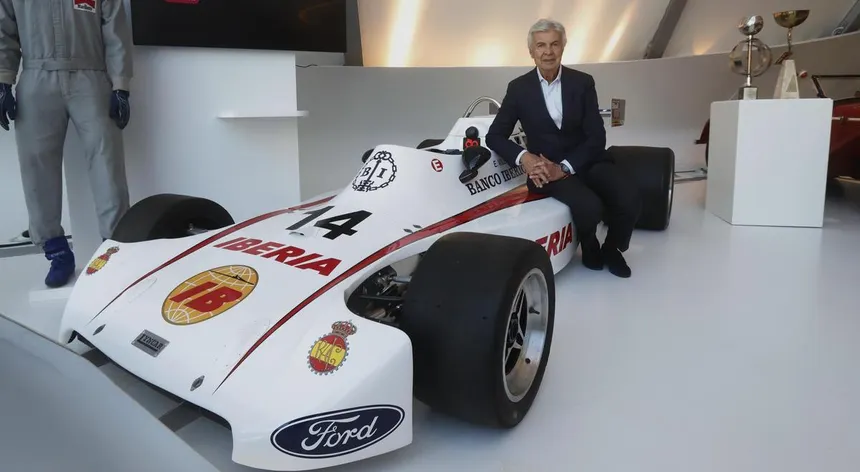
Emilio de Villota: The Spaniard Who Won the British F1 Championship When Spain Couldn’t Win Anything
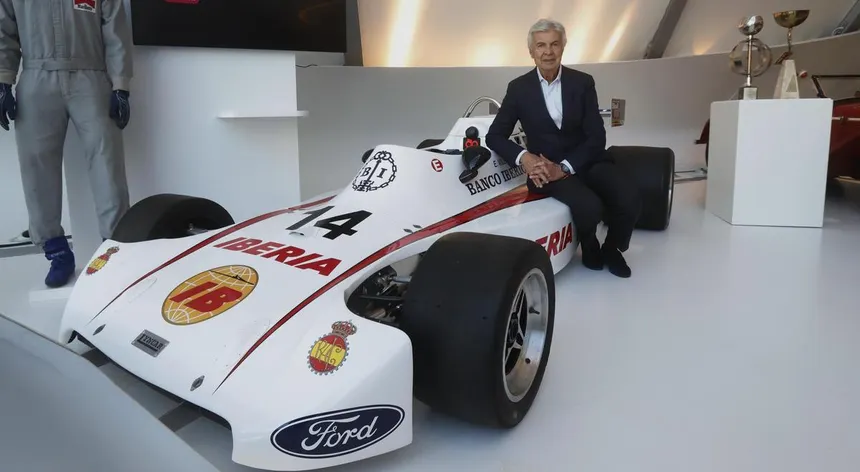
In April 1980, a thirty-three-year-old Madrileño walked into Frank Williams’ workshop in Didcot, Oxfordshire, and bought a Williams FW07. Not a sponsored deal. Not a lease. He bought the car, paid for it, took it back to the Spanish-funded RAM Racing team, and entered it in the Aurora AFX British Formula One Championship — a series run on British soil, with British cars, against British, Chilean, Irish and Australian drivers in machines that until recently had been racing the World Championship. The same model FW07 with which Alan Jones was about to clinch the 1980 World Championship.
Twelve races later, this Spaniard had won six of them, finished second in four, claimed six pole positions, and was crowned 1980 Aurora AFX British Formula One Champion. He won at Silverstone, twice at Mallory Park, at Brands Hatch — and, for good measure, at Monza, the only round of the championship that left British soil. He beat Eliseo Salazar, Désiré Wilson, Rupert Keegan, Geoff Lees, every single name the series put on a grid that year. He was the first non-British driver ever to win the British Formula One Championship. He remains, even today, the only driver from a country with no domestic F1 industry to have ever taken that title.
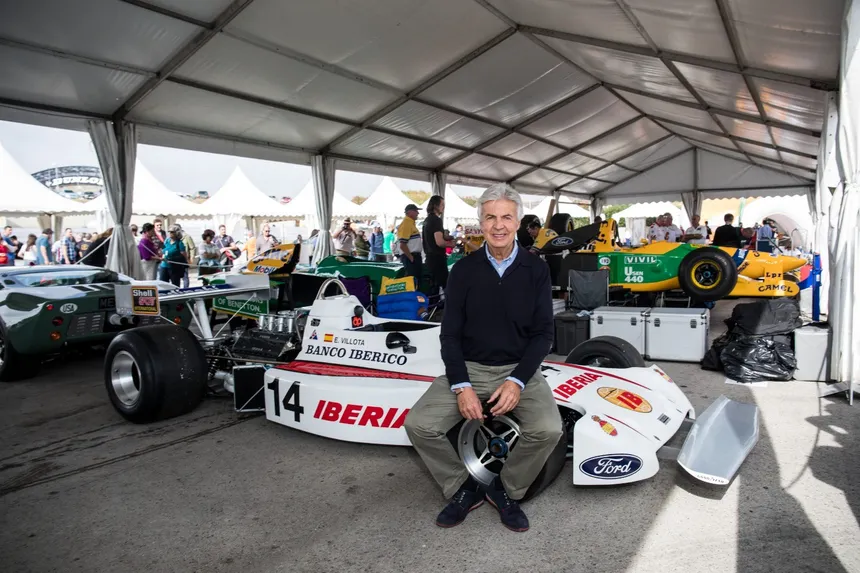
His name was Emilio de Villota Ruíz. He was born in Madrid on 26 July 1946. Three years before that win at Silverstone, he had been working behind a desk at Banco Ibérico in Madrid, processing loan applications. To anyone reading this from inside the British motorsport industry, where Frank Williams’ garden-shed origin story is canon, that career arc should sound familiar. The difference is that Williams was building a team inside a country where motorsport was already an industry. De Villota was building one inside a country where, when he phoned a potential sponsor in 1976, he had to start the conversation by explaining what a Grand Prix was.
This is the story of a Spaniard who tried to do, alone, what entire nations were doing collectively at the same time. He partly succeeded. And then, with the same money and the same energy, he went home and built the racing school that produced almost every relevant Spanish driver of the next thirty years.
A Lotus Seven and a brand-new circuit
When Emilio de Villota started racing in 1967, Spain had just opened its first proper modern racing circuit: the Circuito del Jarama, fifteen kilometres north of central Madrid. He was twenty-one years old, lived nearby, and bought himself a Lotus Super Seven. Family lore, repeated in interviews over the decades, says he paid for that first car by selling the puppies of his dog. It is not a metaphor. He sold puppies, scraped together pesetas, added his own savings and some family help, and bought the Seven. Before that, according to the same family accounts, he used to watch the Jarama races “through the fence” because there was no point of entry, in 1960s Spain, for anyone without a paddock surname.
He has described those years in his own words. In a Sports Car Digest interview decades later, he put it bluntly: “When I was young, growing up in Spain was very difficult for lovers of motor racing. The Spanish were then known for bullfighting, football and golf.” Motorsport, in 1960s Spain, was an oddity practised by a handful of wealthy enthusiasts and a few imported European drivers. There was no national constructor of any consequence. There was no domestic F1 team. There was no career path.
He climbed it anyway. Hillclimbs first, then circuit racing, where his Lotus Seven had to compete against Ford GT40s and Porsche 906s and 908s that should never have been in the same category but were, because in Spain in those years you grouped together whatever was available. From there he moved to the Copa TS, then to the Spanish-built Fórmula SEAT 1430 and 1800, finishing second in the championship of the former. He bought a Ford Capri RS 2600 from Jorge de Bagration and ran the European Touring Car Championship round at Jarama, taking second place alongside Mario Cabral. In 1976, he made a decision that, for any Spaniard of his generation, was effectively a biographical fracture: he bought a Formula 1 chassis.
The car was a Lyncar-Cosworth, the same chassis John Nicholson had used in the 1974 and 1975 British Grands Prix. Bought second-hand, of course. With it, De Villota entered the 1976 Shellsport G8 International Series — a UK-based Formula Libre championship that mixed F1, F2, F5000 and Formula Atlantic on the same grid. He finished fourteenth in the championship with two fifth places. The result mattered for one administrative reason: it earned him the FIA superlicence, which from that season onwards became compulsory to enter any World Championship Grand Prix.
He rented a Brabham BT44B from John MacDonald’s RAM Racing for the 1976 Spanish Grand Prix at Jarama. Did not qualify. End of weekend, end of money, end of obvious next steps. Most people would have gone back to the bank job. De Villota took the data home and calculated what he needed to do differently next year. He decided he needed an entire team.
Iberia Airlines F1: the first Spanish-licensed F1 team in history
In January 1977, Emilio de Villota walked into Banco Ibérico, where he had been working as a branch director, and resigned. Ten years after the Lotus Seven, he had decided to give up the steady salary and build, alone, what no Spaniard had ever built: a Formula 1 team registered with a Spanish FIA licence and entered in the World Championship.
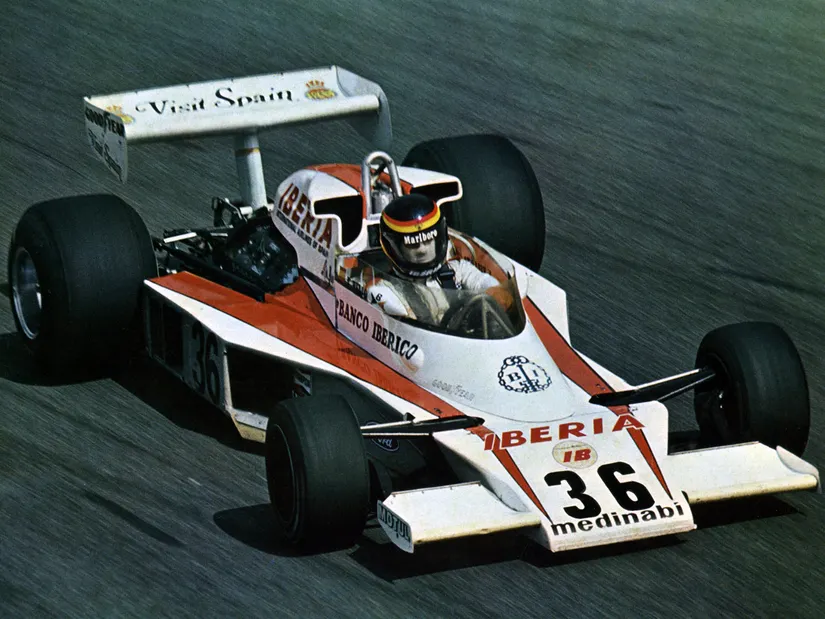
The team was called Iberia Airlines F1, after its principal sponsor. Iberia paid twelve million pesetas of a thirty-million budget. The rest came from Banco Ibérico, Visit Spain, Fase, Lois and a string of smaller sponsors that De Villota recruited individually, by phone, by letter, by face-to-face meeting. For context: thirty million 1977 pesetas was roughly the cost of one McLaren team’s coffee budget for a season. Tyrrell, McLaren, Brabham and Ferrari were operating on budgets ten to twenty times larger.
The full team consisted of six people: De Villota as driver, a manager, a sporting director, two mechanics (one for the chassis, one for the engine), and a truck driver who doubled as tyre handler.
With that budget, De Villota bought two McLaren M23 chassis (the first one from chief mechanic Alistair Caldwell for two million pesetas, originally converted to F5000 specification for the American market and damaged in transit when seawater entered the cargo hold during shipping) and three Ford-Cosworth DFV engines at 1.5 million each. With that, Iberia Airlines F1 entered seven European rounds of the 1977 Formula One World Championship.
There is a useful comparison to draw here. Frank Williams started his first F1 team in 1969 with a Brabham bought second-hand and a budget that would feel familiar to anyone who has read a startup memoir. Ken Tyrrell built his world-championship team out of a converted timber shed in Ockham, Surrey. Bruce McLaren launched his team from a workshop in Colnbrook. The difference between those three and De Villota is structural. Williams, Tyrrell and McLaren were operating inside a country that had decided, decades earlier, that motorsport was an industry worth nurturing. De Villota was operating inside one that had decided nothing of the kind.
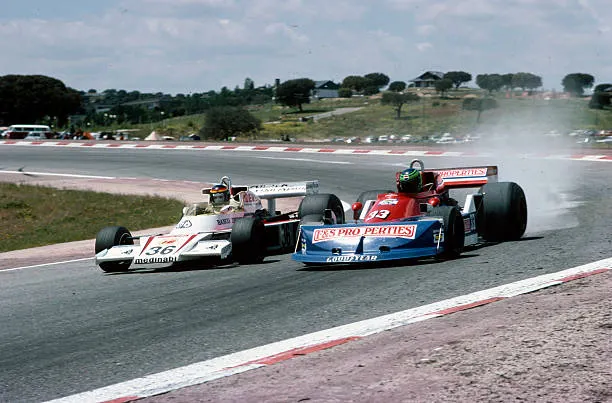
Yet, on 8 May 1977, the McLaren M23 chassis #6, painted in the orange and white livery of Iberia, qualified twenty-third on the grid of the Spanish Grand Prix at Jarama. De Villota took the start. He finished thirteenth, five laps behind the winner, Mario Andretti in the Lotus 78. He became, that afternoon, the fifth Spaniard ever to start a Formula 1 World Championship Grand Prix, after Antonio Creus, Francisco Godia, Alfonso de Portago and Alex Soler-Roig.
He qualified once more that year, at the Austrian Grand Prix in August, where he ran to the final lap before crashing and being classified seventeenth. The other five entries of the season — Belgium, Britain, Holland, Italy, the United States — all ended in “did not qualify.” Those were the seasons when thirty-five drivers were entering for roughly seventeen grid slots; ten failures-to-qualify per weekend were standard for the back of the field. For a six-person privateer team running a 1973 McLaren against 1977 Ferraris, simply making the start line was already, in itself, a result.
And in parallel, in the United Kingdom, something else was happening.
The first Spanish win in international F1
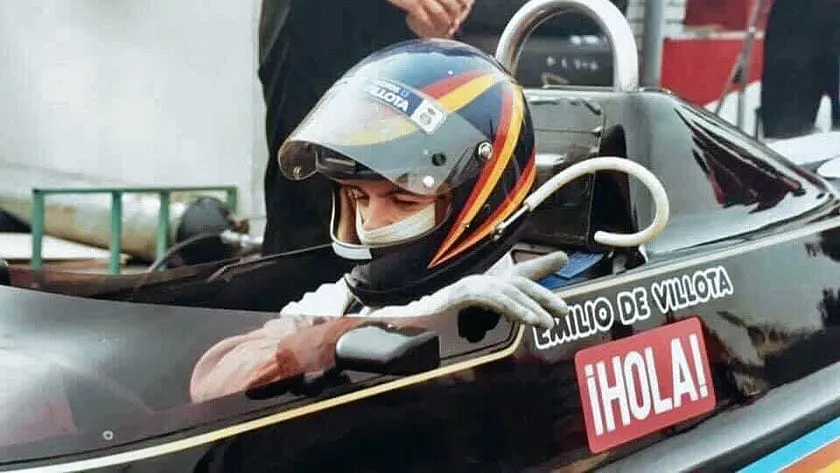
In March 1977, at the opening round of the Shellsport G8 International Series at Mallory Park, Emilio de Villota crossed the finish line first in his Lyncar-Cosworth. It was the first victory by a Spanish driver in an international championship aboard a Formula 1 car. Not the second. The first. He added two more wins that season, including one at Brands Hatch on 29 August in his McLaren M23, beating Tony Trimmer’s Surtees TS19 by exactly one second after forty laps of close racing. He finished fifth in the championship overall.
Here is what was actually happening, when you read the two campaigns in parallel. The Spaniard fighting to make Grand Prix grids on Sunday afternoons was the same Spaniard winning F1 races in Britain on the same weekends. The driver was the same. The difference was the machinery and the budget. In the World Championship he was facing Ferrari 312T2s and Lotus 78s with current technology and full factory backing. In the Shellsport series he was racing against other privateers in 1973-vintage cars. When the equipment was levelled, De Villota won.
That single observation — that the talent was real, the obstacle was structural — would define every decision he made for the next twenty years.
Aurora 1980: a Spaniard wins the British F1 Championship
In 1978, with the loss of his title sponsor, the now-obsolete McLaren M23 failed to qualify even for the Spanish Grand Prix. In 1979, switching to a Lotus 78 (the ground-effect car that Formula 1 was still digesting), he won four rounds of the Aurora AFX Championship at Thruxton, Zandvoort, Oulton Park and Nogaro, but mechanical failures and tyre problems dropped him to third in the title fight.
For 1980 he changed strategy entirely. With Banco Occidental as new principal sponsor, he stopped trying to qualify for World Championship rounds with outdated equipment, walked into Frank Williams’ workshop in Didcot, and bought a Williams FW07 directly from Williams. The same model FW07 that Alan Jones was driving to the 1980 World Drivers’ Championship. He partnered again with RAM Racing as the operating team. Decades later, asked about that purchase in a Sports Car Digest interview, De Villota described the car in his own words: “The car was just the best. I purchased it directly from Frank Williams, and it gave me six pole positions and nine podium places, including five wins, and I became the 1980 Aurora AFX British Formula One champion.”
The 1980 Aurora AFX British Formula One Championship ran twelve rounds between April and October. De Villota dominated it from start to finish. Five race wins. Six pole positions. Nine podiums in twelve races. Two of those wins came at Mallory Park, one at Brands Hatch, one at Silverstone — and one at Monza, the only round of the championship that left British soil. Asked about that Italian win, the protagonist himself does not hesitate: “the win at Monza — the only time the championship ran away from the UK — was special, with all the history surrounding the circuit.”
This is the part that is essential to set down in the proper historical context: in winning that championship, Emilio de Villota became the first Spaniard ever to win any championship sanctioned for Formula 1 cars. The Aurora AFX was not the World Championship; it was a national series running F1 chassis a generation behind the front of the WDC. But it was an F1 championship. The grids included Williams, Lotus, McLaren, Surtees and Tyrrell machines. The competition was real. And no Spaniard had ever won anything like it before him. None would, until Fernando Alonso started winning World Championship Grands Prix in 2003 — twenty-three years later.
King Juan Carlos I of Spain awarded him the Premio Nacional al Mérito Deportivo, the country’s highest sporting honour, that year. The Spanish press wrote about him, briefly. And then, in the way that Spain treats stories that do not fit neatly into its national mythology, the country largely forgot.
1981: the first Spanish win in an FIA World Championship round
For 1981, the increasing dominance of turbocharged engines pushed F1 budgets out of reach for privateers. De Villota began moving into the World Sportscar Championship, where his previous year’s Williams FW07 no longer fitted but where a competitive prototype was still within the reach of a private team. The project was to debut the Lola T600, a car designed by British engineer Eric Broadley and French aerodynamicist Max Sardou as the first true “wing car” sports prototype — a direct technical ancestor of what would become the Group C formula a year later.
With co-driver Guy Edwards, in a Lola T600 entered by Grid Team Lola, De Villota took two overall victories that season: the Coppa Florio at Pergusa and the Flying Tiger 1000 at Brands Hatch. Both counted for the FIA World Championship. Both, taken together, are recognised as the first overall victories by a Spanish driver in FIA World Championship rounds. Another historical first that Spain barely acknowledges to this day.
That June, he debuted at the 24 Hours of Le Mans, sharing the #18 Lola T600 with Edwards and Spanish veteran Juan Fernández. They finished fifteenth overall and third in the S+2.0 class. For most European drivers, getting to Le Mans is a career milestone in itself. For De Villota it was simply the next item on a schedule that had stopped resembling anyone’s normal career path years earlier.
In parallel, in that same 1981, he attempted the Spanish Grand Prix one more time. This time the obstacle was not technical. It was political.
The last attempt at the World Championship and a door that closed for ever
Bernie Ecclestone, leading the constructors’ association FOCA in its open war with FISA, had decided that privateer entries had to end. De Villota submitted his entry for the 1981 Spanish Grand Prix with the same Williams FW07 from the Aurora-winning campaign, now adapted to the new regulations. RACE, the Spanish organiser, was pressured into excluding the entry. He was allowed to run in Friday’s free practice. By the afternoon a telex from FISA had declared his entry “illegal”, and the white-and-blue Williams of Banco Occidental was removed from the paddock.
This is not a footnote. That Friday at Jarama was the last attempt by a privateer driver to enter a Formula 1 World Championship Grand Prix. Not in Spain. Anywhere. After Jarama 1981, privateers were closed out of F1 forever. The era in which a sufficiently determined enthusiast could buy a second-hand McLaren or Williams and line up against the factory teams on a Sunday afternoon ended in that Madrid paddock, with an administrative decision signed by people who had never set foot in a workshop. Ecclestone won the battle, the privateers lost a war that had never officially been declared, and Formula 1 became, from that point on, what it is now: a closed club of industrially-licensed teams. De Villota was the last man who knocked on the door before it was bolted shut.
In 1982 he signed with March as a contracted factory driver — the first time in his entire career that he had been hired as a salaried F1 driver rather than financing his own entry. He was within weeks of competing with full equipment, on equal contractual terms with his rivals, when Rothmans arrived at March with a sponsorship cheque conditional on Jochen Mass taking the seat. De Villota was dropped. The cycle ended exactly the way it had begun: with someone else’s chequebook closing a door.
Le Mans 1986: fourth overall, yogurt sponsorship
If a single race result has to define what De Villota was as a pure driver, it is not the Spanish GP thirteenth from 1977. It is not the Aurora title. It is what happened at the 24 Hours of Le Mans in June 1986.
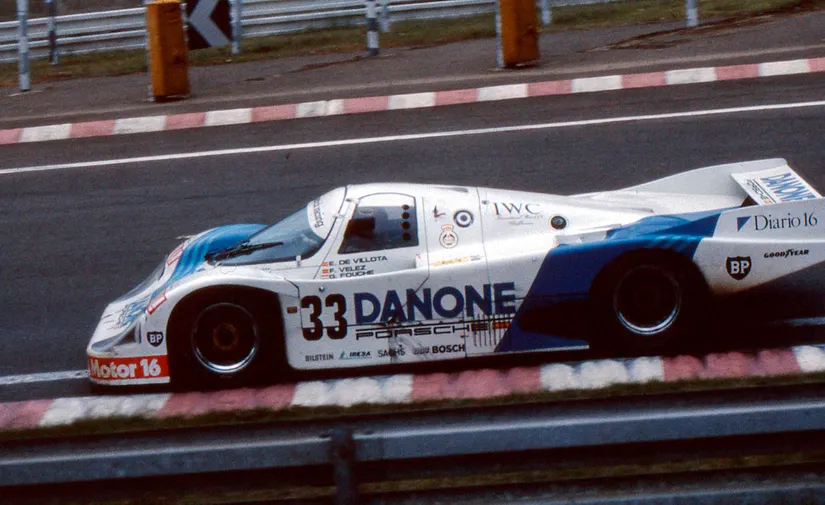
The project was built around a Porsche 956B chassis #114, leased from John Fitzpatrick Racing and registered for Le Mans under the entrant name Danone Porsche España. The livery was white with blue trim, because in 1980s Spain the most viable route to funding a La Sarthe campaign was to convince a yogurt company that putting its name on the flank of a Group C Porsche would be good marketing. And, it turned out, it was.
The driver lineup was Emilio de Villota, Fermín Vélez and the South African George Fouché, with Spanish veteran Juan Fernández entered as fourth driver but ultimately not starting the race. The 956B qualified twentieth on the grid with a time of 3:35.99. Ahead of it sat the factory Rothmans Porsche 962Cs, Tom Walkinshaw’s Jaguar XJR-6s, the Sauber Mercedes C9 that was just beginning to find its feet, the Lancia LC2s, and several privateer Porsche 956s with driver lineups whose individual fees exceeded the Spanish car’s entire annual budget.
What followed across the next twenty-four hours is what separates a competent endurance driver from a pretender. The Spanish Porsche did not break. It did not crash. It did not lose meaningful time in the pits. It rode through the classic phases of any Le Mans (the opening pack, the long Mulsanne night, the dawn through Indianapolis, the brutal mid-day at full pace, the closing hours under defensive driving) and it rode through them three times over, rotated cleanly between three drivers none of whom accumulated enough fatigue to make the catastrophic mistake. Steady. Patient. Methodical. They picked up positions on attrition alone. At the chequered flag they were fourth overall, three laps behind the winner. The podium went to three factory Porsche 962Cs in the hands of the strongest endurance lineups in the world: Bell-Stuck-Holbert in the winning Rothmans, the sister Rothmans car second, and Fitzpatrick’s own 962C third with another full-strength roster. The yogurt-funded Spanish Porsche was the fourth-best car in the world at La Sarthe that Sunday afternoon.
A fourth overall at Le Mans, in a year when the entry list was stacked with full factory teams from Porsche, Jaguar, Lancia, Sauber and Mercedes, is a result that any era would respect. Three months later, the same Spanish trio with the same Porsche 956B took third overall at the 1000 km of Nürburgring. Forty years on, those two results remain among the highest a Spanish driver had ever achieved in FIA World Sportscar Championship rounds, alongside Vélez. It would take more than two decades before Marc Gené started taking podiums in the same category with Peugeot and Audi.
That Le Mans of 1986 was De Villota’s last appearance at La Sarthe. He raced on for several more years in the Spanish Porsche Carrera Cup, winning the championship in 1993, 1995 and 1996 — three titles in four seasons. Then, in his late forties, he turned his full attention to something that would matter more in the long run than any of his own race results.
What Spain didn’t give Villota, Villota gave to Spain
In 1987, Emilio de Villota founded the Escuela de Pilotos Emilio de Villota at the Jarama circuit. The Spanish racing school. The idea was straightforward and, to him, urgent: he had learned everything alone, from buying a Lotus Seven with his savings to calibrating his lap times against Porsche 908s in mixed-class grids to phoning sponsors one by one to fund a Grand Prix entry. He didn’t want the next generation to start from scratch the way he had.
The list of drivers who passed through that school over the next four decades reads like a roll call of modern Spanish motorsport. Carlos Sainz Sr. Carlos Sainz Jr. Pedro de la Rosa. Marc Gené. Jordi Gené. Antonio Albacete. Alfonso García de Vinuesa. Dani Juncadella. And, yes, Fernando Alonso. Not all of them came up through the school as their primary path, but virtually every Spanish driver of consequence between 1990 and 2020 has had some operational link to De Villota’s structure at some point in their development.
In 1997 he expanded the structure into EmiliodeVillota Motorsport, which competed in Euroformula F3, World Series, Euroseries 3000 and Super League Formula, producing race wins, championships and, just as importantly, a generation of trained Spanish mechanics, engineers and team operators who later exported themselves into European teams.
This is the part that no biography of Spanish motorsport explains adequately. The story Spain tells itself, the one repeated every time Alonso wins something, is that the country produced a great driver out of nowhere in the late 1990s. The truth is that the country produced one driver who tried to do it alone in 1976, and who then, when the system failed him, spent the next thirty years building the structure he never had — privately, with his own money, with no institutional partnership of any meaningful weight.
What might have been
It is worth pausing here, for any reader who has not lived inside Spanish motorsport, to make the historical counterfactual explicit. Imagine, for one moment, that the Spanish government, the Real Automóvil Club, the major Spanish manufacturers and a coalition of national sponsors had decided in 1977 to back Iberia Airlines F1 the way France backed Matra, the way Italy sustained Ferrari, the way Britain indirectly underwrote Cosworth, Lotus, McLaren and Williams through forty years of fiscal and infrastructural policy. A thirty-year-old Madrileño with a superlicence, a chassis, qualifying capability, and self-secured sponsors already in place. Add a few million pesetas of institutional backing. Add three or four years of continuity. Add a domestic test programme. What does Spanish Formula 1 look like between 1980 and 1995?
We don’t know. We will never know. Because Spain did not make that decision. The man behind the desk at Banco Ibérico — the one who had quit his salary in 1977 to put a Spanish licence on a Formula 1 entry list — had to fold the F1 project by 1982 because the administrative oxygen had run out, and he had to build everything else with his own hands.
When Alonso won his first world title in 2005, there were, inside the F1 paddock, a small number of people who quietly remembered Mallory Park 1977, or Monza 1980, or Brands Hatch 1981. Very few. But they existed. Because already in 1980, in those same British circuits where the modern F1 industry had taken shape, there was a Spanish driver winning Formula 1 races on weekends when Spanish television rarely sent a reporter.
Cosworth had England. Ferrari had Italy. Frank Williams had Didcot.
Emilio de Villota had a desk at a bank, six employees, an M23 dented by seawater, and the conviction that it could be done anyway.
Check you’re still alive.