
Ferrari’s Flat V12 Engines: Why They Howl and Why Nothing Else Sounds the Same
Some sounds are burned into memory forever. The rumble of an American V8 at idle. The shriek of a Japanese four-cylinder at 9,000 rpm. But no mechanical sound in automotive history comes close to the supernatural howl of a Ferrari horizontally-opposed V12. It’s a sound that doesn’t seem of this world — a wail that begins as a visceral growl and scales towards frequencies that raise the hair on your arms. And the reason it sounds this way is pure physics, pure engineering, pure Italian obsession.
But before we dive into why they howl, we need to clear up a misunderstanding that persists even among the most experienced enthusiasts.
Flat V12 or Boxer? The Distinction That Matters
Technically, Ferrari’s “flat” engines are not boxer engines. And this distinction is crucial to understanding their character.
In a true boxer engine — like those from Subaru or Porsche — each piston has its own independent crankpin on the crankshaft. Opposing pistons move in opposite directions simultaneously: when both move outward (away from the engine’s centre), both reach top dead centre at the same time. And when both move inward, both reach bottom dead centre at the same time. It’s like a boxer throwing both fists outward at once. This symmetrical, mirrored movement is what naturally cancels vibrations.
Ferrari’s flat V12s are, in reality, V engines with a 180-degree angle between cylinder banks. The fundamental technical difference is that opposing pistons share the same crankpin on the crankshaft. This means both pistons travel laterally in the same direction at the same time — when one is at top dead centre, the opposing one is at bottom dead centre. One compresses while the other is in its power stroke. This creates a completely different vibration pattern and firing order compared to a true boxer.
Why does this matter for sound? Because the firing order — the sequence in which cylinders ignite — is what defines an engine’s sonic character. And the firing order of a 180° V12 is unique.
The Physics of the Howl
An engine’s sound is fundamentally a matter of frequencies and harmonics. Each time a cylinder fires, it produces an exhaust pulse. The frequency at which these pulses occur, combined with the characteristics of the exhaust system and the resonances of the engine block itself, creates what we perceive as the engine’s “sound.”
In a 180° V12, the firing order is designed so that pulses are distributed perfectly uniformly in time. With twelve cylinders firing in a carefully calculated sequence, the fundamental exhaust frequency is extremely high compared to engines with fewer cylinders. Where a V8 produces a deep rumble with more widely spaced pulses, the V12 produces a frequency so high and so uniform that the human brain perceives it as a nearly pure musical tone rather than individual explosions.
It’s the same reason a violin sounds different from a double bass: more vibrations per second, higher pitch, more penetrating sound.
But the 180° V12 has an additional characteristic that distinguishes it even from conventional V12s (with 60° or 65° angles): the flat geometry allows exhaust manifolds of more uniform length on both banks. In a conventional V12, cylinders on the side banks have manifolds of different lengths, introducing asymmetries in exhaust frequencies. In the 180° configuration, this uniformity contributes to a “cleaner” sound more concentrated in a narrow frequency band.
The result is that tone enthusiasts describe as a “howl” or a “scream”: a sharp, penetrating, sustained sound that separates from any ambient noise and seems to cut through the air with surgical precision.
The History: From Maranello to the Tracks and Back
Ferrari began experimenting with flat V12 configurations in late 1960s Formula 1. The idea was to reduce engine height to lower the car’s centre of gravity — an enormous aerodynamic and dynamic advantage in the single-seaters of the era.
Ferrari’s most significant flat twelve-cylinder competition engine of the modern era was the one in the 1970 Ferrari 312 B Formula 1 car, though Ferrari had experimented with flat-12s since 1964 with the Tipo 207 in the Ferrari 1512 F1. Designed by the legendary Mauro Forghieri, the 312 B’s 3.0-litre engine demonstrated that the flat configuration offered not only dynamic advantages but extraordinary power potential.
The transition to road cars came with the Ferrari 365 GT4 BB (Berlinetta Boxer) in 1973. Here, Ferrari installed a 4.4-litre 180° V12 in a mid-rear position, creating one of the most iconic architectural layouts in automotive history. The “Boxer” name was technically incorrect — as we’ve explained — but commercially brilliant.
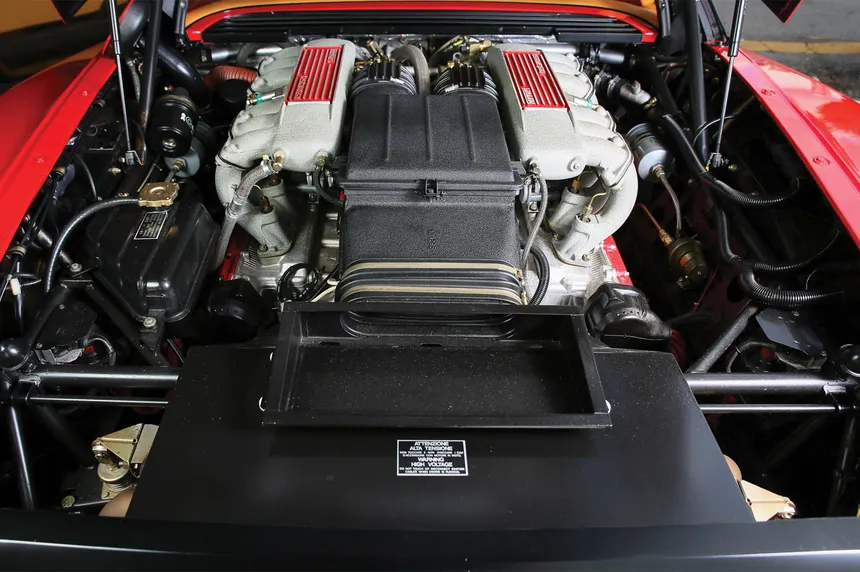
It was followed by the 512 BB in 1976, with the engine enlarged to 4,943 cc (commercially labelled “5 litres”) and 360 horsepower. And then, the immortal Testarossa in 1984, with its 4.9-litre, 390-horsepower engine, the famous side air intakes, and a howl that became the soundtrack of the 1980s.
The Testarossa: The Howl as Identity
The Testarossa deserves special attention because it was arguably the car that did most to cement the sound of Ferrari’s flat V12 in popular culture. It appeared in Miami Vice. It adorned bedroom posters of teenagers across half the world. And its sound, captured in countless videos and recordings, became synonymous with “supercar.”
The Testarossa’s engine, internally designated F113, was an engineering masterpiece. Four valves per cylinder (48 total), Bosch KE-Jetronic electronic fuel injection, Marelli Microplex electronic ignition, and a crankshaft that weighed as much as a small complete engine but spun with supernatural smoothness.
At idle, the Testarossa’s engine produced an irregular, almost lazy burble. But as revs climbed, the sound’s character transformed completely. At 4,000 rpm the howl began. At 6,000 rpm it was a scream. And at the fuel cut-off, near 7,000 rpm, the sound reached an intensity that some have described as “angelic” and others as “demonic,” depending on which side of the car you stood.
Technical Details That Make the Difference
Several technical factors contribute to making the Ferrari flat V12 sound so distinctive:
Crankshaft length. A 180° V12 has a considerably longer crankshaft than a conventional V-angle V12. This affects the crankshaft’s torsional frequencies and, by extension, the harmonics it generates.
Equal-length exhaust manifolds. Ferrari paid obsessive attention to exhaust manifold design on these engines. The goal was for exhaust gases from each cylinder to travel exactly the same distance to the collection point, eliminating any destructive interference between exhaust pulses.
Combustion chamber volume. With relatively large cylinders (over 400 cc per cylinder in road versions), each combustion pulse generates a considerable volume of gases, contributing to the physical presence of the sound. It’s not just sharp — it has body.
Materials. The aluminium alloy block and matching cylinder heads have different resonance properties to cast iron. Aluminium transmits high-frequency vibrations more efficiently, contributing to the “metallic,” crystalline character of the sound.
Curiosities Few Know
The Ferrari flat V12 has fascinating stories that go beyond pure mechanics.
Enzo Ferrari was initially unconvinced about the flat configuration for road cars. It was Forghieri who persuaded him, arguing that the lower centre of gravity would dramatically improve dynamic behaviour. Enzo relented, but insisted the engine maintain the sonic character he considered Ferrari’s signature.
During Testarossa development, Ferrari engineers had to solve an unexpected acoustic problem: the flat engine, being so close to the ground, transmitted vibrations to the chassis that created unpleasant resonances in the cabin at certain speeds. The solution involved specially designed rubber engine mounts and strategically placed acoustic panels.
Pininfarina, the design house responsible for the Testarossa’s exterior, designed the famous side grilles not just as an aesthetic element but as air channellers necessary to cool the flat engine, which due to its horizontal layout generated different airflow patterns than a conventional vertical engine.
The horizontal engine layout also posed unique cooling challenges. Unlike a vertical engine where heat naturally rises, the flat-12 required carefully designed cooling circuits to evacuate heat uniformly across both banks, adding complexity to the system but helping maintain consistent operating temperatures across all cylinders.
The End of the Flat V12
Ferrari abandoned the flat V12 configuration after the Testarossa and its variants (512 TR and F512 M) in the mid-1990s. The V12s that followed — in the F50, Enzo, LaFerrari — returned to the 65° V configuration with a different sonic character: equally spectacular, but with a more guttural tone, more roar than howl.
The reason for the change was mainly practical: flat V12s were enormously wide, complicating the car’s packaging and limiting chassis design options. A V-angle V12 occupies less lateral space and allows more flexibility in arranging auxiliary components.
But purists continue to mourn the disappearance of the flat howl. It’s an unrepeatable sound — a direct consequence of a specific mechanical configuration that Ferrari used for little more than two decades and that has never been matched.
Why Nothing Sounds the Same
Ultimately, the howl of a Ferrari flat V12 is the result of an unrepeatable convergence of factors: twelve cylinders firing in a perfectly uniform sequence, equal-length exhaust manifolds, an aluminium block that resonates like a musical instrument, and the Italian obsession with creating machines that don’t just function but move the soul.
It’s engineering transformed into sonic art. And if you ever have the chance to hear a Testarossa at full load, you’ll understand why some people consider that sound one of the most beautiful creations of the industrial age.
Pingback: The Subaru Boxer Engine: Not Too Reliable, But Tremendously Effective