Fiat Panda 4×4 1983: the mountain goat America never got

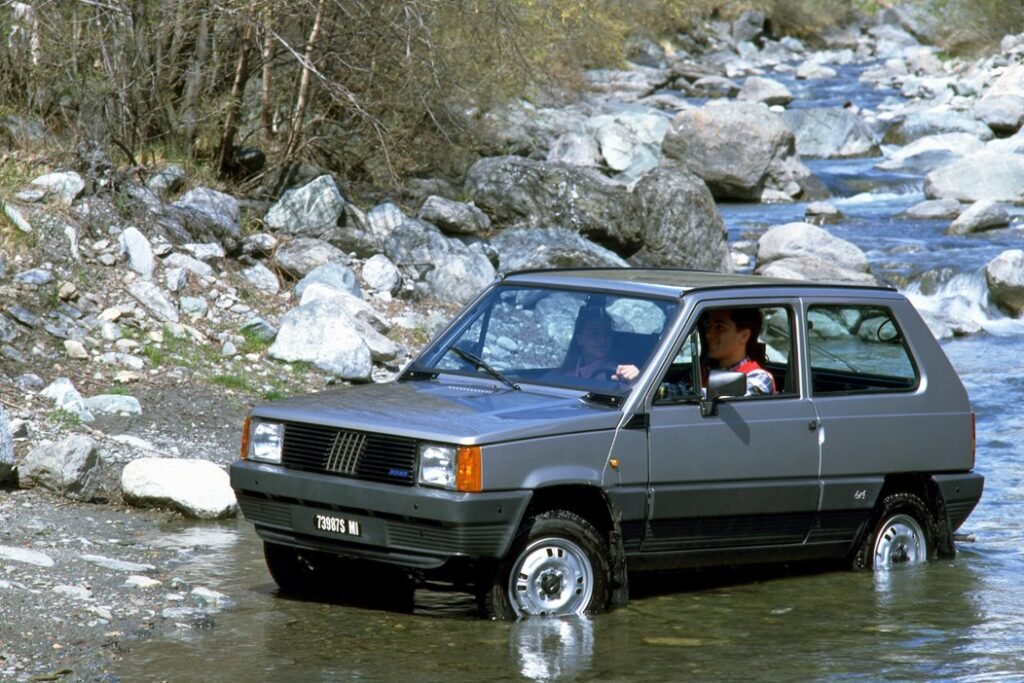
In June 1983 Fiat launched the Fiat Panda 4×4, a four-wheel-drive car that made America’s idea of off-roading look absurd. Under a thousand cubic centimeters, 48 horsepower, a body made of sheet metal thin enough to dent with your thumb, and a curb weight of 740 kilos, about 1,630 pounds. No ladder frame, no transfer case, no locking differentials. It went on to earn a reputation in the Alps that plenty of real trucks never had, and Fiat kept building it until 2003. Twenty years selling the same simple idea: the best way to stay out of the mud is not to weigh much in the first place.
Americans never got to find out. By the time the Panda 4×4 reached European showrooms, Fiat was packing up its US operation. The brand had gone from 100,511 American sales in 1975 to 14,113 in 1982. Fiat blamed the Japanese. Time magazine pointed at the rust: some Fiats rusted rapidly on American roads in the seventies no matter what undercoating their owners paid for, and wags decided FIAT stood for Fix It Again Tony. In January 1983 Fiat announced it was pulling out of the US market. The Panda was never officially sold here. The few that live in the States today came over privately, once they were old enough to clear import rules, like a 1985 4×4 Edizione Limitata that was refurbished in Bologna, shipped to Connecticut and put up on Bring a Trailer.
This series is about classics without the GTI glamour. Farm cars, village cars, the ride of the rural veterinarian. The Panda 4×4 is the smartest of the bunch.
A Giugiaro box
The regular Panda hit Italian dealers in the spring of 1980. Flat glass all around, seats that looked like hammocks, a dashboard that was basically a fabric shelf. Giorgetto Giugiaro drew it for Gianni Agnelli‘s Fiat with one brief: cheap to build, cheap to run. He nailed it.
That same year, at the Turin Motor Show, his studio Italdesign showed the Panda 4×4 Offroader, a concept with leather trim, an inclinometer on the dash and a pop-out pocket of rescue tools in the cargo area. According to Italdesign, the four-wheel-drive patent was sold to Fiat right after the show. The production version arrived three years later. The hard part, getting engine power to the rear wheels as well, was not solved in Turin.
The Austrians who built the G-Wagen
For the all-wheel-drive hardware Fiat went to Steyr-Puch in Graz, Austria. The company had also been Fiat’s official importer in Austria, but that was the least of its credentials. Steyr-Puch had created the Haflinger and the Pinzgauer, two mountain-going military vehicles, and it built the Mercedes G-Wagen. Going from that to a 1,630-pound economy car is a good joke on its own. In the early nineties the same Graz outfit would build Volkswagen’s off-road Golf Country.
Steyr-Puch designed and supplied the complete driveline: clutch, gearbox, a three-piece driveshaft, a solid rear axle with its own differential, and the brakes. The car itself was not assembled in Austria. The driveline was shipped to Fiat’s plant in Termini Imerese, Sicily, where it was mated to the engine and to a body reinforced for the job. The Panda 4×4 was an Italian-built Fiat with Austrian four-wheel drive.
The most visible change was at the back. The 4×4 got a solid rear axle on leaf springs, developed in Graz. A solid axle is a single beam that ties both rear wheels together, with the differential and axle shafts inside it. Leaf springs are stacks of curved steel strips that do the job of a coil spring. Any American pickup owner knows the setup: it takes abuse, it carries weight, and when one wheel climbs a rock the other drops and keeps touching the ground. On broken pavement the rear end bounces around, and the Panda’s did. Fiat quoted roughly 18 centimeters of ground clearance, about 7 inches, for the original 4×4. The front axle, though, sat as low as on the front-drive Panda, and under the engine and gearbox there was no real skid plate, just a couple of steel tubes. A lot of owners ended up bolting on their own steel plate.
Part-time four-wheel drive, explained
This is where the car gets interesting, so let’s take it slowly.
In normal driving the Panda 4×4 is front-wheel drive, exactly like any other Panda. Behind the gear lever sits a pull handle. Pull it and the power take-off, a small box bolted to the gearbox that diverts part of the rotation rearward, starts spinning the driveshaft, and the rear axle joins in. Fiat recommended engaging it at low speed and only on slippery ground, and the reason is the most useful lesson this car teaches.
There was no center differential. Think about a turn. When a car corners, the front wheels trace a slightly longer arc than the rear wheels. On a single axle, if both wheels were locked together, one of them would have to scrub; that is why every axle has a differential, a set of gears that lets the outside wheel turn faster than the inside one. The front and rear axles have the same problem: in a turn they need to rotate at slightly different speeds. A center differential allows that, which is why permanent all-wheel-drive cars like the later Mazda 323 GT-R carry one. The Panda did not have one. With the rear axle engaged, front and rear were forced to turn at exactly the same speed, as if the center diff were permanently locked.
On dirt, mud or snow, that is no problem. The surface gives, the tires slip a little, the stress goes away. On dry asphalt it has nowhere to go. It stays trapped inside the driveline, the tires drag through every corner and the gears take a beating. Off-roaders call it driveline wind-up. Anyone who has run an old part-time 4×4 pickup on dry pavement with the hubs locked has felt it in the steering. The Panda worked by exactly the same rules.
That flaw has an upside. On an icy downhill, with both axles rigidly connected, engine braking is split across all four wheels. Plenty of modern crossovers with clutch-pack on-demand systems behave like two-wheel-drive cars in that situation, because nothing forces the clutch to stay engaged. The Panda, with its pull handle, was locked in.
It also had no locking differentials and no electronic aids. An open differential, the normal kind, sends power where it is easiest to send it, which means to the wheel with the least grip. Lift one wheel or put it on ice and it spins freely while the other sits still. The Panda got around that in two ways: with drive on both axles, at least one wheel usually had traction, and the car was so light that very little force was needed to move it.
The “primina”
There was no transfer case either. A transfer case with low range is a second gearbox that multiplies engine torque at the cost of speed, so you can crawl down a trail or start on a brutal grade without frying the clutch. It costs money and adds weight.
Fiat solved the problem inside the gearbox. The regular Panda had four forward gears; the 4×4 had five, and first was extremely short. Italians call it the “primina”, the little first. It was not low range, since there was no second gearbox multiplying every ratio, but it was not a normal first gear either. It was an extra gear added at the bottom, short enough that the car crept along at walking pace with the engine spinning hard and the torque multiplied at the wheels. Fifth matched fourth on the Panda 45, so at the top end the car geared like a regular one.
On pavement the primina was useless; you saved it for the hills: pulling away on a muddy grade, easing across a ditch, creeping down a rocky trail without touching the brakes. Call it a poor man’s low range, a single crawler gear instead of a full set, and for a car this light it was enough. I have not been able to confirm the exact ratio of that first gear in factory documentation, so I will not quote one.
It has limits. On a truly steep climb in the primina, the engine runs out of torque before the tires run out of grip. With one liter, you feel it.
965 cc
The first Panda 4×4 used the 965 cc four-cylinder from the Autobianchi A112: 48 hp and 69 Nm of torque, about 51 lb-ft, at 3,300 rpm, with a side-mounted camshaft and pushrod-operated valves. An old, simple design, which is exactly why it lasted and needed little attention. With 48 hp the 4×4 was the most powerful Panda in the lineup, ahead of the Panda 45 and its 903 cc, 45 hp engine.
You paid for four-wheel drive at the pump and in top speed. The Panda 45 topped out at 140 km/h, about 87 mph; the 4×4 managed 135 km/h, about 84 mph. At a steady 90 km/h, 56 mph, the 45 returned roughly 48 mpg and the 4×4 about 40. At 120 km/h, 75 mph, it was about 36 mpg against 30. Extra weight, extra gear friction and shorter gearing all cost something.
In 1986 the Panda got a thorough redesign and the 4×4 received the FIRE engine, 999 cc and 50 hp. FIRE stood for Fully Integrated Robotized Engine, a design built to be assembled by robots with fewer parts, the same engine family that went into the Fiat Uno. In 1992 the 999 gave way to a 1,108 cc FIRE, which in the last fuel-injected versions made 54 hp.
Against the Niva and the Suzuki
The numbers only mean something next to what else existed in 1983 for going off-road on a budget.
The Lada Niva of 1977, with its 1.6-liter, 78 hp engine, weighed 1,150 kilos, about 2,535 pounds, and topped out at 132 km/h, 82 mph. It was a real off-roader with permanent all-wheel drive and low range, and it carried more power per pound than the Panda: 14.7 kilos per horsepower against the Fiat’s 15.4. But it hauled around 410 extra kilos, roughly 900 pounds. The Suzuki SJ410 of 1982 had a 970 cc, 45 hp engine, weighed about 840 kilos, 1,850 pounds, in hardtop form, and topped out at 110 km/h, 68 mph. It worked out to 18.7 kilos per horsepower.
The Panda 4×4 weighed 740 kilos empty. In mud, weight sinks you. On a muddy grade you have to haul it uphill. In a ditch you have to drag it out. In that world the lightest car has half the work done before it starts. The Panda did not need low range because there was so little car to move. It was 3.38 meters long, just over 11 feet, and 1.46 meters wide, about 57 inches. On a narrow mountain track that is worth more than any horsepower figure.
Rust
All of that had one enemy, and it shaped the car’s reputation as much as its impossible climbs did: corrosion. The same disease that helped push Fiat out of America followed the Panda into the mountains. Thin steel, cars that lived in snow country, salted roads, mud packed into the underbody for weeks at a time. Hagerty’s British buying guide doesn’t dance around it: rust is the main concern with the bodywork. Check the door bottoms, the tailgate, the sills, the hood edges, the fenders and the inner wheel arches, then the floorpan and the cargo floor, and on a 4×4 run a magnet over it for filler, top and underneath. Pre-1986 cars are also far fewer in number, so finding an early one in good condition is a hard task.
The hardware is another story. The same guide calls the 4×4 transmission tough; what tends to give up is the back end, where hard-used cars sag on tired leaf springs, cured with new springs or by retempering the old ones. In Britain about £3,500 buys a running, driving 4×4, around £6,500 a decent one you would still take off-road, and the very best now change hands for £12,500. An American buyer pays that plus shipping, and only for a car at least 25 years old, the age at which federal rules let a car that was never sold here come in.
Two Pandas at the 1984 Dakar
On September 29, 1983, barely three months after launch, Fiat Auto France took delivery of a Panda 4×4. The French subsidiary bankrolled a plan that still sounds like a joke: enter the Panda in the Paris-Dakar. The cars were registered to the subsidiary itself and prepared by Fiat’s advanced projects group in Heilbronn, Germany. The full outfit was four vehicles: two Pandas, a Campagnola and an Iveco truck.
The man behind it was Hervé de Labriffe, then in charge of dealer network development and management control at Fiat Auto France, with years of rallycross and one-make series racing behind him. René Metge had pushed him to do it, the same Metge who won that 1984 Dakar in the Porsche 953. The plan made commercial sense: one car would carry well-known faces to bring in sponsors, the other would be driven by De Labriffe himself. The green livery was Benetton green, and Barilla and Autovox also put up money.
Those Dakar Pandas shared little more than a silhouette with the showroom car. The engine was the 1,301 cc unit from the Fiat 127 Sport, tuned to 100 hp. The front suspension arms came from Abarth, the front axle from a modified Ritmo Abarth, the rear axle from a Fiat 131 and the rear shocks from a Lancia 037. Fiberglass doors and hood, plexiglass windows, a stripped cabin.
Car number 207, with De Labriffe and Claude Devoyon, got caught up crossing a wadi in a crash involving a Mercedes and an Isuzu. The carburetor came loose, the car caught fire, and the impact shifted the engine so that four-wheel drive could no longer be engaged. They headed back to Paris and were listed as retired. The second car, white with Barilla logos, was crewed by two women, Evelyne Dhéliat and Marianne Hoepfner. Overheating in the Ténéré dropped them out of contention, and they kept driving toward Dakar anyway.
And again in 1985
They came back. Running as number 280, De Labriffe and Devoyon had to stop in southern Algeria because they had run out of shock absorbers. In the other Panda, Pascal Witmeur had Belgian singer Plastic Bertrand as his co-driver, and they broke the engine. The team chose to head home to France rather than wreck more hardware, since it had other Panda events on the calendar. No Panda reached Lac Rose.
One of those cars survives. Italian collector Alfredo Ardenghi bought it in the fall of 2022 from French collector Cyril Gautier, complete with original items like its Tirfor winch and even the field tableware. It was restored in its period livery with the original engine, and the tires, nearly impossible to find, had to come from Brazil.
Sisley and the rest of the family
The first special edition came in September 1985, the Nuova Panda 4×4, 5,000 units with two-tone paint, roof bars and a front guard carrying two extra lights. The most famous arrived in February 1987: the Sisley, wearing the name of Benetton’s clothing brand and powered by the 50 hp FIRE 1000. It stayed in production until December 1991. Benetton had painted the Dakar Pandas green three years earlier and ended up signing the most wanted version of the 4×4. By then the car had proved it could sell: Italdesign says more than 70,000 Panda 4x4s found buyers in the first four years.
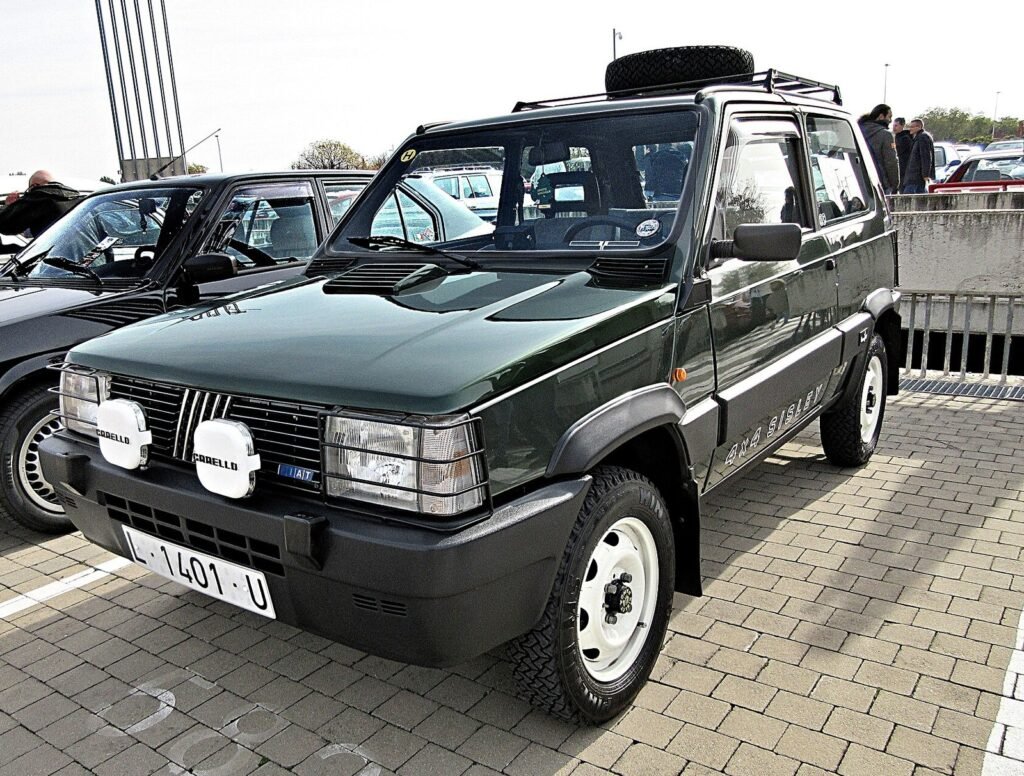
The Steyr-Puch mechanicals carried on, with engine updates, until the first generation ended in 2003. Across all versions, the original Panda was built for 23 years, about 4.5 million cars. There was even an electric Panda, the Elettra, unveiled in 1990.
The Spanish one that never was
In Spain the Panda was not sold as a Fiat at all. It was a SEAT, built under license from 1980 to 1986; Motor.es puts SEAT’s Panda sales over those years at 463,418. And SEAT never offered a four-wheel-drive version. Its most outdoorsy Panda was the 1982 Montaña, a country kit limited to 2,000 units with a roof rack, beefed-up bumpers and headlight guards, and still front-wheel drive.
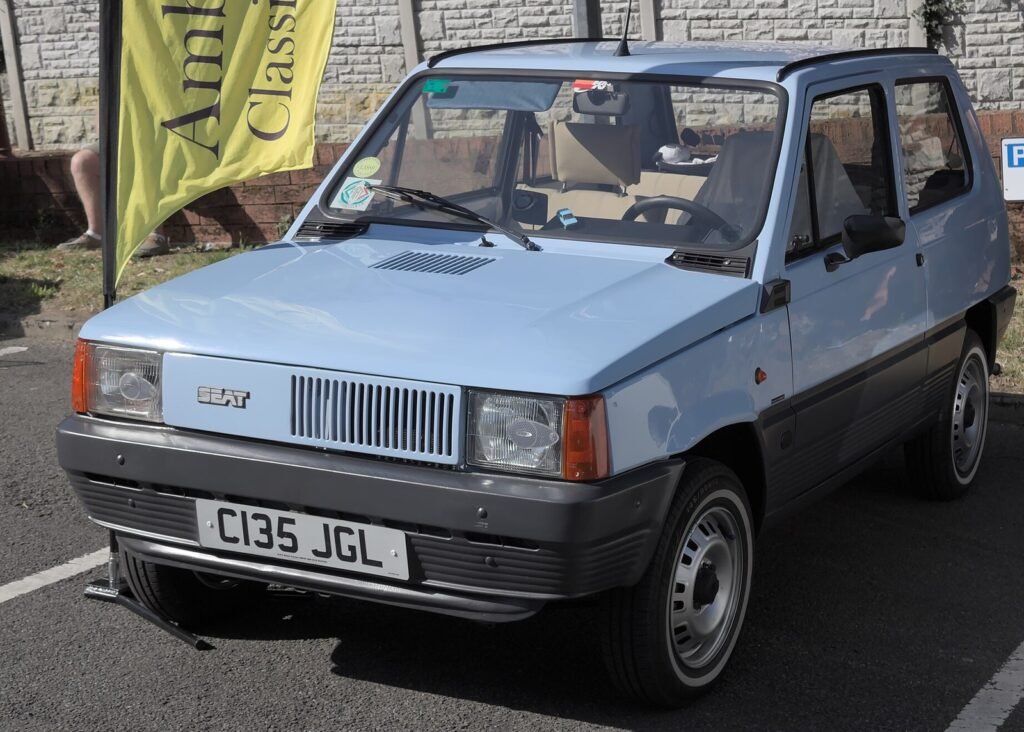
The Spanish 4×4 came from a coachbuilder. Emelba, founded in 1978 and based in Arbúcies, in Catalonia, built SEAT Panda derivatives SEAT did not make, including the Pandita, a SEAT Panda that was a pickup and a convertible at the same time, shown at the 1982 Barcelona Motor Show. From the Pandita came a four-wheel-drive version, built in collaboration with a firm called Juncosa and, according to the SEAT Museum, able to climb 55 percent grades. That museum entry is the only record I have found. How many were built, whether it was ever sold as a model or only as a conversion, and how its drivetrain worked, I have not been able to document. What is on record is that Emelba went under in 1986, buried in debt to SEAT, according to the SEAT Museum (other sources say 1987). That same year SEAT, its Fiat license expired, had to turn its Panda into the Marbella.
Where I stand
The Panda 4×4 is proof that the industry has spent forty years choosing to get it wrong. A modern compact crossover with all-wheel drive tips the scales well past 3,300 pounds, carries more electronics than a 1980s airliner, and gets stuck on the first trail with real mud because its tires are made for the interstate and its weight buries it. The 1983 Panda solved the problem the other way around: take things away instead of adding them. Less weight, fewer parts, fewer things to break. A pull handle instead of a rotary knob with six terrain modes.
It was not a perfect car. Without a center differential you had to know when to engage it and when not to, the brakes were what they were, it sounded like a tin can at 60 mph and rust devoured it. But it did exactly what it promised, for very little money, and it did it for twenty years without anyone managing to replace it. There are still Panda 4x4s at work in mountain villages across Europe, and marketing cannot buy that.
America never got it because Fiat had already gone home, beaten by the same rust that would later chew through every Panda left out in the snow.
Before the Panda, cheap four-wheel drive had already crossed the Sahara in the Marreau brothers’ Renault 4L Sinpar, fifth overall at the first Paris-Dakar in 1979.
Check you’re still alive.
Photos: Stellantis Heritage (press), Stellantis Heritage (press), Txemari (CC BY-SA 4.0), Aethonatic (CC0).