Renault 4L
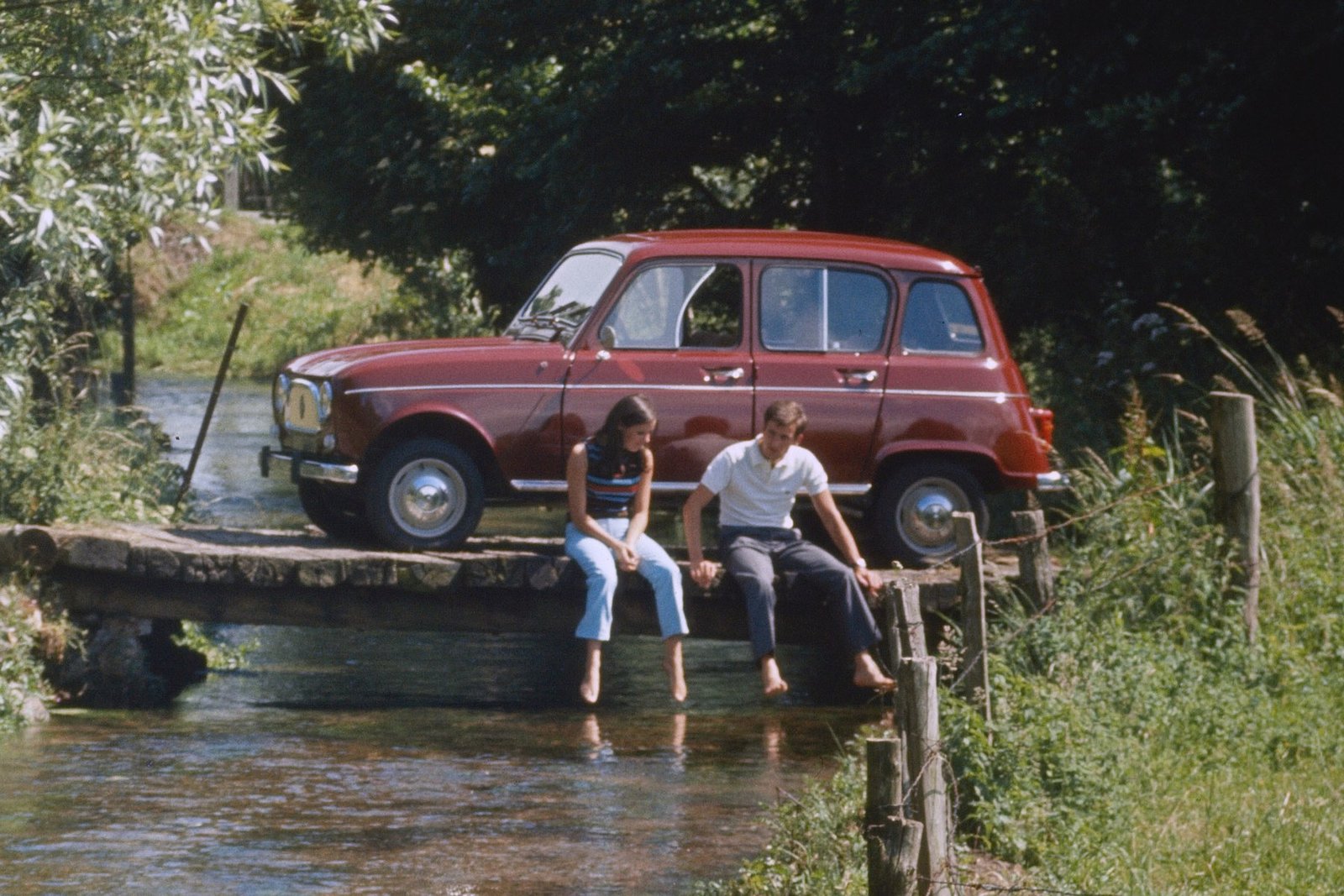
Renault built 8,135,424 copies of the Renault 4, and by Renault’s own count that makes it the fourth most produced car in the world. It sits on the same shelf as the Model T and the Beetle. Yet most Americans could not pick one out of a lineup. That is a shame, because under that tin-box body sits one of the strangest pieces of mass-market engineering ever sold: a car with a longer wheelbase on one side than the other, a gear lever sticking out of the dashboard like an umbrella handle, and a transmission mounted in front of the engine. On paper it looks like a madman’s car. In Spain, where people nicknamed it “cuatro latas”, four tin cans, it was the first real car for a whole generation.
This series is about classics without GTI glamour. The Renault 4 is the weirdest of them on the inside and the most ordinary on the outside.
Blue jeans on wheels
In 1956 Renault chairman Pierre Dreyfus decided the company needed a replacement for the rear-engined 4CV and an answer to the Citroën 2CV. He framed it with an image that stuck: he wanted a “blue jeans” car. Something that worked in town and on the farm, for everybody. He also put it another way: cars could no longer be just four seats and a trunk. Give me volume.
The brief came with a price target of no more than 350,000 old francs, which is why the project was first called “350” and later “112”. By 1959 the prototypes had covered about three million kilometers, close to 1.9 million miles, of testing. The test drivers called the car “Marie-Chantal”, the code name they used in telegrams back to Paris so nobody could guess what they were talking about.
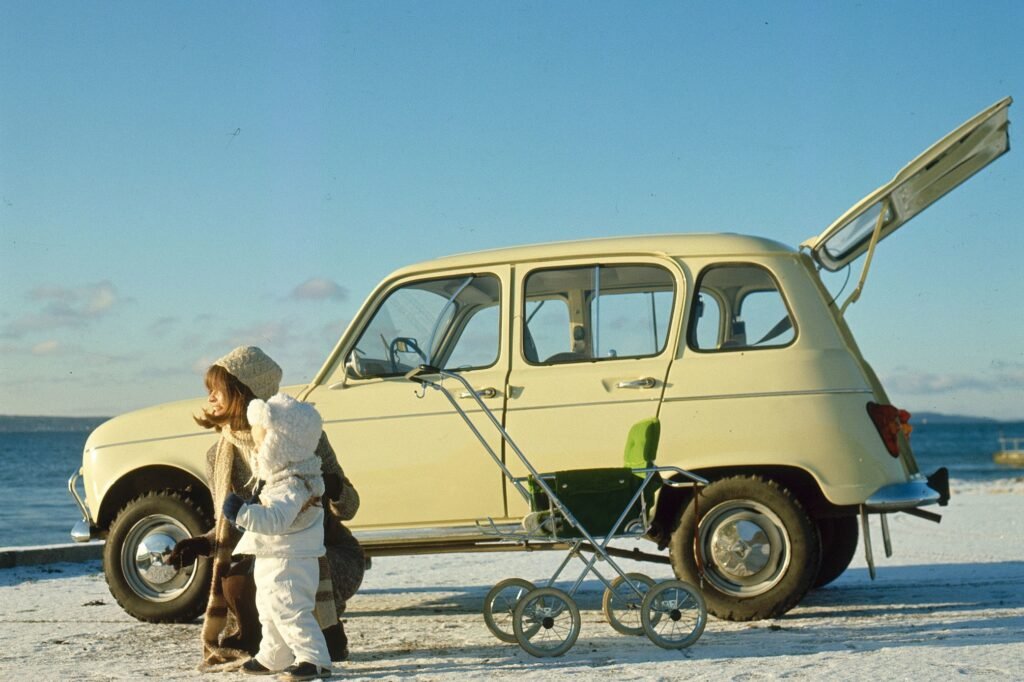
On July 6, 1961, the last 4CV left the Billancourt plant outside Paris. All its tooling was torn out to make room for the new assembly lines, and series production of the Renault 4 started that summer. It was shown at the Frankfurt Motor Show on September 21 and in Paris on October 6. It was Renault’s first production passenger car with front-wheel drive, and the car that brought the big rear hatch and the flexible cargo-friendly interior to the mass market. Americans would call it a hatchback.
A frame under the body
Most modern cars use a unibody, where the body shell itself carries the loads. The Renault 4 did not. It had a separate structural platform made of sheet steel between 0.8 and 1 millimeter thick, and the body sat on top of it. If that sounds like body-on-frame, the old American pickup recipe, it is close in spirit, only much lighter and flatter. Renault did it because it wanted a van from the very beginning, and a platform lets you bolt different bodies on top without redesigning the whole car.
The engine sat up front, mounted lengthwise, pointing forward like it would in a rear-drive car. But it drove the front wheels, and to make the package fit, the gearbox sat ahead of the engine, right in the nose. That explains the shifter. With the gearbox so far forward, there was no sensible way to run a lever to the floor, so it came straight out of the dashboard, horizontally, with a rod running over the top of the engine to the gearbox. The pattern was a normal H, just with the pivot point close to your hand. In return it freed up room inside.
The cooling system was sealed at the factory, with a small expansion tank, and the car kept scheduled greasing to a minimum. For someone living in a village with no repair shop nearby, that counted for more than any horsepower figure.
The crooked wheelbase
This is the detail mechanics love.
Wheelbase is the distance between the center of the front wheel and the center of the rear wheel on the same side. On any normal car it is the same left and right. Not on the Renault 4: the right side is about 4.5 centimeters, roughly 1.8 inches, longer than the left.
Blame the rear suspension. Each rear wheel hung from an arm that trailed behind its pivot, and the spring for each arm was a torsion bar: a steel rod running across the car that twists on itself when the wheel moves up and untwists to push it back down. Renault wanted soft suspension with lots of travel, and that called for long bars running the full width of the car. Two full-width bars cannot occupy the same space, so one went in front of the other. Each bar is tied to one wheel, so one rear wheel ended up slightly ahead of the other.
Geometrically there was another option: stack one bar above the other, keep the wheels lined up, and let the arms pivot at different heights. On the Renault 4 the asymmetry simply stayed visible. You do not feel it on the road. You do feel it in a body shop: a tech repairing a crashed Renault 4 who measured the platform diagonally without knowing the car would get numbers that never matched, because the car is not symmetrical from the factory.
The front used torsion bars too, but running lengthwise. With that long-travel suspension the Renault 4 swallowed the broken roads of rural 1960s France, which is why it worked as well for a farmer as for a delivery driver.
Renault’s reputation problem
Americans who remember Renault in the sixties tend to remember fragility. Renault left a bad taste here with a reputation for cars that did not hold up, and European small cars of that era were built for different conditions: short trips and weekend outings, not long interstate runs. The Renault 4 was the opposite of fragile in its own world. It was built for dirt roads and potholes at low speed, and it lasted thirty-one years in production. It just never got a real chance to prove that to American buyers.
Made in Spain
Spain met the car through FASA, the Fabricación de Automóviles company in Valladolid, which had been assembling Renaults since the fifties. The Renault 4 was the third model built there, after the 4CV and the Dauphine. Assembly started in 1963, and the official Spanish launch came in 1964. It arrived as the 4L, with that badge on the hatch, and Spaniards immediately turned “4L” into “cuatro latas”.
The timing was perfect. In 1964 there was one car for every 48 people in Spain, and by Renault’s own records the Renault 4 already accounted for a third of FASA’s output that year. Some series put it at 14,757 out of 33,341 vehicles, about 44 percent, but I could not confirm that figure in a primary source.
Price was the other punch. The 4L cost 84,000 pesetas when the rest of its class sat around 100,000. For comparison, the basic Dauphine, also built in Valladolid, cost 89,500.
The Spanish car was not a straight copy of the French one. The big difference was the engine: instead of the small engines at the bottom of the French range, the Spanish version used the Dauphine’s 845 cc four-cylinder, already built in Spain, with 30 hp. It had a three-speed gearbox, weighed 630 kilos, about 1,390 pounds, and topped out around 110 km/h, about 68 mph. It also had its own bumpers, no side turn signals on the front fenders, and 12-volt electrics with better lighting before the French car got them.
Its natural rival in Spain was the SEAT 600 D, a licence-built version of the Fiat 600 from Agnelli’s Fiat, launched in 1963: a rear-engined 767 cc car good for about 108 km/h, 67 mph, weighing between 590 and 635 kilos depending on the version. Its power figure varies between spec sheets, from 25 to 29 hp. Similar speed, similar weight, but the 600 was a two-door with a toy trunk, and the Renault 4 had five doors, a huge hatch and an interior that turned into a van.
The Spanish car kept evolving. The Super version arrived in 1965 with better seats. In 1968 came the first serious restyle, with a new grille, while the 4 Super, a version made for the Spanish market only, got the 852 cc Sierra engine, a smaller-displacement relative of the Renault 8 engine with a five-main-bearing crankshaft, plus a four-speed gearbox. The 1982 model year, presented in 1981, brought the 1,108 cc engine, an electric radiator fan and front disc brakes in place of drums. The 1983 model year added a new black plastic dashboard and seats with headrests.
Cop car, phone company car, farm car
The Renault 4 became invisible because it was everywhere. Spain’s Guardia Civil used it as a patrol car for years, just as France’s Gendarmerie did. The national phone company, Telefónica, ran them in its fleet. It was all over rural Spain, and plenty of farm owners bought one instead of a Land Rover, which cost far more. There were versions with a canvas roof and reversible rear seats.
The van deserves its own paragraph. In Valladolid it stayed in production until 1991, two years longer than the car, and worked for decades as a tool of the trade. The platform had been designed from day one to carry that cargo body.

Dakar
Brothers Claude and Bernard Marreau had made a scouting trip across Africa in a Renault 4 in 1969, and later set the Cape Town to Algiers record, that time in a Renault 12 Gordini. When the first Paris-Dakar ran in 1979, they showed up in a Renault 4 Sinpar 4×4, the four-wheel-drive version that the Sinpar company had been converting for Renault since 1964, a simple, cheap four-wheel-drive recipe that the Fiat Panda 4×4 would take mainstream almost twenty years later. They finished fifth overall and second among the cars, behind only a Range Rover.
In 1980 they came back with a far more radical build, the 1,397 cc, 125 hp engine from the Group 2 Renault 5 Alpine and a 140-liter tank, about 37 gallons, and finished third overall, ahead of factory teams. Renault took notice. In February 1980 it delivered them a bare Renault 20 body, and they turned it into the Renault 20 Turbo 4×4 that won the 1982 Paris-Dakar.
Eight million
The first million Renault 4s were done by February 1, 1966, less than four and a half years after launch. Peak production came in 1968, with 368,566 cars. In September 1977 it became the first French car to reach five million. It was built in more than twenty plants across four continents and sold in more than 100 countries.
Spain assembled close to 800,000, almost 10 percent of the total: 403,213 cars between 1963 and 1989 and 396,704 vans up to August 1991, according to Renault. Valladolid built almost as many vans as cars. In France the send-off was the 1992 Bye-Bye special edition, 1,000 numbered cars with a plaque on the dash. The last one came off the line on December 3, 1992, with 8,135,424 built in 29 countries. One reason it was retired was that adapting it to catalytic converters and new emissions rules no longer paid off. In Germany, for example, it was pulled in 1988 because of tighter emissions standards.
It kept living anyway. Since 1998 the 4L Trophy has sent students every year from Paris to Marrakech in Renault 4s, with no modern navigation and 50 kilos, about 110 pounds, of school supplies for Moroccan children in every car. And in 2024 Renault brought the name back on an electric Renault 4, a small crossover that copies the silhouette and even the hatch, with nothing of the old tin box underneath.
What killed them
The Renault 4’s mechanicals were simple and easy to look after. Its weak point was the platform. Rust got in mostly where the rear suspension mounts, inside a double-skinned section just behind the inner mount, where you cannot see it until it is too late. The torsion bars hang off that platform, so a Renault 4 with a rotten platform is not a car you fix with a patch.
Renault knew. In 1983 it added anti-corrosion improvements, and in 1984 it started using cataphoresis, known in the US as e-coating: the assembled body and floor were dipped in a bath where electric current pulls paint onto the steel inside and out, before the mechanical components went in. The last Renault 4s left the factory with much better rust protection than the cars from the sixties and seventies; how they have held up since depends on use, storage and whatever repairs they have had.
Anyone shopping for one should look at the platform first, especially around the rear mounts, then at the CV joint boots, which split and let dirt in. Any torsion bar adjustment needs a special tool and someone who knows what they are doing.
Where I stand
A crooked wheelbase, a shifter in the dash, a gearbox ahead of the engine: everything that looks like an engineer’s whim on paper was really the cheapest, most practical way to deliver what Dreyfus asked for, room, soft suspension and a price anyone could pay.
In Spain it did more than sell. It arrived just as the country was starting to put itself on wheels, and it gave a lot of people one car for everything: work during the week, groceries, the drive back to the family village on Saturday, tools in the back on Monday. It also went where the pavement ended, and at that price nothing else came close. Valladolid built it for twenty-six years and the Guardia Civil had it on patrol all over the country. That says more about it than any spec sheet.
Check you’re still alive.
Photos: Renault (official press photo), Renault (official press photo), Vauxford (CC BY-SA 4.0).