Lotec Sirius: The 1,200-PS Hypercar Built Between Paint Jobs
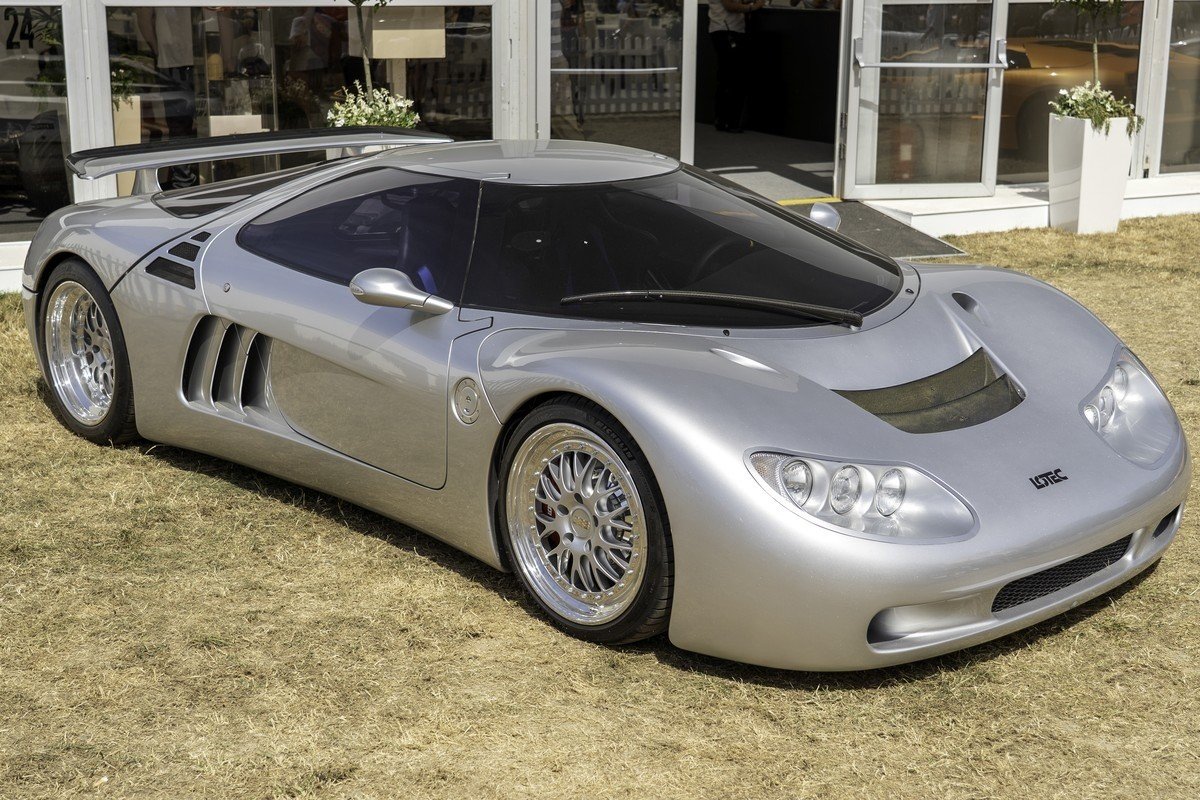
Spend enough time around Monterey Car Week and you start to believe a hypercar needs a billion-dollar parent, a wind tunnel and a marketing department that says “bespoke” every four seconds. The Lotec Sirius is the counterargument, and it’s about to show up in California to make it in person. Three men built it in a body and paint shop in Kolbermoor, a small town in Bavaria, working on it whenever the paying customers left them alone. It runs a twin-turbo Mercedes V12 that pushed 1,200 PS through the rear wheels on a dyno. It was finished in 2001. And after a quarter of a century it has about 450 miles on the odometer.
If the name Lotec rings a bell for American readers, it’s probably because of the Sirius’s older sibling, the C1000, the one-off that spent years bouncing around U.S. auctions and dealer lots before landing at Pebble Beach and the Petersen. We’ll get to that car, because the two stories are tangled together. But the Sirius is the one that sums up the man behind both of them: Kurt Lotterschmid, a Bavarian racer and tuner who had a shot at becoming a hypercar manufacturer in Dubai and said no, because he didn’t want to move.
In short: the Lotec Sirius is a one-off hypercar built by three people in Kolbermoor, Bavaria, between 1994 and 2001, scaled up from a quarter-scale chipboard model. It uses the M120 V12 from the Mercedes S600 with two KKK K27 turbos, and in 2026 it made 1,200 PS and 974 lb-ft at the rear wheels. It debuted in the lobby of the 2001 Geneva show and has covered about 451 miles.
A racer who started building his own
Lotterschmid was born in Munich on June 29, 1941. Lotec, the company he still ran into the 21st century, took its name from the first letters of LOtterschmid TEChnik. He set it up in the early sixties as a tuning business (1962 by the company’s own account; one racing database says he’d been running it since 1960), and through that decade he raced in Formula Vee, the entry-level open-wheel series built around Volkswagen Beetle parts.
By the late seventies he was in the Interserie, Europe’s loose answer to Can-Am, a series for big sports prototypes with very few rules. In 1979, driving a TOJ SC205, he won at Erding and again at Wunstorf in May, and stood on the podium at Most and Hockenheim. Lotec says he won the Interserie title in 1979 and 1980; the race-by-race results that survive don’t confirm it, so treat that one as the company’s claim.
Then he stopped buying race cars and started building them. The Lotec 681 of 1981 used a 3.5-liter BMW M88 straight six, the engine from the BMW M1, and finished third on its debut at the Nürburgring. The M1C followed, built for the new Group C rules, and in 1983 Lotterschmid took the C-Junior class title in the DRM, Germany’s national sports car championship. At the end of that season the car was sold to a Japanese team, Auto Beaurex Motorsport, and kept racing in Japan.
That background matters. When Lotterschmid sat down to shape a road car with 1,000-plus horsepower, he’d spent two decades welding up frames and watching what they did at 150 mph.
Turbo money
The race cars didn’t pay the bills. Mercedes owners did. In the eighties Lotec became one of the German shops that took sensible Benzes and made them deeply unsensible. The specialty was bolting turbochargers onto engines that had never been designed for them, especially in the W124 family, the mid-size Mercedes Americans bought as the 300E and 300CE. A 300 CE-24 Cabriolet with the Lotec turbo conversion made 354 hp. The stock car made 220, so Lotec added more than 130 horsepower to a four-seat drop-top and landed it within shouting distance of a 1990 Corvette ZR-1.
The whole Sirius story runs on boost, so a quick primer. An engine makes power by burning fuel, and it can only burn as much fuel as it has air to burn it with. A turbocharger takes the hot exhaust gas rushing out of the engine and uses it to spin a turbine wheel. On the same shaft sits a compressor wheel that crams extra air into the intake. More air in, more fuel burned, more power out, without adding displacement. It’s not free power: the turbine is a cork in the exhaust, and the engine has to work harder to shove spent gas past it. Our turbo chapter goes much deeper.
Lotec also turbocharged the Porsche 928 and the Ferrari Testarossa, and that’s how it ended up in the most outlandish project of its life. Designer Luigi Colani wanted a Bonneville car, and the result was the Ferrari Testa d’Oro, a 1989 Testarossa with a body Colani shaped like something from a sci-fi pulp cover. Lotec bolted two turbos onto the 4.9-liter flat-twelve and took it to about 750 PS, roughly double stock, and it stayed street legal in Germany. At Bonneville Speed Week in August 1991 it won its class at 217.9 mph. Colani had been talking about Rudolf Caracciola’s 268.9 mph from 1938. The car didn’t get close.
The sheikh’s car that went to Indiana

In 1988 Lotec set itself a target that sounded ridiculous for a regional tuning shop: the fastest road car in the world. The money came from Dubai. A member of the ruling Al Maktoum family commissioned a one-off, and in 1995 he took delivery of the C1000. Sources disagree on exactly which family member ordered it, so “a member of the family” is as far as the paper trail goes.
The C1000’s tub came from an American race car, the Ford Mustang Maxum GTP that ran in IMSA. The body was drawn by a painter, Hendrik Müller, not a car designer. Power came from a Mercedes V8 with two turbos and roughly 1,000 horsepower, which is where the name comes from, in a car weighing 1,080 kg, about 2,380 pounds. Lotec calculated a theoretical 268 mph. Lotterschmid says it did 236 mph on a closed course during the first run with the customer. Nobody independent has ever timed either number.
Then the car came to America and the glamour drained out of it. In September 2007 it sold at Kruse’s auction in Auburn, Indiana, for $250,250. In April 2008 Jalopnik found it in pieces at a dealership in North Carolina. In 2013 it went across the block in Charlotte with an estimate north of $1.3 million. It eventually ended up with collector Jonathan Weisman, who had it restored. It took third in class at Pebble Beach in 2024, and from June 2025 it sat in Supercar Alley at the Petersen Automotive Museum in Los Angeles, part of the “Totally Awesome” exhibit on eighties and nineties car culture.
All of that happened to a car Lotterschmid built for someone else. The one he built for himself never left home.
Shaped by eye in chipboard
The Sirius started in 1992 with no computer and no designer. Lotterschmid cut a quarter-scale model out of chipboard sheets and scaled the full-size car up from it by hand. Asked why he hadn’t hired a professional, he said there was no need, the exact shape was already in his head. His description of growing a 1:4 model into a real car was pure kitchen: “It’s like baking a cake.”
The early drawings had a continuous reflector strip across the tail that got dropped, and a hydraulic rear wing that never got built because there wasn’t time.
The first plan called for a twin-turbo Porsche flat-six. You can still see it in the cockpit: the gauge cluster comes from a Porsche 944, with the speedometer re-dialed to 400 km/h, a leftover from the six-cylinder days that simply stayed. What killed the flat-six was the McLaren F1. Once Gordon Murray’s car became the fastest production car on the planet, Lotterschmid decided six cylinders weren’t going to beat it and went to twelve. The F1 later sealed it with a 240.1 mph average at Volkswagen’s Ehra-Lessien track in 1998.
Real development started in 1994. The team was three people. One of them, race mechanic Hans Raich, was there from the first day and was still at Lotec three decades later. The budget came from the shop floor: bodywork, paint, tuning. Every time a customer car rolled in, the Sirius stopped. Lotterschmid figures the project ate six to seven million Deutschmarks, a few million dollars at the time, for a single car.
An S600 engine with two turbos
The engine is the Mercedes M120, the 6.0-liter V12 out of the W140 S-Class, the car Americans knew as the 600SEL and later the S600. In the S-Class it made 408 PS and 580 Nm (428 lb-ft) and moved a two-ton limousine with total calm. Horacio Pagani picked the same engine family for the first Zonda C12 in 1999, with 394 PS. Lotterschmid had something less calm in mind.
Lotec fitted two KKK K27 turbochargers, dropped the compression ratio to 8.5:1, replaced a long list of internals, rewrote the engine management and converted it to dry-sump lubrication.
The compression change is the key to how this engine behaves. Compression ratio is how much the piston squeezes the air-fuel mix before the spark. Squeeze more and you get more efficiency, up to the point where the mix lights off by itself before the spark, which is knock, or detonation, and it hammers pistons to death. A turbo engine already gets its charge pre-compressed and hotter, so it has to start with less squeeze of its own. The price is that before the turbos wake up, the engine is weaker and lazier than the stock V12.
Dry sump is a race-car trick. In a normal engine the oil sits in a pan under the crankshaft, and in a hard corner it sloshes to one side and the pickup can gulp air. A dry-sump engine keeps the oil in a separate tank and uses pumps to move it, so the engine stays fed no matter what the car is doing. Bonus: with no deep pan, the engine sits lower in the chassis.
On the numbers, be careful, because Lotec never was. In 2004, at 0.85 bar (about 12 psi) of boost, a dyno showed 850 PS and 1,100 Nm, or 811 lb-ft. Back in 2006 Lotterschmid was quoting 1,000 bhp at 1.0 bar. In 2026, turned up to 1.2 bar (about 17 psi), it made 1,200 PS and 1,320 Nm (974 lb-ft), measured at the rear wheels. Wheel figures are always lower than crank figures, because the gearbox and differential eat some power on the way, so the 2026 run is the impressive one. For scale, the 2002 Ferrari Enzo made 660 PS.
Race car underneath

The chassis is a welded steel tube frame, a cage, with a carbon-fiber tub built into it and a carbon and fiberglass body on top. That’s race-shop thinking, closer to an IMSA prototype than to the all-carbon monocoques Ferrari and Pagani used.
All four corners get double wishbones, two A-shaped arms per wheel, one stacked over the other, which lets the engineer control exactly how the tire leans as the car loads up in a turn. The coil-over spring and shock units sit inboard, inside the body, instead of hanging out next to the wheel. That cuts unsprung weight, the mass that moves up and down with the wheel, and less of it means the tire stays in touch with the road over bumps. Anti-roll bars front and rear keep body lean in check.
The original brakes were cross-drilled, vented Brembos with ABS. Tires were 255/35 ZR19 front and 345/30 ZR19 rear. The fuel lives in two 50-liter tanks, about 13 gallons each, built into the carbon side sills, which explains why the sills are so wide and why climbing in is a workout. Air conditioning and power steering were standard. That was the entire comfort package.
It’s 162 inches long and only 44 inches tall, but 81.9 inches wide, almost two inches wider than a Ferrari Enzo.
The clutch that never calmed down
The first gearbox was a Hewland racing unit with no synchros. In a road car’s transmission, synchronizers match gear speeds before the teeth engage, which is why you can shift without crunching. Race boxes skip them and you’d better know what you’re doing. For a car Lotec hoped to sell, that wouldn’t fly, so it switched to a synchronized six-speed transaxle from CIMA, the Italian supplier that also built gearboxes for Pagani and Koenigsegg, with a limited-slip differential. An open diff lets the inside and outside wheels turn at different speeds in a corner, which is good, until one wheel loses grip and gets all the torque. A limited-slip unit caps that difference and keeps feeding the wheel that can still use it.
The clutch is where the Sirius shows its character. To hold more than 1,000 Nm, Lotec used a four-plate Fichtel & Sachs unit with sintered-metal friction material. A normal clutch has one disc with a lining similar to a brake pad. Stacking plates multiplies the friction area without making the clutch huge, and sintered metal, made by pressing and baking metal powder, survives heat that would cook an organic lining. The trade-off is that it’s either fully disengaged or fully locked, with almost nothing in between.
When Auto Bild tested the car in 2004, the clutch grabbed and the shifter hung up. Lotterschmid said it just needed bleeding. In the 2026 test, with the car restored, there’s still a slight judder pulling away, and everybody now considers it normal.
Brochure math

Lotec claimed 0-62 mph in 3.8 seconds, 0-124 mph in 7.8 and a theoretical 249 mph top end. A 3.3-second 0-62 figure has also been quoted recently. None of it has ever been independently timed. Lotterschmid says he once saw 217 mph in it, which nobody else witnessed with a stopwatch. A real, timed 249 mph had to wait for an electric car: the Rimac Nevera ran 256 mph in 2022.
Weight is just as slippery. The spec sheet said 1,280 kg (2,822 lb), with no record of the car being weighed. Period tests said 1,390 kg (3,064 lb), and one 2004 German story gave 1,480 kg in the text and 1,280 kg in its own data panel. Run the friendliest numbers, the spec weight and the 850 PS dyno figure, and the Sirius carried 3.3 pounds per PS. Even with the heavier test weight it’s 3.6. The 2002 Enzo was at 4.6, and the 2005 Bugatti Veyron, at 4,162 lb and 1,001 PS, was at 4.2. On paper, a car from a Bavarian paint shop out-powered both.
What it was like to drive depends on the year. In 2004 Lotterschmid admitted he hadn’t put even 60 miles on it. The Auto Bild tester found it civil at low revs and wild at full throttle, with the tail trying to come around in a straight line in third gear, and called it a car for professionals. In 2026 another German reviewer called it raw, brutal and unfiltered. Below 3,000 rpm, not much happens. Then the turbos light and everything arrives at once. That’s turbo lag: the turbine needs a certain flow of exhaust before it spins fast enough to make boost, and until then you’re driving a low-compression V12 with no help. Lift and you hear the wastegates, the valves that dump excess exhaust around the turbines so boost doesn’t run away. The steering is quick but light, the suspension soft, because that’s how Lotterschmid always set up his race cars.
Inside: blue leather OMP buckets, a leather-wrapped dash, a custom laminated windshield that curves into the A-pillars like a helmet visor, and a small screen that rises out of the dash for the backup camera.
Upstaged in Geneva
The Sirius debuted at the 2001 Geneva Motor Show. Not on a stand, in the lobby. Inside the halls, Volkswagen was rolling out the Bugatti EB 16.4 Veyron, promising 1,001 PS and production in 2003, with the deepest pockets in the European car business behind it. The first customer car wasn’t delivered until 2005.
Lotec talked about building up to five cars a year, to order, at around £380,000, roughly $550,000 at the time. For production, the plan was to swap to the twin-turbo V12 from the Mercedes SL65 AMG so that any Mercedes dealer on earth could service one.
Investors did show up. The most serious deal called for a run of 25 to 50 cars, with production moved to Dubai. Lotterschmid would have had to move to the Gulf. He wouldn’t. In 2004 he said he wanted to sell the whole project to Chinese buyers. That went nowhere too. In late 2008 Lotec released sketches of an updated Sirius and promised sales in 2009; according to the company a new nose was actually finished, and it was never fitted. The Sirius went back into Lotterschmid’s garage in Kolbermoor and mostly stayed there.
The neighbor who bought it
It took a local to get it moving again. Martin Gossner grew up in Kolbermoor, his father worked for Lotterschmid, and he ran his own tuning shop, Projekt Opel, on the Lotec grounds. In 2009 he wrote his engineering thesis on the Sirius and how to build it in small numbers. He has now bought both the Lotec brand and the car, and the long-term plan is a new Lotec with the Sirius as the centerpiece of the relaunch.
To make it usable he replaced the original Brembos with carbon-ceramic brakes, 390 mm rotors up front and 380 mm in back. The original magnesium BBS E29 wheels gave way to a new set of BBS Motorsport E88s in the same style, and old photos also show it on three-piece Work wheels. Every original part is on a shelf.
When Auto Bild’s 2026 test began, the odometer showed 647 km. About 400 were Lotterschmid’s shakedown runs spread over the years; the rest Gossner had put on in the previous three weeks. Asked if the odometer had ever been reset, Gossner said: “No, never.” By the end of the test it read 726 km, about 451 miles. Next stop: an international tour that starts at Monterey Car Week.
The car he refused to sell
Strip out the brochure numbers and the Sirius still has something rare: a dyno sheet showing 1,200 PS at the wheels from a hand-built car scaled up from a chipboard model by a man who never used a computer. While Volkswagen needed a corporate empire and four extra years to put the Veyron on the road, three guys in Bavaria paid for theirs with paint jobs.
Lotterschmid blew the business side, no question. He could have been running a hypercar company out of Dubai. He stayed home, finished the car he’d been seeing in his head since 1992 and kept it. Today, a 2001 hypercar with 451 miles and every original part on a shelf is about as rare as a car gets.
Lotec Sirius FAQ
What engine does the Lotec Sirius use?
The 6.0-liter Mercedes M120 V12 from the W140 S-Class, with two KKK K27 turbos, 8.5:1 compression and a dry sump. At 1.2 bar of boost it made 1,200 PS and 1,320 Nm (974 lb-ft) at the rear wheels.
How many Lotec Sirius cars were built?
Just one. Lotec talked about up to five a year and a deal for 25 to 50 cars built in Dubai, but Kurt Lotterschmid refused to move there and production never happened.
How fast is the Lotec Sirius?
Lotec claimed a theoretical 400 km/h (249 mph), but it has never been independently timed. Lotterschmid says he once reached 350 km/h (217 mph).
Is the Lotec Sirius related to the Lotec C1000?
Both came from Kurt Lotterschmid’s shop in Kolbermoor. The C1000 was a 1995 one-off with a twin-turbo Mercedes V8 built for a member of the Al Maktoum family; the Sirius was the car he built for himself.
Check you’re still alive.
Photos: MrWalkr (CC BY-SA 4.0), Lamboshane (CC BY 2.5), Pyrosuwu (CC BY 4.0), In Vitrio (CC BY-SA 4.0).