
Ford Mustang: The Eternal Gallop of the American Dream
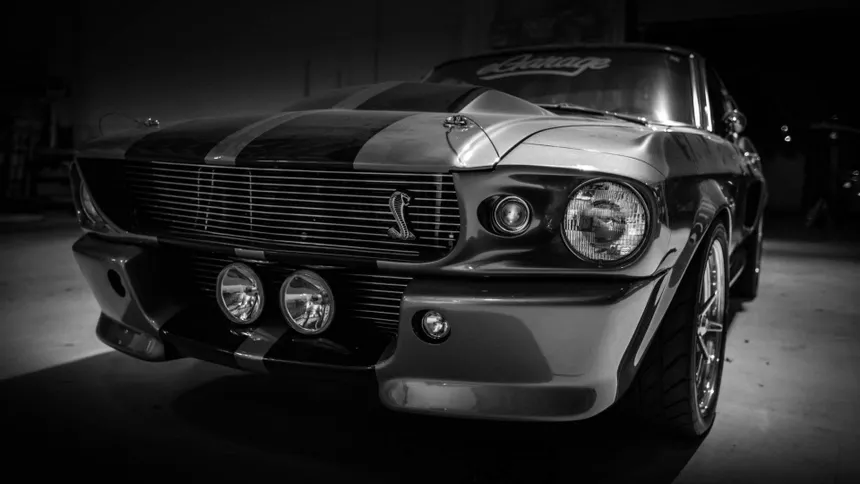
Talking about the Ford Mustang is not simply talking about a car. It’s telling the story of a survivor, of an icon that defined a generation and that, sixty years later, remains the standard-bearer of freedom on wheels. But if we’re going to be rigorous about history, let’s start by debunking a myth that gets repeated like a mantra: the Mustang was not the first pony car. That honor belongs to the Plymouth Barracuda, which hit dealerships on April 1, 1964 — exactly 16 days before the Mustang. The Barracuda, however, was little more than a Plymouth Valiant with an oversized rear window. It was the Mustang that, from its debut on April 17 at the New York World’s Fair, captured the world’s imagination and gave an entire segment its name.
And this is where the data you won’t find in just any article begins.
The Origin of a Myth: Lee Iacocca and the Fairlane Committee
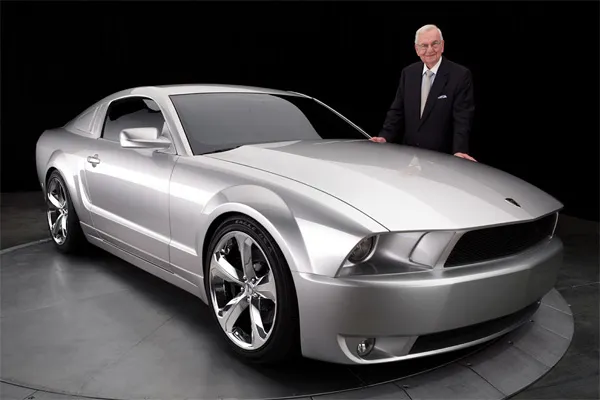
In the early 1960s, Ford Motor Company stood at a crossroads. The baby boom generation was reaching driving age and wanted nothing to do with the sober, heavy, boring sedans their parents had driven for decades. They wanted something that screamed “youth” — something sporty that wouldn’t cost a fortune.
Lee Iacocca, then vice president and general manager of the Ford Division, had the vision to capture that market. But developing a new car from scratch was prohibitively expensive. The genius of Iacocca and his team — the famous “Fairlane Committee” — was to use the mechanical platform of the modest Ford Falcon. By sharing the chassis, suspension, and engines, Ford slashed development costs dramatically. The result: a car with a radically different appearance — long hood, short deck — with a starting price of just $2,368 for the base model with the 170 cubic inch six-cylinder.
Ford projected sales of 100,000 units in the first year. Actual sales surpassed 418,000. The Mustang appeared on the covers of Time and Newsweek simultaneously — unprecedented for a commercial product.
The World’s First Mustang: The Story Almost Nobody Knows
Here’s one of those stories that separates a real article from a Wikipedia rehash.
The first Mustang sold anywhere in the world was not Gail Wise’s in Chicago. It belonged to Captain Stanley Tucker, an airline pilot for Eastern Provincial Airways, in St. John’s, Newfoundland, Canada. And it wasn’t just any Mustang: it was VIN 5F08F100001 — Serial Number One, the very first Mustang to roll off the assembly line at Ford’s Rouge Plant.
How did the first Mustang ever built end up at the easternmost tip of North America? Ford had built approximately 180 pre-production units between February and March 1964 to distribute to dealerships ahead of the official April 17 launch. The logic was simple: the first cars built were shipped to the most distant dealers. And St. John’s, at 3,500 kilometers from Dearborn, was literally the edge of the map.
On April 14, 1964, Tucker was driving past the George Parsons Ford dealership when he noticed a crowd gathered around an unknown car. The next day he walked in, saw the Wimbledon White convertible, and told salesman Harry Phillips — in his first year on the job — that he wanted it. Phillips knew he wasn’t supposed to sell it before April 17, but Tucker was insistent. The deal was done on the spot.
Tucker drove Serial Number One for two years, putting about 10,000 kilometers on it. When Ford found out that unit number one was in private hands, they tried to get it back. Tucker refused. Ford insisted. Tucker kept refusing. Finally, in early 1966, Ford offered him a deal impossible to resist: in exchange for Serial Number One, he would receive the one-millionth Mustang, configured exactly as he wished. Tucker accepted, and when given the option sheet, he placed a giant “X” across every single available option. The only thing he declined was the High Performance 289 engine because it had a shorter warranty.
On March 2, 1966, Tucker picked up his new Silver Frost convertible in Dearborn, where he posed with Lee Iacocca. Serial Number One was donated to the Henry Ford Museum, where it remains on display today.
One day after Tucker, on April 15, 1964, Gail Brown (later Gail Wise), a 22-year-old third-grade teacher from Park Ridge, Illinois, became the first person to buy a Mustang in the United States. She paid $3,447.50 — 69% of her annual $5,000 salary — without test-driving it and without haggling. Her father lent her the money. Gail Wise still owns that Mustang today. According to Hagerty, it’s valued between $350,000 and $450,000.
Carroll Shelby and the Muscle Car Transformation
The original Mustang, with its Falcon base and six-cylinder engines, was dismissed by purists as a “secretary’s car.” Ford needed track credibility, and they turned to the most famous Texan in the world of motorsport: Carroll Shelby.
Shelby took the 1965 Mustang Fastback and transformed it into the Shelby GT350. He removed the rear seats to comply with SCCA homologation, improved the suspension, and squeezed 306 horsepower from the 289 cubic inch V8. In 1967 came the definitive madness: the Shelby GT500, with the “Police Interceptor” 428 cubic inch engine.
428 Cobra Jet and Super Cobra Jet: The Engine Born at a Dealership
By mid-1967, the Mustang had a serious problem: the 390 FE engine was being systematically humiliated at quarter-mile strips by the Chevrolet Camaro 396 and Plymouth Barracuda 383. Ford was losing the drag strip war.
The solution didn’t come from Dearborn — it came from a dealership in Rhode Island. Bob Tasca, owner of Tasca Ford, was fed up with his customers buying Mustangs that were then destroyed by the competition. His team took a ’67 Mustang GT coupe whose 390 had blown, pulled it out, and dropped in a 428 Police Interceptor short block with 406 heads, an aluminum Police Interceptor intake, a high-flow Holley, and various Ford performance catalog parts. A Frankenstein engine built entirely from Ford’s own parts bin.
That Mustang ran quarters in 13 seconds at 105 mph, crushing any factory muscle car of the era. Tasca took it to Dearborn. Ford took the concept and turned it into a production model.
The 428 Cobra Jet (1968)
On April 1, 1968, Ford officially unveiled the 428 Cobra Jet. Enlarged valve heads, the race-bred 427’s intake manifold, Ram Air induction with a functional hood scoop, and a 735 CFM Holley carburetor. Real output was around 410-420 horsepower. Ford officially rated it at 335 hp. This wasn’t an error — it was deliberate strategy. First, to keep insurance premiums low. Second — and this is what few tell you — the NHRA classified cars by advertised power-to-weight. By declaring 335 hp instead of 410, the Cobra Jets competed against cars 75-85 hp weaker. Ford was cheating in plain sight.
At the 1968 NHRA Winternationals in Pomona, Ford sent six prepared 428 CJ Mustangs with five sponsored drivers: Gas Ronda, Jerry Harvey, Hubert Platt, Don Nicholson, and Al Joniec. They reached the finals in every class entered. The Super Stock final was Cobra Jet vs. Cobra Jet, and Al Joniec set a new NHRA record: 11.49 seconds at 120 mph.
Those six Mustangs were part of a limited run of 50 units in Wimbledon White, built exclusively for NHRA competition. Twenty were built with no sound deadening to save weight. In total, Ford sold 1,299 units of the 428 Cobra Jet in 1968. The CJ with Ram Air cost just $420.96 extra. Possibly the best performance investment in American automotive history.
The 428 Super Cobra Jet and the Drag Pack (1969-1970)
In 1969, Ford raised the stakes with the 428 Super Cobra Jet (SCJ). The only way to get one was the “Drag Pack” option for $147.60, requiring a 3.91:1 or 4.30:1 differential. Official power remained the same brazen lie of 335 hp, but the internals were substantially more robust: reinforced nodular cast-iron crankshaft, cap screw connecting rods, modified flywheel and damper, external oil cooler. None of the SCJ’s rotating assembly was interchangeable with the standard CJ.
Starting in 1970, cars with the 4.30:1 ratio could get the fearsome Detroit Locker — a pure competition piece in a street car. And by selecting the Drag Pack, the Mustang could not have air conditioning. The oil cooler occupied the A/C condenser space. Comfort or performance. No middle ground.
Boss 429: The Beast Ford Built at a Loss
The Boss 429 embodies industrial obsession beyond economic sense. Ford needed to homologate a NASCAR engine against Chrysler’s 426 Hemi. The rules required 500 street units. But the 429’s semi-hemispherical aluminum heads — Ford called them “crescent” — made the engine so wide it wouldn’t fit in the Mustang.
Kar Kraft, builders of the Le Mans-winning GT40s, relocated shock towers two inches outward, moved the front suspension forward one inch, and fabricated custom spindles. Each car got a “KK NASCAR” plate: KK #1201 first, KK #2558 last. Official 375 hp (real: ~400+), mandatory 4-speed Toploader, no A/C option possible, battery relocated to the trunk. The hood scoop remains the largest ever on a factory Mustang.
859 units in 1969, 499 in 1970. Total: 1,358. Ford lost money on every one sold. Kar Kraft’s modification costs exceeded the ~$5,000 sale price. The first 50 “S-code” cars with magnesium valve covers are the most valuable: concours examples exceed $390,000.
Ford’s Blunders: The Dark Years
Mustang II (1974–1978): From Stallion to Fairground Pony
Ford based the new Mustang on the Ford Pinto chassis — the car famous for exploding fuel tanks. Small, heavy for its size, desperately slow. Over a million sold. For enthusiasts, an unforgivable betrayal.
The Ford Probe: The Day Fans Saved the Mustang
Mid-1980s: Ford planned to replace the Mustang with a front-wheel-drive Mazda 626-based car, internally the ST-16. On April 13, 1987, journalist Christopher Sawyer published an explosive AutoWeek cover story. Thousands of protest letters flooded Dearborn. Neil Ressler said it was “the champagne-sipping crowd replacing the beer-drinking crowd.” John Coletti said he’d rather see the Mustang name die than put it on the Probe.
Ford had already committed 300,000+ units with Mazda. The car became the Ford Probe, sold alongside the Mustang from 1989. By 1997, Probe sales dropped below 20,000 while the SN95 Mustang dominated. The Probe died. The Mustang survived. Thanks to fans who refused to stay silent.
The Mustang in Competition: From Track to Strip and Back
Trans-Am: The American Civil War (1966-1970)
Ford won the manufacturers’ championship three straight years. The Boss 302 with Kar Kraft suspension made it serious. Parnelli Jones vs. Mark Donohue remains the golden age of American road racing. Ford built exactly 7,013 Boss 302s in 1970 to meet homologation.
Drag Racing: The Quarter-Mile Kingdom
1968: Six Cobra Jets dominate the NHRA Winternationals. 2008: Ford resurrects the name — 50 modern Cobra Jets sell out in three days at $69,995. John Calvert wins the 2009 Winternationals. 2018: 68 units for the 50th anniversary. 2024: The electric Super Cobra Jet 1800 — 1,800 hp — sets the NHRA record: 7.759 seconds at 180.14 mph. Front wheels off the ground at launch. In silence.
NASCAR
The Boss 429 engine raced in Torino Talladegas and Mercury Cyclone Spoiler IIs, not Mustangs. The Mustang was the homologation vehicle. 26 NASCAR wins in 1969. In the modern Cup Series, the Mustang Dark Horse carries Joey Logano (2022 champion) and Ryan Blaney (2023 champion).
GT3 and Le Mans (2024-)
The Mustang GT3 with M-Sport/Multimatic debuted at the 24 Hours of Le Mans in 2024. The GT4 runs the SRO category. The Dark Horse R competes in IMSA’s Mustang Challenge.
NHRA Factory X (2023-)
Mustang Cobra Jet vs. COPO Camaro vs. Drag Pak Challenger. 327 ci Coyote with Whipple supercharger, ~610 hp, Liberty 5-speed manual. Detroit’s war is alive in 2026.
Bullitt: The Chase That Changed Cinema (And Found Its End in Mexico)
October 1968: 9 minutes and 42 seconds that changed action cinema. Steve McQueen in a Dark Highland Green Mustang GT 390 Fastback chasing a Dodge Charger through San Francisco. Warner Bros. bought two identical Mustangs with consecutive VINs. Max Balchowsky prepared both. The 440-powered Charger was significantly faster — stunt drivers had to constantly lift off to keep it in frame.
After filming, the hero car ‘559 passed through several owners until Robert Kiernan bought it for $6,000 in 1974. In 1977, Steve McQueen wrote a letter asking to buy it back. Kiernan said no. McQueen wrote again. Kiernan never replied. The car sat in a Kentucky barn from 1980 until 2018, when Sean Kiernan revealed it at the Detroit Auto Show alongside Molly McQueen. In 2020: $3.74 million at Mecum Kissimmee — the highest price ever for an American muscle car at auction.
The stunt car ‘558? Lost for decades. In 2017, Hugo Sanchez bought two Mustangs near Los Cabos, Mexico. Expert Kevin Marti authenticated one as the lost Bullitt car, found half a century later in a Mexican junkyard.
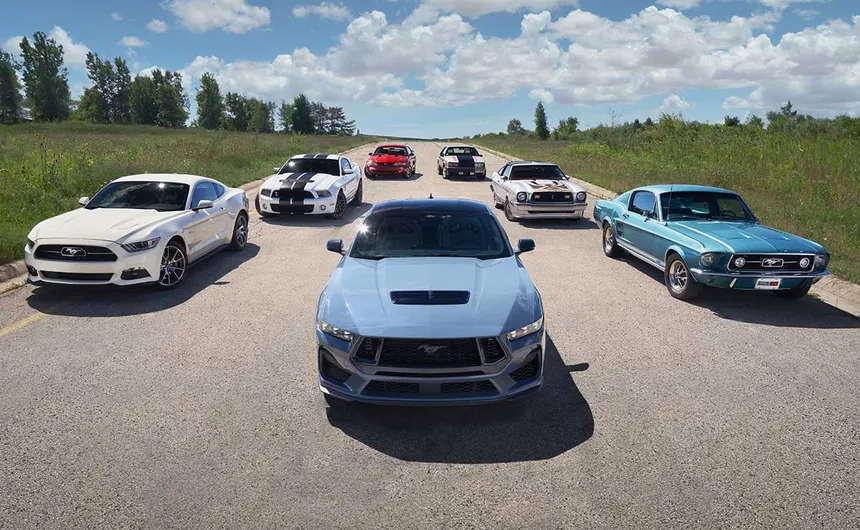
Facts Few People Know
The name “Mustang” comes from a fighter plane, not a horse. Designer John Najjar proposed it after the WWII P-51 Mustang. Ford redirected the association to the wild horse.
The horse logo runs left. American horse racing goes right. Designer Gale Halderman made it run the opposite way — toward the West, toward freedom.
The “1964½” doesn’t officially exist. For Ford, they’re all 1965 models.
Ford rated the 428 Cobra Jet at 335 hp when it made over 410. The lie lowered insurance AND gamed NHRA classifications. Legal cheating in plain sight.
Ford used 23 Mustangs in Disney’s “Magic Skyway” ride at the 1964-65 World’s Fair.
The Mustang in the 21st Century: The Last of Its Kind
In 2024, while the Camaro and Challenger ceased traditional production, the S650 Mustang stayed faithful to its 5.0L Coyote V8. The last of its kind. The Mustang Mach-E is polarizing but strategically brilliant: its profits and emissions offsets keep the gasoline Mustang alive.
Final Statement: Why the Mustang is Immortal
The Ford Mustang is so much more than sheet metal, leather, and gasoline. It survived executives who wanted to kill it, crises that wanted to shrink it, and trends that wanted to domesticate it.
It’s the rebellion of McQueen — who tried to buy back a car and was told no, because a guy from New Jersey loved the Mustang more than the King of Cool himself. The vision of Iacocca. The madness of Shelby. The legal cheating of the Cobra Jet at Pomona. The letters from thousands of anonymous fans who saved the car from becoming a Mazda in American clothing.
You don’t drive a Mustang with your hands. You drive it with your soul. And that, my friends, no technology can replicate.
As long as there’s a drop of gasoline left in the world, there’ll be a Mustang waiting to burn it on an endless straight. And when the gasoline runs out, it’ll find another way to keep galloping — at 7.759 seconds the quarter mile, front wheels off the ground, in silence. Because that’s what mustangs do: they run. Always to the left. Always toward freedom.
Think that was enough? This is Not Enough Cylinders. We don’t come here to repeat what you already know — we come to tell you what nobody bothers to research.
Pingback: Ford 428 Cobra Jet: The Engine a Rebel Dealer Built First
Pingback: Ford Festiva SHOgun: The Mid-Engine Yamaha V6 Build