
Ford RS200: How Two F1 Engineers Built Group B’s Most Advanced Rally Car From Scratch
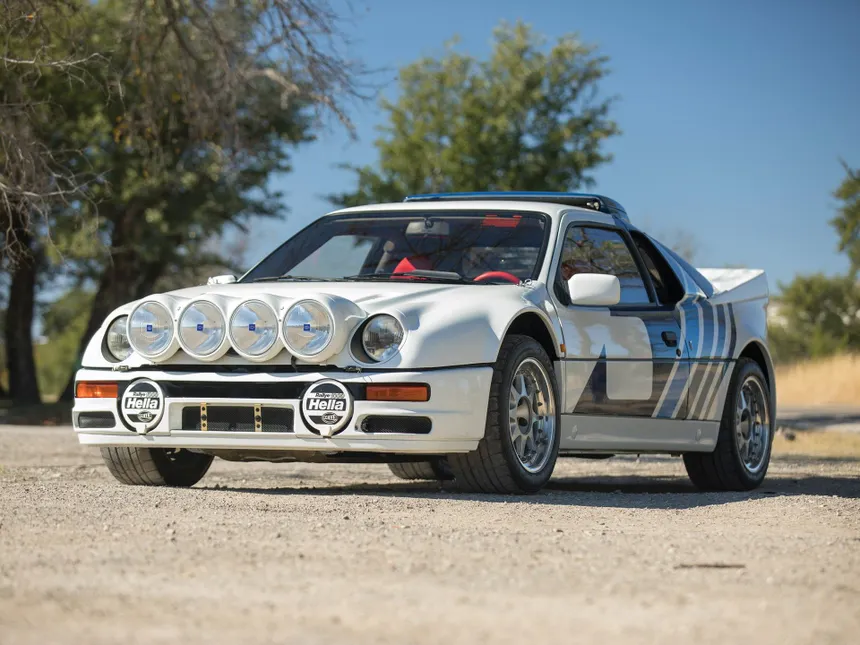
Every Group B car had a touch of madness. The Audi Quattro was a cast-iron block with a turbo strapped to it. The Peugeot 205 T16 was a supermini turned into a mid-engined missile. The Lancia Delta S4 was a twin-charged experiment that killed its drivers. But only one was literally designed from a blank sheet of paper by two Formula 1 engineers, built around an aerospace-grade aluminum honeycomb chassis, clothed in composite bodywork, with the gearbox mounted in the nose and the engine behind the driver. That car was the Ford RS200.
And it arrived late. Too late to win. Just in time to become legend.
The prior failure: the Escort RS 1700T
The RS200’s story begins with a failure. After dominating Group 3 and Group 4 with the Escort Mk1 and Mk2 through the 1970s, Ford needed a car for the new Group B. Their first answer was the Escort RS 1700T: a turbocharged, rear-wheel-drive variant of the Mk3 Escort. Development was a disaster — constant technical problems, internal apathy (the car bore no resemblance to the production Escort), and investment yielding no results. In 1983, Ford killed the project.
They were left with no Group B car. Audi was already dominating with the Quattro. Peugeot was preparing the 205 T16. Lancia was refining the 037. Ford had nothing.
That is when Stuart Turner, Ford Motorsport director, made the decision that changed everything: start from zero. Do not modify a production car. Do not adapt an Escort. Design a pure competition machine with no compromises, and build the 200 road cars required for homologation. The new car’s fundamental design was decided by late summer 1983, and the first prototype was completed by March 1984.
For American readers, the RS200 has a particular resonance. It was never officially sold in the United States — Group B homologation specials were European market products — but a handful have made it stateside over the decades, and the car has a cult following among American rally and exotic car enthusiasts. Tim Allen owns one. Several have appeared at major U.S. concours events. And with values now in the $400,000-$700,000 range, the RS200 sits firmly in serious collector territory.
The design: Formula 1 applied to rallying
What makes the RS200 unique among Group B cars is who designed it.
The chassis was the work of Tony Southgate, an F1 designer responsible for cars at Shadow, BRM, Arrows, and Jaguar’s Le Mans program. Chief engineer was John Wheeler, also from F1, working at Ford Motorsport. These were not rally engineers — they were open-wheel designers applying their knowledge to a closed-roof, four-wheel-drive machine.
The result was extraordinary. The chassis floor, sills, and bulkheads were constructed from bonded and riveted Ciba-Geigy aerospace-grade aluminum honeycomb sandwich with steel outer skins. The stressed central tunnel and inner rear bulkhead were molded from a lightweight reinforced aramid (Kevlar) and carbon fiber composite. The upper structure and roof combined carbon fiber, aramid, and fiberglass. The result was a lightweight, extremely rigid survival cell with a 2,530 mm (99.6 in) wheelbase.
The exterior bodywork was designed by Ghia — Ford’s design studio — in fiberglass composite. It was clean, functional, and according to many enthusiasts, the most handsome car in all of Group B. The windshield and tail lights came from the Sierra. The doors were cut-down Sierra items. Interior switchgear was also Sierra-sourced. Of the car’s 2,900 parts, 900 came from Ford’s production parts bin. Everything else was pure competition design.
The engine: Cosworth BDT at 1,803 cc
Power came from a Cosworth BDT inline-four, 16 valves, DOHC, turbocharged. Displacement of 1,803 cc (3.36 in bore, 3.03 in stroke). All-aluminum block with Nikasil-lined cylinders, Garrett AiResearch hybrid T03/T04 turbocharger running up to 0.8 bar boost, roof-mounted air-to-air intercooler behind the cockpit, Bosch fuel injection, and Ford EEC IV electronic engine management. Compression ratio of 8.2:1.
In road trim, the BDT delivered 250 hp at 6,000-6,500 rpm and 215 lb-ft at 4,500 rpm. In competition spec, figures ranged from 350 to 450+ hp depending on boost configuration. Ford offered upgrade kits for road cars exceeding 300 hp.
But 250 hp did not tell the whole story. The road RS200 was not exceptionally quick in a straight line for its price: 0-60 mph took approximately 5.7-6.1 seconds, comparable to a Sierra Cosworth at a fraction of the cost. At £49,995 in 1985 (roughly $147,000 in today’s money), it was more expensive than a Ferrari 328 GTB. Straight-line road speed was not the point — special stage speed was.
The drivetrain: gearbox in front, engine in back
This is where the RS200 becomes genuinely bizarre — and brilliant.
The engine sat mid-rear, longitudinally, behind the cockpit. But the gearbox — a Hewland five-speed — was mounted at the front of the car. Power traveled from the engine forward via a propshaft to the gearbox and front differential, then was distributed to all four wheels through a permanent AWD system designed by FF Developments (Ferguson Formula).
The Ferguson center differential allowed adjustable torque split: the default was 37% front / 63% rear, but it could be locked to 50:50 or configured as pure rear-wheel drive for tarmac events. All three differentials used viscous couplings as limited-slip units. The clutch was a twin-plate AP Racing unit.
This layout — engine in back, gearbox in front — gave the RS200 a weight distribution close to 50:50, extraordinary for a competition car. Suspension was double-wishbone with twin dampers on all four corners, providing stability and balance that many considered superior to any other Group B machine.
Jackie Stewart was invited to test prototypes and help fine-tune the road car’s drivability, particularly the clutch feel. When a three-time F1 World Champion helps calibrate your clutch pedal, you know the car is something special.
The road-going RS200’s driving character was contradictory. The double-wishbone suspension with twin dampers per corner was absorbent — designed for broken rally stage surfaces, which made it surprisingly compliant on paved roads. Steering was light and precise. Brakes were responsive and required minimal effort. But the Hewland gearbox, with ratios designed for competition, had a 15-20 mph spread between gears, meaning the engine was screaming at 6,000 rpm in fifth gear at 80 mph on the highway. And the turbo lag was brutal: the BDT had a dead zone below 3,000-3,500 rpm where throttle response was essentially nonexistent, followed by a sudden surge of power that could catch any driver off guard. It was a car that demanded committed driving or nothing at all.
In November 1986, Ford loaned an RS200 to the Essex and Suffolk police forces as a high-speed pursuit vehicle. At the time, Ford supplied more than half of the 24,000 cars used by British police, mostly Granadas and Sierra XR4x4s. The RS200 hit nearly 150 mph on a closed motorway section during evaluation and starred in a series of publicity photographs that became iconic. A homologated rally car serving as a police interceptor. Group B in its purest form.
Homologation: Reliant builds the Fords
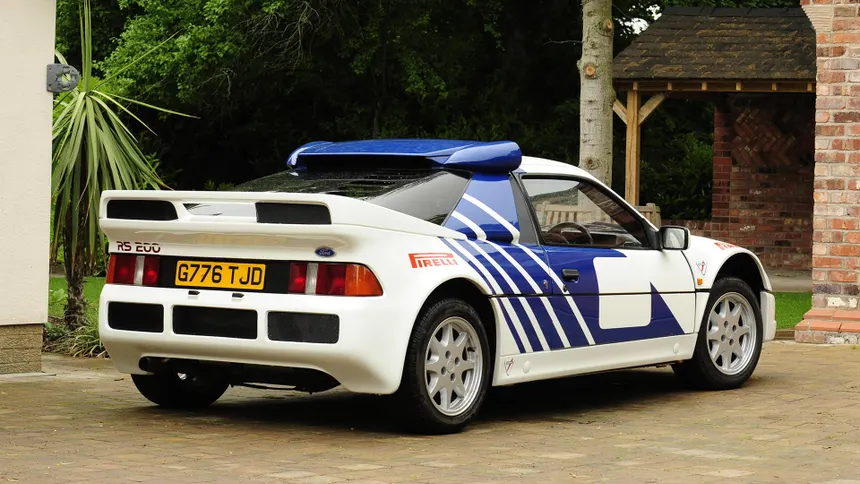
The FIA required 200 road cars for Group B homologation. Ford contracted Reliant Motors PLC — yes, the makers of the Reliant Robin, the most famous three-wheeled car in automotive history — to assemble the 200 units at their Shenstone, Staffordshire facility. Development took place at Ford Motorsport’s headquarters in Boreham, Essex.
Production suffered constant delays due to supply problems. The first production car was not completed until September 1985. Group B homologation was finally approved on February 1, 1986 — mere weeks before the car’s first official WRC entry at the 1986 Monte Carlo Rally.
Of the 200 intended units, only 152 were completed and delivered. When the FIA banned Group B after 1986, Ford realized it needed to sell far more as road cars than originally planned. Many assembled cars were dismantled to ensure parts supply. All 152 completed units had been sold by January 1990.
Competition: one season and a tragedy
The RS200 competed for just one full WRC season — 1986. Results were mixed and marked by tragedy.
The best finish was Kalle Grundel’s third place at the 1986 Rally of Sweden — the RS200’s highest-ever Group B result. But the car suffered from notable low-RPM turbo lag that made it difficult to drive, and its power-to-weight ratio was not the best against the competition.
Then came Portugal. At the 1986 Rally of Portugal, a Ford RS200 left the road and struck spectators. Three people died. Many more were injured. It was not the only fatal accident that Group B season — Henri Toivonen and co-driver Sergio Cresto died in a Lancia Delta S4 at the Tour de Corse, sealing the category’s fate.
The FIA banned Group B at the end of 1986. The RS200 was obsolete after a single season. The car that took three years to develop never had time to prove its potential.
The Evolution: 2,137 cc and 600+ hp
Ford already had the Evolution version ready for 1987. The BDT-E engine, developed by noted race engine builder Brian Hart, enlarged displacement to 2,137 cc (90 mm bore, 84 mm stroke). Bosch Motronic management, Garrett turbo running up to 1.6 bar, compression ratio reduced to 7.2:1. At 1.5 bar, the BDT-E produced 506 hp at 7,500 rpm and 400 lb-ft at 5,500 rpm. In more aggressive configurations, typical output was 580 hp, with documented peaks exceeding 700 hp and even 815 hp depending on boost levels.
With Group B canceled, Ford converted 24 of the original 152 RS200s to Evolution specification. No new chassis were built — existing cars were used. Modifications were primarily mechanical, with additional cooling ducts fitted above the roof on either side of the main engine intake.
The Evolution found its second act in the European Rallycross Championship, where Group B cars remained legal until 1992. Norway’s Martin Schanche won the 1991 European rallycross title with an RS200 E2 producing over 650 hp. Stig Blomqvist campaigned an RS200 at Pikes Peak in 2001, 2002, and 2004. One RS200 was even converted to IMSA GTO specification in the United States with an over-750 hp BDT-E engine, competing against factory Mazda, Mercury, and Nissan teams — proof that the RS200’s engineering was versatile enough to work far beyond its original rally purpose.
Today’s market: half a million for a dream
RS200s are extraordinarily valuable today. Standard cars in good condition trade between £300,000 and £500,000 ($400,000-$650,000). Evolutions reach higher: the auction record is $550,000 (Bonhams, 2017, USA). In November 2023, an Evolution sold for £486,000 at Iconic Auctioneers.
In June 2024, Ford and Boreham Motorworks announced an RS200 “Remaster” continuation program alongside an Escort Mk1 continuation. The RS200’s legacy continues generating business nearly four decades after its creation.
What remains: Group B’s greatest what-if
The Ford RS200 is the car of what-ifs. What if it had been ready a year earlier. What if Group B had not been banned. What if Ford had time to develop the Evolution in competition. What if the turbo lag had been resolved. What if Portugal had not happened.
But the what-ifs are irrelevant against what the RS200 IS: a pure competition car designed from scratch by Formula 1 engineers, with an aerospace-technology chassis, a Cosworth engine capable of over 700 hp, a unique drivetrain with the gearbox in the nose, and bodywork that remains one of the most beautiful ever created for rallying. Built by Reliant. With Sierra parts. And calibrated by Jackie Stewart.
The RS200 stands apart from its Group B contemporaries in one fundamental way. The Quattro was a production car modified for competition. The 205 T16 was a production car rebuilt around a mid-engine layout. The Delta S4 was a Lancia chassis turned into an engineering laboratory. The RS200 was a race car from the very first sketch — it simply happened to need a road-legal version to satisfy the rules. That purity of purpose is what gives it its lasting appeal, and what makes it the most architecturally sophisticated machine to come out of the entire Group B era.
152 cars completed. 24 Evolutions. One WRC season. One podium. And a legacy worth half a million pounds per unit.
Group B died. The RS200 is immortal.
Check you’re still alive.