
I Heard the GTA Spano E&D Run. I’ll Never Forget It.
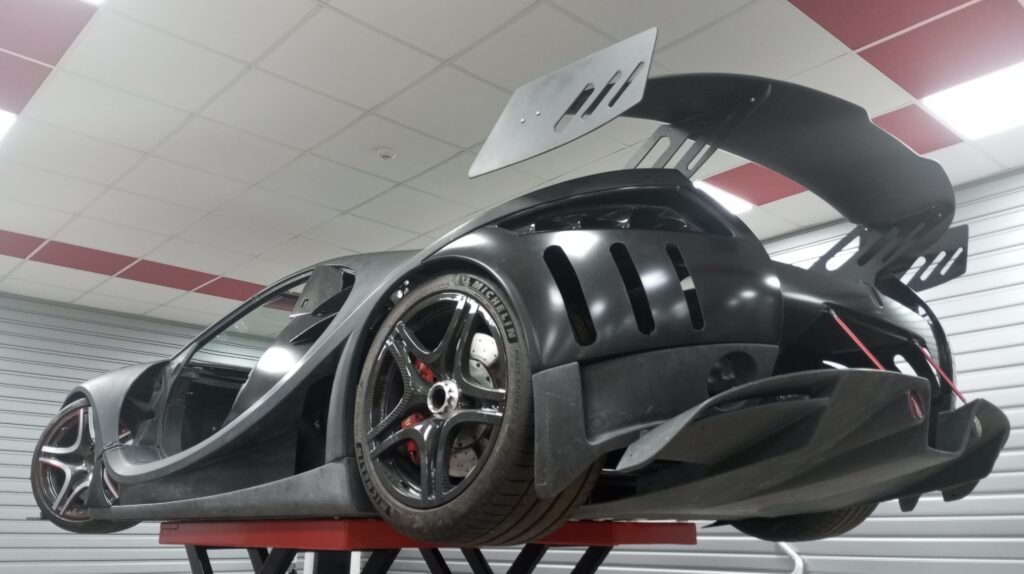
There are moments that don’t translate well into words. Moments where reality overtakes everything you’ve read, watched on video or imagined. Moments that shift your reference point for what’s actually possible in this country when someone has enough determination to keep going no matter how many times the world tells them to stop.
Today was one of those moments.
I visited the Spania GTA factory. I saw the E&D in person. I spent hours talking with Domingo Ochoa. And before I walked out that door, I heard that engine run.
I can’t tell you everything. There are things I saw that can’t be revealed yet — contractual commitments protecting technology still in development, details that will surface when Domingo decides the time is right. But what I can tell you is enough to make you understand why this car is something completely different from anything else being built in Spain right now, and why the speed record attempt on the horizon is not a marketing promise. It’s a personal mission.
Before we talk about the car, we need to talk about the man
When you walk into that workshop and see Domingo Ochoa standing in front of the E&D, something hits you before he opens his mouth. Not the car, though the car is breathtaking. It’s him.
He has the look of someone who has spent decades fighting an inertia that keeps telling him he can’t. That a mechanics workshop in Torrente isn’t where hypercar builders come from. That Valencia isn’t Maranello or Molsheim. That this isn’t what happens in Spain. And he, systematically, for thirty years, has spent every available hour proving that inertia wrong.
He doesn’t say it with arrogance. He says it with the calm of someone who no longer needs to convince anyone — because the evidence is already there. Twelve units built. Cutting-edge technology recognised internationally. A crash at 176 km/h that left him in a wheelchair, took five years to recover from, and from which — instead of retiring — he drew the conclusion that the chassis he’d designed himself had saved his life.
He tells you this without drama. Like it’s just another technical data point.
What you do notice, what slips through even though he doesn’t intend it to, is that this isn’t a business project. The E&D is a statement. A response. A public and documented demonstration that in Spain, with work and knowledge and the guts to see it through, you can build things nobody else builds.
But let’s get to the car. Because the car deserves everything.
The Structure: What Saves Your Life
Start with the foundations. Because in the E&D, the structure isn’t just the chassis. It’s the most powerful argument Domingo has for every design decision he’s made.
On 18 December 2013, Domingo Ochoa survived a head-on impact with a lorry at 176 km/h. Eighteen fractures. One hundred and seventy stitches. Five years of rehabilitation. The monocoque he’d designed himself: intact. That wasn’t luck. That was engineering.
The E&D takes that lesson — learned in the most brutal way possible — and applies it at the next level.
The structure is a carbon fibre monocoque with an integrated honeycomb and aluminium core. This combination isn’t new in the hypercar world — Le Mans prototypes, Formula 1 cars and combat aircraft all use it. What makes it different in the E&D is how the programmed deformation has been designed.
A completely rigid chassis is not necessarily safer. The physics don’t work that way. What saves lives in an impact is a structure’s ability to absorb and dissipate energy in a controlled way, concentrating deformation in zones specifically designed to collapse — while protecting the survival cell at any cost. That’s what the original Spano chassis did in 2013. That’s what the E&D chassis does, taken to a different technical level, under the demands of power outputs that multiply the structural requirements.
Completing the protection: a steel safety cage. Steel inside a carbon structure can seem like a contradiction. It isn’t. The cage provides ductile deformation at the points where carbon — stiffer but brittle under certain load types — could be compromised. The combination of materials isn’t a compromise. It’s the correct solution to the correct problem.
This car is built for a driver to reach 400 km/h. And it’s also built so that if something goes wrong, the driver walks away.
The Heart: A V10 That Never Forgot Where It Came From
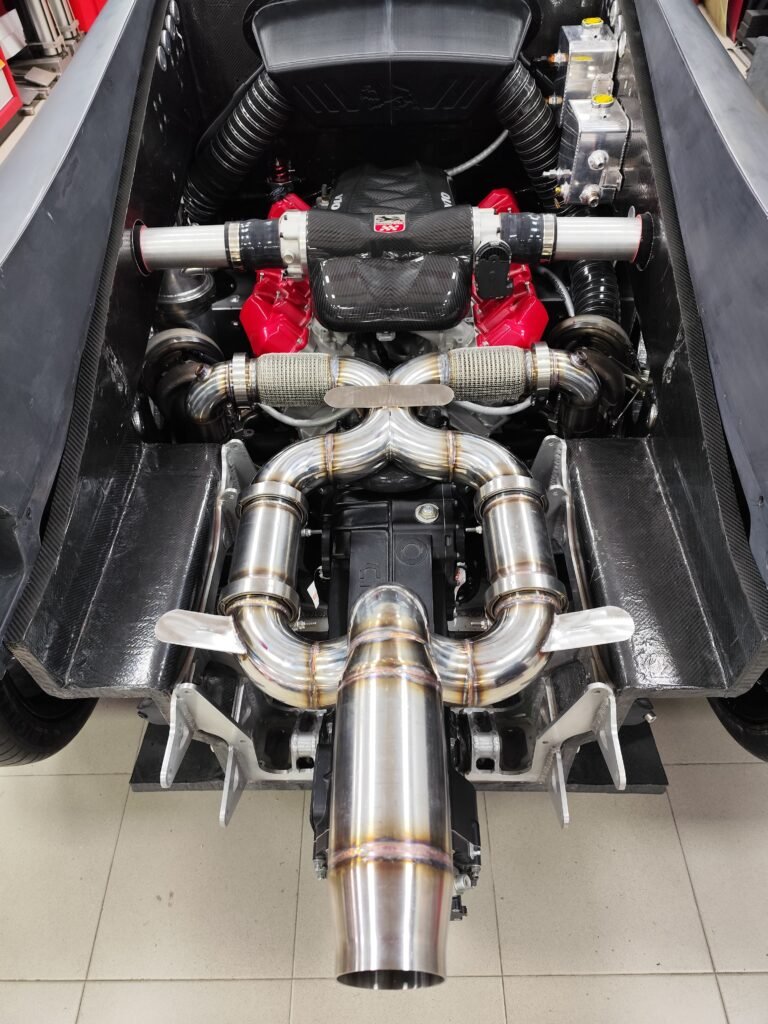
The E&D’s engine is the same Ilmor V10 block — derived from the Dodge Viper — that powered the original GTA Spano. But saying it’s “the same” would be like saying a modern Formula 1 car uses “the same” carbon monocoque as the ones from the 1990s.
The starting point is a 90-degree V10, pure American architecture, with an unequal firing order — alternating intervals of 90 and 54 degrees between combustion events — that gives it an unmistakeable sound. Not the shriek of an F1 V10. Not the European roar of a Lamborghini. Something darker, deeper, with that irregular and menacing pulse that only large-displacement American engines have. A sound you don’t forget.
I know this because today I heard it. In person. And I promise you: it hits.
But beyond the sound, what makes the E&D different is everything that’s been done to that block to reach the target: 1,200 hp and over 1,200 Nm of torque.
To put those numbers in perspective: that’s more power than a first-generation Bugatti Chiron, and torque that surpasses most of today’s electric hypercars. In a car that, by its structural and philosophical conception, has nothing left to prove to anyone in terms of mechanical integrity.
Engine Management: MoTeC
Controlling that level of power takes more than a standard ECU. The E&D runs a MoTeC management system: a programmable M1 series ECU plus two additional MoTeC controllers.
MoTeC is the global reference for motorsport engine electronics. M1 ECUs are the standard in Le Mans prototypes, GT3, international single-seater championships and factory development programmes where mapping precision isn’t a competitive advantage — it’s a survival requirement. The M1 architecture allows strategy programming at firmware level, fully customisable logic, independent management of each turbo, electronic throttle control, advanced antilag strategies, and datalogging capability that turns every test kilometre into structured, analysable information.
The fact that the E&D runs an ECU of this level is not a catalogue detail. It’s the only rational way to manage 1,200 hp with two Borg-Warner turbos, a dry sump, and a top speed target that allows no margin of error.
Thermal Management: A Cooling System to Match
At 1,200 hp from a block of these characteristics, heat management is one of the project’s greatest engineering challenges. The Spania GTA team has addressed it with a complete system solution that leaves nothing to chance.
The E&D runs dedicated radiators for each critical system element:
- Engine oil radiator. At these power outputs and operating loads, oil temperature is a variable that can destroy an engine within minutes if not precisely controlled.
- Water-cooled Borg-Warner turbo radiators. Competition turbos generate heat brutally. Borg-Warner — a supplier to Formula 1 teams, WRC programmes and the most demanding hypercar manufacturers in the world — was the choice for the E&D. Water-cooling the turbos maintains stable operating temperatures during extended runs, which is essential when the target is a speed record that isn’t achieved in a thirty-second pass.
- Fuel and fuel pump radiator. Hot fuel loses energy density. Controlling its temperature means controlling the consistency of power delivery in every condition.
- Main engine radiator.
- Larger intercoolers compared to the original Spano specification, necessary to manage the greater volumes of pressurised air that 1,200 hp demands.
Five cooling circuits. One objective: that every time the throttle is pinned at the end of that straight, the engine delivers exactly what the maps say it will.
Brakes: Carbon-Carbon with AP Racing Callipers
A car targeting 400 km/h needs to be able to stop from 400 km/h. The E&D runs carbon-carbon brake discs with AP Racing callipers — the same brake combination used in Le Mans prototypes and Formula 1. Carbon-carbon offers dramatically lower weight than steel with superior thermal resistance at extreme temperatures, and the fade resistance necessary when braking forces are measured not in g-forces but in the physics of what happens when 1,200 hp meets a deceleration requirement.
Suspension: Independent, Outside the Engine Bay, Built in the USA
The E&D runs double wishbone suspension all round, with the dampers mounted outside the engine compartment. That positioning isn’t cosmetic — it’s a thermal and accessibility engineering decision.
The wishbones themselves are made from a special steel manufactured specifically for this project in the United States: a material that maintains consistent mechanical properties even after welding, without the heat-affected zones that would compromise a conventional steel component’s behaviour under load. This is the kind of solution that doesn’t appear in press releases. It appears when someone has spent thirty years building race cars and knows exactly what fails and why.
The car runs without traction control, with ABS. Domingo’s decision. The reasoning is coherent: at the speeds this car will reach in testing conditions, a traction control system could intervene at exactly the wrong moment. The driver needs total feedback. The electronics manage the engine — not the tyres.
The Aerodynamics: Active, Smart and Not Disclosed
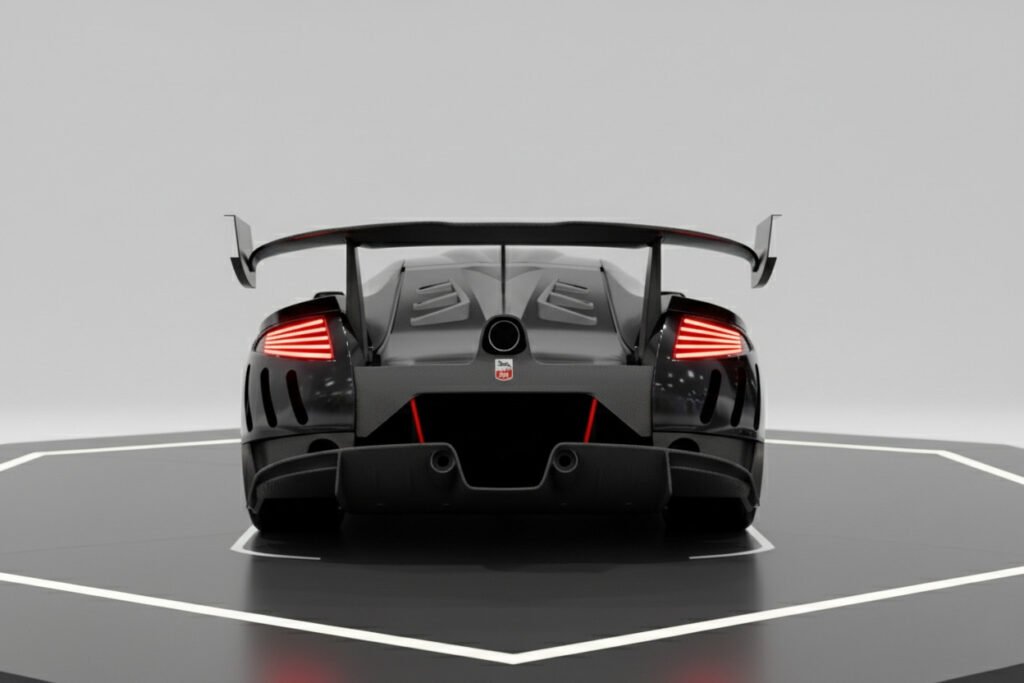
The aerodynamics of the E&D are active — the car has systems that adjust aerodynamic load in real time. The specific mechanisms, the positions, the control logic: under development, under contract, not for publication yet.
What can be said is that active aerodynamics at these speeds isn’t a luxury. At over 300 km/h, aerodynamic forces become the dominant variable in the dynamic equilibrium of the car. Passive aerodynamics designed for 300 km/h creates drag — or instability — at 400. You need systems that adapt. The E&D has them.
Ethan: The Name on the Car
The GTA Spano E&D. The E is Ethan. D is Domingo.
Ethan is Domingo’s son, and he is already learning this project. He’s learning what it means to build something from nothing. What it means to fight for a vision when the environment doesn’t make it easy. What it means to not give up.
There is something powerful in that. A father who builds his dream from scratch, who loses almost everything twice — in the 2013 crash, and in the Valencia DANA floods of October 2024 — and who instead of stopping rebuilds it, putting his son’s name on the project. Not as a tribute. As a statement about the future.
The E&D is not the end of Domingo Ochoa’s story. It’s the story of how you pass the torch.
Where the Project Stands: I Heard It Run
The E&D is running. Not in drawings. Not on a computer screen. In the workshop. Engine installed. Systems operating.
There have been challenges through the process — systems adapting to the new power targets, thermal challenges without precedent in the original project, electronic integrations that required custom solutions — and today those challenges are resolved or being resolved. This is not a project that hit a wall and stopped. It’s a project that hit walls, analysed them, solved them, and kept moving.
How do I know this is real and not just words? Because before I left, the engine started.
There are sounds that don’t leave you. The V10 running in that enclosed space, with that unequal firing order that reaches your chest before it reaches your ears, with that deep and irregular sonic texture that only large-displacement American engines have when they’re alive and at temperature — that doesn’t get invented. That doesn’t get simulated. That engine exists, it runs, and it’s being mapped toward 1,200 hp.
It’s getting close.
The Question I Asked: Why Not Stop
I asked Domingo what he’d say to someone at their lowest point, with everything against them, wondering whether it makes sense to carry on.
He didn’t have to think about the answer.
He told me that when the original GTA Spano had its first public appearance, Horacio Pagani came over to him. The same Horacio Pagani who built his first supercar in a garage in Argentina, who was told he was crazy, who today runs one of the most respected names in the history of high-performance cars.
And Pagani said to him: “Don’t give up — this isn’t easy at all.”
Five words worth more than any motivational talk. Coming from who they come from, carrying the weight they carry, said between two people who know exactly what they’re talking about because they’ve lived it.
Domingo didn’t give up after the first Spano. He didn’t give up after the crash. He didn’t give up after the floods. And the E&D, which today sits in that workshop with the engine running, is the physical proof that he was right not to.
The Challenge: 400 km/h. Ciudad Real. No Spanish Car Has Done This Before.
The target for the GTA Spano E&D is to exceed 400 km/h at the Ciudad Real airfield — the longest straight of its type available in Spain for an attempt at this level.
No vehicle manufactured in Spain has officially and documentably crossed that speed barrier.
And for those who want to understand the scale of what we’re talking about, Domingo gave me a figure that hasn’t left my head: the team estimates the E&D needs just 2 kilometres to reach the target speed.
Two kilometres. To go from a standing start to over 400 km/h.
That’s not just a power figure. It’s the direct consequence of everything described in this article: 1,200 hp on a car designed so that every kilogram, every degree of temperature, every newton of aerodynamic load works in the same direction. An American engine that pushes from the first centimetre. A 50/50 weight distribution that puts all that force into the ground without wasting it on instability. A MoTeC electronic management system that controls torque in real time at the limit of what the tyres will accept.
For context: when the Bugatti Veyron set its 407 km/h record in 2010, it used roughly 9 kilometres of straight at Volkswagen’s Ehra-Lessien proving ground. The E&D estimates reaching similar speeds in less than a quarter of that distance.
Ciudad Real has the straight. The E&D has what it takes to use it.
What Comes Next
The E&D will be a collector’s item of extraordinary value when the record attempt is completed. But before that, it’s the tool with which Domingo Ochoa is going to write the final page — or perhaps the prologue to the next chapter — of a story that started in a workshop in Torrente more than thirty years ago.
Domingo told me that when the time comes to talk about new models, he’ll let me know. That means more story to come. That the track-focused model on the horizon is real. That this doesn’t end with the E&D.
I’ll be here. Following this project closely, with the access Domingo has had the generosity to give me, telling you everything that can be told when it can be told.
That’s why Not Enough Cylinders exists. To be where the real story of motorsport is happening. Not the one told at press conferences. The one being built in an industrial unit in a Valencia business park, with oil-stained hands and a head full of numbers.
The 🐺 is awake.
Not Enough Cylinders. No filters. No half-measures.
Pingback: GTA Motor Competición: The Valencian Team That Ferrari Couldn't Beat — So They Changed the Rules