Hispano-Suiza: The Spanish Brand That Made Rolls-Royce Pay Royalties
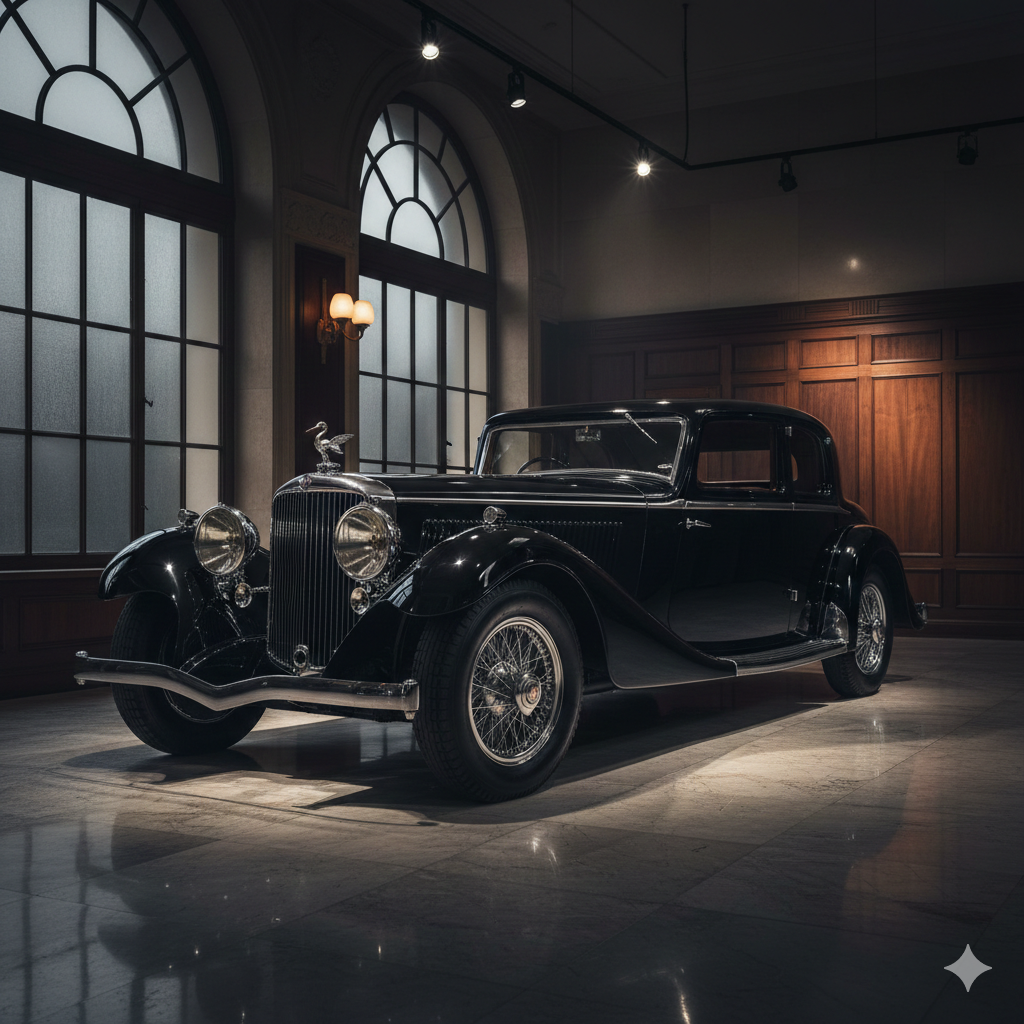
The Luxury Marque You’ve Never Heard Of
There’s a car company that forced Rolls-Royce to license its brake technology.
A manufacturer whose engines powered the fighter planes that won World War I.
A brand whose client list included Einstein, Picasso, Coco Chanel, and half the royalty of Europe.
It was Spanish. It was called Hispano-Suiza. And almost nobody in America knows it existed.
While European collectors fight over the surviving examples and Pebble Beach awards them Best of Show, the average car enthusiast has never heard the name. That’s a damn shame, because Hispano-Suiza wasn’t just competing with the best in the world — it was beating them technically.
This is the story of how Spanish engineering conquered the automotive and aviation world… and how war and politics erased it from memory.
The Origins: A Swiss Engineer, A Catalan Businessman, and A Vision
Spain’s First Attempt: Electric Vehicles in 1898
Before Hispano-Suiza existed, there were two failed attempts that laid the groundwork. In 1898, Spanish military officer and engineer Emilio de la Cuadra founded Spain’s first automobile factory in Barcelona. His idea was revolutionary: build electric buses.
For the project, La Cuadra hired a 21-year-old Swiss engineer fresh out of the Geneva School of Mechanics. His name was Marc Birkigt, and he would become one of the greatest engineering minds of the 20th century.
The project failed. Batteries of the era couldn’t hold a charge, and the technology wasn’t ready. But Birkigt had already started studying internal combustion engines.
J. Castro: The Second Attempt (1902)
When La Cuadra went bankrupt, businessman José María Castro took over. Birkigt stayed on as technical director and designed engines with solutions that were revolutionary for the time:
- Four-speed gearbox (when two or three was standard)
- Honeycomb radiator (more efficient cooling)
- Cardan shaft transmission (eliminating chains)
- Dual camshafts (one for intake, one for exhaust)
But Castro also went bankrupt. Lack of capital sank another promising venture.
June 14, 1904: A Legend Is Born
When J. Castro closed, one of its creditors saw potential where others saw ruins. Damián Mateu Bisa, a Catalan lawyer and metallurgy entrepreneur, listened to Birkigt and became convinced. Together with Francisco Seix, they conducted an exhaustive analysis of why the previous companies had failed.
The conclusion was clear: the problem was never the technology or the talent. It was lack of capital.
On June 14, 1904, “La Hispano-Suiza, Fábrica de Automóviles, S.A.” was incorporated with a capital of 500,000 pesetas. Damián Mateu would be president, Francisco Seix vice-president, and Marc Birkigt technical director.
The name fused the two nationalities of its creators: Spain and Switzerland. The flags of both countries would forever adorn the company’s emblem.
By the end of 1904, they had delivered their first four cars. History had begun.
The Rise: From Barcelona to the World
The King Discovers the Brand (1905)
Alfonso XIII of Spain was passionate about automobiles — what we’d call a “petrolhead” royal today. In April 1905, during a trip to Valencia, the royal convoy was overtaken by a car that arrived first at the Sagunto Castle.
It was a Hispano-Suiza.
The king was fascinated. When he tested a 20 HP model, he declared: “It’s the only luxury automobile that doesn’t drive like a truck.”
From that moment, Alfonso XIII became the brand’s best ambassador. He didn’t just buy cars — in 1910 he acquired 8% of the company’s stock. He would own more than 30 Hispano-Suizas throughout his life.
The “Alfonso XIII”: The World’s First Sports Car (1911)
The king requested something special from Birkigt: a sports model combining speed, lightness, and stability. The result was the Hispano-Suiza T45, better known as the “Alfonso XIII.”
With a four-cylinder engine displacing 3,619 cc and producing 60 HP, it reached 75 mph — a dizzying speed for 1911. It was light, nimble, and tremendously reliable.
Many historians consider it the first production sports car in history.
In 1911, Hispano-Suiza dominated the most prestigious races in Europe:
- Grand Prix de Ostende: Victory
- Coupe de l’Auto de Boulogne-sur-Mer: Victory
The Spanish brand had arrived to stay.
The La Sagrera Factory (1907)
Success demanded expansion. In 1907, Hispano-Suiza moved production to a new factory in Barcelona’s La Sagrera district. The facilities would eventually cover 540,000 square feet and employ 1,800 people.
That same year, Birkigt designed the first six-cylinder engine ever built in Spain. Hispano-Suiza was no longer just competing with the great European marques — it was surpassing them.
The Engines That Won the War
“My Cousin Wants to Know Why You Don’t Build Aircraft Engines”
August 1914. Europe has exploded into war. Marc Birkigt has just returned to Barcelona from Paris.
During a factory visit, Alfonso de Orleans y Borbón — cousin of King Alfonso XIII and one of Spain’s first military pilots — asks a seemingly casual question.
Damián Mateu looks at Birkigt. The Swiss engineer shrugs and replies: “If you’re ordering it…”
In reality, Birkigt had been thinking about it for some time. Aviation engines of the era were rotary — the entire engine spun with the propeller, creating stability and control problems. Birkigt saw an opportunity.
The V8 Engine That Changed History (1915)
In just seven months, Birkigt designed something revolutionary: a water-cooled V8 with an aluminum block, weighing less than 440 pounds and delivering 150-180 HP.
To put this in perspective: rotary engines of the era — where the entire engine spun with the propeller — were creating massive gyroscopic effects that made aircraft difficult to control. German inline engines were heavy and unreliable. Birkigt’s V8 solved both problems.
Its innovations were extraordinary:
- Monobloc aluminum construction with screwed-in steel liners — this was unheard of in 1915
- Overhead camshaft with direct valve actuation — decades ahead of automotive practice
- Forced lubrication — ensuring reliability at high altitudes
- Crankshaft machined from a 600-pound steel billet down to just 35 pounds — obsessive weight reduction
- Enameled water passages to prevent corrosion at extreme temperatures
- Hollow propeller shaft allowing cannons to fire through the spinner — no synchronization gear needed
The engineering philosophy was simple: aircraft engines needed to be light, powerful, and absolutely reliable. Birkigt achieved all three.
On May 12, 1915, the engine successfully passed a 12-hour bench test. The French and British, desperate for air superiority, placed orders immediately.
The demand was so overwhelming that Hispano-Suiza had to license production to manufacturers across the world. In America, Wright-Martin built thousands of these engines, and the lessons learned directly influenced the design of the famous Liberty L-12 engine that powered American aircraft.
The SPAD and the Aces of the Air
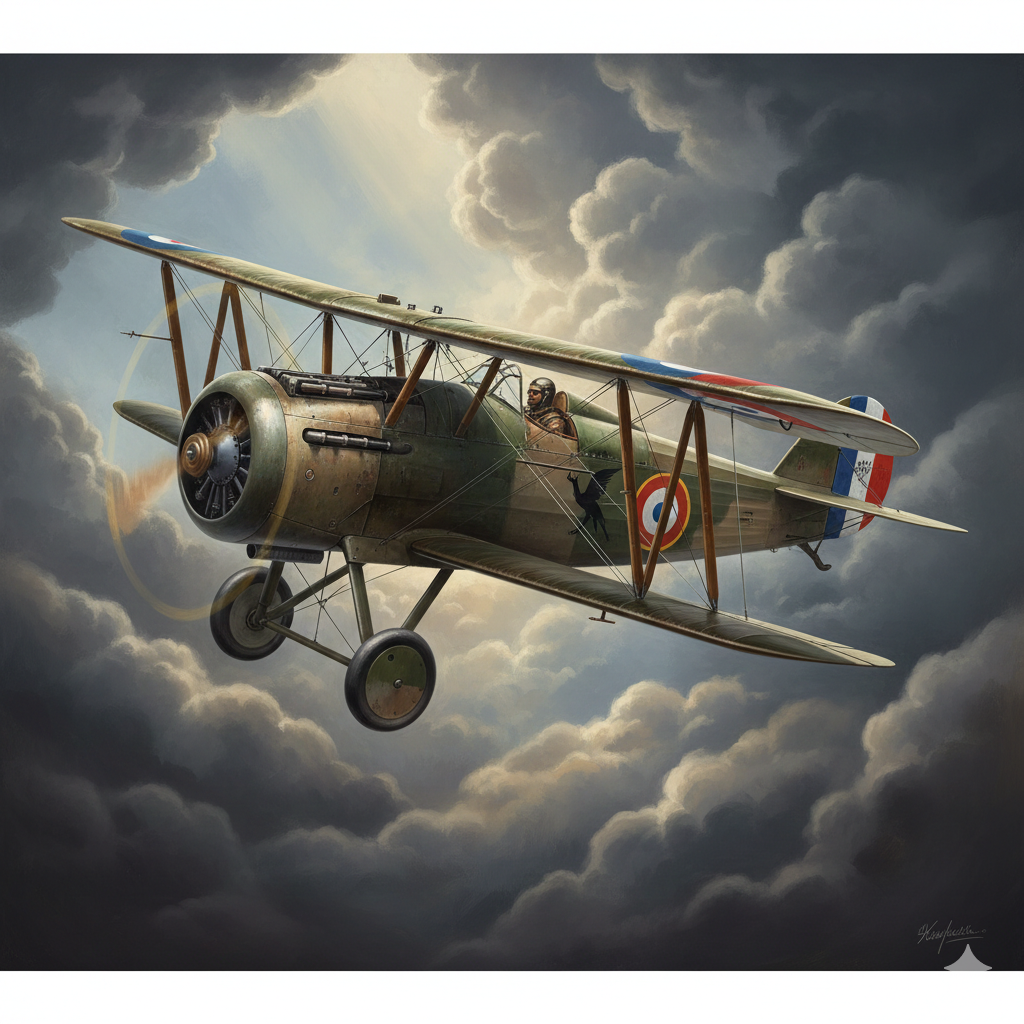
The Hispano-Suiza engine was installed in the SPAD VII and SPAD XIII fighters, designed specifically to exploit its power. It also equipped the British SE.5, another top Allied fighter.
Historians have called the Hispano-Suiza V8 “the Rolls-Royce Merlin of World War I” — the engine that allowed the Allies to win the air war.
The most famous aces flew with Spanish power:
- Georges Guynemer (France) – 53 victories
- René Fonck (France) – 75 victories, the top Allied ace
- Charles Nungesser (France) – 43 victories
- Francesco Baracca (Italy) – 34 victories
- Eddie Rickenbacker (USA) – 26 victories, America’s greatest ace
For American readers, Rickenbacker’s story is particularly significant. The former race car driver from Columbus, Ohio, flew SPAD XIII fighters powered by the 220 HP Hispano-Suiza 8B engine. His combat reports consistently praised the engine’s reliability and power.
When Rickenbacker dove on German aircraft, it was Spanish engineering that gave him the edge. When he pushed his SPAD to its limits over the Western Front, it was Birkigt’s V8 that responded. America’s Ace of Aces owed his victories, in no small part, to a factory in Barcelona.
The Stork: A Symbol Born in Combat
Georges Guynemer belonged to squadron SPA 3, known as “Les Cigognes” (The Storks) for the emblem painted on their aircraft. Guynemer was France’s most famous pilot, a national hero.
On September 11, 1917, Guynemer took off in his SPAD powered by a Hispano-Suiza engine. He never returned. His body was never found.
In tribute to the fallen hero, Hispano-Suiza adopted the stork as the brand’s mascot. Since 1919, the silver stork has crowned the hood of every Hispano-Suiza, alongside the flags of Spain and Switzerland.
The Numbers of Victory
By the armistice in November 1918:
- 50,000 V8 engines built in total
- Over 32,000 produced at the French factory in Bois-Colombes
- Licenses sold to France, Britain, Italy, Russia, Japan, and the United States
- Profit for Hispano-Suiza: 20 million pesetas (when share capital was 10 million)
The American Liberty engine, which powered thousands of Allied aircraft, was clearly inspired by Birkigt’s designs. Over 20,000 units were built.
The Golden Years: Supreme Luxury
The H6: The Car That Embarrassed Rolls-Royce (1919)
With the war over, Birkigt applied everything he’d learned in aviation to automobiles. The result was the Hispano-Suiza H6, unveiled at the 1919 Paris Motor Show.
The H6 mounted a 6.6-liter inline-six, essentially half of the aviation V12. Aluminum block, overhead camshaft, crankshaft on seven bearings machined from a 600-pound billet down to 35 pounds. The same obsessive engineering that won the air war now served wealthy motorists.
But the real revolution was in the brakes.
The H6 was the first automobile in the world with mechanical servo-assisted brakes — a system that multiplied pedal force to stop more than two tons of car. It was so effective that Rolls-Royce, Renault, and General Motors requested licenses to manufacture it.
Yes, you read that right: Rolls-Royce had to pay a Spanish company for brake technology.
To understand how significant this was, consider the context. In 1919, Rolls-Royce was the undisputed king of luxury automobiles. The Silver Ghost was legendary. British engineering was considered the finest in the world.
And yet, when it came to stopping power, they had to go to Barcelona and ask permission.
The servo brake system used the rotation of the driveshaft to power a servo unit that assisted the driver’s pedal pressure. It was elegant, reliable, and effective — characteristics that defined everything Birkigt designed.
The H6C: The World’s Fastest Car (1924)
In 1924 came the H6C, with an enlarged 8-liter engine producing 160 HP. It exceeded 95 mph, making it the fastest production car in the world.
But Birkigt’s genius wasn’t about raw horsepower. He designed the engine to offer extraordinary flexibility and low-rpm response. You could start in second gear and cruise almost always in third, with exceptional smoothness and comfort.
The 37 mph per 1,000 rpm gearing allowed effortless cruising at any speed. It was power for gentlemen, not brutes.
The Clients: The World’s Elite
Who drove a Hispano-Suiza? The list is staggering:
Royalty:
- Alfonso XIII of Spain (over 30 cars, 8% shareholder)
- Gustav V of Sweden
- Carol II of Romania
- Louis II of Monaco
- The Shah of Persia
- The King of Afghanistan
- Constantine I of Greece (ordered a six-wheeled H6A)
Artists and Intellectuals:
- Pablo Picasso
- Albert Einstein
- Coco Chanel
- René Lacoste
- Paul McCartney (decades later, with a 1929 H6)
Business Leaders:
- André Citroën (yes, Citroën’s founder drove a Hispano-Suiza)
- Guggenheim
- Vanderbilt
- Rothschild
- Cartier
- Bacardí
- Edsel Ford
The presence of Edsel Ford on this list is telling. The son of Henry Ford — the man who invented mass production and affordable automobiles — chose a hand-built Spanish luxury car for himself. When the scion of the world’s largest automaker wants something special, he doesn’t buy American. He buys Hispano-Suiza.
Hispano-Suiza didn’t sell cars. It sold chassis and engines. The customer chose their preferred coachbuilder to create a unique work of art. Europe’s finest coachbuilders — Kellner, Van Vooren, Saoutchik, Binder — competed to work on a Hispano-Suiza chassis.
This was the ultimate bespoke experience. No two cars were alike. Each was a collaboration between Spanish engineering excellence and the world’s greatest craftsmen.
The Dubonnet Xenia: Science Fiction on Wheels (1938)
André Dubonnet was a racing driver, aviator, inventor, and heir to the beverage empire bearing his name. In 1938, he commissioned the creation of a unique Hispano-Suiza.
The H6B Dubonnet Xenia (named after his late wife) was a car from the future:
- Aerodynamic bodywork designed by Saoutchik
- 8-liter engine producing 160 HP
- Independent “Hyperflex” suspension invented and patented by Dubonnet himself
- Suicide-style doors
- Wraparound curved glass
- Aviation-inspired interior
It reached 110 mph and looked like it was designed for 1958, not 1938.
The Tulipwood Torpedo: $9 Million (1924)
In 1924, Dubonnet had already created another masterpiece: the H6C Tulipwood Torpedo. Collaborating with aircraft manufacturer Nieuport-Astra, he built a body from tulipwood strips just 1/8 inch thick, assembled with thousands of aluminum rivets and hand-varnished.
The complete body weighed only 160 pounds.
In August 2022, this car was auctioned by RM Sotheby’s in California. Final price: $9,245,000.
In 2024, the same car won Best of Show at Pebble Beach, the world’s most prestigious concours d’elegance.
Beyond the Automobile
The HS.404 Cannon: The Weapon of the Spitfires
Marc Birkigt didn’t just design engines. In the late 1930s, he developed the HS.404, a 20mm autocannon that became one of the finest of its era.
The HS.404 equipped virtually every RAF fighter during World War II:
- Supermarine Spitfire
- Hawker Hurricane
- Hawker Tempest
- Hawker Typhoon
- De Havilland Mosquito
- Bristol Beaufighter
By 1943, the RAF had become an “all-cannon” air force — every fighter mounted the Hispano 20mm. The eight .303 machine guns that had defended Britain during the Battle of Britain were replaced by four Hispano cannons, delivering devastating firepower.
The United States also manufactured the cannon under license (as the M1, M2, and M3), though with more reliability problems than the British version. The U.S. Army Air Forces and Navy both wanted to switch to the 20mm caliber, and by 1942 had stockpiled 40 million rounds of ammunition — but the American-made cannons continued to jam.
It’s one of history’s ironies that American pilots flying P-51 Mustangs stuck with .50 caliber machine guns partly because the U.S. couldn’t reliably manufacture the Spanish cannon design. Meanwhile, British Spitfires were shredding German aircraft with Birkigt’s creation.
The HS.404 remained in service with various air forces well into the jet age, a testament to the soundness of its design.
Marine Engines: The Aurora Speedboat (1935)
Birkigt also developed V12 engines producing 1,300 HP for racing boats. The most famous was the Aurora, built in 1935 with the engineer’s personal collaboration.
A few years ago, the Aurora was auctioned for nearly one million euros.
Aviation During World War II
The French division of Hispano-Suiza manufactured aviation engines throughout the conflict. The Hispano-Suiza 12Y, an evolution of the original V8, powered French fighters like the Dewoitine D.520 and Morane-Saulnier MS.406.
The Soviet Klimov engines that powered the famous Yakovlev fighters were direct derivatives of Hispano-Suiza designs built under license.
The Fall: Civil War and Nationalization
1936: Anarchists Seize the Factory
On July 18, 1936, the CNT (National Confederation of Labor) seized the Hispano-Suiza factory in Barcelona. It was symbolic: the dispossessed taking control of the company that represented absolute elitism.
The anarchists murdered administrator Manuel Lazaleta. Miguel Mateu, the founder’s son and company president, was detained trying to cross into France. Only the intervention of the French consul secured his release.
The factory stopped producing luxury cars. It started manufacturing armored vehicles and war materiel for the Republic.
The Exile and Return (1939)
On April 14, 1931, Alfonso XIII had left Spain aboard a Hispano-Suiza, heading into exile after the proclamation of the Republic.
On April 1, 1939, Francisco Franco entered Madrid in his Victory Parade… aboard a Hispano-Suiza.
The Attempt to Revive the Company (1940-1946)
After the war, Miguel Mateu tried to recover the company. Marc Birkigt, now in his 60s, returned to Barcelona with his son to design a new truck engine, the Type 66.
The country was devastated. The Guadalajara factory had been completely stripped. International sanctions made importing raw materials difficult.
The Type 66 was excellent — so good that plans to merge with Alfa Romeo were abandoned. But Franco’s government had other plans.
1946: The State Takes Over
The newly created National Institute of Industry (INI) believed Spain needed a single national truck company, large and state-owned.
They pressured the Mateu family until they sold. In 1946, Hispano-Suiza’s assets were absorbed by the new ENASA (National Truck Company).
The Type 66-G truck continued production… as the Pegaso I.
Marc Birkigt received news of his honorary doctorate from the Zurich Polytechnic. He had also been decorated with Spain’s Grand Cross of Isabella the Catholic and France’s Legion of Honor.
But his company no longer existed.
Birkigt returned to Switzerland, where he reorganized “La Hispano-Suiza (Suisse), S.A.,” dedicated to machine tools. He died on March 15, 1953, of lung cancer. He is buried in Versoix, near Geneva.
The Forgotten Legacy
From Hispano-Suiza to Pegaso
ENASA inherited the technology, patents, and La Sagrera factory. With them, it created Pegaso, which for years built the trucks that moved Spain.
But Pegaso also attempted something more ambitious: proving that Spain could build high-performance sports cars. The Pegaso Z-102 and Z-103 of the 1950s were masterpieces of Spanish engineering, designed by Wilfredo Ricart (ex-Alfa Romeo).
The Hispano-Suiza DNA lived on. But few remembered.
Pegaso Park: Where the Factory Stood
Today, in Barcelona’s La Sagrera district, there’s a park called Pegaso Park. It’s a green space where the Hispano-Suiza factory once stood.
Only the entrance gate on Gran de la Sagrera street and the old office building remain, converted into neighborhood facilities.
Residents stroll, children play. Nobody thinks about how some of the world’s most advanced cars were built there.
The Resurrection: The Carmen (2019)
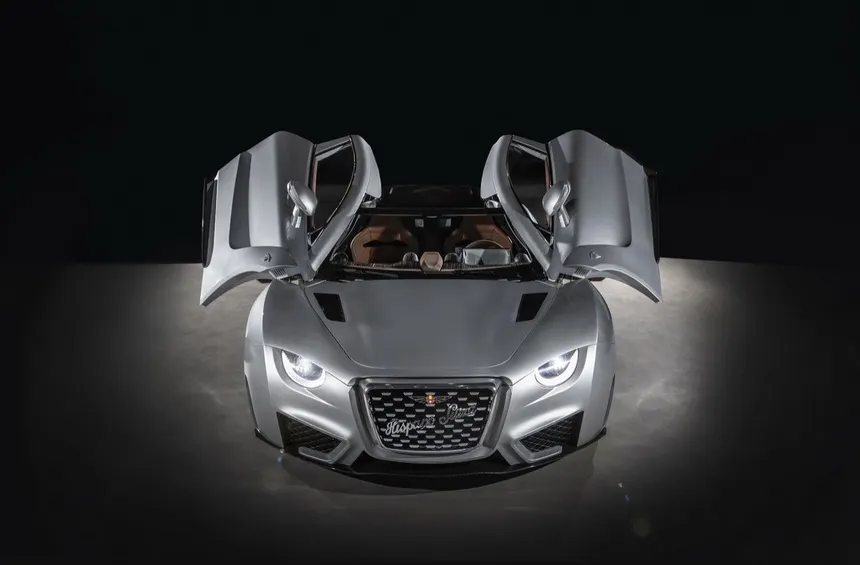
In 2019, the brand was reborn. Miguel Suqué Mateu, great-grandson of the founder, unveiled the Hispano Suiza Carmen at the Geneva Motor Show — an all-electric hypercar producing 1,019 HP.
The name honors Carmen Mateu, Damián’s granddaughter and the current president’s mother. The design is inspired by the 1938 Dubonnet Xenia.
The Carmen Boulogne version reaches 1,114 HP and accelerates from 0-60 mph in under 3 seconds. Only 24 units will be built, at $1.6 million each.
The stork flies again. 121 years later.
Things You Didn’t Know
The Dispute with France (1920-1922)
After World War I, the French government tried to avoid paying royalties for engine manufacturing licenses. They seized all Hispano-Suiza properties in France.
Damián Mateu involved the Spanish government. The diplomatic conflict lasted until 1922, when former Swiss president Gustave Ador ruled in Spain’s favor.
Spain’s First Six-Cylinder Engine (1907)
Hispano-Suiza built the first six-cylinder automobile ever manufactured in Spain. It was a configuration of three blocks with two cylinders each.
The Rabassada Record (1905)
One of the first Hispano-Suizas, the 20 HP model, set a record climbing the Rabassada hill in Barcelona: 4 miles in 8 minutes and 27 seconds.
The Six-Wheeled H6 (1923)
King Constantine I of Greece ordered a six-wheeled H6A. After his abdication, film director D.W. Griffith bought it for $35,000. Today it’s displayed at the Forney Museum in Denver, Colorado.
The “Jesús del Gran Poder” Flight (1929)
In 1929, the Breguet XIX aircraft “Jesús del Gran Poder,” powered by a 600 HP Hispano-Suiza engine, crossed the Atlantic from Seville to Bahia, Brazil.
12,000 Cars, 50,000 Engines
Between 1904 and 1946, Hispano-Suiza built more than 12,000 luxury automobiles and over 50,000 aviation engines.
Eddie Rickenbacker’s Engine
America’s greatest World War I ace, Captain Eddie Rickenbacker, scored most of his 26 victories flying a SPAD XIII powered by a Hispano-Suiza engine. The same technology that propelled Spanish engineering to world dominance put America’s top ace in the history books.
Final Thoughts: What Could Have Been
Hispano-Suiza proves something that many Americans don’t realize: Spain was once capable of competing with — and beating — the best in the world in cutting-edge technology.
It wasn’t luck. It was world-class engineering, business vision, and a determination that didn’t accept second place.
Marc Birkigt was Swiss, yes. But he chose Spain. And in Barcelona, he found the entrepreneurs, workers, and industrial ecosystem that allowed him to create wonders the world still remembers.
Consider what Hispano-Suiza achieved:
- Brake technology that Rolls-Royce had to license
- Engines that powered America’s greatest ace
- Cannons that defended Britain against the Luftwaffe
- Clients who chose it over every other marque in the world
And then consider how it ended. The Spanish Civil War, Franco’s autarky, and forced nationalization killed Hispano-Suiza. A company that had been at the absolute forefront of global technology was absorbed by a state-owned truck manufacturer.
It’s a cautionary tale about what happens when politics and war destroy industrial excellence. It’s also a reminder that greatness can come from unexpected places.
The next time you see a Pebble Beach winner, a museum exhibit, or hear about Spanish engineering, remember Hispano-Suiza.
The brand that made Rolls-Royce pay royalties.
The engines that won World War I.
The cars that Einstein, Picasso, and Coco Chanel chose over everything else.
The cannons that armed the Spitfires.
And ask yourself what might have been if history had gone differently.
Because today, 121 years after its founding, the stork flies again. New electric hypercars bearing the Hispano-Suiza name are being built in Catalonia, blending the brand’s heritage of excellence with 21st-century technology.
Some legacies refuse to die.
Check you’re still alive.