
Kimera Automobili: When a Rally Driver Decides History Isn’t Over
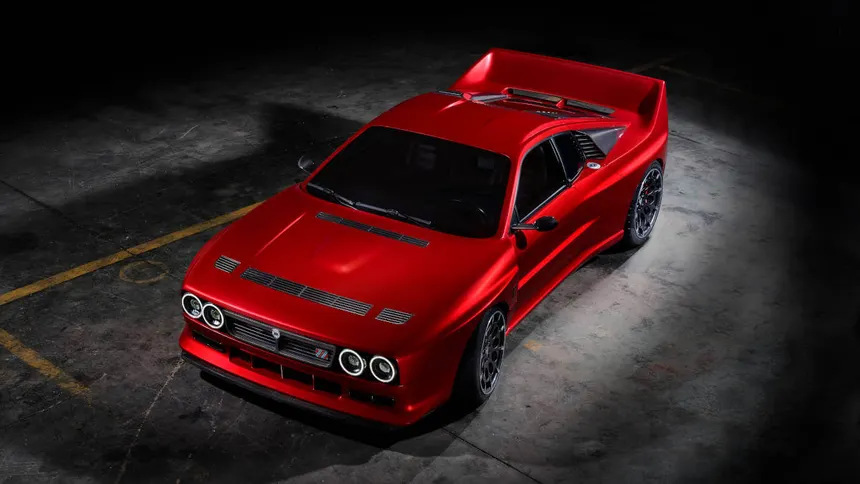
There’s a question petrolheads ask themselves in silence every time a manufacturer kills a model that marked us: What if someone with the right hands and the right reasons brought it back? Not as a museum replica. Not as a collector’s toy with untouchable carpets. But as the machine it would have been if the original engineers had access to today’s technology.
That question has a concrete answer. It’s called Kimera Automobili. And the answer doesn’t come from an investment fund, or a design studio that discovered classic cars through Instagram. It comes from a former rally driver from the Italian Piedmont who grew up breathing burnt oil in his father’s workshop — a Lancia dealer in Cuneo — and who decided the Lancia Rally 037 deserved a second life. A real one.
Luca Betti: The Driver Who Couldn’t Stop
Luca Betti was born in Cuneo, Italy, on February 22, 1978. His father was a Lancia dealer who raced rallies in Stratos, 037, Delta, and Ascona cars. The kid never stood a chance of escaping gasoline. By 18 he was driving, and by 20 he made his professional debut in the Fiat Cinquecento Trophy in 1998. A year later, at 21, he was the Italian Under-23 Champion within the Fiat Auto Junior Team.
This wasn’t a weekend hobby. Betti competed in the World Rally Championship from 2000, debuting at the Rally of Great Britain. He went through the Junior WRC with 21 starts, then to the Intercontinental Rally Challenge, and accumulated 48 class victories across more than 15 years of racing. All self-financed. Without the backing of a major factory team. Without a family name opening doors. Pure personal financial muscle and competitive obsession.
In 2008 he founded Kimera Motorsport, his own racing team, combining his role as driver and manager. But something started shifting. Betti felt there was a gap between the iconic cars of the past — especially the Lancias — and what modern technology could offer. It wasn’t empty nostalgia. It was a technical conviction: the engineers of the ’80s built extraordinary machines with the tools of their era. What would happen if you gave them today’s tools?
Around 2014 he stepped back from active competition. In 2018 he initiated project development. In 2019 he secured funding. In 2020, Kimera Automobili officially kicked off engineering work. The project’s foundation was clear from day one: the Lancia Rally 037.
The Original 037: The Last Act of Rear-Wheel-Drive Rebellion
To understand what Kimera builds, you need to understand what the 037 was. And above all, what it meant.
In 1980, the FIA introduced Group B regulations for the World Rally Championship. The rules were simple and brutal: build 200 road-legal units to homologate your competition car, and then do whatever you want with it. That opened the door to the most savage machines that have ever attacked a timed stage.
Lancia, under chief engineer Sergio Limone, commissioned the SE037 project development to a team that included Abarth, Pininfarina, and Dallara. The result was a mid-engined car based on the central structure of the Lancia Beta Montecarlo, but sharing virtually nothing else with it. Tubular steel subframes at the front and rear. Kevlar and fiberglass bodywork. A 2.0-liter inline-four engine with an Abarth Volumex supercharger, designed by the legendary Aurelio Lampredi. Rear-wheel drive. In 1982, when everyone was looking toward all-wheel drive.
The decision to keep rear-wheel drive wasn’t a mistake. It was a calculated gamble. Lancia’s engineers argued that lower weight and better balance could overcome the brute traction of the Audi Quattro. And for one glorious season, they were right.
In 1983, Walter Röhrl and Markku Alén drove the 037 to the World Constructors’ Championship. Lancia won the title by just two points over Audi. The 037 was the last rear-wheel-drive car to win the WRC. That record still stands over 40 years later.
But history has sharp edges. Group B escalated into madness. Lancia itself replaced the 037 with the Delta S4, a monster combining supercharger, turbo, and all-wheel drive. Attilio Bettega died at the wheel of a 037 in 1985. Group B was cancelled at the end of 1986. And the 037 entered the pantheon of machines that changed everything and then vanished.
The hard data: the road-going Stradale version produced 205 hp. The Evolution 2 competition version, with an enlarged 2,111 cc engine, reached 325 hp at 8,000 rpm. 207 Stradale units were built for homologation and only 20 Evolution 2s. Today, an original 037 in good condition commands six- or seven-figure prices.
What Kimera Builds: Not a Restomod. A Time Machine with Modern Engineering.
This is where Kimera’s story separates from the rest of the restomod market. And you need to be very precise with the data, because the data is what justifies everything.
The EVO37: “Autentica Evoluzione”
Kimera Automobili’s first project. Limited to 37 units. All sold. Base price: €480,000, though later special editions reached €840,000. Each unit carries a female name chosen by its owner.
But what matters isn’t the price. It’s how it’s built and who’s behind it.
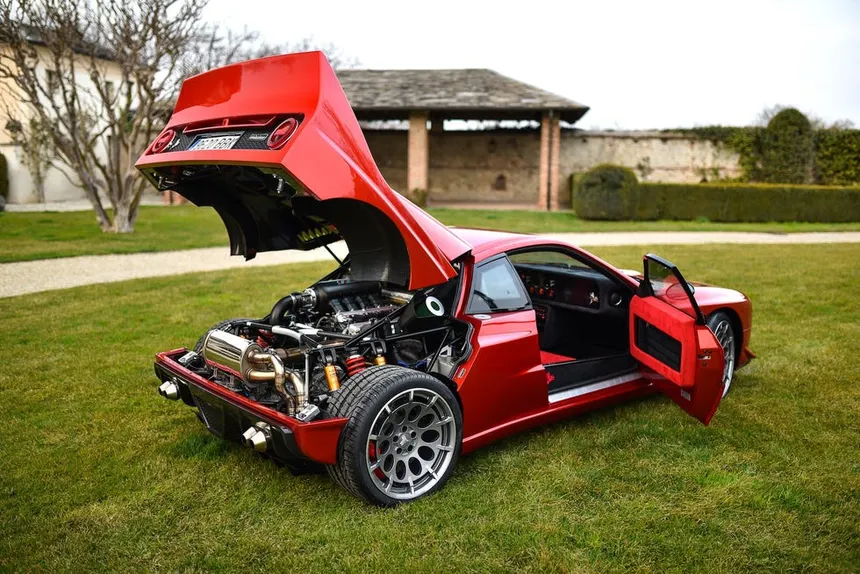
The chassis. Every EVO37 starts life as a Lancia Beta Montecarlo — the same car that served as the base for the original 037. Kimera buys the donor car, retains the central section of the steel monocoque (and its original chassis number, which is why a Lancia badge remains at the front), and builds new tubular structures at the front and rear. Exactly as Lancia did for the competition 037. The entire body is carbon fiber. Forged double-wishbone suspension with Öhlins dampers — dual units at the rear, as on the original 037. Brembo carbon-ceramic brakes. Total weight: 1,100 kg.
The engine. Here’s the heart of the matter. A 2,150 cc inline-four, built from scratch by Italtecnica. DOHC, 16 valves, mounted longitudinally in a mid-rear position. 7.5:1 compression ratio. Dry sump lubrication with a triple-stage oil pump. Liquid cooling with an electronically controlled water pump. Air/water intercooler.
The forced induction is where engineering becomes mechanical poetry: a Roots-type volumetric compressor with an electromechanical clutch (for instant response from low revs) combined with a centrifugal turbocharger (for maximum power at high rpm). The same concept as the Lancia Delta S4 — the 037’s successor — but executed with current technology. Result: 505 hp at 7,000–7,500 rpm and 550 Nm of torque, of which 400 Nm is already available at 2,000 rpm.
Who built it. Claudio Lombardi oversaw the engine development. Lombardi was responsible for the Group B powertrain at Lancia and later designed the Tipo 043 V12 for the Scuderia Ferrari Formula 1 team — the engine that powered the 1994 and 1995 F1 cars. Sergio Limone, the chief engineer who led development of the original 037 (and later the Delta S4, the Delta WRC car, and the Alfa Romeo 155 touring car), validated the chassis configuration. Miki Biasion, two-time World Rally champion with the Delta Integrale, fine-tuned the driving dynamics. And Vittorio Roberti, another engineer from the Lancia era, also contributed to the project.
This isn’t a superficial homage. These are the same hands that built the original legend, using 21st-century tools.
The transmission. A 6-speed manual gearbox manufactured by Dana Graziano specifically for Kimera. 184 mm dry twin-disc clutch with hydraulic control. Rear-wheel drive with a plated limited-slip differential. A rev-matching system that works on both upshifts and downshifts.
Performance figures: 0–100 km/h in 3 seconds. Estimated top speed: 310 km/h. With a four-cylinder engine. At 1,100 kg. With rear-wheel drive.
The Martini7 Edition: 10 Units of Certified Madness
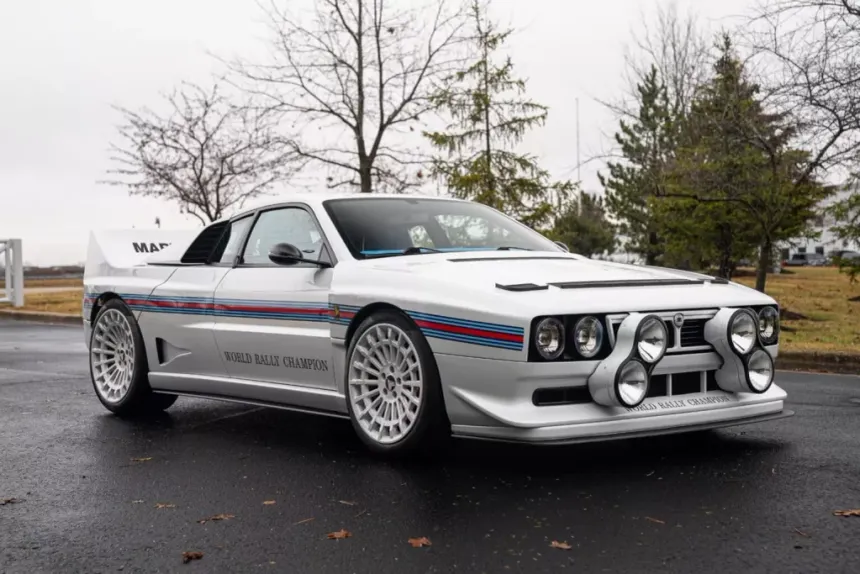
In April 2023, Kimera presented the EVO37 Martini7 Edition in Sardinia. 10 units, each named after a rally in which the original 037 competed. All wearing a certified official Martini Racing livery. Power increased to 550 hp (45 more than the standard EVO37). Developed and fine-tuned alongside Miki Biasion. Different side skirts, more aggressive front splitter, additional headlights, NACA air intake, and minor aerodynamic tweaks. Price: €840,000 per unit.
The EVO38: “Ultima Evoluzione” — The Car Lancia Never Built
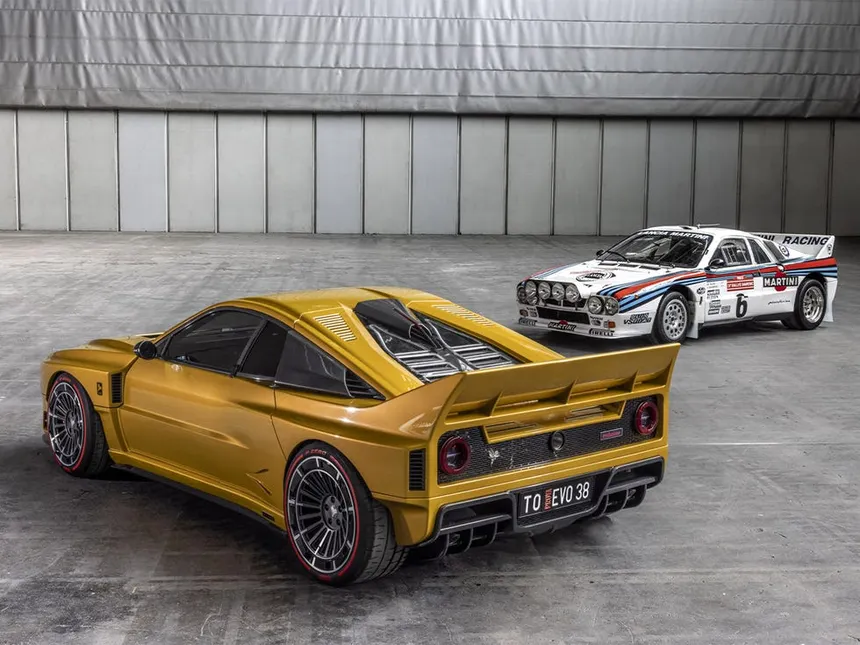
Here Kimera does something no other restomod maker has attempted: it doesn’t just revive a car that existed — it builds the car that should have existed and never materialized.
The Lancia 038 was a real project. An evolution of the 037 with all-wheel drive that would have competed against the Audi Quattro S1 on its own terms. At least one prototype was built and tested. But the program was cancelled when Lancia decided to advance directly to the Delta S4. The 038 never reached production.
In February 2024, at the Geneva Motor Show, Kimera presented the EVO38. 38 units. The engine retains the twin-charged 2.15-liter four-cylinder base, but with a larger turbo, new camshafts, variable valve timing, and improved ventilation. Result: 600 hp and 580 Nm of torque. A 6-speed manual gearbox with shorter ratios, with an electro-actuated sequential transmission under development as a future option.
The fundamental difference: all-wheel drive. A motorsport-derived AWD system with an electrohydraulic differential controllable from the cockpit, allowing the driver to manage the traction percentage between front and rear axles. Exactly like the electronic WRC cars of the early 2000s. And with the ability to disconnect the front axle for rear-wheel-drive-only driving.
Pushrod suspension front and rear, with an HLS system to raise and lower the entire car. Motorized dampers controlled via steering wheel buttons. The KSD exhaust (Kimera Scarico Diretto) offers a choice between two lateral exits and a central direct exit for track use.
The detail that defines the philosophy: in the interior, the transmission shaft is exposed beneath a plexiglass cover. You can see it spinning when the car rolls in gear. That isn’t decoration. It’s a statement of principles: here, mechanics aren’t hidden. They’re celebrated.
Weight target: maintaining the EVO37’s 1,100 kg despite the additional all-wheel-drive system, through massive use of carbon fiber and titanium.
The K39: The Race to the Clouds
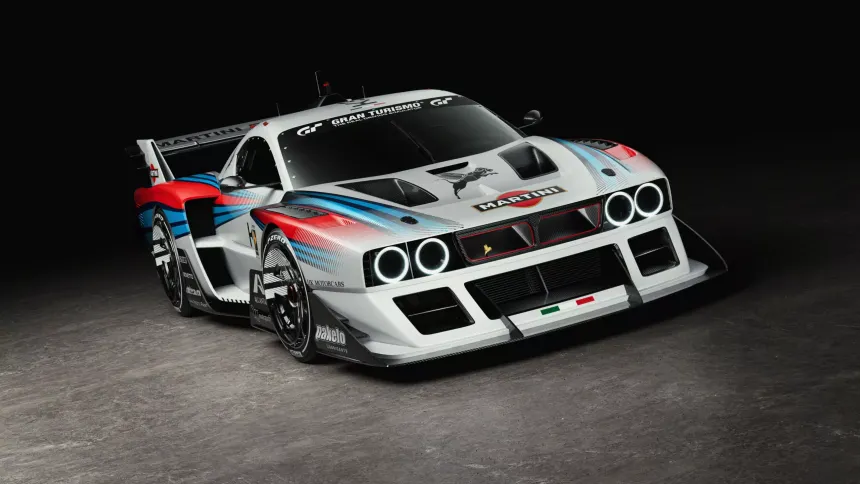
Kimera’s third act isn’t a restomod. It’s a pure competition car.
Presented in the summer of 2024, the K39 draws inspiration from the Martini Racing team’s “Silhouette” cars — the Lancia Beta Montecarlo Turbo Group 5 machines that dominated the World Sportscar Championship in the late ’70s and early ’80s. But unlike the EVO37 and EVO38, the K39 doesn’t start from a donor car. Complete carbon fiber monocoque. Bodywork redesigned from scratch for maximum aerodynamic efficiency, developed in a virtual wind tunnel. Pushrod suspension. Possible KERS-type system. Target: a 1:1 power-to-weight ratio.
The most provocative part: Kimera wants to take the K39 to Pikes Peak to beat the outright record. Not the internal combustion record — the absolute record, including the Volkswagen ID.R’s 7:57.148 set by Romain Dumas in 2018. With a combustion engine. At altitude, where thinner air directly penalizes thermal engines while electric ones remain unaffected.
The K39’s engine specifications haven’t been officially confirmed. But a twin-turbo V8 has been hinted at, with an architecture similar to the LC2 that Ferrari developed for Martini Racing’s Sport Prototypes — an engine that in its day produced 828 hp. Kimera also plans an extremely limited road-legal version for collectors.
What Kimera Represents: The Restomod as an Act of Mechanical Justice
There are restomods that are marketing exercises with pretty bodywork. And there are restomods that are acts of justice.
What Kimera does is technically different from what most restomod builders do. They don’t take a classic car, drop in a modern engine from another brand, fit generic coilover suspension, and sell it as “reimagined.” Kimera works from the base of the same donor car used in 1982, with the same engineers who built the original, using the same engineering philosophy (mid-mounted longitudinal engine, twin-charged, tubular frame on monocoque), and pushes it to the limit of what current technology allows.
They don’t change the essence. They amplify it.
When Claudio Lombardi designs the EVO37’s engine, he does so with the same understanding of the Lampredi block he had when working at Lancia. When Sergio Limone validates the chassis, he does so with the same criteria he applied to the competition 037. When Miki Biasion tunes the dynamics, he does so with the muscle memory of thousands of kilometers of timed stages in cars from that same family.
The name “Kimera” comes from the mythological chimera — a hybrid being. But also from the letters K-M-R, which for Betti stand for “Keeping My Road” — staying true to your path, to what you believe in, to your passion, even when things get hard. And that’s exactly what he does: he maintains the road Lancia abandoned.
Because that’s the part that hurts. Lancia is the most successful brand in WRC history with 10 World Championships. Fulvia, Stratos, 037, Delta S4, Delta Integrale — an unmatched bloodline. And today, Lancia is a brand that sells a rebadged Peugeot 208. The Ypsilon. That’s what remains.
Kimera isn’t filling a market gap. It’s filling an emotional void. It’s building the cars Lancia should be building and isn’t. And it’s doing it with the people who built them the first time.
The Numbers That Matter
For those who need cold data before being swept away:
The original Lancia Rally 037 Stradale: 205 hp, 225 Nm, 0–100 in 7 seconds, top speed 220 km/h. 207 units built between 1982 and 1984.
The Kimera EVO37: 505 hp, 550 Nm, 0–100 in 3 seconds, estimated top speed 310 km/h. 37 units. All sold. Base price €480,000.
The Kimera EVO37 Martini7: 550 hp, 10 units, €840,000. All sold.
The Kimera EVO38: 600 hp, 580 Nm, all-wheel drive, 38 units. Price not officially confirmed, estimated above €500,000.
The Kimera K39: specifications to be confirmed. Carbon monocoque. Pikes Peak target. Possible ultra-limited road-legal version.
The EVO37’s power output is 2.46 times that of the original competition 037 Evolution 2. The weight is virtually identical. The power-to-weight ratio is 0.46 hp/kg. With a four-cylinder engine. In 2024.
Why This Matters to Us
We live in an era where high-performance cars are faster, safer, and more capable than ever. And also more disconnected from the driver than ever. Electric steering that filters the road. Dual-clutch gearboxes that decide for you. Screens replacing instruments. Sound insulation separating you from the engine. Electronic systems intervening before you even perceive the problem.
The EVO37 has no sound insulation. No central screen. It has a twin-disc clutch that demands your left leg. A plated limited-slip differential that asks for judgment, not algorithms. A twin-charged engine that speaks to you with the roar of a turbo waking at 3,000 rpm and a supercharger pushing from 2,000. And it weighs 1,100 kg.
That isn’t nostalgia. That’s engineering with clear priorities. The priority is that the driver drives. That they feel the road. That they make decisions. That they’re part of the mechanical equation, not a passenger with a decorative steering wheel.
When Top Gear tests the EVO37 and says it’s more memorable and thrilling to drive than any modern supercar, they don’t say it because it’s faster than a Lamborghini Revuelto. They say it because the driving experience is incomparably more direct, more visceral, more real. And that’s what petrolheads are looking for. Not speed in a sensory vacuum. Mechanical connection without intermediaries.
Context: A Restomod Market in Full Swing
Kimera doesn’t operate in a vacuum. The premium restomod market is at its most active moment: Singer with the Porsche 911, Alfaholics with the GTA-R 290, Cyan Racing with the Volvo P1800, Automobili Amos with the Delta Integrale Futurista, E-Legend with the Audi Quattro-based EL1. And on the horizon, MST with the Metro 6R4 and Boreham Motorworks with the RS200 — two other Group B monsters that could return.
What sets Kimera apart from the rest is something that can’t be bought: legitimacy of origin. There is no other restomod builder that has the original engineers of the car they’re reinterpreting. That’s not marketing. It’s a verifiable fact. Lombardi, Limone, Biasion, Roberti — each of them is a name with a technical track record traceable to the Lancia-Abarth engineering documents of the 1980s.
And Betti isn’t an investor who discovered classic cars as a business opportunity. He’s a driver with 48 class victories who spent his own money competing for over 15 years. That doesn’t automatically guarantee the product is good — but it does guarantee the motivation is genuine.
The Future: Villa Kimera and What’s Coming
Kimera operates from Villa Kimera, in Cuneo, Piedmont — the heart of Italian automotive territory, a stone’s throw from Turin, where Lancia and Fiat have their historical roots. That proximity isn’t accidental: it gives them access to artisans and suppliers with deep knowledge of the Italian rally tradition.
The EVO38 Prototipo 01 climbed the hill at Goodwood in 2025. The K39 is aiming for Pikes Peak. Betti has stated that the K39 will be “the most Betti of them all” — a project born from 30 years in motorsport, but without being a restomod derived from an old model.
And that tells us where Kimera is heading: not toward repetition, but toward evolution. From restomod to constructor. From reinterpreter to creator. With the same philosophy — analog, mechanical, driver-focused, limited, artisanal — but with original projects.
If the EVO37 was the question (“What if the 037 had kept evolving?”), the EVO38 was the answer to a question nobody dared ask (“What if the 038 had existed?”), and the K39 is a declaration: Kimera no longer looks only backward. It looks forward from the foundations of the past.
NEC Editorial Note: This article is part of our investigative line on brands that build with their hands what large corporations have let die. We have contacted Kimera Automobili directly to verify the accuracy of all technical and historical data published here. Any corrections will be incorporated immediately and transparently.
Now, check you’re still alive.
Not Enough Cylinders — Where data comes first and the machines bring the emotion.
Pingback: Lancia 037: The Last Rear-Wheel Drive WRC Champion