Lancia Delta S4: The Group B Monster That Killed Its Own Category
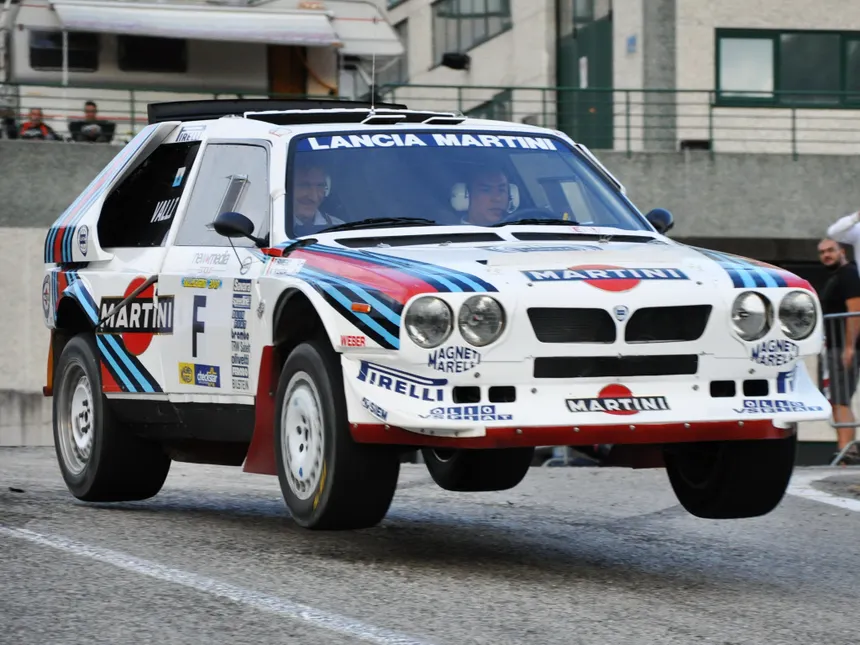
The rally car that proved engineers could build machines no human could handle
In 1985, Lancia unveiled a car that had no business existing. Not an evolution. Not an incremental improvement. A full-scale engineering assault disguised as a Lancia Delta.
The Lancia Delta S4 — internal Abarth project code SE038 — was built for one purpose: to win the FIA World Rally Championship under Group B regulations. It did that with a combination of technical solutions so radical that, nearly four decades later, the car remains one of the most extreme competition vehicles ever homologated for road use.
But the S4 didn’t just win rallies. It helped kill the category that created it.
What the Delta S4 was not
The first mistake people make is confusing it with the Delta Integrale. Same name. Same manufacturer. Zero technical relationship.
The Delta Integrale (1987-1993) was a Group A car: based on the production Delta body, front-mounted transverse engine, permanent all-wheel drive. A street car turned into a rally weapon.
The Delta S4 was the opposite. A silhouette car. On the outside, it looked like a production Lancia Delta. Underneath, it shared absolutely nothing with it. Chrome-molybdenum steel tubular spaceframe chassis. Longitudinal mid-mounted engine. Fully detachable carbon fiber composite bodywork. It was a competition prototype wearing a street car costume — not a street car adapted for racing.
That distinction is critical for understanding what Group B was: a category where almost everything was allowed. Ultra-lightweight materials. Unlimited boost pressure. All-wheel drive. The regulations only required manufacturers to build 200 road-going homologation units. Everything else was engineering imagination with no leash.
The engine: twincharging before the word existed
The S4’s heart was an inline four-cylinder engine displacing 1,759 cc with dual overhead cams and 16 valves. The displacement wasn’t random. FIA regulations applied a 1.4x multiplier to forced-induction engines, and 1,759 × 1.4 = 2,463 cc — placing the S4 in the under-2,500 cc class with a minimum weight of 890 kg (1,962 lbs).
What made this engine unique was its forced induction system: an Abarth Volumex R18 supercharger paired with a Kühnle, Kopp & Kausch K27 turbocharger. Not one or the other. Both. Simultaneously — but with complementary functions.
The turbo problem in 1985 was boost threshold — the RPM range below which the turbocharger generates no useful pressure. The KKK K27 had its threshold around 4,500 rpm. Below that, the engine had zero response. For a rally car constantly exiting tight corners at low speed, that was unacceptable.
Lancia’s solution was to use the supercharger to cover the low and mid range. The Volumex supercharger is driven directly from the crankshaft, so it delivers boost from idle. No lag. No dead zone. The driver pressed the throttle and the car responded instantly.
But the supercharger has a cost: at high RPM, the parasitic load on the engine is significant — it consumes crankshaft energy to operate. So when the engine exceeded 4,500 rpm and the turbo entered its operating zone, the system transferred the load to the turbocharger. Seamless delivery from idle to redline.
This concept — twincharging — didn’t have a name when Lancia implemented it. The Delta S4 was the first production vehicle to use it. Volkswagen wouldn’t apply it until 2005, two decades later, in their 1.4 TSI engine.
In competition trim, the engine delivered a verified 490 hp. Multiple sources place the real figure closer to 500 hp. During Lancia’s 1985 laboratory tests, with boost pressure raised to 5 bar (versus the standard 2.2 bar for racing), the engine hit 1,000 hp. From a 1.8-liter four-cylinder. That’s not a legend. It’s documented by the engineers who built it.
Fuel injection and electronic ignition were Weber-Marelli (integrated IAW system), and the engine used two intercoolers to manage compressed air temperatures.
Chassis, suspension, and drivetrain
The chassis was a tubular spaceframe made of chrome-molybdenum steel with aluminum crash structures. No monocoque. No structural bodywork. The tubes did all the work.
Suspension was double wishbone on all four corners with long travel — essential for rally surfaces. Front: single coilover per wheel. Rear: separate spring with dual dampers per wheel.
The all-wheel drive system used three differentials. The center unit sent 30% of torque to the front (open differential) and 70% to the rear (limited-slip). The gearbox was a 5-speed unit — in competition trim, without synchromesh; in the Stradale version, a synchronized unit by CIMA.
The rear differential was a proven mechanical Hewland unit. The bodywork was carbon fiber composite with fully detachable front and rear sections — not for aesthetics, but for function: quick access to mechanical components and immediate panel replacement during events. Aero elements included a front splitter, bumper-molded winglets, hood opening with Gurney flap, and a rear wing.
Competition weight: 890 kg (1,962 lbs). With 490 hp.
Power-to-weight ratio: 3.99 lbs/hp. For context, a current Porsche 911 GT3 RS sits around 5.07 lbs/hp.
The competitive battlefield: Group B’s arms race
The S4 didn’t arrive in a vacuum. By 1985, Group B was a battlefield with massive budgets and an unprecedented technological escalation. Audi had the Sport quattro S1 with its turbocharged five-cylinder and all-wheel drive. Peugeot dominated with the 205 Turbo 16 Evolution 2, mid-engine and over 450 hp. Ford had introduced the RS200 with its Ferguson Research four-wheel-drive design. And MG, improbably, had built the Metro 6R4 with an atmospheric 3.0-liter V6 pushing over 400 hp.
Each team sought advantage in a different area. Audi bet on traction. Peugeot on power. Ford on transmission engineering. Lancia found its edge in power delivery: twincharging eliminated the structural weakness of every turbo engine of the era.
Competition: brief glory, tragic end
The Delta S4 debuted at the RAC Rally of Great Britain in November 1985, with Henri Toivonen at the wheel. He retired with mechanical failure, but the pace was unmistakable — Lancia had a real weapon.
In January 1986, Toivonen and co-driver Sergio Cresto won the Monte Carlo Rally with chassis #215. It was the S4 program’s crowning achievement and one of the most impressive performances in WRC history.
But on May 2, 1986, at the Tour de Corse (Rally of Corsica), Toivonen lost control of the S4 on a left-hand bend during the Corte stage. The car went off the road, fell down a ravine, and caught fire. Toivonen and Cresto were killed instantly. There were no safety barriers. No run-off zones. The tubular chassis and composite body burned with a violence that made rescue impossible.
Toivonen was 29. Cresto was 25.
That crash, combined with the accident at the Rally of Portugal weeks earlier — where a Group B Ford RS200 struck spectators, injuring over 30 people — accelerated the FIA’s decision to ban Group B at the end of the 1986 season.
Only 28 complete competition chassis of the Delta S4 were ever built.
The Stradale: the street car that barely existed
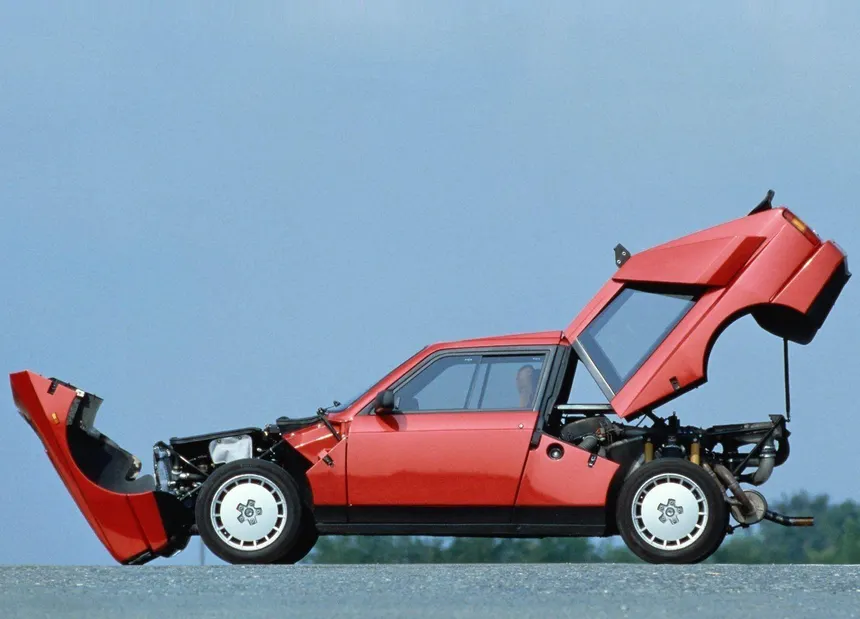
For Group B homologation, Lancia needed to produce 200 road-going units. The official designation was Lancia Delta S4, though it’s universally known as the “Stradale.”
Fewer than 100 are believed to have been built.
The Stradale retained the tubular chassis, mid-mounted engine, three-differential AWD system, and composite bodywork. But it was civilized: engine detuned to 250 hp at 6,750 rpm and 215 lb·ft at 4,500 rpm, synchronized 5-speed manual gearbox, Alcantara interior, suede steering wheel, air conditioning, power steering, and trip computer.
Lancia quoted a top speed of 140 mph and a 0-62 mph time of 6.0 seconds. In Italy, it cost roughly 100 million lire — five times the price of the most expensive production Delta at the time.
The technical legacy
The S4’s twincharging system was a solution ahead of its time. The concept of combining a mechanical supercharger for instant response with a turbo for peak power solved a fundamental problem of 1980s forced-induction engines. Volkswagen revived it in 2005 with their 1.4 TSI Twincharger. Volvo experimented with similar systems in their four-cylinder T6. The principle remains valid, though advances in turbo technology (variable geometry, electric turbos, anti-lag) have made it less necessary.
The CrMo tubular chassis with detachable composite bodywork anticipated the philosophy of modern endurance prototypes and LMP cars. The total separation between load-bearing structure and aerodynamic bodywork is now standard in competition — but in 1985, it was exceptional for a rally car.
And the 1,000 hp figure from a forced-induction 1.8-liter four-cylinder proved that the limits of internal combustion engines in 1985 weren’t where most people thought. They were where the FIA decided they were. The engine could give more. Much more. What couldn’t give more was the human body behind the wheel.
Where the S4 sits today
The Delta S4 occupies a unique space in the collector car world. Of the 28 competition chassis, a handful have been meticulously restored and appear at high-profile events like the Goodwood Festival of Speed, Rallye Monte-Carlo Historique, and Rallylegend in San Marino. Chassis #205 — the first S4 to enter a European Championship Rally — has been maintained by renowned Lancia rally specialists, the Baldi twins in Turin, who are ex-works mechanics from the Group B era.
The Stradale versions, with fewer than 100 believed to exist, command prices well into seven figures when they appear at auction. They are among the rarest homologation specials ever produced and represent one of the purest expressions of the Group B philosophy: a racing car with just enough civilization to be registered for the street.
For Americans, the S4 is particularly exotic. It was never sold in the United States. Lancia had withdrawn from the US market years before the S4 was built. Seeing one in person, outside of Goodwood or a specialist collection, requires a deliberate pilgrimage. The S4 doesn’t come to you. You go to it.
That exclusivity — combined with the tragic backstory, the engineering audacity, and the sheer violence of the performance numbers — makes the Delta S4 one of the most emotionally charged vehicles in the history of motorsport. It is simultaneously the highest achievement of Group B engineering and the most vivid evidence of why Group B had to die.
The Lancia ECV (Experimental Composite Vehicle) — the intended replacement for the S4 under the proposed Group S regulations for 1987 — never raced. Group S was canceled along with Group B. Lancia pivoted to the Delta HF 4WD for the 1987 season, the car that would evolve into the Integrale and dominate Group A for the next half-decade. But the ECV prototypes remain tantalizing evidence of where Group B might have gone — and how much further beyond human limits those cars might have pushed.
28 chassis. A dead driver. A destroyed category.
The Lancia Delta S4 existed for 14 months in competition. Between November 1985 and the Group B ban at the end of 1986. In that time, it won Monte Carlo, proved twincharging worked, and contributed to an escalation of power and speed that exceeded what drivers, organizers, and safety infrastructure could handle.
It wasn’t the only car responsible. The Peugeot 205 T16, the Audi Sport quattro S1, the Ford RS200, and the MG Metro 6R4 were all part of the same arms race. But the S4 — with its 490 competition horsepower, its brutal power-to-weight ratio, and its 0-62 time of 2.4 seconds on loose gravel — represents better than any other what happens when technology outruns human biology.
That’s what Group B was: an experiment where engineers proved they could build machines that no human being could safely and consistently control. Not on a circuit. Not with gravel traps and SAFER barriers. On mountain roads, with trees, cliffs, spectators standing half a meter from the racing line, and no run-off.
Today you drive with ESC, traction control, ABS, a reversing camera, and seven airbags. And you complain about traffic.
The Delta S4 had a steering wheel, three pedals, 490 hp, and the roads of Corsica.
Check you’re still alive.