
The Lancia Thema 8.32: When Lancia Put a Ferrari Engine in a Family Sedan
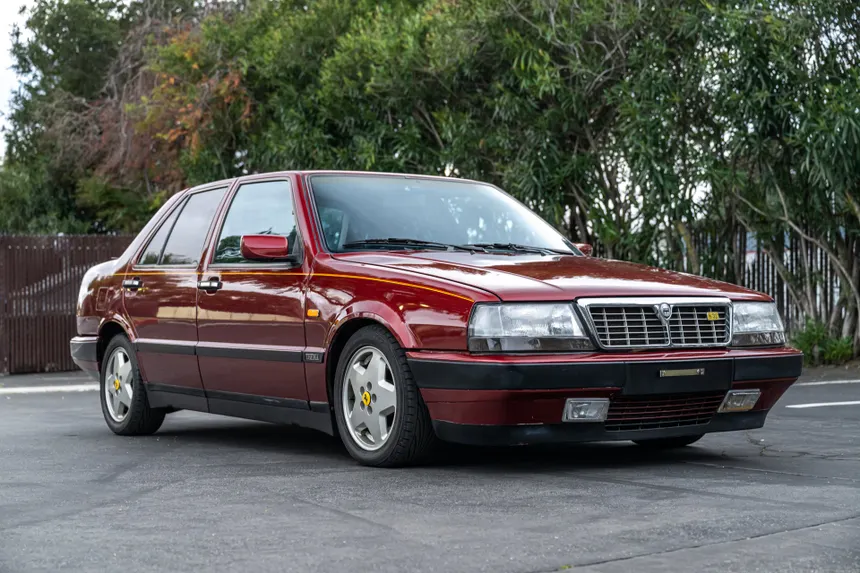
The Most Insane Executive Car Ever Built
In 1986, Lancia did something that should have been impossible: they convinced Ferrari to give them an engine.
Not just any engine. The 3.0-liter V8 from the Ferrari 308. The motor that powered the sports car defining an entire decade of poster-wall dreams. That engine, slightly detuned, found its way into the engine bay of a four-door executive sedan.
The result was the Lancia Thema 8.32—a car so conceptually absurd that it shouldn’t have worked, so brilliantly executed that it absolutely did, and so criminally forgotten that most enthusiasts have never heard of it.
This is the story of the executive sedan that could embarrass sports cars, confuse valets, and bankrupt its owners with equal efficiency.
The Numbers That Don’t Make Sense
Let’s start with the specifications:
- Engine: Ferrari-designed 2,927cc V8
- Configuration: 90-degree, quad-cam, 32 valves (hence “8.32”—8 cylinders, 32 valves)
- Power: 215 horsepower at 6,750 RPM
- Redline: 7,300 RPM
- 0-60 mph: 6.8 seconds
- Top Speed: 149 mph (limited)
- Price: Roughly equivalent to a contemporary 911 Carrera
Now remember: this was a sedan. With four doors. And a proper trunk. And room for five adults. And a ride quality suitable for executive transport.
In 1986, a four-door sedan that could hit 60 in under seven seconds was essentially witchcraft.
The Ferrari Connection
The engine’s origins trace to the 1973 Ferrari Dino 308 GT4. This V8—designed during the era when Lancia and Ferrari both lived under Fiat’s corporate umbrella—was everything you’d expect from Maranello: high-revving, naturally aspirated, and absolutely glorious at full noise.
For the Thema 8.32, Ferrari modified the engine to produce peak torque lower in the rev range, making it more suitable for daily driving. Power dropped from 240 horsepower to 215, but the engine gained low-end responsiveness that the sports car version lacked.
The result was a motor that could idle smoothly in traffic but still screamed to 7,000 RPM when asked. It sounded like a Ferrari because it was a Ferrari—just wrapped in sensible Italian business attire.
The Rear Spoiler Nobody Expected
The Thema 8.32’s most visually distinctive feature was its rear spoiler.
Not just any spoiler. A power-operated spoiler that rose from the trunk lid above 75 mph and retracted below 43 mph. In 1986, this technology existed primarily on exotics like the Porsche 959.
Lancia fitted it to a sedan.
The spoiler wasn’t entirely theatrical—at the Thema’s top speed, the additional downforce genuinely improved stability. But let’s be honest: nobody bought a Thema 8.32 because they needed high-speed aerodynamic intervention. They bought it because a pop-up spoiler on a business sedan was magnificently absurd.
The Interior Experience
Step inside the Thema 8.32 and the Ferrari origins became immediately apparent.
The instrument cluster featured a tachometer redlined at 7,300 RPM—numbers that seemed fantastical in a car with rear passenger space. The leather was Italian, the build quality was… Italian. The details included wood trim, power everything, and climate control that worked when it chose to work.
But the defining interior experience was sound. The Ferrari V8, positioned longitudinally under the hood, transmitted a mechanical symphony through the firewall that simply didn’t exist in any other sedan.
At idle: a sophisticated burble. At 3,000 RPM: a purposeful growl. At 6,500 RPM: a shriek that announced, unmistakably, that this was not a normal businessman’s car.
The Competition It Destroyed
The Thema 8.32’s natural competitors were cars like the BMW M5 E28, Mercedes 500E, and Audi 200 Turbo.
The BMW M5 had similar power but less character. The Mercedes was more refined but heavier and slower. The Audi was turbocharged, which some preferred but which felt agricultural compared to the Ferrari’s natural aspiration.
Against all of them, the Thema offered something unique: the genuine soundtrack and mechanical feel of an exotic sports car in a package that could transport executives to meetings without raising eyebrows.
Until you pressed the accelerator, at which point the car transformed into something that raised every eyebrow within earshot.
The Ownership Experience
This is where the Thema 8.32 story gets complicated.
Owning one today—or in period—meant accepting certain realities:
Maintenance costs approached supercar levels. That Ferrari engine required Ferrari-level attention, but without Ferrari-level service networks. Finding mechanics who understood the 8.32’s specific requirements was challenging in 1988 and nearly impossible now.
Reliability was “Italian.” The engine itself proved remarkably durable for a high-strung Ferrari V8. Everything around it—electrical systems, suspension components, interior trim—followed typical 1980s Lancia standards, which is to say they required constant attention.
Parts availability was limited from day one. Lancia built fewer than 3,000 Thema 8.32s, and many components were unique to the model. Finding replacements often meant fabrication or cross-referencing with obscure Ferrari parts catalogs.
Those who accepted these compromises discovered a car that rewarded dedication with an experience unavailable elsewhere. Those who expected BMW-level convenience discovered why the Thema 8.32 never conquered the executive market.
Why It Failed Commercially
The Thema 8.32 should have been a sales success. On paper, it offered something no competitor could match: genuine exotic car credentials in a practical package.
In reality, several factors conspired against it:
The price was ambitious. For 8.32 money, buyers could have actual sports cars. Justifying the premium required believing that a Ferrari-engined sedan was worth more than the sum of its parts—a philosophical position not everyone shared.
The Lancia reputation preceded it. By 1986, Lancia’s reliability reputation was already damaged. The Beta rust scandals had devastated the brand in key markets. Asking customers to spend sports car money on a Lancia required tremendous faith.
The market didn’t understand it. Executive buyers wanted reliability and prestige. Sports car buyers wanted two seats and styling. The Thema 8.32 appealed to a narrow demographic: wealthy enthusiasts who needed four doors but refused to compromise on driving experience.
That demographic existed. It just wasn’t large enough to justify the car’s development costs.
The Collector Market Awakening
For decades, the Thema 8.32 languished in obscurity. While the Delta Integrale became a collector darling, the 8.32 remained a curious footnote—known to enthusiasts, ignored by the market.
That’s changing.
Clean examples now command €25,000-€40,000, with exceptional specimens approaching €50,000. The market has finally recognized what a small group of enthusiasts always knew: the Thema 8.32 offers Ferrari engine sounds and character at a fraction of Ferrari prices.
The challenge remains finding good examples. Many survivors suffer from decades of deferred maintenance. The Ferrari engines, while durable, are expensive to rebuild. Rust has claimed cars in climates that punish Italian steel.
But for buyers willing to search—and maintain—the Thema 8.32 represents remarkable value. Where else can you get a Ferrari V8 soundtrack in a usable four-door package for under €50,000?
The Legacy
The Lancia Thema 8.32 was too weird to succeed and too good to forget.
It represented a moment when Italian automakers still believed that engineering audacity could overcome market logic. They were wrong about the market—but they were absolutely right about the car.
The 8.32 proved that a sedan could deliver genuine exotic car emotions without sacrificing practicality. It proved that Ferrari engines could work in unexpected applications. And it proved that sometimes, the most interesting cars are the ones that make absolutely no commercial sense.
Today, as we watch the automotive industry consolidate around efficiency, electrification, and algorithmic market research, the Thema 8.32 stands as a monument to a different philosophy.
Sometimes, the right answer to “should we do this?” is simply “yes, because it would be magnificent.”
The Final Verdict
The Lancia Thema 8.32 is simultaneously one of the greatest and worst executive cars ever built.
Greatest because nothing else delivered this combination of performance, sound, and practicality. The Ferrari engine in a usable sedan body remains unique nearly four decades later.
Worst because owning one required accepting Italian reliability, limited parts availability, and maintenance costs that approached the absurd.
Whether the 8.32 suits you depends entirely on priorities. If you value convenience, look elsewhere. If you value unique experiences that money can barely buy, the Thema 8.32 offers something no other sedan ever has.
A Ferrari that can take the kids to school.
Would you daily drive a Thema 8.32? Or is the maintenance nightmare too much even for the Ferrari soundtrack? The comments section awaits your risk assessment.
Pingback: Oemmedì Fiat 500 V12 Lamborghini: 580 HP in a Cinquecento