
Le Mans: The Race That Changed the Rules (And Broke Them When It Suited)
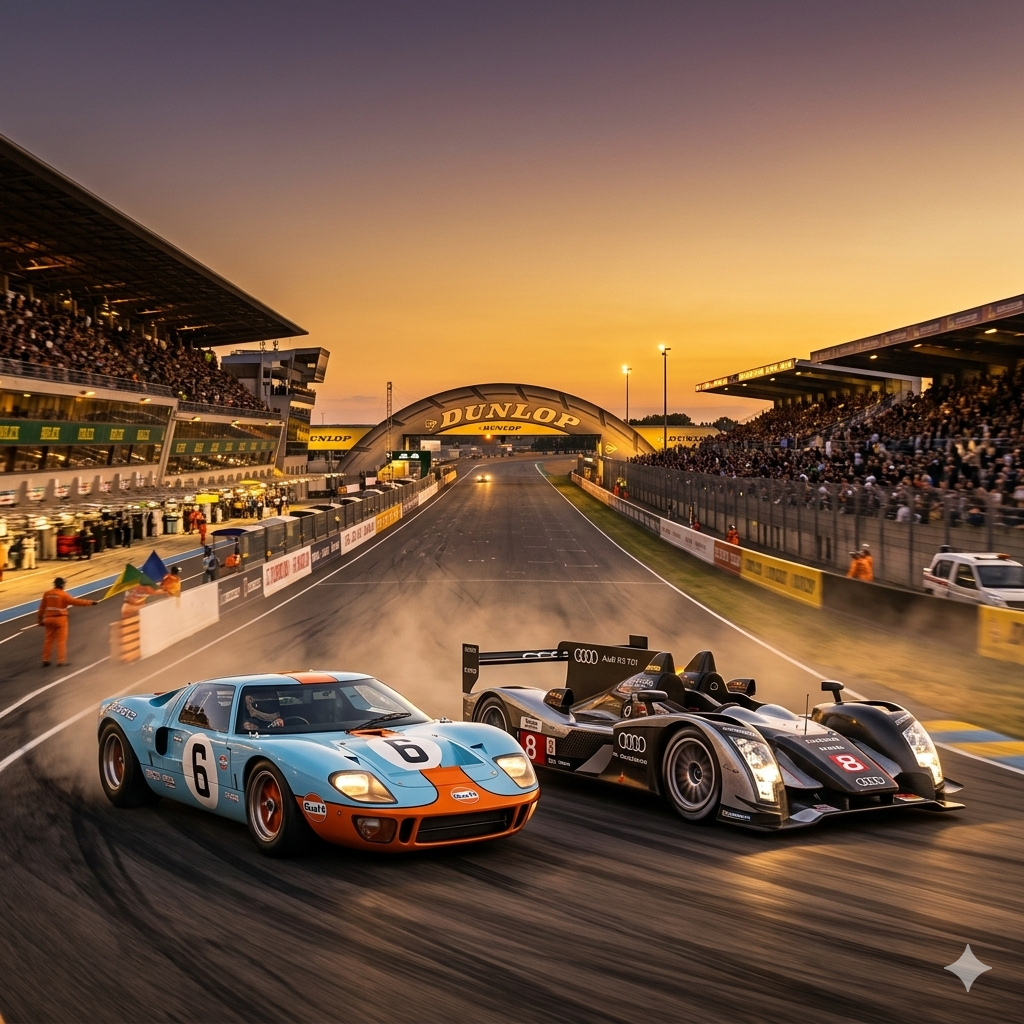
Le Mans is not just a race. It’s a battlefield where manufacturers, regulators, and human ego have been colliding at 350 km/h for over a century. And if you think the 24 Hours of Le Mans is just cars going around in circles for a full day, you don’t know the half of it.
Because behind the glamour, the futuristic prototypes, and the champagne popping, there’s a history riddled with absurd regulations, blatant favoritism, tragedies that nearly killed motorsport, and political decisions that would have made any European parliament blush.
Welcome to the real Le Mans. The one they don’t tell you about in the pretty documentaries.
The birth: when racing was basically organized suicide
The 24 Hours of Le Mans was born in 1923, at a time when safety was as abstract a concept as WiFi. The original Circuit de la Sarthe was a beast of over 17 kilometers combining public roads, blind corners, and strategically placed trees to maximize drama.
The cars of that era were basically engines with wheels and a seat. No seatbelts, no roll cages, no crash barriers. The concept was simple: drive as fast as you can for 24 hours and pray you make it to the end alive.
And it worked. More or less. Because Le Mans quickly became the ultimate test of mechanical and human endurance. Manufacturers saw the race as the perfect laboratory: if your car survived 24 hours at racing pace, you could sell anything to the public.
Bentley dominated the early years with their luxury tanks. Bugatti brought French elegance at absurd speeds. And Alfa Romeo proved Italians knew how to make more than just pasta. But all of that was just the appetizer for what was coming.
The 1955 tragedy: the day Le Mans nearly died
On June 11, 1955, Le Mans witnessed the worst accident in motorsport history. Pierre Levegh’s Mercedes-Benz 300 SLR was catapulted into the grandstands after an on-track contact. The car disintegrated against the spectators. 83 people died. Over 120 were injured.
What happened next is almost as shocking as the accident itself: the race wasn’t stopped. Organizers decided that stopping the race would cause more chaos with spectators trying to leave the circuit. Mercedes withdrew their cars out of respect, but everyone else kept racing while emergency services collected bodies meters from the track.
This disaster led to the banning of motorsport in Switzerland — a ban that, by the way, lasted until 2022. Nearly 70 years. Several European countries temporarily suspended racing. And Le Mans had to reinvent itself or disappear.
The uncomfortable question nobody wants to ask: was the lesson truly learned? Because safety improvements came, yes, but in dribs and drabs and always after someone died. The history of motorsport is, to a large extent, a history written in blood.
Ford vs Ferrari: the most expensive ego war in history
In the 1960s, Henry Ford II wanted to buy Ferrari. Enzo Ferrari said no in the most Italian way possible: insult included. Ford, with his pride wounded and his pockets full, decided that if he couldn’t buy Ferrari, he would destroy them at Le Mans.
What followed was an obscene expenditure of resources. Ford invested millions in the GT40 program, hired the best engineers, bought the best available driver (Carroll Shelby), and essentially declared industrial war on a small factory in Maranello.
The GT40 failed spectacularly in its first attempts. Reliability problems, design errors, engineers’ egos clashing with each other. But in 1966, Ford achieved the unthinkable: a 1-2-3 finish at Le Mans. Three GT40s crossing the finish line in formation.
But here comes the controversy. Ford wanted their three cars to cross the finish line together for the perfect photo. The problem was that Bruce McLaren and Chris Amon’s car had started further back on the grid. According to the rules of the time, by crossing the line simultaneously with Ken Miles and Denny Hulme’s car, McLaren/Amon won for having covered more distance.
Ken Miles, who had led practically the entire race and was the soul of the GT40 program, lost the victory to a political decision by Ford. Miles died two months later testing a prototype. He never got his Le Mans victory.
The Hollywood movie softens this story considerably. Reality was harsher: a driver sacrificed at the altar of corporate marketing.
Porsche’s reign: when winning becomes habit
If there’s one brand that defines Le Mans, it’s Porsche. With 19 overall victories, Stuttgart’s finest have won more than anyone. And not always in popular fashion.
The Porsche 917 of the 1970s was a beast that terrified its own drivers. Steve McQueen became so obsessed with the car that he made an entire movie about Le Mans just so he could drive one. The 917 had so much power and so little aerodynamics in its early versions that drivers were literally afraid to go full throttle on the straights.
But Porsche’s dominance reached absurd levels with the 956 and 962 in the 1980s. They won Le Mans almost by inertia, and the rest of the paddock started complaining that regulations were designed to favor air-cooled flat-engine prototypes, which just happened to be Porsche’s specialty.
Coincidence or design? At Le Mans, that line has always been very thin.
Mazda 787B: win with a Wankel, and we’ll ban the Wankel
If you want a perfect example of how Le Mans changes the rules when it doesn’t like the result, look no further than 1991.
Mazda had been trying to win Le Mans with a Wankel rotary engine for years. Years of failures, of cars breaking down, of a Japanese manufacturer crashing against the wall of European prototypes. Nobody took them seriously. The rotary engine was a technical curiosity, not a real threat.
Until it was.
The 787B, with its four-rotor R26B engine producing 700 HP, won the 24 Hours of Le Mans in 1991. It was the first and only victory by a Japanese manufacturer in the top category, and the first and only victory for a rotary engine. The sound of that engine — a high-pitched wail that sounded like a fighter jet — is still considered one of the most iconic in motorsport history.
And what did FISA (the governing body at the time) do immediately after? Ban rotary engines from competition. From 1992 onward, only conventional piston engines would be allowed in the top category.
The official justification: the new Group C regulations required 3.5-liter naturally aspirated engines based on Formula 1, and the rotary didn’t fit that definition. The real justification, according to many: the European establishment couldn’t tolerate a Japanese manufacturer with an “exotic” technology humiliating Western prototypes.
The most ironic part is that Mazda barely had time to celebrate. They won Le Mans and the following year their engine was outlawed. It’s like winning the lottery and having them change the rules the next day so you can never collect again.
The 787B is a legend today. Mazda brings it out for historical events and the crowd goes wild every time that engine fires up. But the question remains, more than 30 years later: was the rotary banned for legitimate technical reasons, or because the wrong team won?
At Le Mans, as we’ve already seen, that question always has the same answer: it depends on who it’s convenient for.
The diesel scandal: Audi and the TDI that shouldn’t have existed
And here we reach one of the juiciest controversies in Le Mans history. In 2006, Audi showed up with the R10 TDI, a prototype powered by a twin-turbo V12 diesel engine. Yes, a diesel. At Le Mans.
Here’s where it gets interesting. The regulations at the time allowed diesel engines to use turbochargers, while gasoline engines were restricted to naturally aspirated configurations. The official justification was that diesels needed the turbo to be “competitive.” The reality is that a turbocharged diesel has a brutal advantage in torque and fuel efficiency over a naturally aspirated gasoline engine.
The result was exactly what you’d expect: Audi dominated. They won in 2006, 2007, 2008, and continued dominating with variants of the TDI concept for years. The diesel turbo’s torque was so superior that gasoline cars couldn’t compete in corner-exit acceleration, and diesel efficiency meant fewer pit stops.
The gasoline teams protested. Obviously. How could it be fair for one car to run a turbo and the other not? The ACO (Automobile Club de l’Ouest, Le Mans organizers) responded with adjustments to air restrictors and minimum weight, but it was like putting a band-aid on a bullet wound.
The question nobody answered satisfactorily: why was this asymmetry allowed in the first place? Some suggest the ACO wanted to attract diesel manufacturers to project a “greener,” more technologically advanced image. Others, more cynical, point out that Audi was one of the biggest investors in the championship.
Whatever the reason, the result was a dominance that distorted competition for nearly a decade.
Peugeot, Toyota, and the art of losing at Le Mans
If Audi wrote the story of dominance, Peugeot and Toyota wrote the story of suffering. Peugeot invested enormous amounts in their 908 program, managed some victories, but always in Audi’s shadow. When they finally seemed to have the car to win consistently, the 2012 economic crisis forced them to withdraw. Perfect timing.
But Toyota’s case is even more painful. Le Mans has been to Toyota what the Champions League was for decades to certain football clubs: an obsession that always ends in tears.
The cruelest moment came in 2016. The Toyota TS050 was leading the race with authority, just three minutes from the end. Three minutes. And then, on the main straight, the car suffered an electrical failure and stopped. Literally parked on the main straight while the Porsche overtook it to win.
Toyota’s mechanics were crying. The drivers couldn’t speak. Years of development, millions invested, all destroyed in the last 180 seconds of a 24-hour race. If fate exists, it has a very twisted sense of humor.
Toyota finally won in 2018, but many argue it was because by then Porsche had already withdrawn from the LMP1 category, leaving Toyota competing essentially against themselves. A bittersweet victory, to say the least.
Balance of Performance: the controversy that never dies
The BoP (Balance of Performance) is the system the organization uses to try to equalize performance between cars of different technologies and manufacturers. In theory, it’s a reasonable idea: if you have a hybrid competing against a non-hybrid, you need some compensation mechanism.
In practice, BoP is one of the most consistent sources of controversy in modern Le Mans. Adjustments are made behind closed doors, criteria aren’t always transparent, and there’s always some team feeling that the adjustments hurt them while favoring another.
With the current Hypercar era, where manufacturers like Toyota, Ferrari, Porsche, Peugeot, Cadillac, and BMW compete under convergent regulations, BoP has become even more political. Ferrari’s victory in 2023 with the 499P was celebrated by many as the Italians’ return to glory, but others pointed out that pre-race BoP adjustments seemed to suspiciously favor the red car.
Is BoP necessary? Probably yes. Is it fair? Depends who you ask. Does it generate suspicions of favoritism? Always.
Le Mans today: more manufacturers, more politics, more spectacle
The current reality of Le Mans is fascinating and contradictory. Never before have so many manufacturers simultaneously competed in the top category. Toyota, Ferrari, Porsche, Peugeot, Cadillac, BMW, Lamborghini, Alpine — the grid looks like a motor show.
But more manufacturers means more politics. Every brand wants to win, every brand invests hundreds of millions, and every brand has a communications department ready to scream injustice if things don’t go well. BoP has become a diplomatic weapon as much as a technical one.
And then there’s the elephant in the room: electrification. Le Mans has always been a technology laboratory, and now that laboratory is experimenting with increasingly powerful hybrids. How long until we see a fully electric Le Mans? Probably longer than optimists believe, but shorter than purists would like.
What Le Mans teaches us about motorsport
Le Mans is, in many ways, a mirror of the automobile industry. The same tensions between innovation and tradition, between regulation and freedom, between sport and business, are reflected in every edition of the 24 Hours.
The race has survived tragedies, world wars, economic crises, and regulation scandals. It has seen entire categories born and die. It has turned unknown brands into legends and humiliated giants.
And that is precisely the magic of Le Mans: it’s unpredictable, it’s unfair, it’s political, it’s cruel, and it’s absolutely glorious. Just like motorsport itself.
Is it the perfect race? Not even close. Is it the most important race in the world? Without a doubt.
See you at La Sarthe.
— NEC
Enjoyed this unfiltered analysis? Then don’t miss our articles on NASCAR’s history and the rise and fall of DTM. And if you prefer classics with soul, check out our European classic cars section.
Pingback: DTM: Cómo las Marcas Alemanas Crearon, Dominaron y Mataron Su Propio Campeonato
Pingback: I Heard the GTA Spano E&D Run. I'll Never Forget It.
Pingback: MA-FIA: How the FIA Is Destroying the Very Sport It Claims to Protect
Pingback: Ford 428 Cobra Jet: The Engine a Rebel Dealer Built First
Pingback: Renault Clio V6: Full History, Specs & The Truth About the Mid-Engine Supermini
Pingback: Porsche 918 Spyder: The Hybrid Hypercar That Changed Everything
Pingback: orsche Thought It Had Won. Then the Alpine A110 Happened.