
Lexus LFA: The 553 HP Japanese Symphony That Nobody Appreciated in Time
Not Enough Cylinders — Unfiltered Automotive Opinion
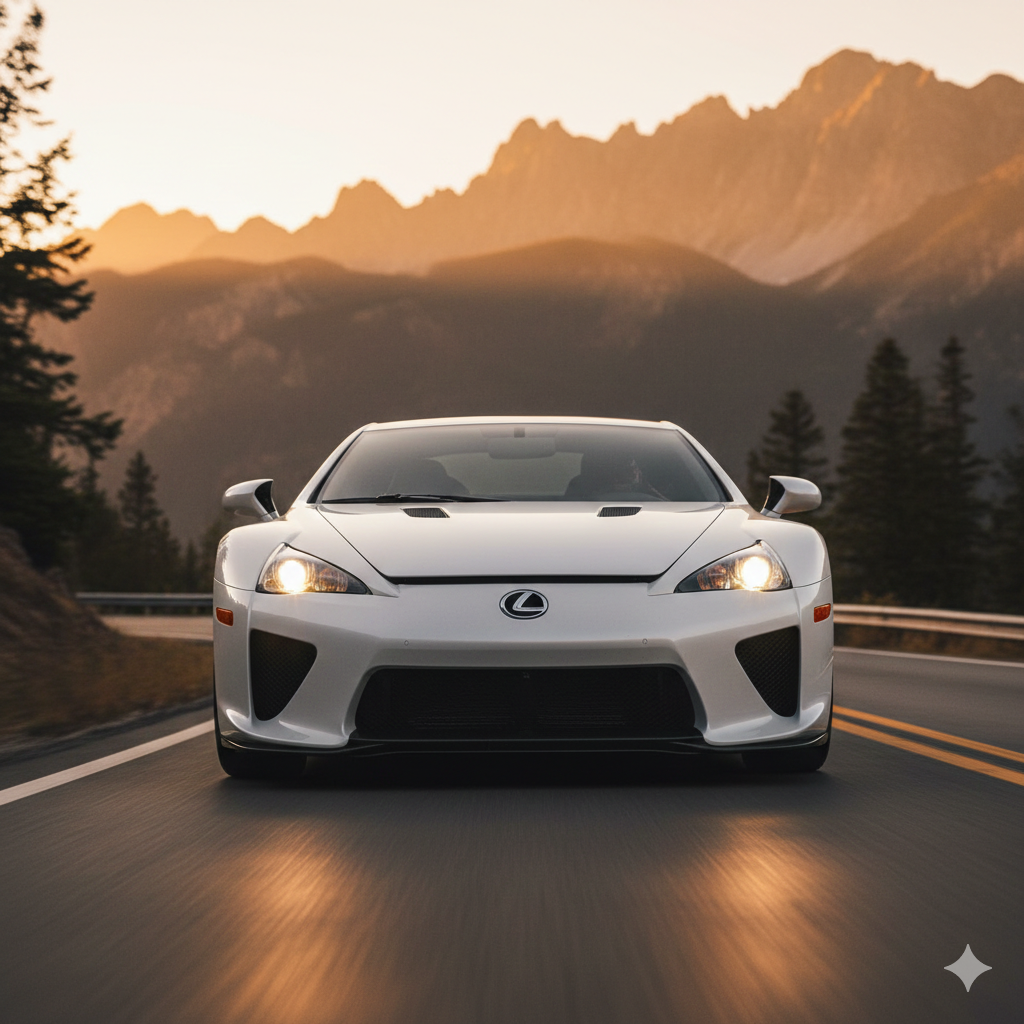
There are cars born to be admired. And then there are cars born too far ahead of their time—misunderstood, rejected by a market that wasn’t ready to grasp what was in front of them. The Lexus LFA is the latter.
When it launched in 2010 for $375,000, dealerships couldn’t give them away. Today, those same units change hands for over $1 million. The people who laughed back then are now standing in line. But the LFA isn’t just a story about ROI. It’s a story of obsession, of Japanese perfectionism pushed to the absolute edge. It’s the story of an engineer who convinced the Toyota board that Lexus could build a supercar capable of staring down Ferrari and Porsche.
He succeeded. He built a car with a V10 that sounds like a 1990s Formula 1 car, a body woven on a loom invented specifically for this project, and a level of engineering that borders on madness. This is the story of the car many consider the greatest mechanical symphony ever produced.
The Origin: A Dream Born on a Spreadsheet
It all began on February 10, 2000. Chief Engineer Haruhiko Tanahashi had just finished his first laps at the newly opened Shibetsu proving grounds when he had a revelation: “I want to build the ultimate sports car.” He wrote it in his diary—which, by the way, he kept in Excel, not on paper. The legend of the LFA was born in a spreadsheet cell.
Convincing the Toyota board was a nightmare. A brand known for building the most reliable—and boring—cars on the planet wasn’t exactly a breeding ground for a million-dollar supercar project. But Tanahashi had an ally: Akio Toyoda. Toyoda was a true gearhead who drove his own prototypes. With his support, the project got the green light in 2003 with one crucial condition: an unlimited budget.
Tanahashi and legendary test driver Hiromu Naruse created a list of 500 indispensable requirements. From the suspension geometry to the shape of the steering wheel, there was no room for compromise. By October 2004, a camouflaged LFA was already lapping the Nürburgring Nordschleife.
The Engine: When Yamaha Composed a Masterpiece
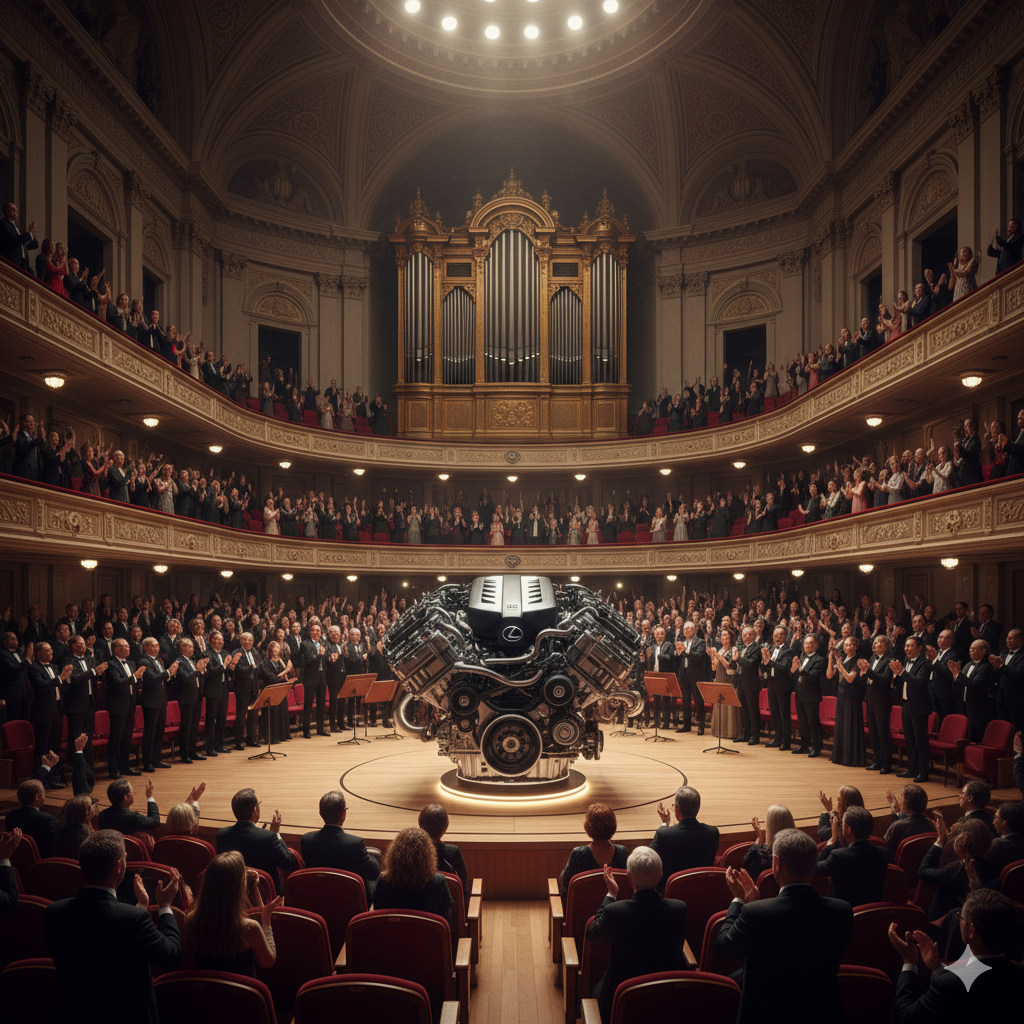
This is where the story becomes extraordinary. The heart of the LFA is a 4.8-liter naturally aspirated V10, designated the 1LR-GUE, developed with Yamaha. But not just Yamaha Motor—Toyota brought in Yamaha’s musical instrument division.
Engineers who design pianos and guitars were tasked with “tuning” the engine’s acoustics.
- The Specs: 553 HP @ 8,700 rpm; 354 lb-ft of torque @ 6,800 rpm; 9,000 rpm redline (fuel cut at 9,500).
- The Construction: Forged aluminum pistons, forged titanium rods, and solid titanium valves.
- The Speed: This V10 revs from idle to 9,000 rpm in 0.6 seconds. It was so fast that Lexus had to develop a digital tachometer because a physical needle couldn’t keep up with the engine’s inertia.
Yamaha treated the exhaust like a brass instrument. The intake surge tank was designed so its vibration mode produced a harmonic centered at 250 Hz—the fundamental combustion frequency of the V10. They carved channels to pipe this sound directly into the cabin. No electronic processing. No fake speaker noise. Just raw, acoustically sculpted mechanical bliss.
The Carbon Fiber: Toyota Returns to its Textile Roots
Five years into development, the engineers made a radical choice: scrap the aluminum construction and switch to Carbon Fiber Reinforced Polymer (CFRP).
The problem? The technology to weave complex 3D carbon shapes didn’t exist. Subaru told them it would take 10 years to develop. Lexus did it in one.
Toyota was originally a textile company; the automatic loom invented by Sakichi Toyoda in 1906 funded the car division. A century later, LFA engineers invented a 3D circular carbon fiber loom. One of only two in the world, it used 144 bobbins to weave 12 layers of carbon fiber directly around a mold. No seams. No weak points. Just aerospace-grade structural perfection.
The car was never profitable. Toyota lost money on every single unit sold. And they didn’t care.
Technical Specifications
| Spec | Data |
| Engine | 4.8L Naturally Aspirated V10 (1LR-GUE) |
| Power | 553 HP @ 8,700 rpm |
| Transmission | 6-Speed Automated Sequential (Aisin) |
| 0-60 mph | 3.7 seconds |
| Top Speed | 202 mph |
| Weight | 3,263 lbs |
| Chassis | CFRP Monocoque with Aluminum Subframes |
| Production | 500 units |
The Nürburgring Package: The Ultimate Beast
Of the 500 LFAs, only 50 received the Nürburgring Package. This was the track-focused monster:
- Power bumped to 562 HP.
- Faster gear shifts and stiffer suspension.
- Fixed GT-style rear wing and front winglets.
- In 2011, Akira Iida clocked a 7:14.64 lap at the ‘Ring—a record for production cars on non-competition tires at the time.
10 Things You Didn’t Know About the LFA
- The Spreadsheet: Chief Engineer Tanahashi kept every development detail in a massive Excel file.
- No Dual-Clutch: Lexus built a DCT but rejected it because it felt “too smooth.” They wanted the driver to feel the mechanical engagement of a single-clutch sequential.
- Safety First: They chose a front-mid engine layout instead of mid-engine because it’s more forgiving for less experienced drivers at the limit.
- Weight Balance: The fuel tank is placed in front of the rear axle to keep the center of gravity low and centralized.
- Unique Builds: With 30 billion possible configurations, it’s said no two LFAs are identical.
- The $1 Billion Cost: Toyota reportedly spent nearly a billion dollars on development. It was a pure “Halo” project.
- Unsold for Years: Some units sat in showrooms until 2019. Now, those dealers are kicking themselves for not keeping them.
- Lease Only: In some markets, you couldn’t buy it; you had to lease it for two years to prevent immediate flipping/speculation.
- The Boss Raced It: Akio Toyoda personally raced LFA prototypes at the Nürburgring 24 Hours.
- Wet Weather King: Top Gear recorded the LFA as the fastest car ever around their track in the rain.
The Value Explosion: From Flop to Gold Mine
The irony is brutal. A car dealers couldn’t move at $375k is now a blue-chip investment.
- Current Average Price: $950,000 – $1.4 million.
- Record Sale: $1.87 million for a Nürburgring Package in late 2023.
Conclusion: The Last of its Kind
The LFA is special because it is the last of its breed. It’s a naturally aspirated V10 with no turbos, no hybrid motors, and no fake noise. It was built by a company that produced one car per day, hand-assembled by artisans.
It wasn’t the fastest of its era, but it was arguably the most honest. It wasn’t built to win a spec-sheet war; it was built to produce euphoria. That was the exact word Tanahashi used to describe the goal.
If you ever get the chance to hear an LFA at wide-open throttle, you’ll know exactly what he meant.
What do you think? Should Lexus attempt a true successor, or would a hybrid/electric LFA ruin the legacy? Let’s talk in the comments.
— Not Enough Cylinders