
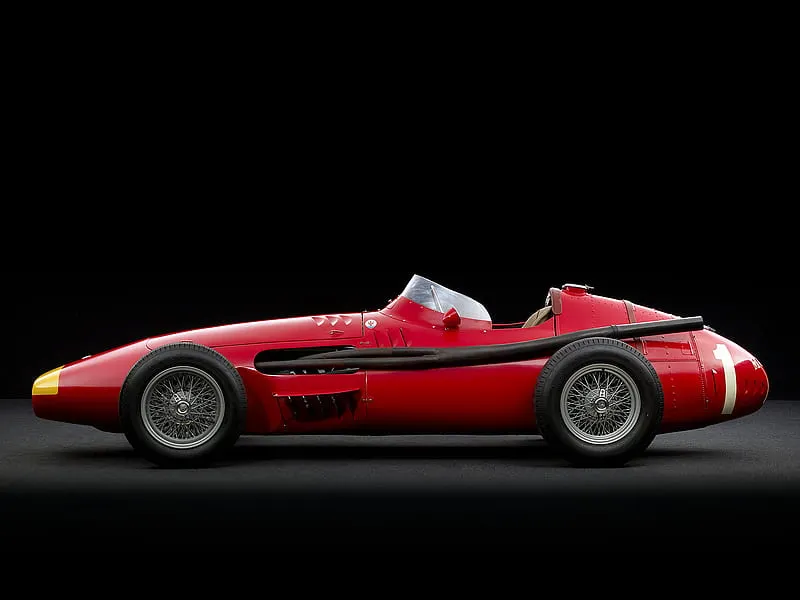
Maserati 250F: The Most Beautiful Car to Ever Win a War
Denis Jenkinson, the great Motor Sport correspondent who rode shotgun with Stirling Moss to win the 1955 Mille Miglia, did not hand out praise cheaply. He had watched everything the 1950s had to offer. And of one particular afternoon at the Nürburgring he wrote that Juan Manuel Fangio “surpassed himself.” Coming from Jenks, that is roughly equivalent to a saint being told he’d outdone the angels.
The car Fangio surpassed himself in was a Maserati 250F. The afternoon was 4 August 1957. And by the end of it, the greatest driver who ever lived stepped out of the cockpit, soaked through and shaking, and said he had never driven that fast in his life and never expected to again.
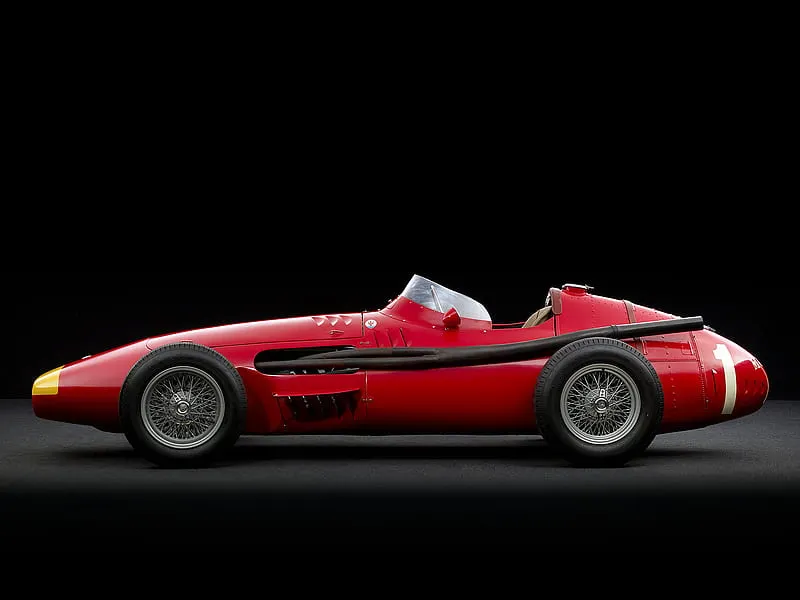
This is the story of that car. The front-engined Grand Prix Maserati that a great many people — not just sentimental Italians — consider the most beautiful Formula 1 car ever built, and one of the most significant.
Born From a Rulebook
The 250F exists because the rules changed. For 1954, Formula 1 adopted a new formula: 2.5-litre naturally aspirated engines, no supercharging. Maserati, based in Modena, had spent the previous seasons campaigning the A6GCM — a converted Formula 2 car that was competent but forever living in the shadow of Ferrari. When the 2.5-litre regulations arrived, Modena knew it needed a clean-sheet machine.
The name was pure arithmetic. “250” for the 2,500 cubic centimetres of engine displacement, “F” for Formula. Earlier proposals included “6C2500” — too close to an Alfa Romeo designation — and “250/F1.” It settled on 250F, which happens to sound like poetry.
The team behind it reads like a roll call of 1950s Italian engineering. Principal design fell to Gioacchino Colombo, the man who had penned Ferrari’s first V12 engines before crossing over from Maranello to Modena. The tubular chassis work was handled by Valerio Colotti. The original engine came from Vittorio Bellentani and Alberto Massimino. And then, from 1955 onward, the man who truly turned the 250F into a legend: Giulio Alfieri. The bodywork — that silhouette that still stops people dead in their tracks — was the work of Medardo Fantuzzi.
For British enthusiasts, there’s a name missing from that list who belongs in this story anyway: Stirling Moss. More on him shortly. The point for now is that the 250F was never the work of one lone genius. It was an entire workshop operating at the edge of what 1950s technology allowed.
The Engineering: Simple, Robust, Honest Graft
Here’s where we talk mechanically.
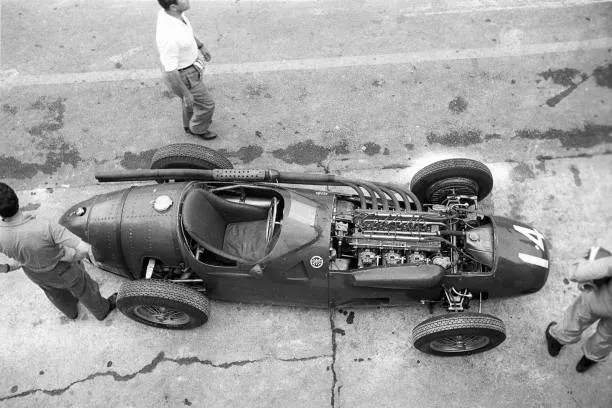
The heart of the 250F was a 2,493 cc straight-six, front-mounted and longitudinally installed, as the era demanded. Bore and stroke of 84 mm by 75 mm. Twin overhead camshafts, two valves per cylinder, three twin-choke Weber carburettors gulping air through intake trumpets. Twin-spark ignition — two plugs per cylinder — fed by two magnetos. Initial output sat around 240 horsepower at 7,200 rpm and climbed through development toward 270 in the most refined specifications. In 1955 the works cars experimented with SU fuel injection and Dunlop disc brakes.
The original chassis was an aluminium tubular ladder frame — straightforward and effective. Front suspension was independent by wishbones and coil springs. At the rear sat a De Dion tube with a transverse leaf spring, the same concept Mercedes-Benz had popularised with its pre-war Silver Arrows. Braking came from ribbed 13.4-inch drums.
Was any of this revolutionary? No. And that’s the first lesson the 250F teaches anyone in this game. It didn’t win by being weird. It won by being well made. Every component did its job without pretension; the whole package was balanced, predictable, and noble in its behaviour. That’s precisely why privateers fought to buy one. A car that forgives, that warns you before it lets go, that lets you drive at the limit without killing you in the first damp corner — that’s a car a real racer learns to treasure.
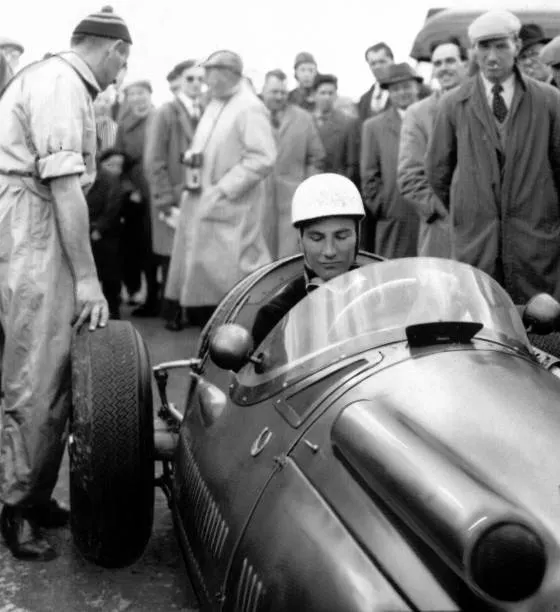
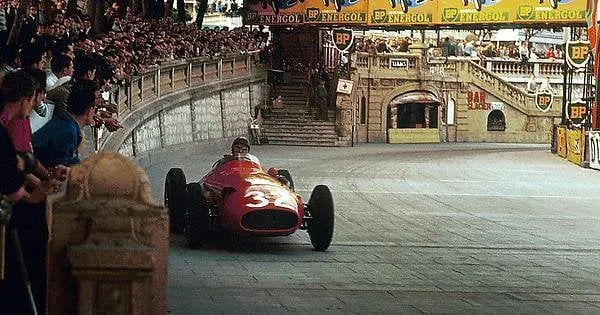
And here’s where Moss enters. Maserati did something almost no other factory of the era did: it sold to privateers, often delivering cars to customers before its own works machines were finished. A young Stirling Moss bought a 250F with his own race winnings in 1954, drove it so brilliantly that Mercedes-Benz signed him for 1955. That is the kind of car this was — a passport to the elite, provided you had the money and the talent. Moss would return to drive for the Maserati works team in 1956, winning at Monaco that year. The 250F runs straight through the spine of British motorsport history, not just Italian.
The Experiment Almost Nobody Remembers: The V12
Here’s something that even committed enthusiasts often don’t know.
Giulio Alfieri, not content with the straight-six, designed a completely new engine from a blank sheet in 1956. A 2,491 cc V12 with a 60-degree angle between banks and twin overhead camshafts driven by a train of gears from the front of the engine. The narrow vee left so little room between the banks that Alfieri had to mount the Weber carburettors in the valley, between the camshafts. Twin-spark again: 24 plugs, two enormous magnetos, 24 individual coils.
This jewel revved to 12,000 rpm and produced 320 horsepower — some fifty more than the most refined version of the straight-six. Read that again: a 2.5-litre V12 spinning to twelve thousand rpm, in 1956. That’s 1980s Formula 1 technology arriving three decades early.
And do you know what? It barely helped. The V12 offered little or no real advantage over the old straight-six. It was more complex, harder to set up, its power arrived too high in the rev range for many circuits, and the six remained more usable race after race. It appeared in some works cars in 1956 and 1957 but never displaced the six. For my money, this is one of the most beautiful truths in the entire 250F story: proof that more cylinders and more revs don’t always win. Sometimes the honest engine — the one that delivers where you need it and survives the whole race — eats the masterpiece’s lunch.
There’s a lesson there that echoes loudly in today’s spec-sheet arms race. Chris Harris has spent years pointing out that the numbers on the brochure rarely correspond to the car you actually want to drive. The 250F figured that out in 1956.
1957: The Lightweight Chassis and the Return of the Master
Two things changed everything for 1957. First, Alfieri laid down an all-new multi-tubular spaceframe chassis — considerably lighter and stronger than the original. Lighter and stronger at the same time, which is the holy grail of any competition engineer. Second, Fangio came home to Maserati.
Fangio and Maserati had a love affair. He himself called Maserati his second love after Alfa Romeo. He had debuted the 250F with a victory at the 1954 Argentine Grand Prix — winning the car’s very first race, which is some way to introduce yourself — before leaving mid-season for Mercedes. He passed through the Silver Arrows, won titles, passed through Lancia-Ferrari, won another, and in 1957, aged 46, returned to Modena and the Trident.
What he did that year is simply one of the most perfect seasons any driver has ever assembled. He won in Argentina, Monaco, France, and Germany. Four victories that delivered his fifth and final World Championship — a record of five titles that stood untouched for 45 years until a certain Michael Schumacher equalled it in 2002 and surpassed it from 2003 onward.
But of those four wins, one isn’t really a win. It’s something else entirely. It’s the race that defines not just the 250F, but the very idea of what a man and a machine can achieve together when everything goes wrong.
Nürburgring, 4 August 1957: The Drive of Drives
Set your stopwatch and hold on, because this deserves to be told properly.
The Nürburgring of the day was 14.2 miles of Green Hell per lap. Twenty-two laps. Fangio qualified on pole with a 9 minute 25.6 second lap, nearly three seconds clear of Mike Hawthorn’s Ferrari. Ahead of him in the race were the two Ferraris of Hawthorn and Peter Collins — young, fast, with cars they intended to run flat to the finish without stopping, on full tanks and hard tyres.
Fangio played a different hand. He chose to start on half tanks and softer, faster tyres, accepting that he’d have to pit for fuel and rubber at mid-distance. A gamble. A calculated risk.
He let the Ferraris go early, studying them. On the third lap he passed both and began to pull away. By lap 12 he led by 28 seconds and pitted as planned.
Then came the disaster.
The mechanic on the right rear removed the centre-lock nut quickly but let it roll under the car unnoticed. While they fitted the new tyre, the crew hunted desperately for the lost nut. The stop, which should have taken seconds, stretched to nearly a minute. Fangio climbed out for a fresh pair of goggles while chaos reigned in the pit. When he finally rejoined, the two Ferraris had long since swept past. He emerged third, 48 seconds behind Collins in second.
Forty-eight seconds. On a circuit where a single lap took over nine minutes. To any mortal, the race was finished.
For his first two laps after the stop, Fangio was cautious, bedding in the new tyres. The Ferrari pit, seeing him fail to close, signalled their drivers to ease off and conserve. A catastrophic error. Because when Bertocchi, the Maserati chief mechanic, hung out the “flat-out” board, the old man transformed.
What followed defies easy comparison. Fangio broke the Nürburgring lap record nine times. Nine. Seven of them on consecutive laps. He took 15.5 seconds off Hawthorn in a single lap. Another 8.5 the next. The car — that lightweight 1957 chassis — was on the edge of disintegration, and Fangio was driving it using higher gears through the corners than reason allowed, scraping the banks, left wheels biting into the grass.
His pole had been a 9:25.6. Mid-chase he set a 9:17.4 — more than eight seconds under his own qualifying time, in a car that had already run twelve flat-out laps, with half the Green Hell punishing his tyres.
On lap 21 of 22, Fangio caught Collins and went past on the inside at the ESSO Terrasse. Moments later, in the section before the Breidscheid bridge, he descended on Hawthorn. He passed with his left wheels on the grass, shut the door on the following corner, and was gone. Hawthorn threw everything at him over the final miles and came up about 3.6 seconds short.
Five World Championships to his name. And the man said he had never driven like that and never would again. He was right: it was his final Formula 1 victory.
The Most Beautiful Car on the Grid
Let me step off the stopwatch for a moment, because this matters as much as the lap times: the 250F is simply one of the most beautiful cars ever built.
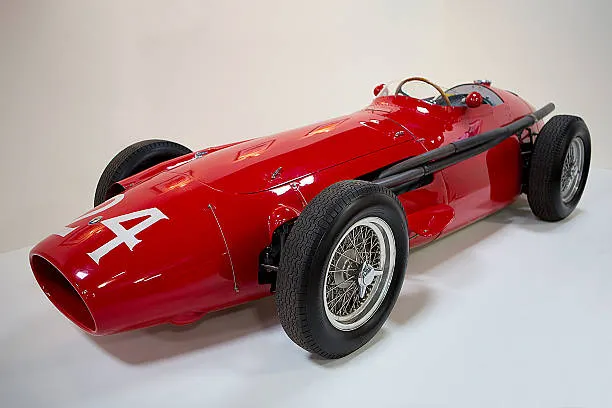
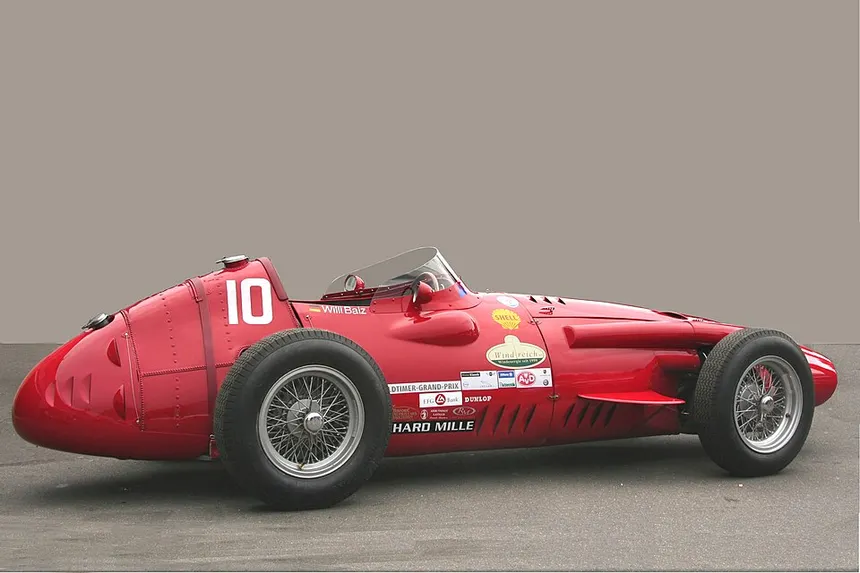
Fantuzzi’s bodywork has proportions no spreadsheet can explain. The long, low nose, that oval mouth, the cockpit where the driver sits bolt upright, the exhausts exiting along the flank, the teardrop tail tank. There was even a streamliner version with partially enclosed wheels, similar to the Mercedes W196, used at the 1956 French Grand Prix on fast circuits. But the classic long-nose 250F silhouette is the one burned into everyone’s memory. Anyone who has wandered the paddock at the Goodwood Revival and heard that straight-six fire up knows exactly the effect it produces.
It’s no accident that the 250F is an object of absolute desire among collectors. Only 26 chassis were built across five years, numbered from 2501 to 2534. And here’s a detail Maserati people love: the number 2517 is missing. Why? Because in Italian superstition — particularly in gambling circles — 17 is deeply unlucky. Modena simply skipped it. Each of those 26 cars was unique, built with differing details as the design evolved. No two 250Fs are identical.
A Closing Argument
Ask me to name the most important competition car in Maserati’s history and I won’t hesitate: it’s the 250F. The MC12 won more consecutive championships, true. The 450S had more brute force under the bonnet. But the 250F is the car that defines what Maserati means when it gets serious on a circuit.
And I’ll tell you why, from the workbench, spanner in hand.
Because the 250F proves a truth that the modern industry has forgotten. It won without being the most powerful car. It didn’t have the most exotic engine — in fact, the most exotic engine it ever carried, Alfieri’s 12,000-rpm V12, was precisely the one that didn’t work. It won because it was beautifully balanced, because it was noble, because a driver could trust it to the point of risking his life chasing two Ferraris through the Green Hell. The 250F didn’t betray you. And in an era when drivers genuinely died, almost every season, that nobility was worth more than fifty extra horsepower.
Today everyone chases the number. More power, more revs, more cylinders, more figures to print in a brochure. The 250F reminds you that the number doesn’t win races. The whole package wins races. The trust between man and machine wins races. Fangio didn’t break the Nürburgring record nine times because his Maserati had more horsepower than the Ferraris — it didn’t. He did it because he knew that car, trusted that car, and that car answered when he asked it for the impossible.
You can’t buy that with displacement. You build it with honest engineering and hours of graft. And that’s why, seventy years on, when you watch a 250F stream past at a historic meeting with that straight-six singing, the hair stands up on your arms. Not because it’s fast by today’s standards. But because inside that Fantuzzi bodywork lives the proof that a well-made car, in the right hands, can touch the divine.
Fangio touched it one August afternoon in 1957. He did it in a Maserati.
Check you’re still alive.