
HORACIO PAGANI: THE MAN WHO DARED TO CHALLENGE FERRARI
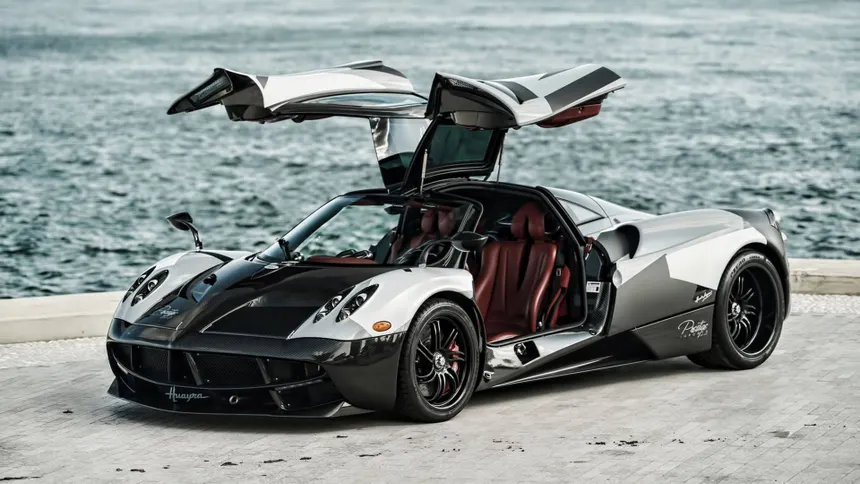
Pagani: The Argentine Immigrant Who Built the World’s Most Extraordinary Car
There are stories the automotive world doesn’t deserve, but receives anyway — gifts for those who know how to look. Horacio Pagani’s story is one of them. He wasn’t born in Maranello. He didn’t inherit a factory. There was no venture capital behind him, no family name to open doors. He was an Argentine kid from Casilda — a city most Europeans couldn’t find on a map — armed with an obsessive love for cars and a conviction that’s becoming increasingly rare: if you can imagine it, you can build it.
I find it hard not to feel a deep connection to that mindset. There’s something profoundly honest about someone who refuses to accept that the world is split between those who create and those who consume. Horacio Pagani decided he was going to be in the first group, whatever the cost.
From Casilda to Modena: A Madman’s Journey with Big Dreams
Horacio was born in 1955. From childhood, he built car models with his own hands, sketched designs, took things apart to understand how they worked. He wasn’t the typical kid who admires cars from a distance — he needed to know what was inside, why that aerodynamic curve and not another, what happens if you swap this material for that one.
At 20, he built a Formula 2 single-seater almost from scratch in Argentina. Not to race. To prove to himself that he could. That car, that monumental effort from a young man without resources in a country that had nothing to do with high-end motorsport, was his calling card to the universe.
In 1983, he made the decision that would change his life and automotive history: he moved to Italy. To Modena. To the very heart of the Italian Motor Valley, where Ferrari, Lamborghini, Maserati, and Dallara breathe the same air. He arrived without money, with a portfolio under his arm and an unsettling conviction for someone in his situation. He went to knock on Lamborghini’s door.
And Lamborghini shut the door in his face.
This part is essential to tell properly, because the world always remembers the triumphs but forgets the closed doors. Lamborghini wouldn’t hire him. The official reason: he lacked the required university degree. The real reason: nobody bet on an unknown Latin American without academic credentials, regardless of the talent he radiated. Horacio went home, studied Italian, learned composites, kept drawing, kept building.
And came back. This time, Lamborghini said yes.
The Lamborghini Years: Learning in the House of the Bull
During his years at Lamborghini, Horacio Pagani was no ordinary employee. He was the man who pioneered the large-scale production use of carbon fiber in automobiles. He worked side by side on the Countach team and later on the Diablo. But more important than what he built was what he learned — and above all, what he decided he would do differently.
At Lamborghini, he saw what was possible. He also saw its limits. He saw where corners were cut, where things were simplified, where the industry made compromise decisions between the ideal and the profitable. And in his mind, an idea took shape with increasing clarity: he wanted to build cars without compromise.
The problem was that nobody would fund that. Nobody except, perhaps, the greatest Formula 1 driver in history.
The Senna Connection: The Godfather Who Never Saw the Result
The relationship between Horacio Pagani and Ayrton Senna is one of those motorsport chapters that leaves you speechless. Senna, at the peak of his career, found in Pagani someone who spoke his language: the language of perfection without excuses. Both were Latin Americans in Europe. Both had an obsession with detail that bordered on the pathological. Both believed that excellence isn’t a destination — it’s a way of walking.
Senna financially supported the Pagani project. He visited the workshop. He tested prototypes. He talked about wanting to see the finished car. That car was the Zonda.
In May 1994, Ayrton Senna died at Imola.
Horacio Pagani continued. Because when someone has believed in you that way, quitting is the only true betrayal.
The Zonda was presented at the Geneva Motor Show in 1999. Its name came from the warm wind that blows through the Argentine Andes. A way for Horacio to never forget where he came from.
The Zonda: When a Man Builds His Dream
The 1999 Pagani Zonda C12 was, technically, a bomb. AMG V12 6.0-liter engine, carbon-titanium monocoque structure, a weight that shamed far less ambitious cars. But what made the Zonda truly different wasn’t the performance on paper. It was the philosophy behind every single component.
Horacio Pagani has a quote I consider one of the most important things I’ve ever read about design and manufacturing: “Art and science must walk together.” That’s not a marketing slogan. It’s a declaration of intent. At Pagani, every bolt is machined with a precision that has no functional justification beyond aesthetics. The interiors look like Swiss watches that someone has turned into cockpits. Nothing exists that hasn’t been thought about, reconsidered, and thought about again.
The Zonda evolved for over a decade. Zonda S, Zonda F, Zonda Cinque, Zonda R, Zonda Revolucion. Each version pushing further, each more extreme, more expensive, more scarce. Pagani never produced in volume. Never wanted to. The company makes fewer than 40 cars a year. That’s not a conventional business model. It’s a statement of values.
The Huayra: The Second Masterpiece
In 2011 came the Huayra, named after Huayra-tata, the wind god in Quechua Andean mythology. Another nod from Horacio to his roots. Another AMG V12 biturbo, this time 6 liters with 720 hp. Another piece of art with an engine.
But the Huayra introduced something new: active aerodynamic flaps on all four corners of the car, adjusting individually according to driving conditions. Not to be first. Because it was the right solution to the problem Horacio wanted to solve. That’s how Pagani works: no innovation for marketing, just solutions because the problem required them.
The Huayra BC of 2016 is, to me, one of the five most impressive cars ever built. No qualifications. 789 hp, 1,218 kg, built around a carbon-titanium frame that Pagani calls “carbotitanium” — developed in collaboration with the aerospace industry. Base price was around €2.4 million. All 20 BC examples were sold before the physical car existed.
What Pagani Teaches Me About Doing Things Right
At this point, I need to write something more personal — because if I run this blog it’s to say things you don’t read everywhere else.
Pagani’s story fascinates me for what it has that’s universal. It’s not just a story about cars. It’s a story about someone who refused to accept the place the world had assigned them. Who arrived in Italy with nothing, who absorbed Lamborghini’s rejection without breaking, who spent years learning what needed to be learned before making the leap, who lost the person who believed most in him when the dream was about to materialize, and who continued anyway.
That’s what separates those who do from those who talk. Not talent, though that matters. Not capital, though it helps. It’s the capacity to absorb the blow, recompose yourself, and keep building.
In an industry dominated by corporations that measure every decision by ROI and production volume, Pagani exists as a beautiful anomaly. One man, one workshop, one obsession with perfection. Fewer than 300 cars built in total since 1999. Each one a unique work. Each one with Horacio’s name behind it in the most literal sense.
When I see a Zonda or a Huayra, I don’t see a luxury car. I see the materialization of a brilliant stubbornness. I see what happens when someone decides the rules of the game don’t apply to them.
The Future of Pagani
In 2022 came the Utopia — the third great chapter. The name says it all: not aspiring to the perfect, but to the impossible. 852 hp from the AMG V12, a 7-speed manual gearbox because Horacio believes the driver must be connected to the car, weight under 1,280 kg. 99 units. Starting price: €2.2 million.
All sold.
Horacio’s son Christopher is involved in the company. There’s an almost artisanal, family dimension to all of this that contrasts brutally with the supercar world dominated by Volkswagen Group, Ferrari, and Stellantis. Pagani remains an independent company. Still the personal project of a man who never accepted that dreams have budget limits.
And while the automotive world debates electrification, shared platforms and economies of scale, in San Cesario sul Panaro, a few kilometers from Modena, there’s a workshop where every bolt is machined by hand, where every carbon piece is made in-house, where every car carries the weight of a story that started in Casilda, Argentina, with a kid who wanted to build the most incredible car in the world.
He did it.
Pingback: The Spanish Phoenix: Domingo Ochoa and the GTA Spano Story
Pingback: Mercedes SL 500 R129: The Last No-Compromise Mercedes Roadster
Pingback: I Heard the GTA Spano E&D Run. I'll Never Forget It.