Plymouth ‘Cuda Hemi 426: The 425-HP Beast Now Worth Millions
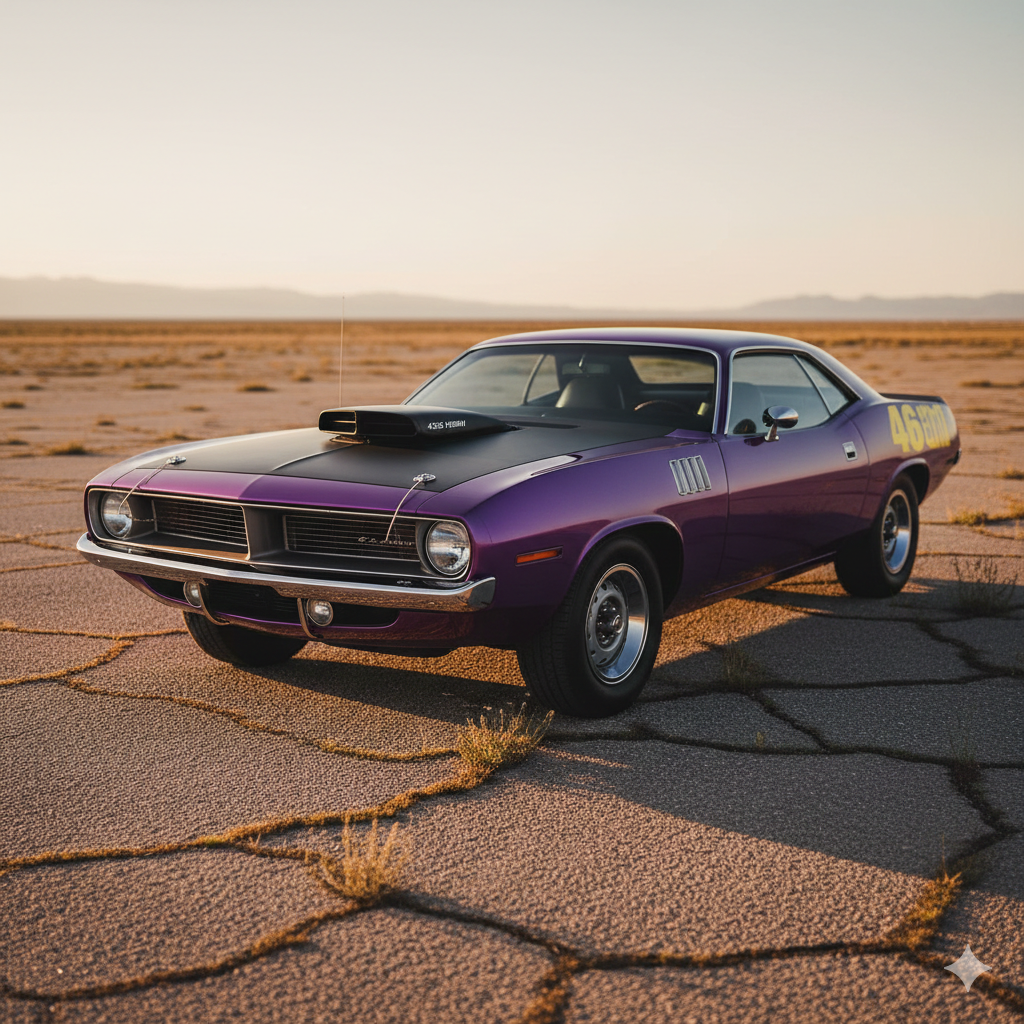
There are cars that are myths. And then there is the Plymouth Hemi ‘Cuda.
We aren’t talking about just another muscle car. This isn’t just another American V8 with loud paint and racing decals. The Hemi ‘Cuda is the line that separates what American manufacturers dared to do during four glorious years from what insurance companies, emission regulations, and the oil crisis forced them to stop doing forever.
Between 1970 and 1971, Plymouth stuffed the wildest engine Chrysler had ever built into its most compact pony car. The result was a car that cleared the quarter-mile in 14 seconds and hit 0 to 60 in 5.8 seconds. In 1970. With carburetor technology and zero electronics.
Today, a 1971 convertible just sold for $3.3 million at Mecum Kissimmee in January 2026. Let’s tear this beast down, part by part.
The Engine That Started It All: The 426 Hemi
To understand the ‘Cuda, you have to understand the Hemi. And to understand the Hemi, you have to go back to World War II.
Chrysler engineers spent the war developing engines for M47 Patton tanks and experimenting with a 2,220 cubic inch V16 for the Republic P-47 Thunderbolt fighter. That V16 never entered production, but the experience with hemispherical combustion chambers was etched into the company’s DNA.
The concept is mechanically elegant. A half-sphere combustion chamber allows the spark plug to be placed at the exact center, reducing the flame propagation distance. The intake and exhaust valves are angled on each side, allowing for larger valves than a conventional chamber. More valve area, more airflow, more power. Basic engineering executed with military precision. Literally.
The first-generation Hemi arrived in 1951 with the Chrysler FirePower. But it was the second generation, the 426 Hemi of 1964, that changed the game. Chrysler built the 426 exclusively for competition—NASCAR and drag racing. When Plymouth Belvederes swept the top four spots at the 1964 Daytona 500, Ford pressured NASCAR to ban it for not being available in production vehicles. Chrysler’s response? Build a street version of the Hemi for 1966. If NASCAR wanted homologation, they were going to get it.
The Figures Chrysler Didn’t Want You to Know
Officially, the street 426 Hemi produced 425 hp @ 5,000 rpm and 490 lb-ft of torque @ 4,000 rpm, fed by two four-barrel Carter AFB carburetors on a cast-iron intake manifold.
But those figures were a lie. A deliberate, calculated lie.
In the ’60s and ’70s, insurance companies set premiums based on declared horsepower. Chrysler, knowing the real Hemi produced considerably more, declared 425 hp to keep insurance rates in a range that wouldn’t scare off buyers. Modern dyno tests have recorded 450 hp @ 5,600 rpm in stone-stock configuration. With open headers, that figure climbs above 520 hp. Chrysler was selling a 500+ hp car while telling the world it had 425. Today, that would be a scandal. In 1970, it was commercial survival.
The ‘Cuda: When the Hemi Found Its Chassis
The Plymouth Barracuda had existed since 1964, but for its first two generations, it was basically a Valiant with pretensions. The third generation, launched in 1970 on the new E-body platform shared with the Dodge Challenger, changed everything.
The E-body engine bay was significantly larger than the previous A-body. It was big enough for engineers to fit the 426 Hemi as a regular production option. The model was offered in three levels: base Barracuda, luxury Gran Coupe, and the sporty ‘Cuda. Only the ‘Cudas received the Hemi badge on the sides, and only when they actually carried the engine. No “posuer” decals here.
Mechanical options for the ‘Cuda included the 340, 383, 440 Magnum, 440 Six Barrel (three carbs), and at the top, the 426 Hemi. With the Hemi came heavy-duty suspension, a Dana 60 rear end (with manual transmission), or the Mopar 8¾ (with automatic), and additional structural reinforcements.
Production: The Rarity That Feeds the Myth
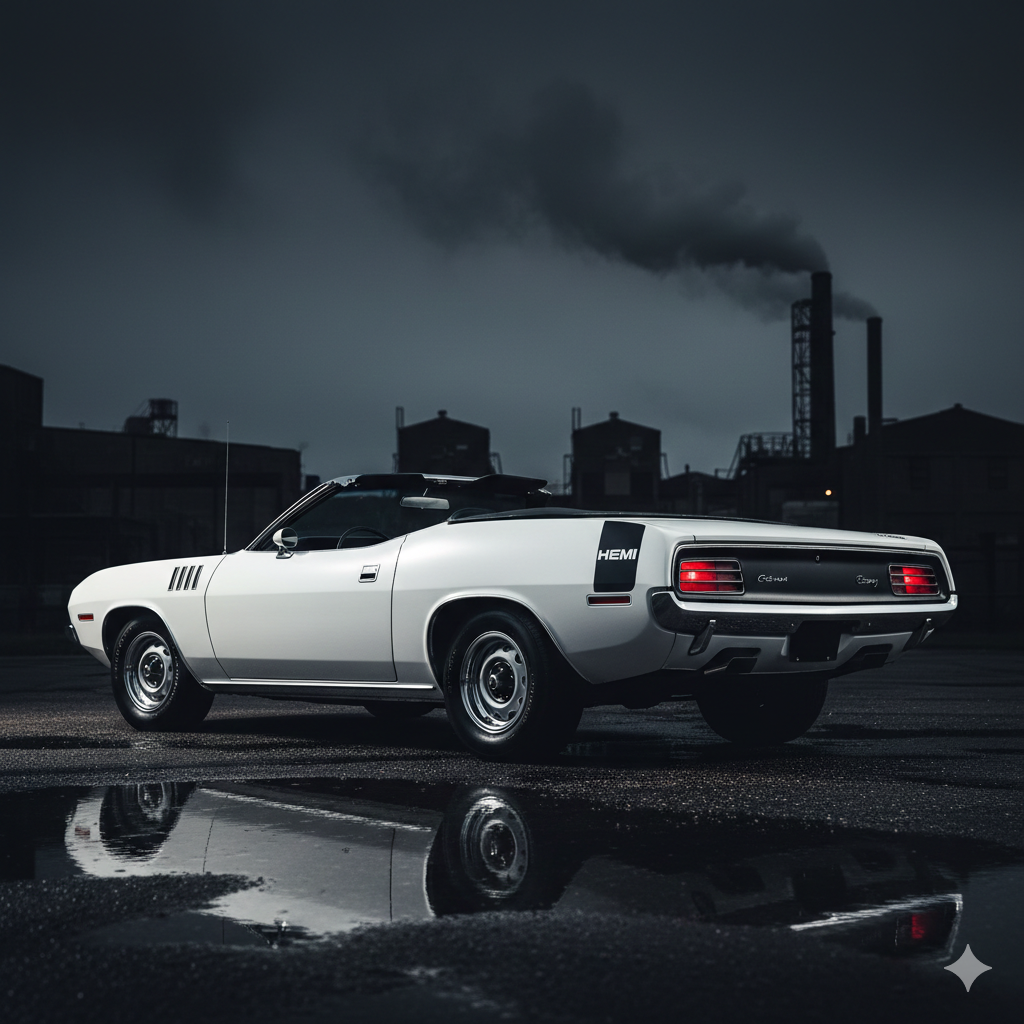
This is where the Hemi ‘Cuda story moves from impressive to legendary.
- In 1970, Plymouth sold nearly 49,000 Barracudas. Only 666 were Hemi ‘Cudas. Just 284 of those had the four-speed manual. Only 14 were convertibles.
- In 1971, the numbers plummeted. Only 119 Hemi ‘Cudas left the Hamtramck, Michigan factory. Eleven were convertibles. Of those eleven, only two had the four-speed manual transmission.
Two cars. In the entire world.
The Hemi package cost an extra $900 in 1970 (about $7,500 today). That was nearly a third of the base price of the car. Insurance was astronomical. Fuel consumption was brutal. And the engine required meticulous maintenance: mechanical lifters needed periodic adjustment, and the dual-shaft rocker covers made changing spark plugs an exercise in patience. It wasn’t a car for everyone; it was for the person who wanted a street-legal race car.
1971: The Last Roar
For 1971, the ‘Cuda received minor aesthetic changes: a new grille, four headlights (the only year), and the characteristic “gills” on the front fenders. It was also the only year for the massive “Billboard” side decals.
But the real enemy was in Washington D.C. Emission regulations were tightening. Compression ratios were being slashed to run on regular gas. 1971 was the final year of the 426 Hemi and the 440 Six Barrel. The era of the pure American muscle car died that year, and the Hemi ‘Cuda was its most dignified epitaph.
The Auction Market: From Car to Fine Art
Hemi ‘Cuda prices have defied gravity for decades. Coupes with correct documentation average $300,000–$400,000. But convertibles play in a different league.
- In January 2026, a 1971 Sno White automatic convertible sold at Mecum Kissimmee for $3.3 million.
- The historical record is held by a 1971 four-speed manual convertible that reached $3.5 million in 2014.
- In 2021, a 1971 convertible (the only export model delivered new to Europe) saw a high bid of $4.8 million, but it did not meet the reserve.
Why these prices? Extreme rarity (fewer than 800 total units), historical significance (the last street Hemi), and a mystique no other muscle car has replicated. A Hemi ‘Cuda isn’t just a car. It’s a death certificate for an era, signed with 490 lb-ft of torque.
What the Hemi ‘Cuda Teaches Us
As a mechanic with over 30 years under the hood, I find the 426 Hemi fascinating because of its honesty. There are no turbos. No electronics. No injection maps optimized for emissions cycles.
There is a cast-iron block with two heads that weigh like anchors, mechanical lifters that need a wrench every few thousand miles, and a lubrication system that works triple-time. Everything that engine produces is the result of pure mechanical design. In an era of three-cylinder electronic-assisted engines, the 426 Hemi reminds us that mechanical engineering, without electronic crutches, was once capable of creating something worth more than a Manhattan penthouse.
And that, like it or not, isn’t coming back.
Did you like this article? Share it with someone who knows what “shaker hood” means.
Not Enough Cylinders — Technical opinion with judgment, not an algorithm.
Pingback: Hot Wheels: The History, Car Culture & Collecting Guide