
The Volkswagen VR6: The Engine That Broke All the Rules
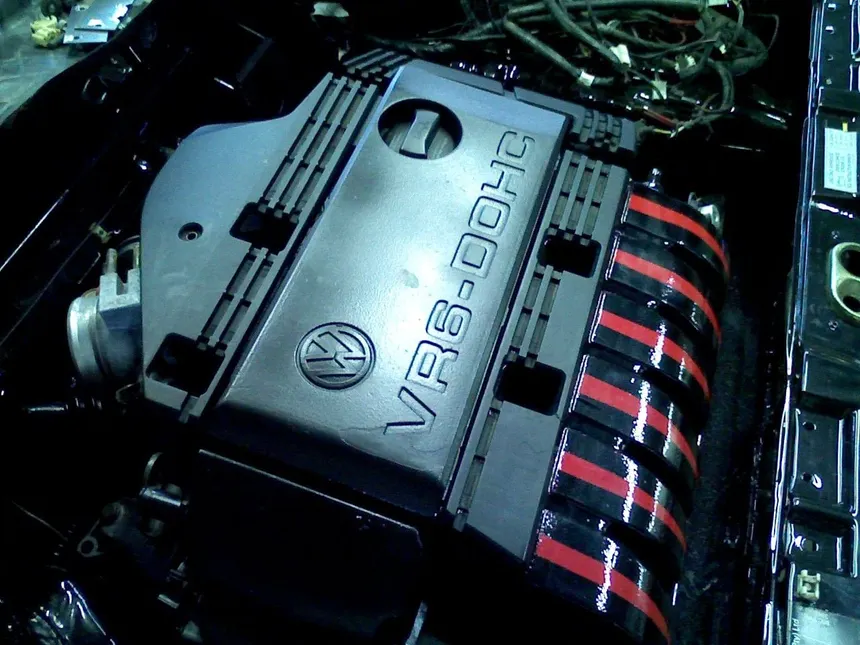
How Germany Made a V6 Fit Where a Four-Cylinder Lives
In 1991, Volkswagen solved an engineering problem nobody asked them to solve.
They wanted to fit a six-cylinder engine into the Golf. Not an inline-six, which would be far too long. Not a conventional V6, which would be far too wide. Something else entirely.
What they created was the VR6—a motor that looks wrong, sounds wrong, and works brilliantly.
This is the story of an engine that shouldn’t exist, shouldn’t work, and somehow became one of the most beloved powerplants in automotive history.
The Problem Nobody Needed Solved
By the late 1980s, Volkswagen had a problem that was mostly psychological.
The Golf GTI had become Europe’s hot hatch benchmark. But premium competitors were arriving with six-cylinder engines: the BMW M3 had its screaming inline-six, various luxury sedans offered silky-smooth V6 power.
Volkswagen’s executives wanted six cylinders. Their engineers pointed out that the Golf’s engine bay couldn’t fit them.
Most companies would have accepted this reality. Volkswagen’s engineers instead invented an entirely new engine configuration.
The VR Configuration Explained
The VR6 is neither a V6 nor an inline-six. It’s something in between.
A conventional V6 has two banks of three cylinders arranged in a V-shape, typically 60 or 90 degrees apart. This requires substantial width—space the Golf’s engine bay didn’t have.
An inline-six places all six cylinders in a row. This requires substantial length—again, space the Golf didn’t offer.
The VR6 uses a 15-degree bank angle. This is narrow enough that all six cylinders can share a single cylinder head, like an inline engine. But the staggered arrangement is compact enough to fit where a four-cylinder lives.
The “VR” stands for “V-Reihenmotor”—V-inline engine. A name that perfectly captures its hybrid nature.
The Sound That Defined a Generation
The VR6 produces one of the most distinctive engine sounds ever created.
At idle, it produces a mechanical churning unlike any other engine. It doesn’t burble like a V8. It doesn’t hum like an inline-six. It makes a sound that’s almost industrial—chain-driven, gear-driven, utterly unique.
At full throttle, the VR6 howls. The narrow angle and unique firing order create harmonics that sound like nothing else. It’s aggressive without being harsh, characterful without being obnoxious.
Thousands of enthusiasts will tell you they fell in love with the VR6 because of how it sounds. The specifications—initially 174 horsepower from 2.8 liters—were competitive but not exceptional. The experience was unforgettable.
The Applications
The VR6 appeared in nearly every Volkswagen Group platform throughout the 1990s and 2000s:
Volkswagen Corrado (1991-1995): The VR6’s debut application and arguably its spiritual home. The Corrado’s swoopy styling and sport-focused chassis perfectly matched the engine’s character.
Volkswagen Golf III VR6 (1992-1998): The car that justified the engine’s existence. A six-cylinder Golf seemed impossible until it suddenly wasn’t.
Volkswagen Passat (1991-1996): The VR6 brought sports car character to family sedan duty. These remain sleeper performance cars today.
Volkswagen Jetta (1992-1998): The sedan version of the Golf VR6 experience, with slightly more refinement.
Seat Toledo/Cordoba: The Spanish arm of VAG received VR6 power in their performance models.
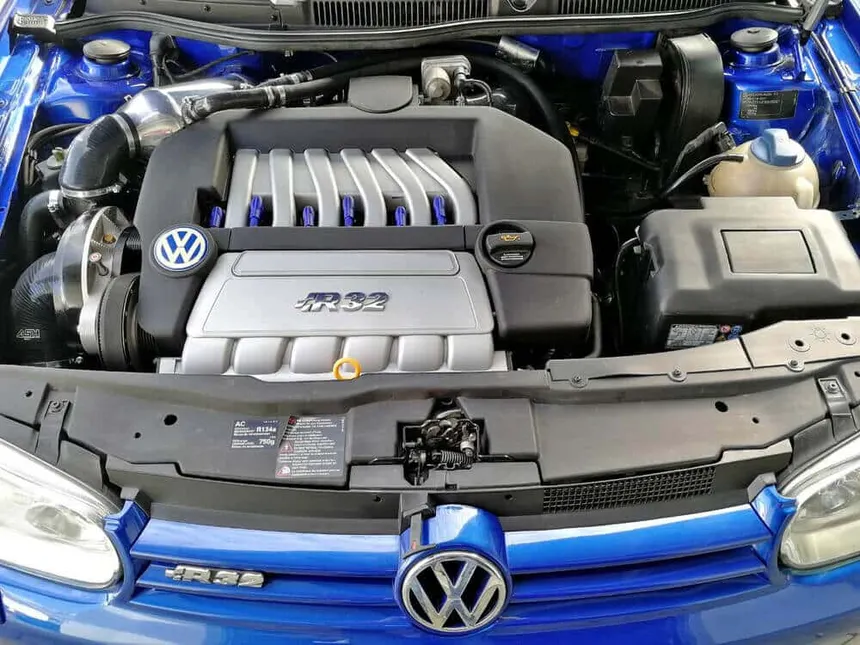
Later Generations: The VR6 evolved through multiple displacements (2.8L, 2.9L, 3.2L, 3.6L) and continued in various VAG products through the 2010s, including the Audi TT and R32/R36 variants.
Engineering Challenges and Solutions
The VR6’s unusual configuration created engineering challenges that Volkswagen solved with characteristic thoroughness:
Cooling: The narrow angle meant cylinders were very close together, creating thermal management challenges. Volkswagen designed sophisticated cooling passages to prevent hot spots.
Balancing: The 15-degree angle created unique vibration characteristics. Unlike perfectly balanced inline-sixes or 60-degree V6s, the VR6 required careful balancing work and specific counterweights.
Timing: All six cylinders sharing one head meant one very long timing chain. Early VR6 engines were chain-driven throughout; later versions used belt-driven accessories with chain-driven cams.
Maintenance: The single-head design actually simplified certain maintenance tasks compared to conventional V6s. Head gasket work, for instance, involved one gasket instead of two.
The solutions worked. VR6 engines proved remarkably durable, with many examples exceeding 200,000 miles without major intervention.
The Tuning Scene
The VR6 became a tuning icon, particularly in Europe and the UK.
The engine’s robust construction tolerated modification well. Turbocharger installations became popular, with the 2.8L and 2.9L versions regularly producing 300+ horsepower with relatively simple setups.
The narrow-angle design created interesting turbo packaging opportunities. Twin-turbo setups could be fitted more easily than on wider V6 configurations.
Supercharger kits appeared for those who preferred linear power delivery. The VR6’s torque characteristics suited forced induction well.
Perhaps most impressively, the VR6 tuning scene developed without factory motorsport support. While BMW and Mercedes poured resources into their performance divisions, VR6 enthusiasts built their scene from pure grassroots passion.
The Evolution: 3.2L and Beyond
The original 2.8L VR6 established the formula. Later evolutions refined it.
The 3.2L version, appearing in vehicles like the R32 Golf and Audi TT, added displacement and power (250 hp) while maintaining the engine’s fundamental character. This version, paired with Volkswagen’s 4MOTION all-wheel-drive system, created some genuinely rapid vehicles.
The 3.6L version extended the concept further, appearing in vehicles like the Passat R36 and Atlas. By this point, the engine had matured into a genuinely sophisticated powerplant—smooth, powerful, and still capable of that distinctive VR6 sound.
But purists often argue the original 12-valve 2.8L remains the most characterful version. Sometimes the first attempt captures something that refinement loses.
The Competition It Embarrassed
In the early 1990s, the Golf VR6 had no direct competitors.
BMW’s inline-six engines wouldn’t fit in compact car platforms. Mercedes didn’t play in the hot hatch segment. Alfa Romeo’s Busso V6 appeared in larger vehicles.
The VR6 Golf essentially created its own class: a genuine six-cylinder hot hatch at attainable prices. It made $40,000 cars feel inadequate next to a $25,000 Volkswagen.
This situation persisted for nearly a decade. Not until the mid-2000s did competitors really catch up—by which point Volkswagen had moved on to turbocharged four-cylinders that offered similar performance with better efficiency.
Why It Matters Today
The VR6 represents something increasingly rare: engineering audacity without marketing committee interference.
Someone at Volkswagen believed that a six-cylinder Golf should exist. They didn’t commission focus groups or calculate ROI. They invented an entirely new engine configuration to make it happen.
This philosophy—that engineering solutions should serve driving passion rather than spreadsheet optimization—has largely disappeared from modern automotive development.
Today, turbocharged four-cylinders offer more power with better efficiency than any VR6 ever made. They’re objectively superior by every measurable metric.
They have no soul.
The VR6 had soul in abundance. It had character. It had a sound that made people stop and listen. It had mechanical drama that modern engines cannot replicate.
The Collector Market
VR6-powered vehicles are finally gaining collector recognition.
The Corrado VR6 leads the pack, with clean examples commanding €15,000-€25,000 and exceptional specimens exceeding €30,000.
Golf III VR6 values have tripled in the past five years. What was a €3,000 car a decade ago now commands €10,000-€15,000 for clean examples.
The later R32 and R36 models have maintained strong values throughout, benefiting from their limited production numbers and performance credentials.
The challenge, as always, is finding well-maintained examples. The VR6 engine itself typically survives well, but 1990s German electronics and chassis components require attention.
The Legacy
The VR6 proved that conventional wisdom is sometimes wrong.
Everyone knew you couldn’t fit a six-cylinder engine in a Golf. Volkswagen did it anyway.
Everyone knew 15-degree bank angles were impractical. The VR6 made them work.
Everyone knew compact cars didn’t need six-cylinder drama. The VR6 proved that they absolutely did.
The engine represented a moment when German engineering prioritized driver experience over efficiency, character over specification sheets, passion over prudence.
That moment has passed. Modern Volkswagens are competent, efficient, and utterly forgettable.
But anyone who experienced a VR6 at full song remembers. And probably always will.
Have you driven a VR6-powered vehicle? Share your memories of that unmistakable sound in the comments.
Pingback: VW Lupo DOP Motorsport: 3,600 HP Twin-Engine 7.71s Quarter Mile
Pingback: VW Lupo 3L TDI: 78 MPG, 1,830 lbs, and a 3,600 HP Drag Car Legacy
Pingback: Volkswagen Beetle RSI: 250 Unidades de Locura VR6 y Tracción Total