
WEIGHT IS THE ENEMY: HOW YOUR TWO-TON CAR DESTROYS ROADS, PARKING STRUCTURES, YOUR WALLET AND PROBABLY YOUR LIFE
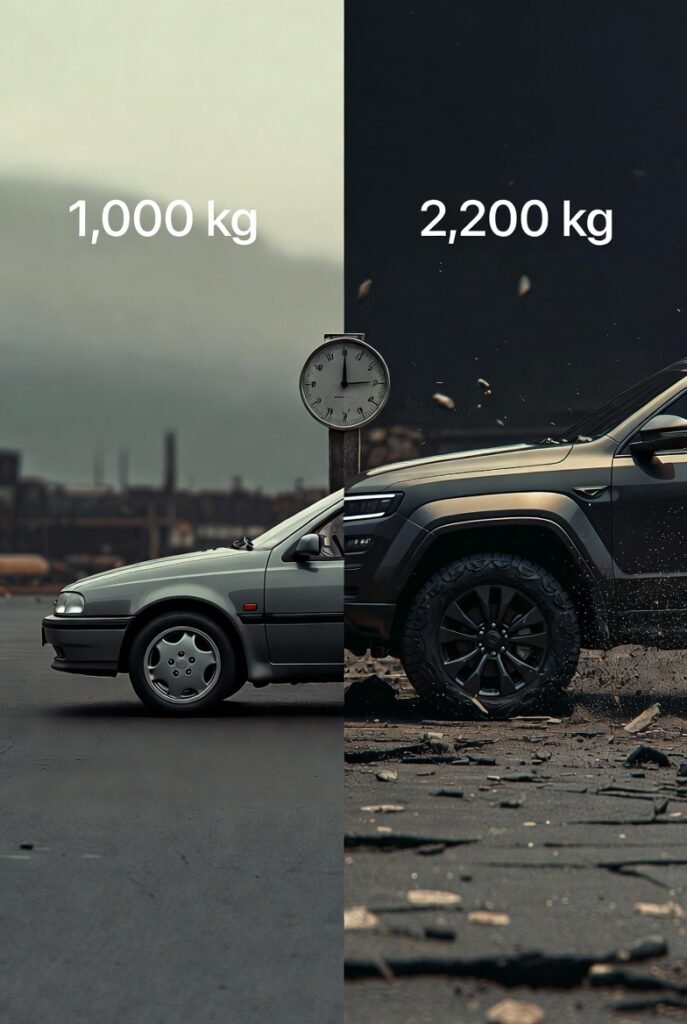
Everything you’ve been told at the dealership is wrong. Every SUV ad showing a happy family crossing a mountain pass. Every brochure promising safety through size. Every assumption you’ve made about progress and protection. You’re about to read the evidence that dismantles all of it. With data. No sugar-coating. No concessions.
Your car weighs too much. And that excess weight isn’t a side effect of progress. It’s a design choice that destroys roads, threatens parking structures, inflates fuel consumption, poisons the air with invisible particles, drives up every repair bill and insurance premium, and when the crash comes, turns kinetic energy into your worst enemy. Weight is the problem. Everything else is a consequence.
And nobody wants to talk about it.
The bloat: from 1,020 kg to nearly 1,500 in thirty years
Let’s start with the numbers, because this is where the argument either stands or falls. According to Inovev, the European benchmark for automotive market analysis, the average curb weight of passenger cars produced in Europe rose from 1,020 kg (2,249 lbs) in 1990 to 1,380 kg (3,042 lbs) in 2011. That’s 360 kg gained in two decades. And just when it seemed to plateau, electrification arrived: by 2022, the average climbed to 1,462 kg (3,223 lbs). Pure electric vehicles now average 1,730 kg (3,814 lbs).
If you need a concrete example, think about the Volkswagen Golf. The MK1 GTI weighed 810 kg (1,786 lbs). A 110 hp engine, front-wheel drive, no ABS, no ESP, no touchscreen. Today, a base Golf VIII exceeds 1,300 kg (2,866 lbs). The eHybrid version pushes past 1,500 kg (3,307 lbs). Nearly double the original. To do exactly the same thing: move four people and their luggage from A to B.
And this isn’t a VW problem. The 1995 Toyota Corolla weighed about 1,150 kg (2,535 lbs). The 2024 model tips the scales at around 1,400 kg (3,086 lbs). The 1985 Honda Civic barely reached 820 kg (1,808 lbs). Today it comfortably exceeds 1,400 kg. In the US, the EPA reported that the average weight of a 2023 model year vehicle hit a record 4,371 lbs — 215 lbs more than the 2019 average. The trend is global, cuts across every brand and every segment, and shows no sign of reversing.
In Europe, there are no longer any cars produced below 900 kg. The 800-899 kg segment has vanished entirely. The lightest car in European production was the Renault Twingo, and even that’s gone.
Where did those extra 400-500 kg go? Structural reinforcements demanded by safety regulations. Hybrid battery packs. Screens, cameras, sensors, connectivity modules. Extra sound insulation because the car is bigger and generates more aerodynamic noise. Bulkier bodies because the market decided everyone wants an SUV. And a vicious cycle nobody has any interest in breaking: more weight demands bigger brakes, heavier suspension, higher-load tyres, more powerful engines to maintain performance, and all of that adds more weight.
It’s the bloat spiral. And you’re paying for it.
The road your car is eating alive
Here’s the first consequence nobody tells you about. Asphalt isn’t indestructible. Every time a wheel passes over it, the surface suffers. And the damage it causes isn’t proportional to weight. It’s exponential.
There’s a principle in pavement engineering called the Fourth Power Law. It was discovered during the AASHO Road Test, a massive experiment conducted in Illinois between 1958 and 1960, where stretches of highway were subjected to millions of vehicle passes at different axle loads. The conclusion was devastating: pavement deterioration is proportional to the fourth power of the axle load. In plain English: if a vehicle with 500 kg (1,102 lbs) per axle causes a baseline damage of “1”, a vehicle with 1,000 kg (2,205 lbs) per axle causes a damage of “16”. Not double. Sixteen times more.
Now think about what’s happened in thirty years. In 1990, a 1,020 kg economy car put roughly 510 kg per axle. Today, a 2,200 kg plug-in SUV puts 1,100 kg per axle. Under the fourth power law, that SUV deteriorates the road surface approximately 21 times more than the 1990 economy car. Twenty-one times. Driving the same roads, paying the same road taxes.
The result? Roads that need more frequent resurfacing. Potholes that form earlier. Bridge expansion joints that wear out faster. And we all pay for it through taxes, whether we drive a Twingo or a Tesla Model X.
The Fourth Power Law does have its nuances. Researchers like David Cebon at Cambridge have pointed out that the real exponent varies depending on pavement type, climate conditions and axle configurations. A 1988 Australian report suggested that for fatigue cracking, an exponent of 2 might be more appropriate than 4. But even if we apply that more conservative exponent, an SUV weighing twice as much as an economy car causes four times more damage to the road surface (2² = 4). Not twenty-one times, but not two either. The relationship is never linear. Weight always wins.
Particles: the pollution that doesn’t come from the tailpipe
When you think of car pollution, you think of the exhaust pipe. But that no longer reflects reality. The UK Government’s Air Quality Expert Group (AQEG) published a figure that should change the entire emissions conversation: non-exhaust particles — from tyres, brakes and road dust resuspension — already account for 60% of PM2.5 and 73% of PM10 generated by road traffic. More than half of traffic-related particle pollution doesn’t come from any exhaust pipe. It comes from under your wheels.
And that’s where weight changes everything.
The heavier the vehicle, the more pressure it exerts on the tyres, the more friction it generates against the road surface, the more the rubber compounds deform with each rotation, and the more particles are released. This isn’t theory. It’s basic contact mechanics. A car in Europe sheds an average of 1.1 kg of tyre rubber per year. And each tyre releases on the order of a trillion ultrafine particles — smaller than 100 nanometres — per kilometre driven.
To put those figures in context: Emissions Analytics, the leading independent emissions testing firm, has measured that the mass of particles generated by tyres can exceed those from the exhaust of a modern Euro 6d car by orders of magnitude. Why such an extreme difference? Because exhaust emissions have been regulated for decades and modern filters are extraordinarily effective. Tyres, on the other hand, have zero regulation. Nobody asks you for a “rubber particle filter”. The exhaust is nearly clean. The tyres are not. And weight is the multiplier.
A study by Timmers and Achten published in Atmospheric Environment quantified that electric vehicles, being significantly heavier than their ICE equivalents, generate approximately 20% more PM10 and 30% more PM2.5 from tyre wear. That study dates from 2016, when the weight gap between an EV and its ICE equivalent was roughly 24%. Today, with higher-capacity batteries and electric vehicles regularly exceeding 2,400 kg (5,291 lbs), the gap has only widened.
This is what no electric car ad will ever tell you. Your EV has no exhaust pipe, true. But its mass is grinding the asphalt and releasing a cocktail of rubber, heavy metals, zinc, copper and over 400 chemical compounds — some of them carcinogenic — with every kilometre you drive. The substance 6PPD-quinone, derived from an antioxidant present in virtually every tyre in the world, has been proven lethal to coho salmon on the US West Coast. And we’re only beginning to understand what it does in human lungs.
If we actually wanted to reduce particle pollution from traffic, the answer isn’t swapping tailpipes for batteries. It’s reducing vehicle weight. Full stop.
The dynamics that electronics are trying to hide
Let’s talk physics. Not brochure physics. The kind that operates every time you touch the steering wheel, the brake pedal or the throttle.
A heavier car has more inertia. That means it needs more force to change direction, more distance to stop, more grip to hold a line through a corner, and more time to respond to an emergency manoeuvre. This isn’t opinion. It’s Newton’s second law.
The industry has responded with a battery of electronic systems: ESP, predictive ABS, traction control, emergency braking assist, torque vectoring, adaptive suspension. And they work. But they’re not a solution. They’re a patch. Electronic crutches to compensate for a design flaw that is the vehicle’s own weight.
Think about a 1994 BMW 3 Series E36. A 1,300 kg (2,866 lbs) car, low, with a centre of gravity glued to the ground, without a single electronic stability system. If you threw the wheel at 80 km/h (50 mph) on a wet road, the car responded. You could feel the limits, correct with your hands, modulate with the pedal. Now think about a modern compact SUV at 1,800 kg (3,968 lbs), tall, with a high centre of gravity. Try the same manoeuvre and the ESP has to intervene, braking individual wheels to keep the car on the road or prevent a rollover. The system isn’t helping you. It’s saving you from the consequences of driving a vehicle that, by design, shouldn’t be making that manoeuvre.
Every extra kilo degrades the ability to dodge. Every extra centimetre of height raises the centre of gravity and increases rollover risk. And rollover is one of the leading causes of death in SUVs and crossovers.
The sense of security that size gives you is an illusion. Dynamically, a light, low, well-balanced car is safer because it has a greater ability to avoid the crash altogether. The heavy car depends on electronics reacting before you do. And when they fail — because they do — physics doesn’t negotiate.
The myth of “bigger is safer” (and what the IIHS actually says)
This is the argument that sustains the entire SUV industry: “My big car protects my family.” Let’s see what the data says.
The IIHS (Insurance Institute for Highway Safety) published a study in February 2025 based on fatal crash data from 2011 to 2022. The conclusions are crystal clear, and they don’t say what the industry would like.
For vehicles below the fleet average weight — roughly 4,000 lbs (1,814 kg) in the US — every additional 500 lbs of curb weight reduced the driver death rate by 17 deaths per million registered vehicle years. Up to that point, weight helps. But the advantage runs out fast.
For vehicles above that average, adding 500 lbs more barely reduces the driver’s own death rate by 1. But — and here’s the devastating number — it increases fatalities in the other vehicle by 7. Seven more people die in the car on the receiving end for every 500 lbs you add to yours.
In the words of Sam Monfort, IIHS senior statistician and lead author of the study: choosing an extra-heavy vehicle doesn’t make you any safer, but it makes you a bigger danger to other people.
That destroys the argument. You’re not buying safety. You’re buying a marginal statistical advantage for yourself at the cost of multiplying the risk of death for everyone around you. It’s an arms race on asphalt: I buy an SUV because yours scares me, you buy a bigger one, and eventually we’re all driving two-and-a-half-ton tanks where the total kinetic energy in any collision is 50-80% higher than it was thirty years ago.
And against a pedestrian, there’s no debate. The IIHS documents that vehicles with tall front ends and blunt profiles — meaning SUVs and pickups — are 45% more likely to kill a pedestrian than a conventional car. Pedestrian deaths in the US have risen more than 75% since their low point in 2009. And the average vehicle has grown 10 inches longer, 8 inches taller and 1,000 lbs heavier in that same period.
That’s not a coincidence. It’s a direct consequence.
More expensive crashes, more brutal repairs
Weight doesn’t just kill. It destroys. And the bill lands on you, whether directly or through your insurance premium.
A vehicle’s kinetic energy is ½ × mass × velocity². At the same speed, a 2,000 kg car carries double the energy of a 1,000 kg car. In a low-speed impact — a parking lot nudge, a rear-end at a traffic light — that extra energy translates into worse deformation, structural damage where you once had a dented bumper, and parts that need replacing rather than repairing.
The Highway Loss Data Institute (HLDI), affiliated with the IIHS, documented that cars in 2022 were 33% heavier than in 1985. And the average cost of a collision repair in the US reached $4,730 in 2024, according to CCC Intelligent Solutions. Even more alarming: one in four cars is now declared a total loss after an accident. In 2018 it was one in five. The ratio is climbing because repairs cost more than the car is worth.
And it’s not just the sensors and cameras. It’s brute physics. Heavier cars hit harder. They deform more structure. They generate side impacts against parking pillars that used to be a scratch and are now structural damage. Insurers are adjusting their risk models, and premiums are rising. Not because of your driving record. Because of the weight of the vehicles around you.
Parking structures on the edge
This is what should genuinely scare you. Because it’s a structural problem — literally — that’s sitting there waiting to manifest.
Underground car parks and multi-storey parking structures built in the 1960s, 70s, 80s and 90s were designed with live load references of 2.5 kN/m² in Europe and 40 psf (~1.9 kN/m²) in the US. Those figures were calculated for a vehicle fleet where the average car weighed between 1,000 and 1,400 kg (2,205-3,086 lbs).
Today, a Volvo XC90 Recharge exceeds 2,300 kg (5,071 lbs). A BMW iX xDrive50 pushes past 2,500 kg (5,512 lbs). A GMC Hummer EV approaches 4,100 kg (9,039 lbs). And they park in the same structures that a 1,400 kg Ford Cortina used fifty years ago.
In 2023, the UK’s Institution of Structural Engineers updated its design guidance for car parks. The recommended design load increased from 2.5 kN/m² to 3 kN/m², a 20% rise. Chris Whapples, the structural engineer who authored the report, said something no parking operator wants to hear: “I don’t want to be too alarmist, but there definitely is the potential for some of the early car parks in poor condition to collapse.”
In April 2023, a five-storey parking garage in Lower Manhattan partially collapsed. Years of unaddressed code violations, a structure dating to 1925, and a fleet of vehicles bearing no resemblance to what circulated when the slabs were calculated. Images from the scene showed at least a dozen SUVs parked on the top floor alone.
Why isn’t anyone talking about this? Because there’s no easy fix. Inspecting and reinforcing thousands of existing structures costs billions. Enforcing weight limits would require weighbridges at access ramps. Owners don’t want to know. Builders don’t want to hear it. Local councils look the other way. And insurers are starting to crunch the numbers.
We have height restrictions in parking structures. Why not weight?
The fuel efficiency that progress doesn’t deliver
Modern combustion engines are engineering masterpieces. Thermal efficiency has climbed from 25% in the 1990s to over 40% in the best combined cycles. Downsized turbocharged engines squeezing power from thin air. Direct injection at pressures exceeding 2,000 bar. Start/Stop systems, cylinder deactivation, Miller and Atkinson cycles optimised by software.
And yet, real-world fuel consumption has barely improved. Why? Because every litre the engine gained has been devoured by the extra weight.
Data from Natural Resources Canada, based on an MIT study, quantifies it precisely: for every 100 kg of additional weight, combined fuel consumption increases by 0.4 to 0.5 L/100 km. Other studies, such as Van den Brink and Van Wee (2001), put the figure at 7-8% more consumption per 100 kg on a 1,000 kg baseline. And the US Department of Energy confirms that a 10% weight reduction translates to a 6-8% decrease in fuel consumption.
Do the maths. A 1990 economy car weighing 1,000 kg that consumed 5.5 L/100 km in real use would today, with a modern improved engine, theoretically achieve perhaps 4.0 L/100 km. But at 1,400 kg — 400 kg heavier — those extra kilos add 1.6 to 2.0 litres back. Result: 5.5-6.0 L/100 km. Exactly the same as 35 years ago. Every gain from the engine, neutralised by weight.
And the same logic applies to EVs. A lighter EV consumes less electricity, needs a smaller battery (which weighs less, further reducing consumption), needs fewer charges, and each charge is faster. EV weight doesn’t just increase consumption: it feeds a loop that demands more battery, more weight, more consumption, more battery. It’s a spiral the industry solves by fitting bigger batteries instead of building lighter cars. Because a 100 kWh battery sells better than a 40 kWh battery in a car that weighs 700 kg less.
The absurd cost: technology to fix what they created
Every extra kilo demands an engineering countermeasure. And every countermeasure costs money.
Ventilated disc brakes on all four wheels, large-diameter, because dissipating the kinetic energy of 2,000 kg demands braking surfaces a 1,100 kg car never needed. High-power electric power steering, because turning an extra 300 kg in slow manoeuvres doesn’t happen with your fingertips. Mandatory ESP since 2014 in Europe, not as an advancement but as a necessity imposed by the inertia and body roll of ever-heavier, ever-taller vehicles. Extra Load (XL) rated tyres, because a puncture at 2,200 kg is a far more dangerous emergency than at 1,100 kg. Mandatory Tyre Pressure Monitoring (TPMS), because running low pressure at these weights can be catastrophic. Multi-link or adaptive suspension, because the torsion bars of the 90s cannot control the roll of a modern SUV.
Each of those components adds development, manufacturing, maintenance and repair costs. A 1990s economy car, adjusted for inflation, cost roughly €12,000-14,000. Today, an equivalent car — same segment, same function — doesn’t go below €18,000-22,000. A significant portion of that surcharge isn’t “better car.” It’s the engineering bill for making a car that weighs 400 kg more remain safe and functional.
Your car isn’t more expensive because it’s better. It’s more expensive because it needs an army of components to solve a problem it created: its own excess weight.
Paris is already charging by weight. Who’s next?
In February 2024, Parisians voted in a referendum to triple parking fees for heavy vehicles. Since October 2024, ICE and hybrid vehicles exceeding 1,600 kg and EVs exceeding 2,000 kg pay €18/hour in central Paris and €12/hour elsewhere. They previously paid €6 and €4, respectively.
In France, a weight penalty tax (malus au poids) has applied since January 2024 from 1,600 kg upward, at €10 per extra kilo up to 2,100 kg and €30 per kilo beyond that. An average SUV can face €16,000 in additional weight tax at the point of purchase alone.
Grenoble and Lyon have announced similar measures. The EU is studying weight regulations for new vehicles. The European Parliament has already proposed a “B+” driving licence specifically for vehicles over 1,800 kg.
This is just the beginning. Because when governments start quantifying the true cost of excess weight — in road maintenance, in healthcare from particle exposure, in structural failures, in fatalities from mass-mismatched crashes — regulations will go much further. It’s not a question of if. It’s a question of when.
The question nobody wants to ask
Is a car that needs two tons to protect you from other cars that also weigh two tons really worth it?
Wouldn’t it be more logical — safer, cheaper, cleaner, more sustainable — for every car to weigh 1,200 kg again? Less kinetic energy in crashes. Fewer particles in the air. Less road deterioration. Less stress on parking structures. Lower consumption — of fuel or electricity. Lower manufacturing and repair costs. Lower insurance premiums.
Cars from the 90s weren’t perfect. They lacked side curtain airbags, programmed crumple zones, ISOFIX mounts. But they were light. And that lightness gave them something no electronic system can replicate: real agility, real evasive capability, and a level of kinetic energy in play that, in the event of impact, was half of what it is today.
If you put today’s safety technology — the airbags, the pretensioner seatbelts, the cellular passenger compartment — into a car weighing 1,100 kg, you’d have the safest vehicle ever built. But you won’t see it at any dealership. Because you can’t sell a light car at the same price as a two-ton SUV packed with dispensable electronics. And the profit margin is in the kilos.
The industry has sold you weight disguised as safety, technology disguised as progress, and size disguised as status. The roads, your wallet, the parking structures cracking beneath your wheels, the air you breathe and the lives lost in crashes between mismatched masses are paying the bill. And the five Euro NCAP stars on the brochure were tested against a wall, not against reality.
Weight is the enemy. And until we treat it as such, we’ll keep driving whales and applauding their efficiency. You decide whether you want to stay with the herd or start looking at the scales before the touchscreen.
Check you’re still alive.
Key sources
- Inovev — European passenger car average weight evolution studies (2000-2023), published January 2024
- IIHS / HLDI — “Supersizing vehicles offers minimal safety benefits — but substantial dangers”, February 2025
- IIHS — Vehicle size and weight research area; crash compatibility data 2011-2022
- Emissions Analytics — Tyre wear particle emission studies, March 2020. Tyre particles exceed exhaust emissions by orders of magnitude in Euro 6d vehicles
- Timmers & Achten (2016) — “Non-exhaust PM emissions from electric vehicles”, Atmospheric Environment
- AASHO Road Test (1958-1960) — Empirical basis of the Fourth Power Law, Ottawa, Illinois
- Institution of Structural Engineers (UK) — Updated car park loading guidance, June 2023 (from 2.5 to 3 kN/m²)
- Natural Resources Canada / MIT (2008) — Weight-consumption relationship: 0.4-0.5 L/100 km per 100 kg additional weight
- US Department of Energy — 10% weight reduction = 6-8% fuel consumption reduction
- US EPA Automotive Trends Report (2024) — Average 2023 model year vehicle weight: record 4,371 lbs
- Van den Brink & Van Wee (2001) — 100 kg extra = 7-8% more consumption on a 1,000 kg baseline
- CCC Intelligent Solutions — Crash Course Report 2024-2025: average collision repair cost and total loss rates
- AQEG (UK) — Non-exhaust emissions: 60% of PM2.5 and 73% of PM10 from road traffic
- City of Paris — Weight-based parking surcharge, effective October 2024
- European Parliament (2023) — Proposed B+ licence category for vehicles over 1,800 kg