
Porsche 911: The Most Overrated Great Car Ever Made?

Let’s get something out of the way immediately: the Porsche 911 is a great car. It has always been a great car. It will probably always be a great car.
But is it the greatest sports car ever made? Is it the benchmark against which all others should be measured? Is it worth the quasi-religious devotion that surrounds it?
I’m going to argue that the 911’s reputation has outgrown its reality. And before the Porsche faithful reach for their pitchforks, hear me out — because understanding where the myth diverges from the machine actually makes you appreciate the 911 more, not less.
The Accidental Icon
The 911 was never supposed to be eternal. When Ferdinand “Butzi” Porsche designed it as a replacement for the 356 in 1963, the plan was straightforward: take the rear-engine, air-cooled formula and make it bigger, faster, and more refined. The car debuted at the Frankfurt Motor Show in September 1963 as the “901” before Peugeot’s trademark on three-digit numbers with a zero in the middle forced the name change to 911.
The original 911 used a 2.0-litre flat-six producing 130 horsepower. It was beautiful, it was fast for its era, and it had a tendency to kill inexperienced drivers who lifted off the throttle mid-corner. The rear-engine layout that gave the 911 its distinctive character also gave it snap oversteer that earned a terrifying reputation. Early 911s were genuinely dangerous in the wrong hands, and the cars gained a reputation among insurance companies that would persist for decades.
And here’s the first paradox of the 911: its most defining characteristic — the engine hanging behind the rear axle — is objectively a bad idea for a sports car. Every engineer knows this. Porsche knows this. They’ve spent sixty years and billions of euros in development trying to mitigate the inherent disadvantages of a layout they chose because it was cheap and familiar. The entire history of the 911 is essentially Porsche solving a problem of their own creation, and the fact that they’ve done it so brilliantly is both a testament to their engineering ability and an argument against their original design philosophy.
Sixty Years of Solving the Same Problem
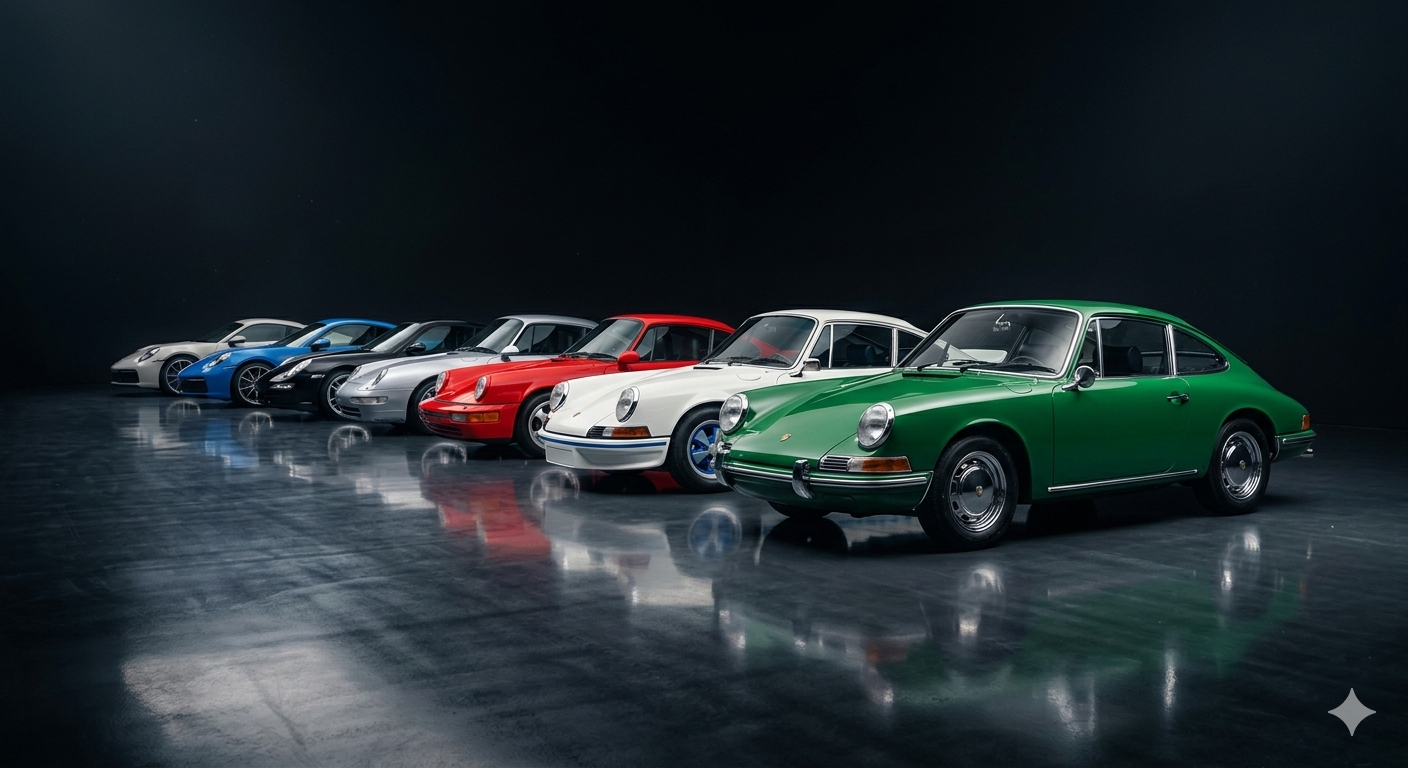
The history of the 911 is essentially the history of Porsche engineering around a fundamental packaging compromise. Each generation represents another chapter in the longest-running engineering correction in automotive history:
The original 911 (1964–1973) established the template. The S variant brought fuel injection and more power. The Targa offered open-air motoring with a distinctive roll bar. And the legendary 2.7 RS — the car that arguably started the collector 911 market — combined a bigger engine with dramatic weight reduction through thinner steel, lighter glass, and the iconic ducktail spoiler. The 2.7 RS might be the most desirable 911 ever built, a homologation special that combined lightness with the bigger engine to create something truly special. It was built to go racing, and it showed. Only 1,580 were produced, and they now trade for well over a million euros.
The G-body/Impact Bumper era (1974–1989) brought regulatory compliance and the car’s most terrifying variant. The impact bumpers were ugly — let’s not pretend otherwise — but they were necessary to meet American crash standards that kept the 911 legal in its most important market. This era gave us the 930 Turbo, the original widowmaker. A turbocharged 911 with lag you could measure with a calendar and enough power to overwhelm the chassis when boost finally arrived. It was spectacular and terrifying in equal measure, and it created a generation of 911 owners who genuinely feared their own cars. The naturally aspirated Carrera 3.2 from this era is arguably the sweet spot of classic 911 ownership — fast enough to be exciting, civilised enough to be usable, and old enough to have genuine mechanical character without the complexity of later cars.
The 964 (1989–1994) was the first major modernisation. Coil springs replaced torsion bars. Power steering arrived. ABS became standard. All-wheel drive appeared as an option. The 964 was 85% new compared to its predecessor, though it looked almost identical — classic Porsche evolution. Purists hated it at the time for being “too soft” and “too electronic.” Now they can’t afford one. The 964 also introduced the Tiptronic automatic gearbox, which the purist community treated as an act of war against driving purity. History has been kinder to the Tiptronic than the forum warriors of the 1990s were.
The 993 (1994–1998) is widely considered the pinnacle of the air-cooled 911 and will get its own article in this series. It represents the moment where every element — design, engineering, performance, build quality — came together in a way that neither the cars before nor the cars after quite managed.
The 996 (1998–2004) went water-cooled and nearly destroyed the brand’s credibility. Shared parts with the Boxster, the infamous IMS bearing, and those fried egg headlights created a perfect storm of disappointed expectations. We’ll cover this separately because it deserves its own reckoning.
The 997 (2004–2012) was the course correction — a return to more traditional 911 styling and a restoration of the quality and exclusivity that the 996 had undermined. The 991 (2012–2019) went turbo across the range, adding forced induction to every variant except the GT3, a decision that divided opinion sharply. The 992 (2019–present) is the current model, a technological tour de force that weighs 1,500+ kg and costs as much as a small apartment in many European cities.
The Case Against Sainthood
Here’s where I’ll earn my hate mail. These are the arguments that the 911 faithful don’t want to hear, and that Porsche’s marketing department would prefer I didn’t make.
The 911 has always been more expensive than it needs to be. Porsche charges a premium that’s based as much on mystique as on engineering. A base 911 Carrera costs roughly the same as an AMG GT or a well-specced Corvette Z06, both of which are arguably more capable cars on any measurable metric. You’re paying for the badge, the heritage, and the parking lot credibility. Porsche knows this, and they lean into it with an options list that can add €50,000+ to the base price for items that should arguably be standard equipment at this price point.
The rear-engine layout is a solved problem, not an advantage. Modern 911s handle brilliantly because Porsche has thrown every electronic system imaginable at taming the physics. Rear-axle steering, active suspension, torque vectoring, stability management — the engineering effort required to make a rear-engined car handle as well as a mid-engined one is enormous. A mid-engined car achieves the same results more naturally and with less complexity. The Cayman has always been whispered about as the “better handling” Porsche, and Porsche has deliberately limited the Cayman’s power output for decades to avoid embarrassing the 911. The 911’s layout is a tradition, not an engineering decision, and defending it requires ignoring the laws of physics.
The 911 identity crisis is real. A base Carrera and a GT3 RS share a name and a silhouette, but they’re fundamentally different cars built for fundamentally different purposes. The Carrera is a comfortable grand tourer. The GT3 RS is a semi-racing car with number plates. The Turbo S is a straight-line missile. The Targa is a boulevard cruiser. At what point does the name become meaningless? When a single model name covers everything from a 385-horsepower touring car to a 525-horsepower track weapon to a 650-horsepower drag racing champion, you have to ask whether the name still signifies anything beyond a silhouette and a price bracket.
Porsche milks the 911 nostalgia mercilessly. Special editions, heritage colours, “sport classic” variants with a surcharge for retro styling — Porsche has turned 911 nostalgia into a business model that would make a luxury fashion house envious. The 911 S/T, a stripped-out special that costs more than a house in most countries, is essentially a marketing exercise in charging people enormous money for less car. And the market rewards them for it every single time, because the 911’s greatest feature isn’t its engine or its chassis — it’s its mythology.
The Case For Greatness
Now, having said all that — and I mean this sincerely — the 911 earned its reputation. Here’s why the counterarguments, while valid, don’t tell the whole story.
No other sports car has maintained this level of excellence for this long. The Ferrari 308 gave way to the 348 disaster. The BMW M3 has had identity crises with every generation since the E46. Corvettes spent decades being the punchline of sports car jokes before the C8 transformed them into genuine world-class machinery. The Aston Martin Vantage has been brilliant, terrible, brilliant again, and mediocre, depending on which decade you’re asking about. The 911 has been consistently excellent since 1964. Not perfect — but excellent. That’s a sixty-year track record that no other sports car can match.
The driving experience of a well-sorted 911 is unlike anything else. The rear-engine weight distribution creates a unique sensation under braking and turn-in that, once you learn to trust it, becomes addictive. It’s not better than mid-engine — it’s different. And that difference is what makes the 911 feel like a 911 and nothing else. Every mid-engine sports car feels broadly similar to every other mid-engine sports car. The 911 feels only like itself. That uniqueness has genuine value.
The practicality argument is real and shouldn’t be dismissed. Those vestigial rear seats and the front boot mean you can actually use a 911 as daily transport. Try doing a weekend away in a mid-engined supercar — it’s an exercise in compromise and frustration. The 911 swallows luggage, carries (small) passengers, and handles the mundane realities of daily driving in a way that pure sports cars simply cannot. It’s the car you can drive to work, take to the track on Saturday, and use for a road trip on Sunday. That versatility is part of why it has endured.
And the build quality has been, with the exception of the early 996 IMS bearing debacle and some bore scoring issues in certain M96/M97 engines, consistently among the best in the industry. A well-maintained 911 will run for hundreds of thousands of kilometres with a reliability that Italian and British sports cars can only dream of. The engineering quality is genuine, even if the price premium is debatable.
The Verdict From Someone Who Wouldn’t Buy One
The 911 is a great car that benefits enormously from being treated as the greatest car. Its reputation amplifies its qualities and masks its compromises. It exists in a feedback loop where legend reinforces perception, which reinforces legend, which reinforces perception — a cycle that has been running for sixty years and shows no signs of stopping.
Would I spend €120,000 on a new Carrera? No. Would I spend €200,000 on an air-cooled 993? Absolutely not. There are too many alternatives that offer equal or greater driving pleasure for less money and less posturing.
But do I respect what the 911 represents — sixty years of continuous improvement on a fundamentally flawed concept, resulting in something genuinely extraordinary? Yes. Completely.
The 911 isn’t the best sports car ever made. But it might be the most important one. And in the automotive world, importance and greatness aren’t always the same thing.
Agree? Disagree? I know exactly which camp the comments section will lean toward. Come at me.
21 thoughts on “PORSCHE 911”