Porsche Mission S: A Supercar Above the 911, No EV Version, and an 18-Cylinder Patent Nobody’s Talking About
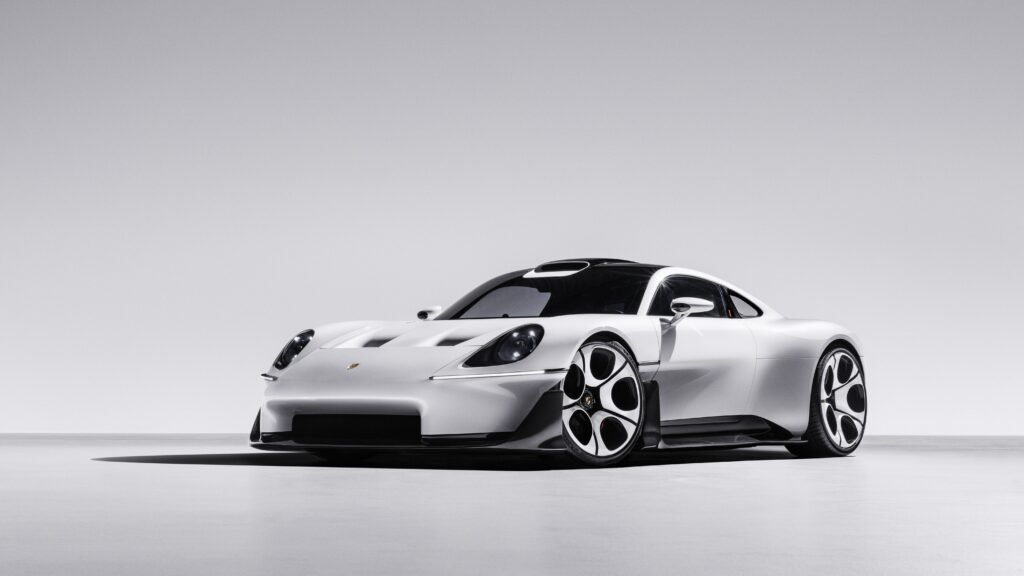
Porsche just took the most important car it has shown in years to New York and refused to say what’s under the engine cover. Horsepower, weight, price, on-sale date: all missing. The one thing CEO Michael Leiters said out loud is that there will be no battery-electric version, because nobody is asking for one. Back in June we dug into a Porsche patent for an 18-cylinder engine. Now Porsche has a car where something that wild could, in theory, find a home.
Back to the Queens pier, with a dealer’s Instagram one step ahead
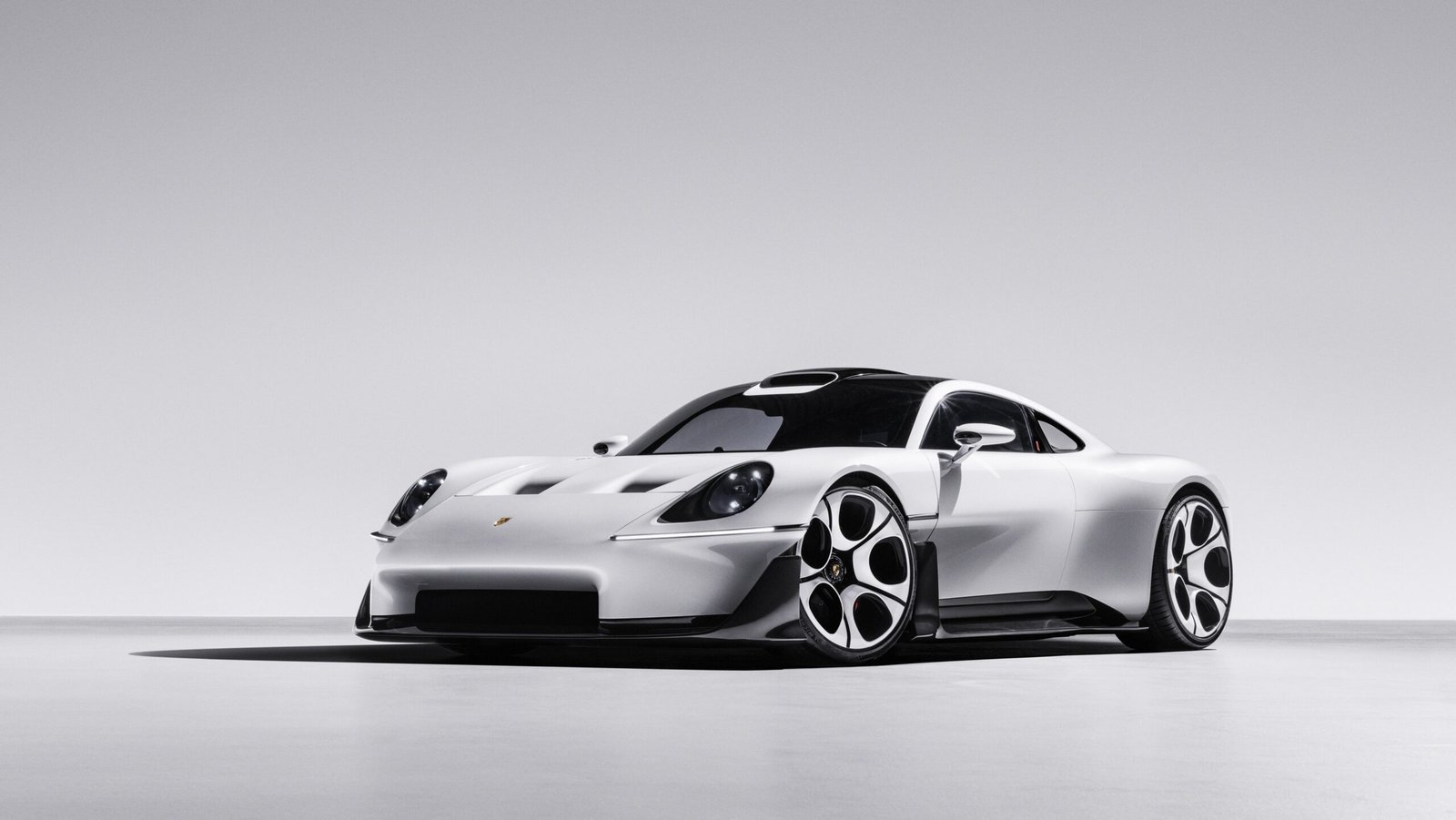
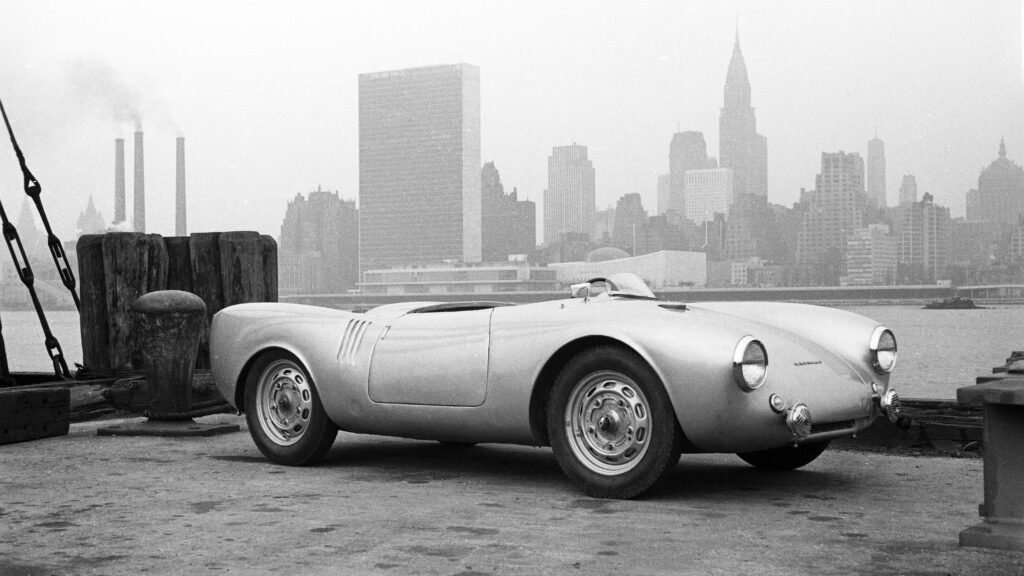
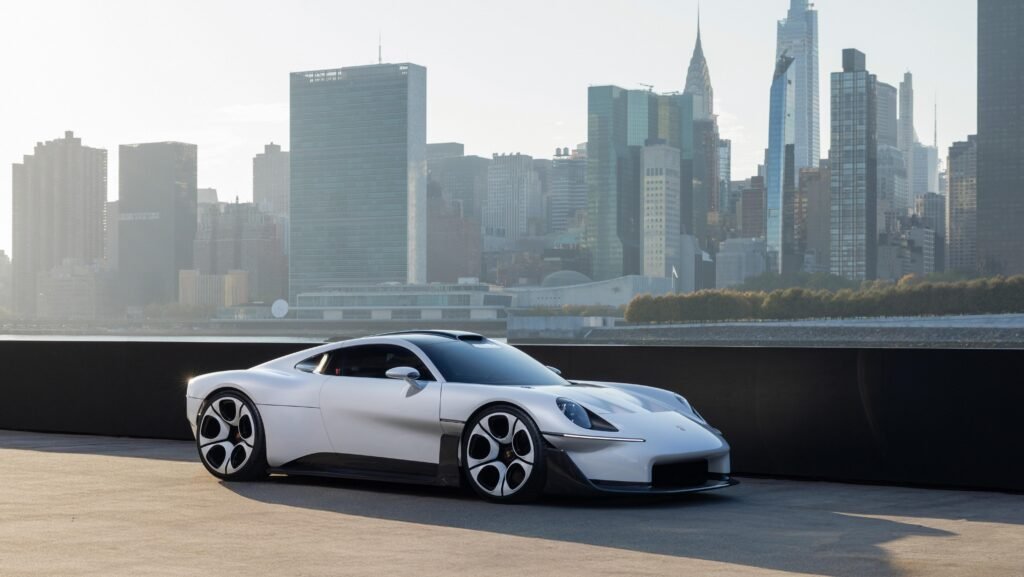
Porsche picked a pier in Queens, with the Manhattan skyline behind it, for the world premiere of the Mission S on October 15, 2026. The location was chosen with care. In 1953, photos of a 550 Spyder shot on that same pier went around the world, and Porsche wanted the new car standing exactly where the old one had stood, seventy-three years later. Both are mid-engine sports cars. The message wrote itself.
New York has always been more than a backdrop for this company. It was the home base of Max Hoffman, the Austrian-born importer who started ordering Porsche 356s in 1950 and became the factory’s unofficial man in America. Hoffman told Stuttgart that Americans wanted a cheaper, stripped-down open car for under $3,000. Porsche built the 356 Speedster and sold it for $2,995. A good chunk of the brand’s American legend grew out of that conversation.
The 2026 script had a hole in it, though. Before the 4:30 p.m. Eastern unveiling, an Instagram account that The Autopian said appeared to be linked to a Porsche dealership had already posted footage of the uncovered car, filmed in a private courtyard from somewhere above the wall. Months of planning, archive photos of the 550, a global livestream, and the first look came from a phone held over a fence.
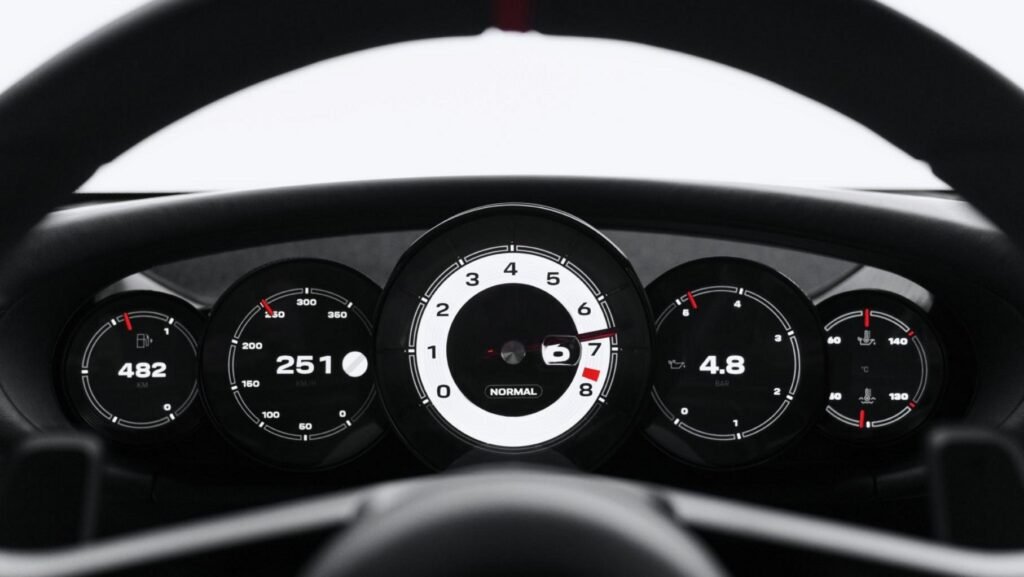
That clip told us more than Porsche’s press release. Italian outlet Motorbox spotted a horizontally mounted cooling fan in the middle of the rear deck, a rear wing that recalls the 959, and two pairs of exhaust outlets. Four tailpipes on a car whose powertrain Porsche won’t name. A few days earlier, a teaser posted on social media had shown the digital tachometer sweeping to an 8,000-rpm redline.
What nobody showed was a spec sheet. No horsepower, no displacement, no curb weight, no performance numbers, no price, no production date. What Porsche did announce matters more than any of those: the Mission S previews a mid-engine supercar platform that sits above the 911. Leiters called it “not a one-off hypercar, but a permanent and versatile addition to our customer offering.” Porsche says it is the first time it will have a supercar on sale on a permanent basis.
Read quickly, that sounds like press-release filler. It’s a big deal. The 959, the Carrera GT and the 918 Spyder were all spectacular, and all of them were limited runs that came, sold out and disappeared. Porsche has never kept a permanent model line parked above its most sacred car.
“There won’t be a BEV on that platform”
Rewind to June 2023. Porsche showed the Mission X, an all-electric hypercar concept, at a time when almost every luxury brand was promising investors that batteries would take over faster than they actually did.
Three years on, the next concept with “Mission” in its name points the other way, and the boss says so himself. “We have the flexibility in that platform to do pure ICE, hybrid and also plug-in hybrid,” Leiters told Auto Express. Then he closed the door: “There won’t be a BEV on that platform: there is no demand.”
That doesn’t mean Porsche is walking away from EVs. It still sells the Taycan and the electric Macan and hasn’t announced plans to stop. What changed is the pace and the scope. A daily-driver buyer may love the silence and instant torque of a Taycan. A buyer writing a check for a mid-engine supercar wants something else: noise, gearshifts, an engine that climbs to its redline, a mechanical relationship that doesn’t come down to a 0–60 mph time. Straight-line acceleration stopped being a gas-engine monopoly years ago, so speed alone can’t be the selling point.
Auto Express also reported that Porsche engineers describe a toolbox of engines for the platform: a four-cylinder, a V6, a V8 and the flat-six. The magazine suggested the flat-six suits the low rear deck best. Keep that list in mind. We’ll come back to what’s missing from it.
Stuttgart’s new math: fewer cars, higher prices, 9,000 fewer jobs
Eight days before the reveal, on October 7, Porsche held its Capital Markets Day at the Weissach development center. For anyone who doesn’t follow the stock market, that’s the meeting where a publicly traded company tells investors what it plans to do with their money. Porsche presented Sportwagenschmiede ’35, its plan through 2035. The name translates roughly as “the sports car forge,” which sounds like hammers and hand-formed aluminum. The slides were about margins.
The targets are blunt. Around 20 percent fewer model variants. Roughly 30 percent more units sold per variant in the medium term. Up to 20 percent lower development costs for future model lines and up to 10 percent lower material costs on new projects. Average prices of its top models up about 20 percent. Revenue from Sonderwunsch, the factory personalization program that lets a customer specify almost anything from a stitching color to a one-off body, up sixfold. And 9,000 jobs cut, with management positions down 40 percent.
Put simply: fewer versions, more shared parts, cheaper development and cars that sell for a lot more money. Porsche wants to get back to an operating margin of 10 to 15 percent in the medium term and to break even below 200,000 cars a year.
There’s nothing scandalous about that. Porsche’s operating profit collapsed in 2025. China stopped absorbing luxury cars the way it used to, the EV ramp didn’t happen on the schedule Porsche had sold to investors, and U.S. tariffs keep squeezing its American business.
That’s the board the Mission S is being placed on. Porsche hasn’t said what it will cost, and any number floating around today is a guess. Its job is clear anyway. It doesn’t need to sell tens of thousands of units. It needs every unit to raise the average value of the top of the lineup, and the platform has to spread its development bill across enough versions and enough model years to pay for itself.
An expensive car isn’t automatically a profitable one. Crash testing, emissions certification, tooling, supplier contracts and a dealer service network cost the same money whatever the buyer ends up paying. That’s why the key word in the presentation was “versatile.” A versatile platform lets Porsche build different products on the same bones and swap powertrains without starting from zero. The risk is obvious: charge one-off money for a car that shares too much with its siblings and the customer notices.
The Ferrari guy is running Porsche now
Michael Leiters has been chairman of Porsche AG’s executive board since January 1, 2026, taking over from Oliver Blume so Blume could focus on running the Volkswagen Group. Before that, Leiters was Ferrari’s chief technology officer and then CEO of McLaren Automotive, and he had already spent years inside Porsche earlier in his career.
He knows better than most that selling expensive cars and building a wildly profitable business around them are two different skills. Ferrari controls supply, manages scarcity and turns personalization and limited series into a core part of the brand. Porsche can’t copy that wholesale. It sells far more cars, and much of its volume comes from SUVs. But it can apply a slice of that logic to the very top of the range, and the Mission S looks built for exactly that.
Leiters told Auto Express the production car will “sit clearly above the 911.” The hard part is giving it a personality. If the only pitch ends up being “very fast and very expensive,” it walks into a showroom fight with Ferrari, Lamborghini and McLaren, which have been selling exactly that for decades.
Chevrolet already showed America what this move means
In July 2019, at a media event in Tustin, California, General Motors did the thing Corvette loyalists had argued about for half a century. It moved the engine behind the driver. The C8 Stingray, sold as a 2020 model, ended seven generations and 67 years of front-engine Corvettes, and it started under $60,000 with a 490-hp, 6.2-liter pushrod V8 sitting right behind the seats.
The logic was physics, not fashion. Put the heaviest part of the car between the driver and the rear axle and the weight sits over the tires that put the power down, so the car launches harder. With the mass gathered near the middle, the car also rotates into a corner more eagerly, the way a figure skater spins faster with her arms pulled in.
The 911 sits at the opposite extreme. Its flat-six hangs behind the rear axle, and lifting off the throttle mid-corner can make that weight push the tail wide. Engineers call it lift-off oversteer, and early 911s were notorious for it. Porsche spent six decades engineering around it with suspension, tires, aero and electronics, to the point where the 911 Turbo S shown at Munich’s IAA show in September 2025 makes 701 hp from a 3.6-liter twin-turbo flat-six with electric turbochargers. It’s the most powerful production 911 ever built.
Here’s the difference with Chevy. GM replaced the front-engine Corvette. Porsche is keeping the 911 exactly where it is and building a new floor on top of it. The last time it went all-in on a mid-engine flagship was the 918 Spyder, built from 2013 to 2015: a 4.6-liter V8 plus two electric motors for a combined 652 kW, a little over 870 hp, in a run of exactly 918 cars. When the last one was built, the line ended. The Mission S is supposed to stay.
Porsche’s W18 patent, explained for anyone who’s looked under a Mustang’s hood
On June 23, Not Enough Cylinders published our investigation into Porsche’s W18 patent, months before the Mission S was public. The document is German patent application DE102024110327A1, filed by Porsche on April 12, 2024, published on October 16, 2025, and credited to inventors Vincenzo Bevilacqua, Thomas Schaal and Norbert Ruider.
Start with something familiar. Open the hood of a Mustang GT and the 5.0-liter V8 shows you two rows of four cylinders leaning away from each other. Each row is called a bank, and each bank has its own cylinder head, the top section where the valves open and close. Both banks drive one crankshaft, the shaft that turns the pistons’ up-and-down motion into rotation. Now picture a third bank standing up in the middle, fanned out between the other two, all three turning that same crankshaft. That’s a W engine.
Porsche’s reference design is a W18: three banks of six cylinders, spaced 60 degrees apart. The filing allows other cylinder counts, but every detail in the drawings is worked out for eighteen.
What makes it Porsche’s own idea is the plumbing. Its current twin-turbo V8s, like the 4.0-liter in the Cayenne Turbo, use what engineers call a hot-vee: the turbos sit inside the V between the banks, where exhaust gas reaches them fast. The W18 patent goes the other way. Air comes in from the top of each bank, on the side facing away from the crankshaft, out of a plenum (a shared air box) with short, almost straight ports into each cylinder. Exhaust leaves from the outer sides of each head. Cool air on top, hot gas on the flanks, never crossing. Each bank’s pipes then merge into an exhaust system with its own emissions hardware, and the preferred layout gives each bank its own turbocharger. Three turbos, one per row.
Volkswagen’s 1998 W18 and the Bugatti nobody could buy
Before anyone pictures an 18-cylinder Porsche, remember that the Volkswagen Group, Porsche’s parent, has done this before. At the 1998 Paris Motor Show, freshly VW-owned Bugatti showed the EB 118, a coupe designed by Giorgetto Giugiaro at Italdesign and powered by a Volkswagen-developed 6.25-liter W18: three banks of six cylinders at 60 degrees, the same geometry in Porsche’s patent. It made 555 hp (414 kW), sat up front and drove all four wheels.
That engine got around. It went into the EB 218 sedan shown at Geneva and Tokyo in 1999, and into the 18/3 Chiron concept the same year, which was built on the mid-engine bones of a Lamborghini Diablo VT and rated at 547 bhp. None of them went into production. When VW finally built a road-going Bugatti, it took a different route: the 8.0-liter W16 in the Veyron.
The precedent cuts both ways. It proves the group knows how to make a W18 run. It also proves that having the engine doesn’t mean having a car. What separates Porsche’s 2024 idea from that late-’90s W18 is the detail of how it breathes and sheds heat, which is exactly what the patent protects.
Squeezing three banks into a supercar
The 18/3 Chiron tells you something useful: a W18 can physically go in the middle of a supercar, because Volkswagen did it in 1999 using a Lamborghini Diablo VT as the base. A W wins on length. Eighteen cylinders in three rows of six make a far shorter block than a V-shaped engine would need in two rows of nine, and in a mid-engine car every inch of engine and transmission length gets taken from the wheelbase or the cabin.
What that concept never had to do is pass crash tests, meet modern emissions rules, survive summer traffic in Phoenix or carry turbochargers. It made 547 bhp without any boost. A production Porsche W18 built to the patent would carry three turbos, three cylinder heads with their camshafts, intake and exhaust plumbing on every side, and the heat all of that produces. A W is short but wide and tall, and engineers call the job of fitting all of it around the crash structure, suspension and aero tunnels “packaging.” Think of it as loading a moving truck where half the boxes are hot enough to melt the other half. Add a hybrid system and the truck also needs room for electric motors, a battery pack, inverters, orange high-voltage cables and their own cooling loops.
Nobody outside Porsche knows the Mission S platform’s dimensions, structural limits or weight target. Anyone telling you a W18 fits is guessing.
The bigger question is why Porsche would bother. Power isn’t the reason. Six cylinders with electric help already give the 911 Turbo S 701 hp, and the 918 cleared 870 hp more than a decade ago. A W18 would only make sense as rarity you can hear, the engine for a version no other car on the road can match. That market exists. Bugatti has been proving it with its W16 since the Veyron. A market isn’t a business case, though. A W18 might be too heavy, too complex, too expensive to certify, or simply pointless next to a hybrid V8. And Porsche may have patented the idea purely to own it. Patents protect options; they don’t announce cars.
Ford and Chevy already wrote the playbook, and the W18 isn’t in chapter one
Two American cars explain where an exotic Porsche engine could and couldn’t fit.
When Ford built its 2017 GT, a halo car with one job, beating the world’s supercars, it didn’t reach for twelve cylinders. It used a 3.5-liter twin-turbo EcoBoost V6, developed through its Daytona Prototype race program in IMSA, rated at 647 hp. The halo was the car, not the cylinder count.
Chevrolet showed the second half of the playbook. It launched the C8 with a familiar pushrod V8 and only later added the Z06, with a high-revving 5.5-liter flat-plane-crank V8 making 670 hp on the same basic architecture. Launch with what you know, then go exotic once the platform is paid for.
Now look at what Porsche engineers told Auto Express they have for the Mission S platform: a four-cylinder, a V6, a V8 and the flat-six. No W18. That’s the strongest fact against our hypothesis, and we’re not burying it.
It doesn’t kill the idea. It moves it down the timeline. A W18 makes no sense in the first Mission S or in the regular lineup. It could make sense years later, Z06-style, as the extreme version on a platform that has already earned its money. The EB 118’s W18 needed a whole new car built around it, and that car never happened. On a permanent platform, the engine only has to prove it fits and that buyers will pay for it.
That’s our thesis, labeled as one. We have no internal Porsche documents, no packaging drawings and no engineer on record linking the platform to a W18. The rear-deck fan doesn’t change that. Motorbox compared it to a scaled-down version of the cooling fans on the Le Mans-winning Porsche 917, but a design nod says nothing about what’s under it. We’ll keep watching Porsche’s patent filings. We were on this trail before the Mission S existed in public.
Five gauges, real switches, and a phone mount that assumes you own an iPhone
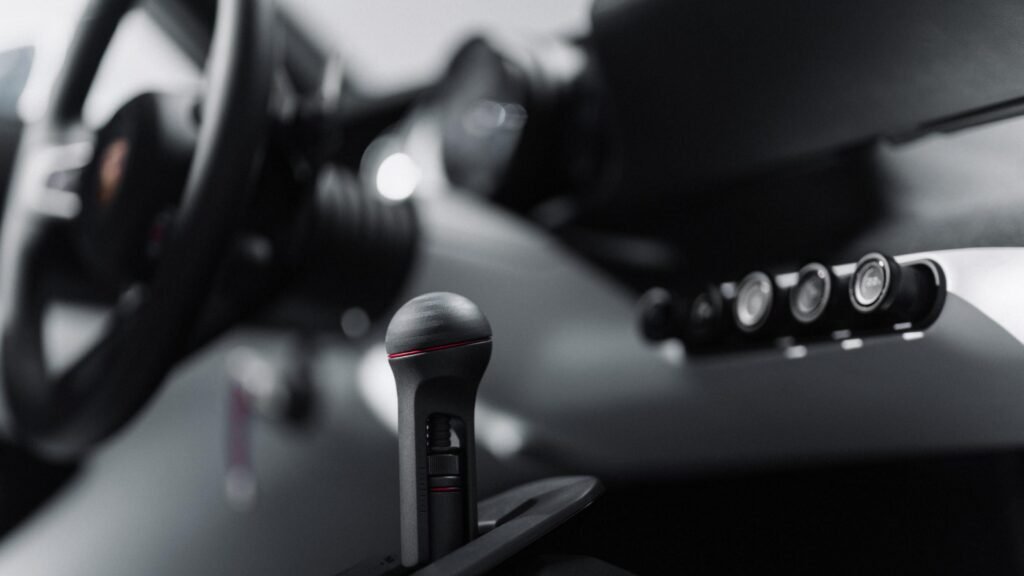
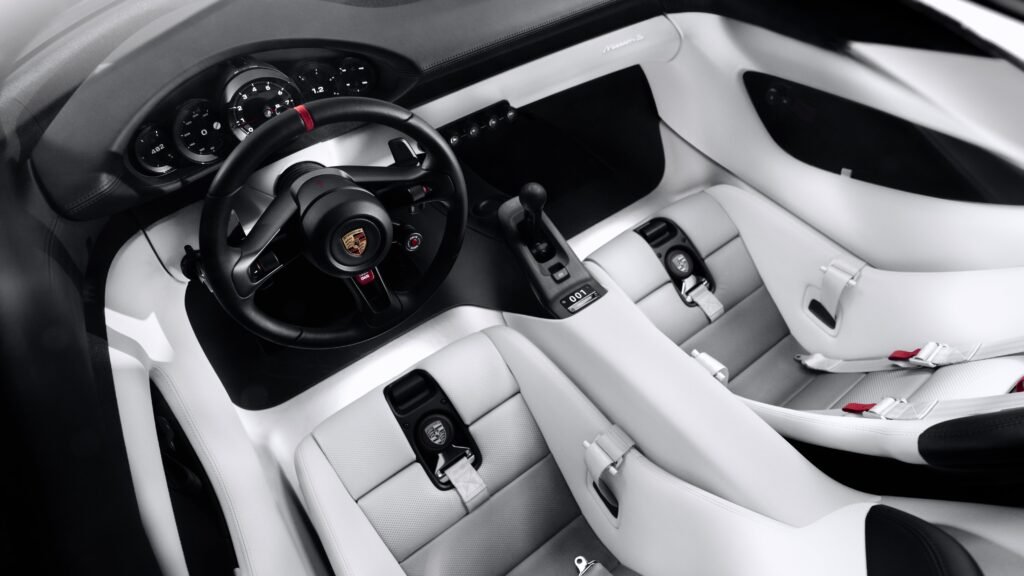
Inside, Porsche went backward on purpose. Five round gauges sit behind the wheel, with the tach in the middle and a physical needle in front of a display. There are real switches and buttons, push-pull controls on the dash and the key holder left of the steering wheel, a Porsche habit that goes back to Le Mans starts. The permanently mounted center screen is gone. In its place is a retractable holder that turns the driver’s phone into the navigation and information display, and the My Porsche app lets owners choose gauge graphics inspired by older Porsches.
The holder is MagSafe-compatible, and MagSafe is Apple’s magnetic system. Android owners will need a phone or case with magnets to play along. That’s a strange bet in a car meant to stay in the lineup for years, because it ties a core function to hardware Porsche doesn’t make and software it doesn’t write. Phones get replaced every few years; a Porsche supercar is expected to work for decades.
The switches are the easy win. A button you find by feel keeps your eyes up at 100 mph in a way no touchscreen ever will, and after a decade in which carmakers treated screen size as a horsepower figure, Porsche is now selling the absence of a screen as an upgrade. Somewhere a product planner is pricing physical climate controls as an option. The phone mount is the part we’ll judge in the production car.
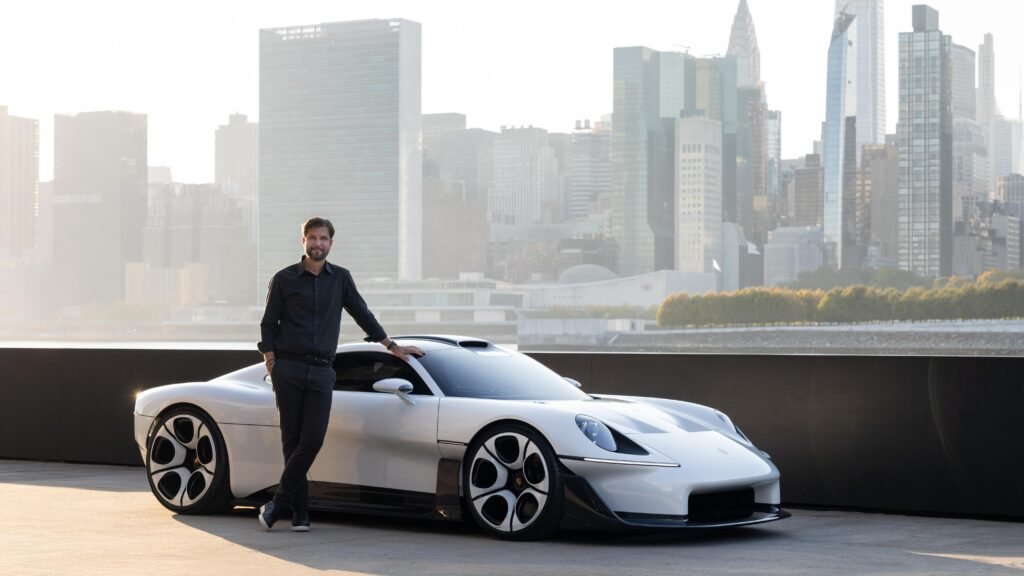
The GT3 RS is about to get an upstairs neighbor
Porsche has to handle the 911 carefully. A GT3 RS or a 701-hp Turbo S already sits very high in the market, and the new family has to be clearly separated so the two don’t fight over the same buyer. With the plan calling for top-model prices to rise about 20 percent, the Mission S will almost certainly cost more, and more power alone won’t justify that. Make it feel too much like a 911 and buyers will wonder why they’re paying extra. Make it too different and it has to prove, in Leiters’ own words, that it’s recognizable as a Porsche at first glance.
Porsche hasn’t said when the production car arrives. Auto Express reported the company wants to cut development time to 30 months and expects the car before the end of the decade. When the spec sheet finally shows up, the first line we’ll read is the engine.
Check you’re still alive.
Photos 1-6: Porsche AG. Photo 7: Bill Abbott, CC BY 4.0