Porsche W18: the engine patented amid an electric crisis
Let’s do an exercise together. Picture the following situation.
You’re a Porsche AG executive in October 2025. Your group’s full-year operating profit has just collapsed 93%, from €5.640 billion to €413 million (or 98% if you include the €4.7 billion writedowns from abandoning parts of the EV roadmap, dropping net operating profit to just €90 million). Your Taycan — the electric car that was meant to share the league of the 911 — has strung together four consecutive years of decline from its 41,296-unit peak in 2021, through 34,801 in 2022, down to 16,339 in 2025. Your shares trade 45% below the 2022 IPO price. You have to push through 1,900 job cuts. Your CEO Oliver Blume is leaving. The brand that the entire premium industry used as a mirror is going through what its own executives call “the worst financial crisis since the Volkswagen merger”.
And at that exact moment, in October 2025, your engineers in Zuffenhausen file with the German patent office a combustion engine with eighteen cylinders.
Yes. Eighteen.
Here’s what happened. NEC has to walk you through it, because almost no one is telling it properly.
The patent, layer by layer
To the verified facts, no padding.
On 5 April 2024, Porsche AG files with the German Patent and Trade Mark Office (DPMA) a patent application for an internal combustion engine they label, literally, “space-optimised combustion engine”. The WIPO registration number is DE465751793. The patent remained under review for eighteen months. It became publicly available in October 2025, right in the middle of the worst financial quarter Porsche has had in modern times. A nuance is essential here so we don’t fall into a trap reading: the publication calendar of a German patent is bureaucratic, not strategic. Porsche did not choose to publish the patent in October 2025; DPMA patents become public automatically 18 months after filing. What Porsche did consciously choose was to file the patent in April 2024, when it already saw the first signs of Taycan deterioration and growing European regulatory pressure. The strategic choice is in the filing date, not in the publication date.
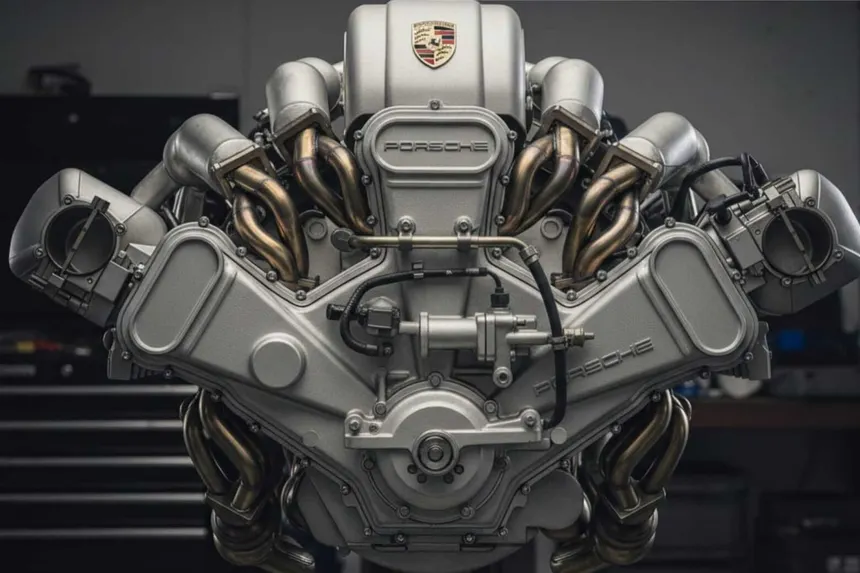
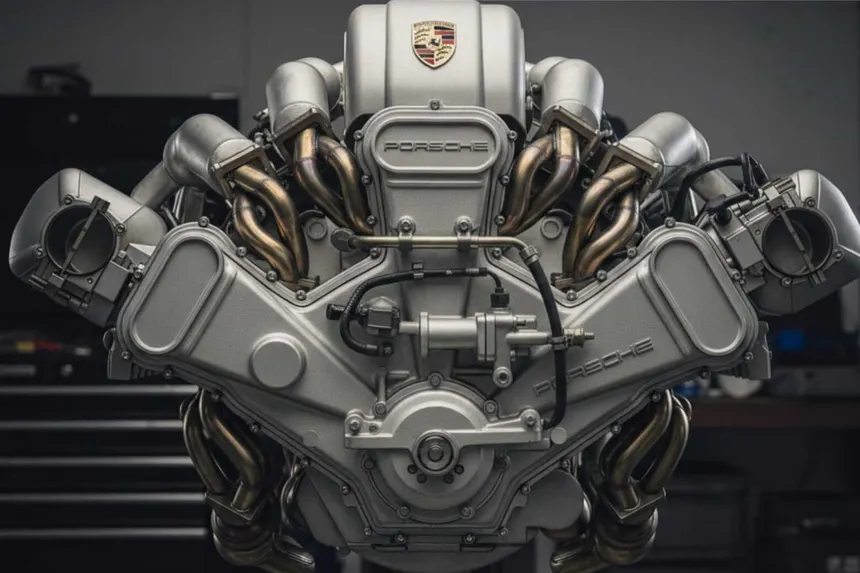
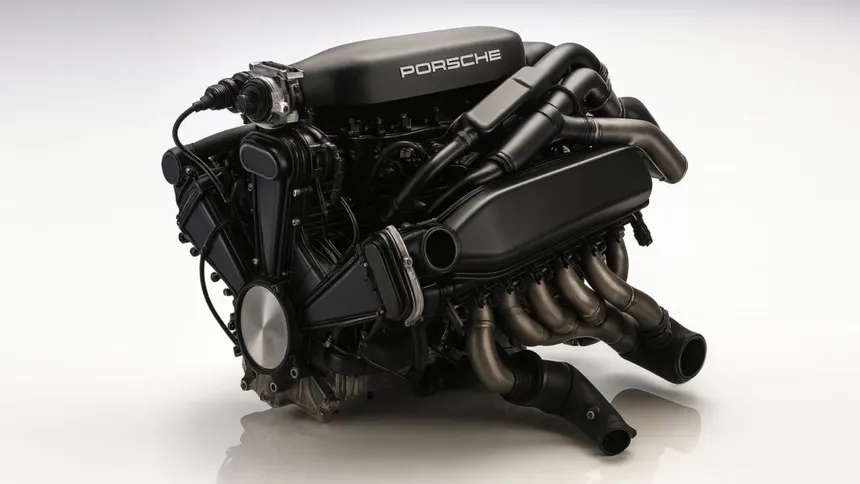
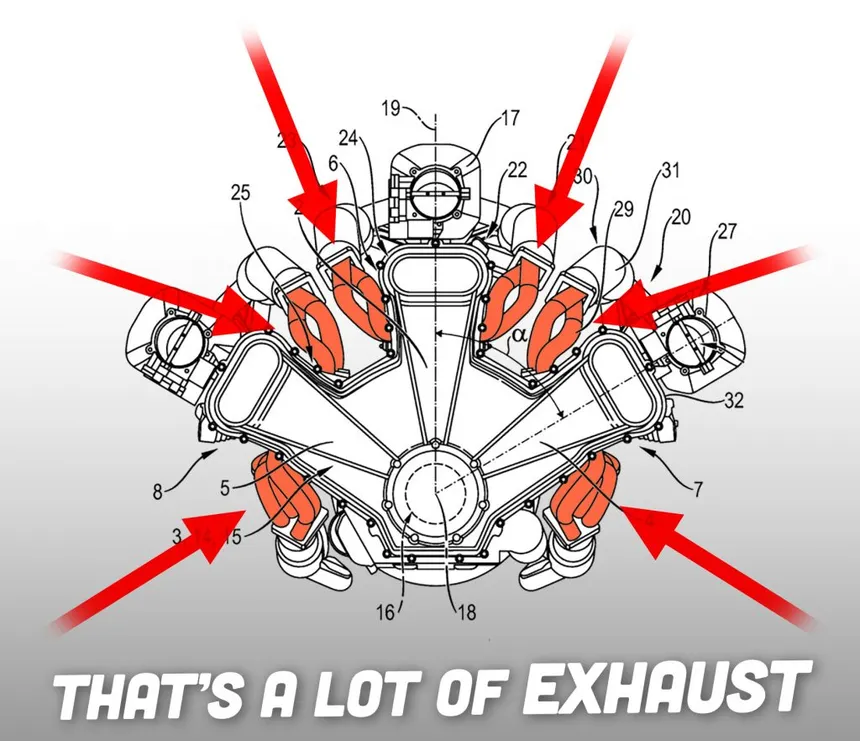
Now the engine itself. Three banks of six cylinders each, converging on a single crankshaft, with 60 degrees between each bank. Total: eighteen cylinders. Each bank has its own cylinder head, its own valves and, importantly, explicit technical provision for one turbocharger per bank, producing a triple-turbo W18.
A nuance is worth flagging here because it’ll come up in public debate and NEC needs to draw the line cleanly. What Porsche is patenting is not what Bugatti once called a W16 in the Chiron. That Chiron engine was actually two narrow V banks bolted together, sharing a single crankshaft. A geometric trick the purists called a “false W”. What Porsche is patenting is a real W: three actual cylinder banks, three separate cylinder heads, a genuinely W-shaped geometry. The difference is industrial, not aesthetic. It allows Porsche to cool the intake better, manage the exhaust better and build a significantly shorter engine block than a conventional W12 or V16.
How many cylinders is it designed for? The patent explicitly states the architecture is scalable: 9 cylinders (three banks of 3), 12 cylinders (three banks of 4), 15 cylinders (three banks of 5) or 18 cylinders (three banks of 6). Porsche isn’t patenting a single engine. They’re patenting a complete industrial family built on the same base architecture. In corporate language, that’s locking down a strategic industrial asset for twenty years.
And one detail worth highlighting. In the patent drawing, the intake manifolds sit directly above each bank, with short straight runners. That’s maximum volumetric efficiency. The exhaust manifolds run between and beneath the banks, keeping the intake air away from exhaust heat. Every geometric decision is aimed at maximising breathing and power density. This is high-end engineering.
What was happening around the patent
And now the context, which is where the real news lives.
The patent became public on 22 October 2025. Here’s what was happening at Porsche AG in that same month.
On 24 July 2025, Porsche had published its first-half results. Group operating profit: €1.010 billion, a 67% drop from €3.060 billion the previous year. Operating margin: 5.5% versus 15.7% the year before. Global sales down 6.7%. And, above all, Porsche announced 1,900 job cuts before 2029.
By the end of October, management publicly acknowledged what they called “the worst quarter since the IPO”. Operating profit through the first three quarters: 40 million euros. That’s the final figure, not a typo. Forty million, against 403 million for the same period a year earlier. A 99% drop.
In August, Oliver Blume had announced his departure as CEO of Porsche AG. On 24 October 2025, the Supervisory Board appointed Michael Leiters as new CEO, effective 1 January 2026. Leiters is not just any name. He’s the former CTO of Ferrari for more than eight years. Former CEO of McLaren Automotive since 2022. And thirteen previous years at Porsche, with responsibility over Macan and Cayenne.
Read it again: the new CEO of Porsche comes from Ferrari and McLaren. Two brands whose product identity has been historically built on the combustion engine. The world’s most V12-obsessed and flat-six-obsessed company has just hired the man who shepherded Maranello’s V12 into production for a decade.
And at that exact moment, the W18 patent enters the public domain.
What this means in industrial language
Here’s where NEC has to put a finger where nobody else is putting it. I’ll say it plainly, with the discipline of not signing prophecies.
Patenting an engine isn’t building one. That needs saying upfront. Industrial patents are strategic weapons with a twenty-year shelf life. Any serious manufacturer patents things constantly, many of which never reach production. But patents cost money, engineering resources and organisational energy. When a company in deep crisis dedicates the hours of its best technical talent to developing a patent of this complexity, it’s sending a message to its competitors, its shareholders and its own employees.
The message is threefold.
One: the electric transition isn’t going as promised. Porsche has just written down €4.7 billion from abandoning parts of its EV roadmap. The electric Cayenne is delayed. The new luxury SUV, originally meant to be pure electric, will now launch as a hybrid. The Taycan itself, Porsche’s first premium electric car, has gone from 41,296 units sold in 2021 to 16,339 in 2025. That decline is not cyclical, it’s structural. The premium customer is not buying electric at the pace European regulation promised.
Two: combustion won’t die in the premium segment. The customer who pays €200,000 for a Porsche doesn’t want the same thing as the one paying €25,000 for a Renault. The premium customer is buying emotional differentiation. And combustion, particularly exotic combustion, carries an emotional component that the electric engine has not managed to replicate in fifteen years of trying. Porsche knows it. Ferrari knows it. McLaren knows it. That’s why Porsche’s new CEO comes from Ferrari and McLaren.
Three: the W18 is a declaration of intent, not a product announcement. Porsche isn’t saying “we’re going to build a W18”. Porsche is saying “if regulation allows, we could build a W18, and we want the patent locked down so nobody else does it first“. In industrial language, that’s worth more than any product announcement. It’s a future insurance policy. A twenty-year option, paid in advance.
A bit of historical memory helps understand what this really means. Dormant industrial patents are one of the oldest strategic tools in heavy engineering. Toyota filed hybrid technology patents in the 1970s that didn’t reach actual production until the 1997 Prius. Mercedes filed active suspension patents in the 1980s that didn’t enter commercial production until Magic Body Control almost three decades later. Patents aren’t products, they’re reserved ground. When a brand like Porsche reserves technical ground during the worst year of its history, it isn’t because it has no other priorities. It’s exactly the opposite. It means the leadership has decided that this technical ground is valuable enough to protect in the middle of the fire.
There’s a second point worth making for the analytical reader. Patents like this are also a recruiting and retention tool. The best combustion engine designers on the planet — the people who can actually build a W18 — are a tiny global community. They don’t move to companies that have stopped investing in combustion engineering. By filing patents like the W18, Porsche is sending an internal and external message: we are still hiring, retaining and rewarding talent that knows how to design extreme combustion engines. That alone makes the patent worth what it cost.
The link to the NEC combustion hub
If you’ve read the six pillars of the NEC combustion hub and the two independent Engine Syndicate pieces (BMW M Ignite, Honda/Ferrari oval pistons) and the Achates Power piece, this W18 closes a very clear pattern. Let me lay it out. Mazda keeps 36 engineers in Hiroshima developing the Wankel rotary and a new Lambda 1 combustion engine for the 2027 CX-5. Pure industrial romanticism, against all economic logic.
BMW M patents a combustion pre-chamber in 2024 and drops it into production in the M3 and M4 from July 2026. Pragmatic German engineering to dodge Euro 7 without losing power.
Ferrari patents in March 2025 a V12 with stadium-shaped pistons, rescuing a 1979 Honda idea. Possibly returning the central V12 to Maranello.
And now Porsche patents a scalable triple-turbo W18 in October 2025. Same gesture. Same timing. Same industrial reading.
Four premium manufacturers, four different countries (Japan, Germany, Italy, Germany), four radically different architectures (rotary, pre-chamber, oval pistons, W18), all doing exactly the same thing: patenting radical combustion technology at the exact moment when European regulation declares the combustion engine is about to disappear.
And, as we covered in the sixth pillar of the hub, the suppliers that hold up this whole industry — Bosch, MAHLE and AVL — are pouring billions into keeping combustion alive for the rest of the world. The European combustion industry isn’t silent. It’s working double shifts.
The hard question
Porsche is going through the worst financial year of its modern history. It has to lay off 1,900 people. It has to rewrite its electric roadmap from scratch. It has an incoming CEO who comes from the last company still mass-producing V12 engines. And, despite all of that, its best engineers have devoted hours, resources and money to patenting a W18.
Why?
Because they know something European regulation hasn’t been willing to acknowledge yet. They know the electric transition at the promised pace isn’t going to happen. They know that by 2035, when the sale of new combustion-engined cars is supposedly banned in Europe, that date will probably move. They know that meanwhile, the Chinese market, the American market, the Middle Eastern market and the emerging-market customer will keep buying combustion. And they know that when that moment arrives, the player with the patent and the industrial machinery ready wins. Porsche is preparing to win.
The W18 isn’t an academic exercise. It’s a strategic industrial option. It’s worth twenty years of legal protection. And it’s signed exactly when operating profits collapse 93% (98% if you count the writedowns), which means that for Porsche, this patent is worth more than any optimistic press release they could have issued instead.
Petrolheads get goosebumps imagining a triple-turbo W18 howling around the Nürburgring. Serious industrial analysts get goosebumps thinking about what that patent says about Porsche’s internal confidence in the future of the combustion engine.
Both can be true at once. And that’s why this story had to enter NEC.
Check you’re still alive.