Alfa Romeo Tipo 33: the race car America named, and the world title an aperitif paid for
A two-liter Italian sports racer has no business being named after Daytona. The Alfa Romeo Tipo 33/2 is anyway, because in February 1968 three of them came home fifth, sixth and seventh overall in the 24 Hours, right behind the factory Porsche 907s, and Udo Schütz and Nino Vaccarella took the two-liter class. A car that had spent its first year breaking walked out of Florida with a nickname, and the nickname stuck.
Alfa needed the good news. The first world title was still seven years away, and it would cost two drivers, a Targa Florio lost by 16.8 seconds and a rescue by a company that makes red liquor.
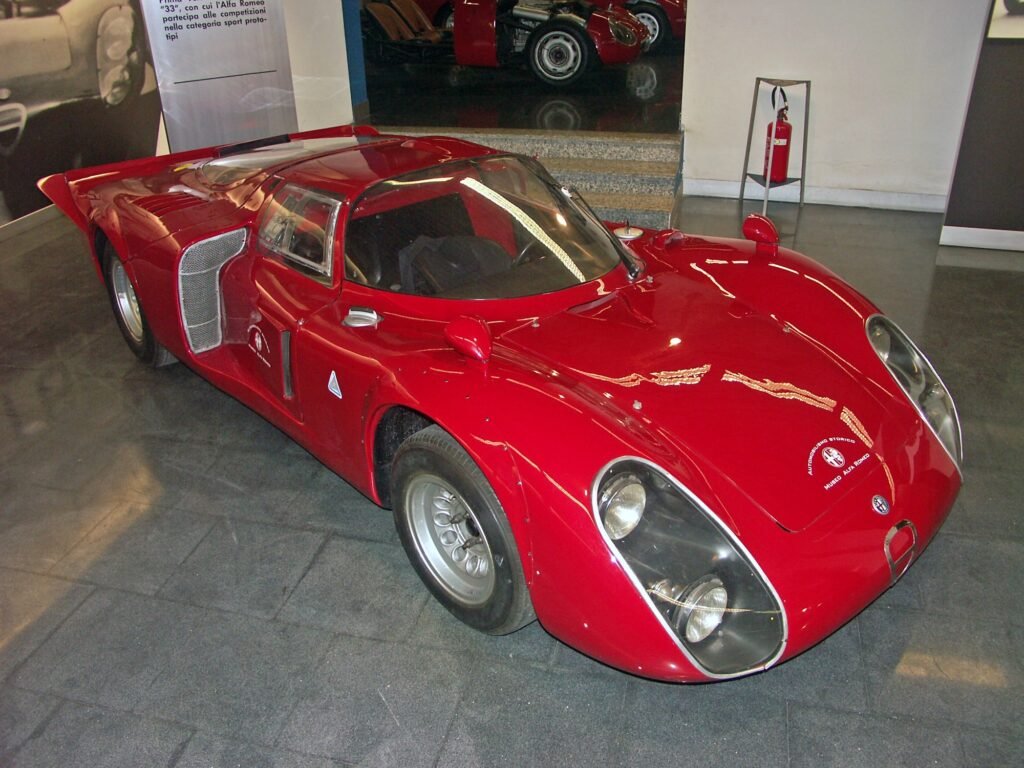
If you know the 33 Stradale, that’s the road-going cousin, and so is the 33/2 Coupé Speciale. This is the one that raced.
Two liters and a periscope
Start with the 1967 car, because it explains why Daytona felt like a miracle. Carlo Chiti, the engineer behind the Ferrari 156 that made Phil Hill America’s first world champion in 1961, was running Alfa’s competition shop, Autodelta, out of Settimo Milanese. Alfa hadn’t fielded a factory team at the top level since it walked away from Formula 1 as champion in 1951, and it wanted back in with a pure prototype.
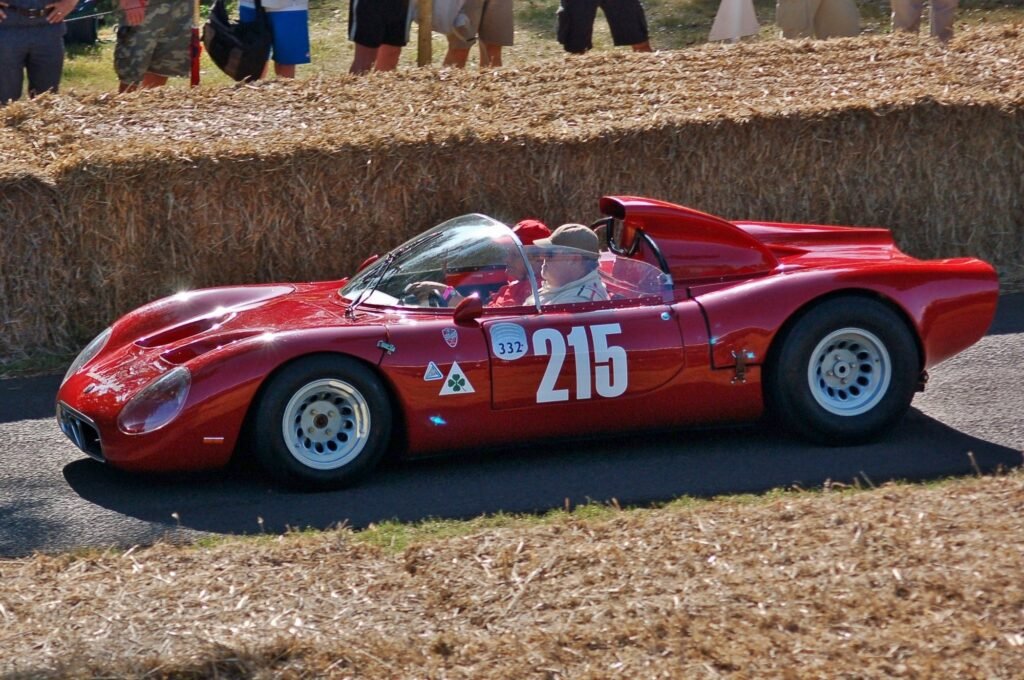
What Chiti built looked strange even for the sixties. The frame was a set of fat tubes joined in the shape of an H, with magnesium cross-members at the ends. Early cars ran an engine borrowed from the TZ2, and then came a 1,995cc V8 at 90 degrees: 122 cubic inches, 270 horsepower, 9,600 rpm. A tall scoop poked up behind the driver’s head to feed it, so everyone called the car the Periscopica.
Its debut was perfect and meaningless. Teodoro Zeccoli, the company test driver, won the Fléron hill climb in Belgium on March 12, 1967. Then the car came to America and fell over. Three were entered at Sebring, two showed up, and both retired. At the Targa Florio two broke their front suspension. A Swiss hill climb at Ollon-Villars disqualified it for being too heavy. Fifth at the Nürburgring (one source says fourth) produced the only two points of the season, good for seventh and last in the championship. In practice for the Paris 1000 km, Jean Rolland left the road in a Tipo 33 and died.
Customers, from California to Madrid
Autodelta’s answer for 1968 was a new body, a 2.5-liter option with 315 horsepower, and an obsession with getting to the end. Daytona came first and did the naming. After that came second overall at the Targa Florio for Ignazio Giunti and Nanni Galli, an outright win at Mugello in July with Lucien Bianchi in the crew, and fourth, fifth and sixth at Le Mans, which France had pushed to September because of the May riots. Alfa finished third in the makes championship with an engine a third the size of the big stuff.
American customers noticed. Racing Sports Cars has Scooter Patrick winning SCCA Nationals at Holtville and Phoenix in the spring of 1969 in a 33/2 entered by Otto Zipper. Belgians bought them too. Racing Team VDS won at Zandvoort and Koksijde, and on March 2, 1969, its driver Teddy Pilette won at Jarama outside Madrid, a race nobody seems able to name today. We looked. The result is on the books with a date and a grid time and no title.
183 cubic inches against the world
The FIA had handed Alfa an opening. To stop the Ford and Ferrari arms race it capped prototypes at three liters from 1968, and Chiti’s V8 had thick cylinder walls and room to grow. Autodelta took it to 2,998cc with Lucas injection. Call it 183 cubic inches making 400 horsepower at 9,000 rpm, and 440 by the time development was done. For scale, the 1969 Camaro Z/28’s 302 was rated at 290 horsepower. The H-frame couldn’t take the load, so it gave way to an aluminum monocoque, where the outer skin carries the stress the way an airliner’s fuselage does. A tamed version of that V8 ended up in the Alfa Romeo Montreal.
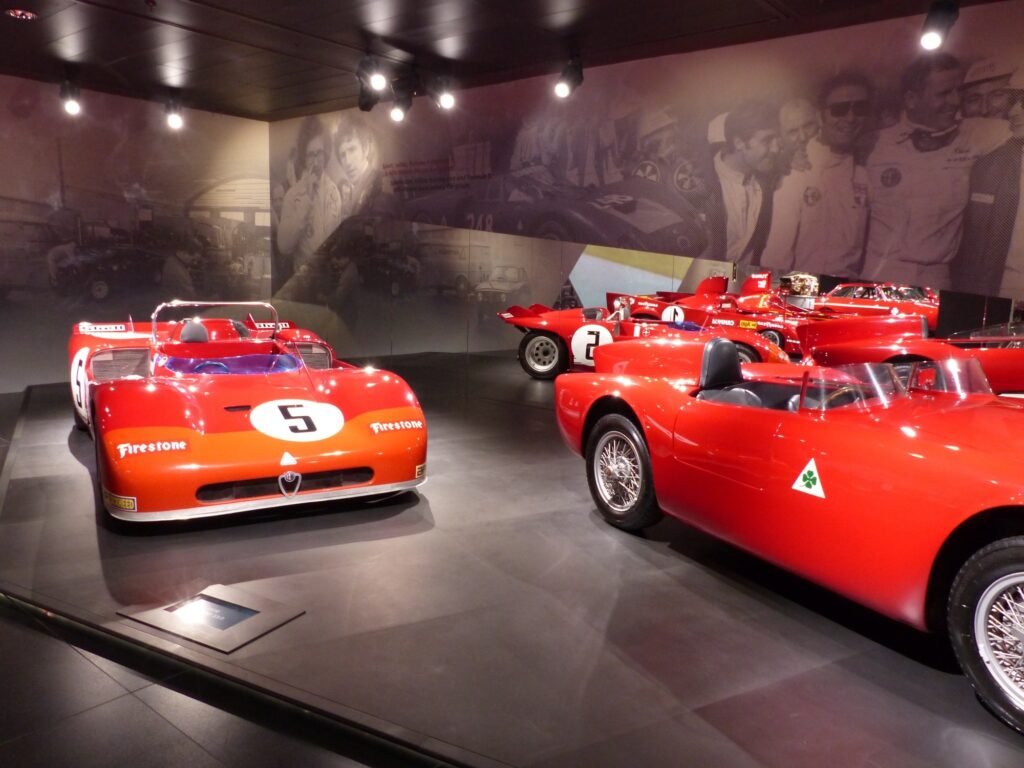
The problem was that the rules had a hole in them. Porsche found it with the 917 and Ferrari followed with the 512, both five-liter cars built under the sports car limit. So in 1970 the Tipo 33 went to Sebring giving away two liters. Toine Hezemans and the American Masten Gregory finished third anyway, one lap down, in the race everyone remembers for something else. Peter Revson and Steve McQueen, who had a foot in a cast, were out front in a Porsche 908/02 until Mario Andretti ran them down in a Ferrari on the last lap. Alfa was the car right behind that movie. Later an actual movie got involved: a 33/3 shows up in McQueen’s Le Mans.
The real Le Mans that June was grim. One Alfa was disqualified after 220 laps for jumping the start, another lost a piston to a stone after five laps, a third went off on lap 43. Piers Courage and Andrea de Adamich ran second before the alternator quit on lap 222. A week later Courage was dead at Zandvoort, in Frank Williams’s De Tomaso.
A hood latch at Le Mans
The death that changed Autodelta came a year earlier. Lucien Bianchi had won the 1968 24 Hours with Pedro Rodríguez, and he joined Alfa’s three-liter effort for 1969. At the Le Mans test at the end of March his 33/3’s front bodywork flew open at speed. The crew reworked the fasteners and sent him back out, and they failed again. He had to slow, lost the car and hit a pole, and it burned. Bianchi was 34. Alfa withdrew its three-liter cars and stayed away from the race.
Robert Little, an American who worked for Chiti and later built the best English-language archive on Autodelta, says it pushed Chiti toward safety. Early in 1970 he and an engineer named Garbarino came up with a foam-filled cellular fuel tank that wouldn’t dump its load in a crash. Chiti offered it to rivals and asked for it to be made mandatory. Nobody took him up on it.
The name came back to racing in the worst way 45 years later. Lucien’s great-nephew Jules Bianchi was fatally injured at Suzuka in 2014, one of the crashes behind the F1 halo.
Drizzle in Kent, a cloudburst in New York
The win that finally counted came on April 4, 1971, at Brands Hatch: De Adamich and Henri Pescarolo in the 33/3, three laps clear after 1,000 kilometers. It was Alfa’s first world championship race win in 20 years. One French history gives it to Rolf Stommelen and Hezemans, which is wrong, though you can see how it happened. Motor Sport’s report has their sister car leading until a suspected piston failure around lap 183.
Nobody should mistake it for speed. It was a freezing morning with hard drizzle and a track that was dry by about lap 150. Faster cars just kept finding ways out: a fuel blockage for Rodríguez’s 917, a loose wheel for Jo Siffert, a pit fire for the Elford and Redman car with Redman stuck in his belts. Finishing sixth in a privately run 917 was a German named Willi Kauhsen, a detail worth remembering. De Adamich’s own view was simple. Fast and dry, you can’t touch a 917. Slow and wet, you can.
Then came America’s turn. At the Watkins Glen 6 Hours in July, De Adamich and a young Ronnie Peterson started on intermediate Firestones and held off changing until the skies opened. They covered 279 laps, two up on the Gulf 917 of Siffert and Gijs van Lennep, on the weekend the Can-Am came to town, in a three-liter car. Vaccarella and Hezemans had already won the Targa Florio. Alfa finished the year second to Porsche.
Tilted at the gas pump
Alfa came to Sicily in May 1972 with a new car, the 33 TT 3, back on a tubular frame (telaio tubolare) with a compact five-speed that pulled weight toward the middle. Don’t ask about the wheelbase, because one published history says it shrank about five inches and another says it grew about eight.
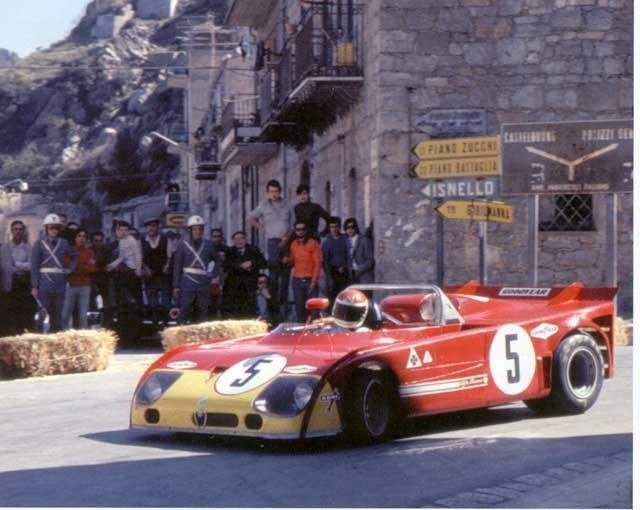
Ferrari won ten of the eleven championship rounds in 1972 with the 312 PB from Mauro Forghieri and skipped the other one. It brought a single car to the Targa, for Arturo Merzario and a rally driver, Sandro Munari. Merzario’s version of the pre-race talk is a classic: “I’m here to win, trouble for you if you break my car, go slow and don’t do any nonsense!”
Alfa had four cars and it should have been enough. Vic Elford’s popped an oil filter on the opening lap. Stommelen’s V8 went on lap three. That left the De Adamich and Hezemans car and the quick one, shared by Galli and Helmut Marko. Marko got past Munari, and then it fell apart in the pits: 40 seconds for Alfa’s driver change, 24 for Ferrari’s. On lap eight Galli ran dry near Campofelice. Michelangelo Teresi, a witness whose account Little published, says the car had been refueled tilted over and the tank never filled.
Marko took over more than two minutes down on a 44-mile lap of mountain road. The gap went to 32 seconds, 20, 18. He set the fastest lap of the race, 33 minutes 41 seconds, and lost by 16.8. Six weeks later at the French Grand Prix a stone took the sight in one eye, and his driving career was over.
Andretti at Monza, Campari on the nose
The flat-12 that Chiti had been promising arrived in 1973 in the 33 TT 12: three liters, cylinders lying flat in opposed pairs to keep the mass near the ground, about 500 horsepower. Mario Andretti and Merzario won the Monza 1000 km with it in 1974, which would make a neat American ending if Alfa hadn’t finished fourth in the championship, with 65 points to Matra‘s 140. Revson had already spent part of 1972 in Alfa’s sports cars, with entries at Daytona and Sebring. The Americans kept showing up. The titles didn’t.
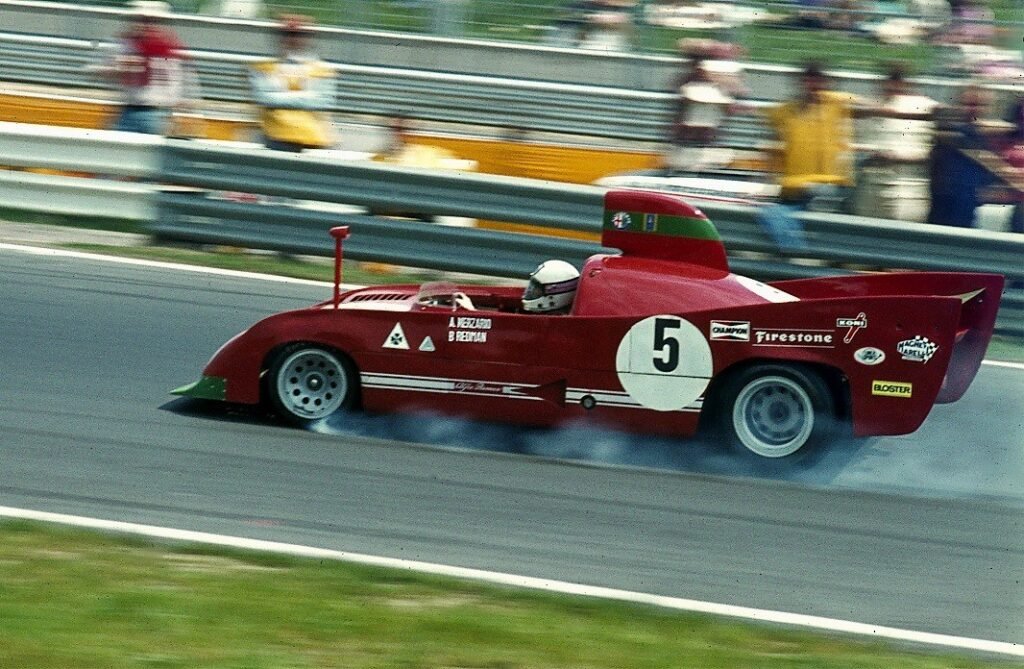
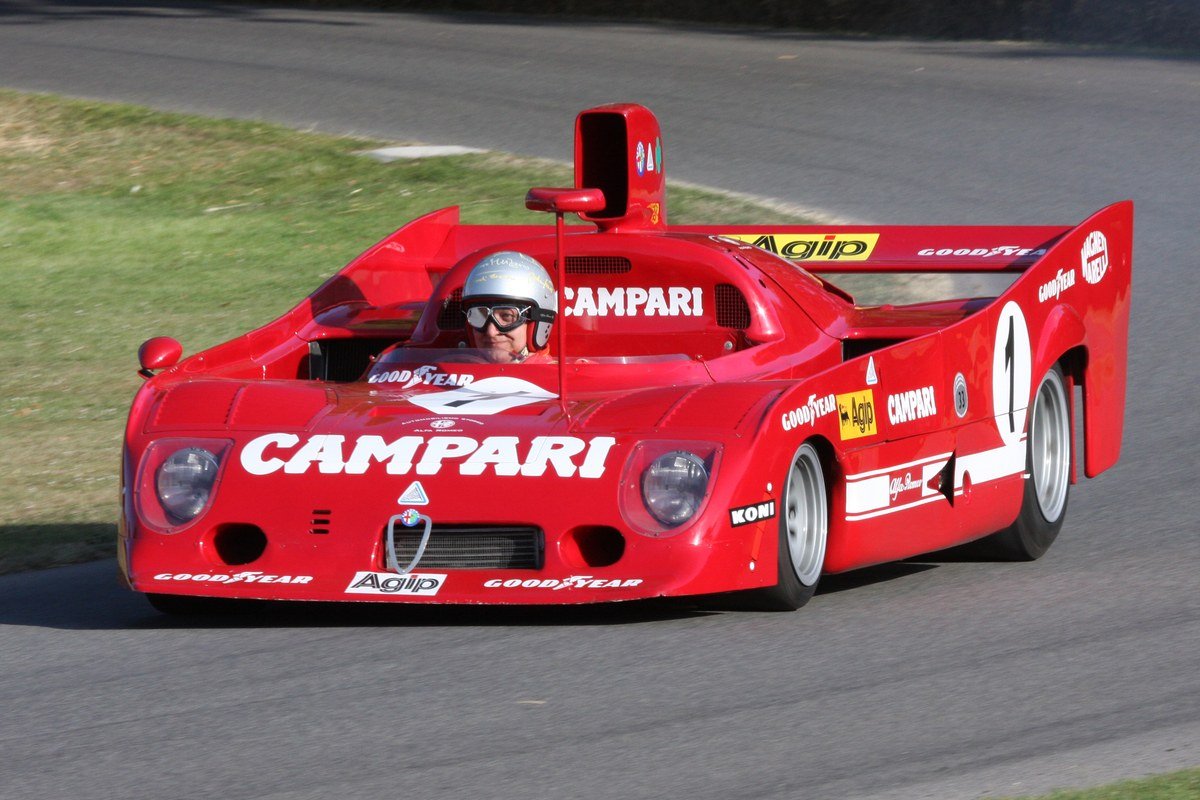
By 1975 the owner was the problem. Alfa belonged to the Italian state, the oil crisis was on, and nobody could say whether the program should go on. So the cars ran as the Willi Kauhsen Racing Team, red and white with Campari across the nose. How much of that was real depends who you ask. Italian accounts cited by Motor Sport say it was the same Autodelta team and Kauhsen filled a funding hole. Derek Bell, who drove for them, gives Kauhsen most of the credit: “When I first drove the car it felt like a tank, but Willi got to work and very quickly sorted it out.” A 1975 report mentions “a lot of unofficial factory support behind the scenes.”
The car weighed 670 kilos, about 1,477 pounds, with 500 horsepower at 11,500 rpm. According to Bell, Merzario was using 13,000. It was, Bell said, “not quite as quick as the Renault but a whole lot more reliable.” His summary of the race plan has outlived everything else from that year: “We’d just wait for them to break, which they usually did.”
The numbers back him. Sources disagree on whether it was seven wins from eight races or nine, and the reason is American: Daytona lost its championship status for lack of entries, then got it back from the FIA after the fact. Alfa didn’t go. Renault’s Alpine took Mugello in March. Alfa won the other seven, three of them for Bell and Pescarolo, including the Watkins Glen finale on July 12. Final score: Alfa Romeo 140, Porsche 98, Alpine-Renault 54. Enna in May had been a farce, sixteen starters and five real prototypes, and Motor Sport called it “more of a five-hour demonstration run.” The third car, Reinhold Joest’s turbo Porsche, came home about 70 miles back.
Eight for eight, against nobody
Autodelta sat most of 1976 out because it was busy building flat-12s for Bernie Ecclestone’s Brabhams. For 1977 it rolled out the 33 SC 12, scatolato meaning boxed, a monocoque built from closed panels. Output was 520 horsepower at 12,000 rpm with four valves per cylinder.
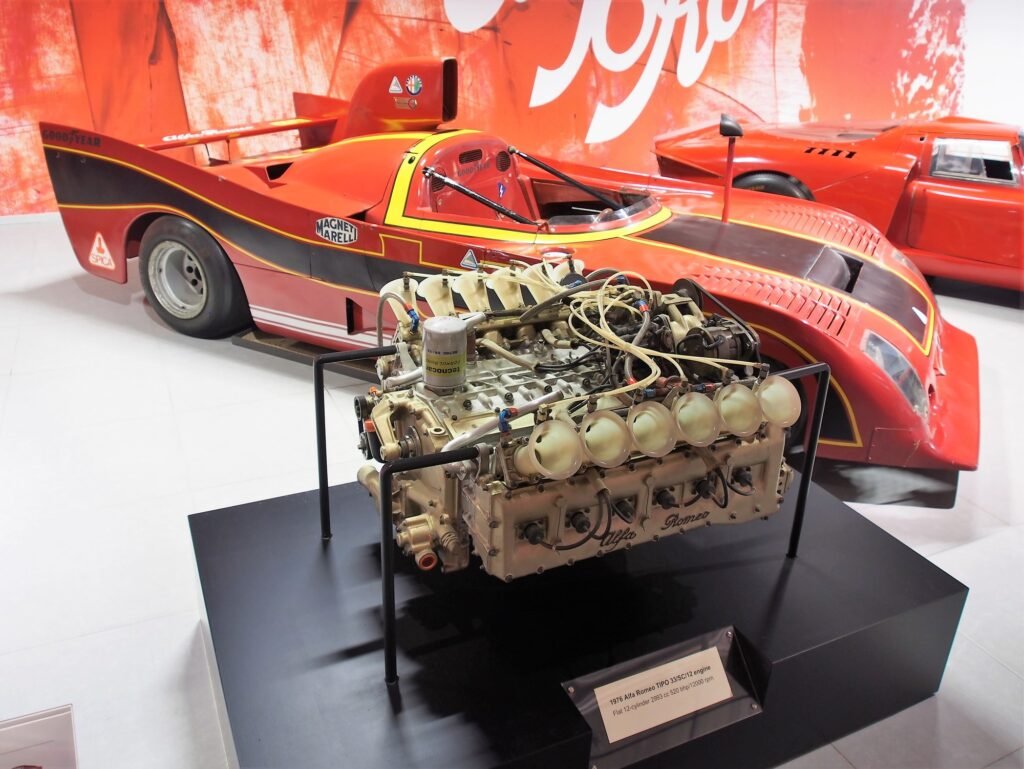
Merzario, Vittorio Brambilla and Jean-Pierre Jarier won all eight rounds of the World Championship for Sports Cars. Before you get excited, look at the schedule: 250 to 500 kilometers, Dijon to the Salzburgring, while Porsche collected the other world title that year, the one for makes, with the 935. The season closer at the Salzburgring went at 126.6 mph. Alfa also ran a 2,134cc turbo version there, one turbo per bank and 640 horsepower, and Merzario finished second in it.
I’ll give the critics 1977. A clean sweep with nobody home proves very little. They can’t have 1975. Bell’s line about waiting for the others to break gets repeated like an admission of guilt, and in a sport where the job is to be running at the end it’s the whole job description. The Tipo 33 beat turbo Renaults and Porsches over a full season on reliability, six years after Bianchi’s hood latch, in a team its owner wasn’t sure it wanted to pay for. Alfa Romeo’s biggest win in a quarter century had a bitter on the bodywork and a German’s name on the entry form.
Check you’re still alive.
Photos: Brian Snelson (CC BY 2.0), Bahnfrend (CC BY-SA 4.0), traumautoarchiv.de (CC BY-SA 2.0), azrhey (CC BY-SA 2.0), unknown author (public domain), Lothar Spurzem (CC BY-SA 2.0 de), Alf van Beem (public domain).