
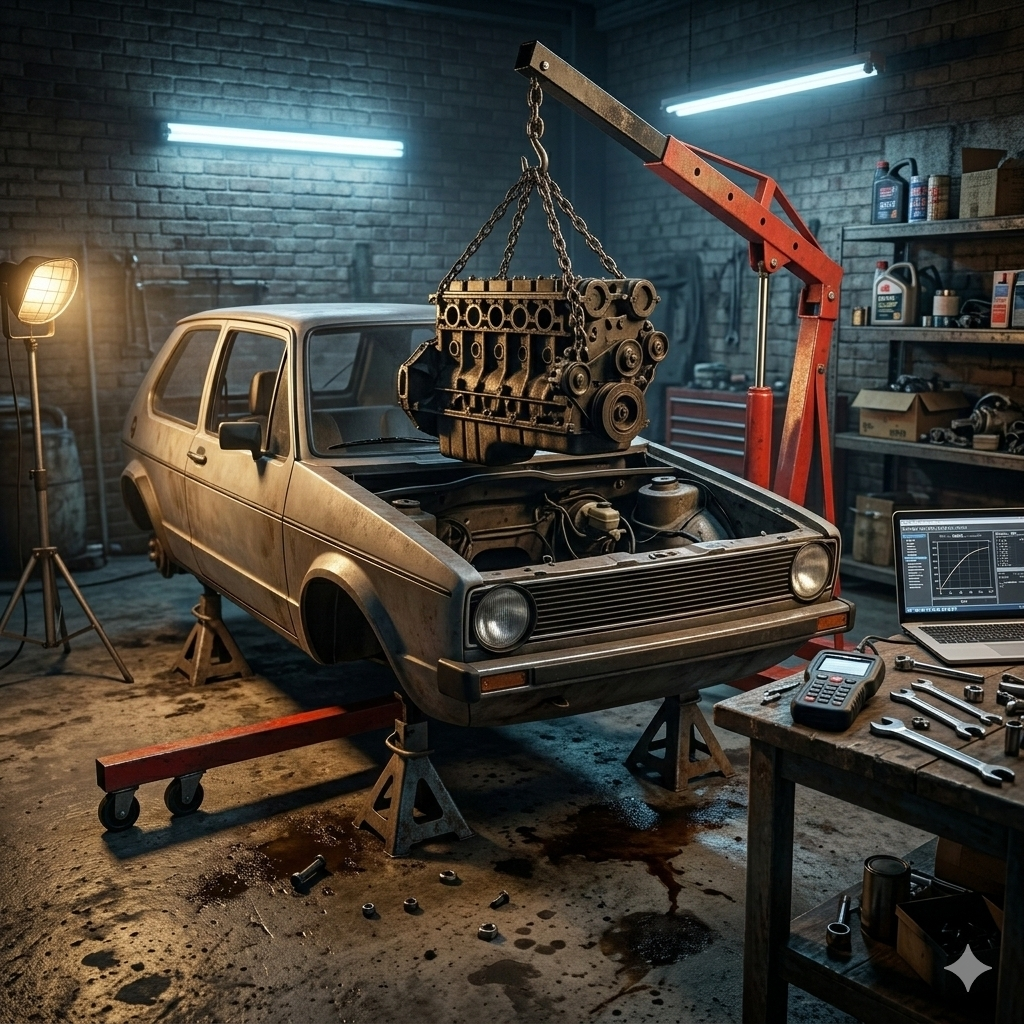
Why Builds & Swaps: A Manifesto for Those Who Still Believe in Getting Their Hands Dirty
This Isn’t About Stickers
There’s a moment in the life of anyone with petrol in their veins when they look at their car — or at the car of their dreams rotting on a classified ad — and think: “I can do something better with this.” Not necessarily better than the original engineering. Better than letting it die. Better than accepting that a blown engine is a death sentence for a chassis that still has stories left to tell.
That moment is what separates people who talk about cars from people who build them. And this section, Builds & Swaps, exists for the latter.
Not Enough Cylinders was born with a clear philosophy: tell the truth about the automobile without filters, without political correctness, and without fear of offending. We’ve torn apart myths about EGR systems, laid bare what the industry doesn’t want you to know about AdBlue, explained why Start-Stop technology is a band-aid that shortens your engine’s life, and pointed out the contradictions of Low Emission Zones that punish those who can’t afford a new car while subsidising two-tonne SUVs with eco labels.
But something was missing. We were still in the business of pointing out problems. We hadn’t started building solutions. Real solutions — with tools in hand, grease on our knuckles, and a budget that doesn’t come from a venture capital fund.
The Context: A World That Doesn’t Want You Touching Your Car
We live in an era where the automotive industry has decided that your relationship with your vehicle should be that of a user, not an owner. Think about it. According to data from the Spanish Vehicle Leasing Association (AER), operating leases accounted for 27.67% of total new vehicle registrations in Spain in 2024. More than one in four new cars hitting the road don’t belong to the person driving them. And the trend is climbing: it was 26.37% in 2023 and 26.66% in 2022.
I’m not against leasing as a financial instrument. It makes sense for many businesses and certain driver profiles. What concerns me is the underlying philosophy: the normalisation of the idea that a car isn’t something you own, understand, maintain, or improve. It’s something you consume for 48 months, return, and move on to the next one. Like a mobile phone with wheels.
Meanwhile, Spain’s car fleet keeps ageing. According to ACEA (the European Automobile Manufacturers’ Association), the average age of passenger cars in Spain reached 14.5 years in 2024 — well above the European average of 12.3 years. Of more than 26 million registered vehicles, over 16.6 million are more than ten years old. Every second car you see on a Spanish road was built at least a decade ago.
And according to ANFAC (Spain’s automotive manufacturers’ association), for every new passenger car registered in Spain, 1.3 used cars older than ten years are sold. The market is drifting toward older vehicles — not because people are romantics who love vintage cars, but because new ones are simply unaffordable.
The Forced Renewal Trap
Here’s where it gets interesting. The institutional response to an ageing fleet is not to make it easier for people to maintain, repair, or upgrade their existing vehicles. The response is: buy a new one. Or better yet, lease one.
The Euro 7 standard, adopted by the EU Council in April 2024 as Regulation (EU) 2024/1257, will apply to new car and van types from November 2026. Among its innovations: for the first time, non-exhaust emissions from brakes and tyre abrasion are regulated, durability requirements expand from 5 years or 100,000 km to 10 years or 200,000 km, and battery durability standards are introduced for electric vehicles. The European Commission estimates this will add approximately €150 to the cost of a new car.
I’m not arguing against reducing emissions. What I’m arguing against is the narrative that the only way to achieve this is by pulling millions of perfectly functional vehicles off the road and replacing them with new cars that half the population cannot afford.
And meanwhile, SUVs — the segment that contributes most to rising weight, fuel consumption, and fleet emissions in Europe — hit a record 54% market share in 2024 across Europe, according to JATO Dynamics data. More than half of all new cars sold in Europe are SUVs. In 2010, only one in ten new vehicles was an SUV. Today it’s more than one in two. And nobody seems to see the contradiction in punishing the owner of a 2008 Volkswagen Golf while subsidising the purchase of an 1,800 kg hybrid SUV.
The Weight Paradox and the Label System
It’s worth pausing on this contradiction because it’s the elephant in the room of European environmental policy. ICCT data (International Council on Clean Transportation) shows that since 2001, average CO2 emissions from new EU passenger cars have dropped 47%. Sounds great, right? The same report notes that over the same period, the average weight of new vehicles increased by 21% and average engine power by 56%. We’re building heavier, more powerful cars and offsetting the damage through exhaust technology and partial electrification. It’s like going on a diet while doubling your portions: the numbers might look good on paper, but the physical reality hasn’t changed.
And within this context, what environmental label does a 1,900 kg hybrid SUV with 150 horsepower plus an electric motor that only works in full-electric mode for 3 kilometres get? In Spain’s DGT system: ECO or even ZERO. Meanwhile, the owner of a 2004 Volkswagen Golf TDI weighing 1,300 kg that still starts every morning has no label at all. They can’t enter the centre of Madrid, Barcelona, or Valencia. Not because it necessarily pollutes more in absolute terms — especially if it’s well-maintained and has a valid ITV — but because the labels classify by powertrain technology and age, not by actual measured emissions. It’s a caste system based on manufacture date, not real pollution.
Builds & Swaps: The Answer From Those Who Use Their Hands
Against this backdrop, there are people who’ve decided not to wait. People who look at a chassis with solid geometry, with a history that deserves to continue, and say: “I’m giving this a second life.” That’s a build. That’s a swap. It’s not mechanical vandalism. It’s not disrespect to original engineering. It’s the natural continuation of a tradition that spans decades and has produced some of the most fascinating cars ever to hit the road.
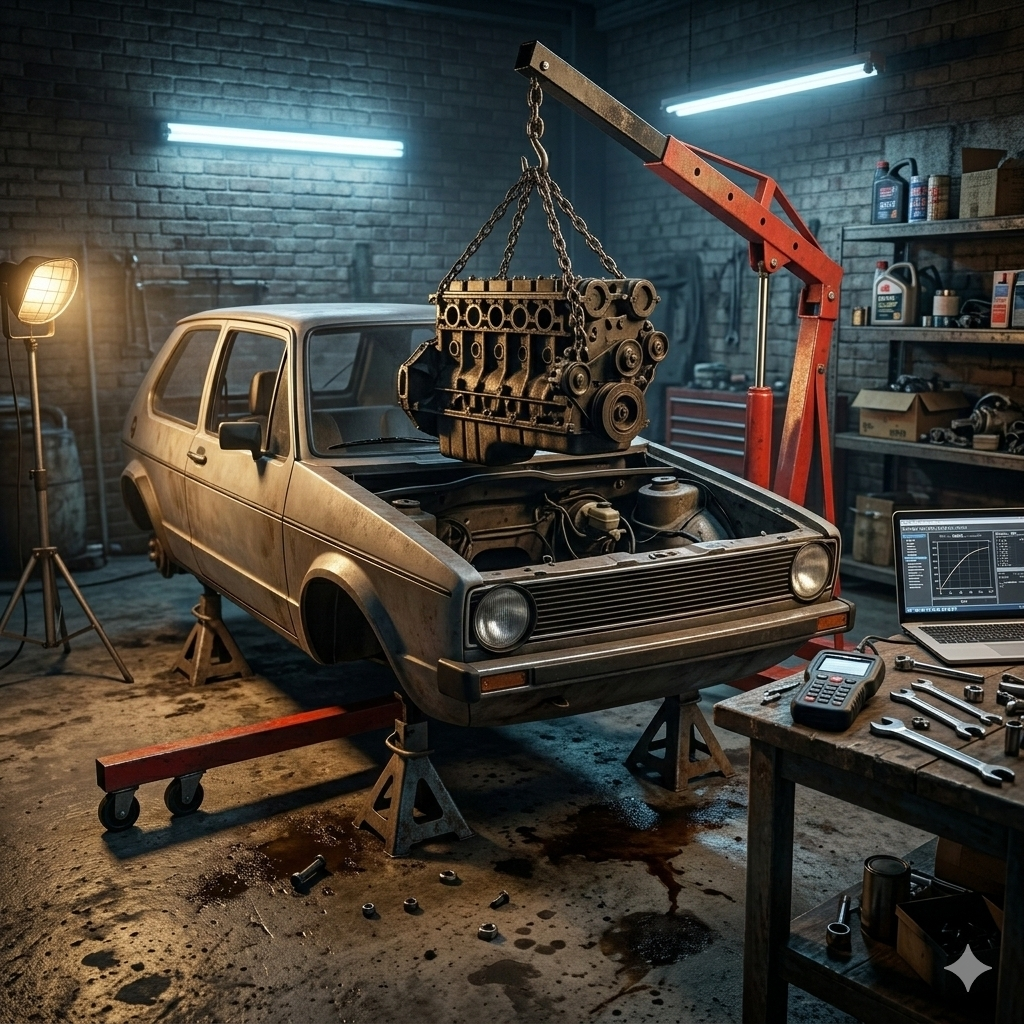
When a Japanese tuner drops a 2JZ into a Nissan 240SX, they’re not destroying a car. They’re creating something new. When a mechanic in an industrial estate workshop installs a VR6 in a Mk1 Golf, they’re not committing a crime against Volkswagen. They’re doing exactly what Volkswagen should have done but didn’t. When someone rescues a Fiat Multipla from the scrapyard and installs an engine that keeps it rolling for another twenty years, they’re not polluting more than the neighbour’s brand-new SUV. They’re preventing tonnes of metal, plastic, and components from ending up in a landfill.
Builds & Swaps is the section where we’re going to document all of this. Without cheap romanticism, without Instagram filters, without fantasy budgets. With real data, real costs, real problems, and real solutions.
What You’ll Find Here
This section will cover the full spectrum of what it means to build or transform a car in the real world — and especially in Spain, where the regulatory framework turns any modification into a bureaucratic obstacle course.
We’ll talk about the homologation process. About Real Decreto 866/2010, which governs the processing of vehicle reforms after definitive registration, and its central tool: the Manual de Reformas de Vehículos (Vehicle Reform Manual), a document drafted by Spain’s Ministry of Industry in collaboration with regional governments that categorises every possible modification under specific reform codes. If you want to change your car’s powertrain, you need an engineering project signed by a qualified engineer, a workshop certificate, a final works certificate, and a conformity report before the ITV (Spain’s MOT equivalent) will even look at your vehicle. And if your reform changes the vehicle registration document, you’ve still got a trip to the traffic authority ahead.
We’ll talk about real costs. How much an engineering report actually costs. What a workshop charges to execute a swap according to regulations. The vast gap between what the engine costs and what it costs to make it legal.
We’ll talk about the technical side without shortcuts. Subframe compatibility and mounting points. Engine management: standalone ECUs versus rewiring the original unit. Transmission adaptation. Upsized cooling systems. Engine mapping. Braking proportional to the new power output. Every detail that separates a swap that works from a swap that leaves you stranded on the motorway.
We’ll talk about history. The swaps that defined entire subcultures. The LS swap as the American phenomenon that democratised horsepower. The 2JZ as the engine that turned Toyota into an aftermarket icon. The VR6 that transformed the European GTI scene. Because this didn’t start yesterday, and anyone who says it’s a fad hasn’t opened a book in their life.
And we’ll talk about our own projects. Because at NEC, we don’t preach from a pulpit. We preach from the garage. We have our own active build projects that we’re going to document here, step by step, with total transparency. The wins and the cock-ups. Because a real build includes both.
Who This Section Is For
Builds & Swaps isn’t for someone looking for a five-minute YouTube tutorial. It’s for those willing to invest time, money, research, and sweat into a project that’s worth it. It’s for the weekend mechanic who wants to level up. It’s for the workshop professional who wants to see how others tackle the same problems. It’s for the dreamer who has a shell sitting in a lockup and doesn’t know where to start.
It’s also for those who need someone to tell them the truth before they jump in headfirst. Because the build world is full of social media romanticism: photos of a freshly painted engine, videos of first start-ups with epic music, and then silence. Nobody shows the three weeks spent hunting for a compatible wiring harness. Nobody documents the two failed ITV visits. Nobody posts the engineer’s invoice. Here, we will. We’re going to show the complete process, including the ugly parts, because the ugly parts are the most useful part of the learning curve.
The Garage as the Last Trench
There’s something deeply human about building something with your hands. In an increasingly digital, abstract world mediated by screens, the garage remains the last space where the relationship between person and machine is direct, tangible, and honest. The bolt tightens or it doesn’t. The engine starts or it doesn’t. No algorithm will fix it. No software update compensates for a poorly welded engine mount.
It’s for anyone who understands that in a world where 54% of new cars are clone SUVs, where one in four cars is leased rather than owned, and where the average age of Spain’s fleet exceeds 14 years because nobody can afford to renew… building your own car isn’t a luxury. It’s an act of resistance.
Welcome to Builds & Swaps. Here, we get our hands dirty.
2 thoughts on “BUILDS & SWAPS”