

De Tomaso: The Argentinian Who Built Italy’s Most Underrated Supercar Empire
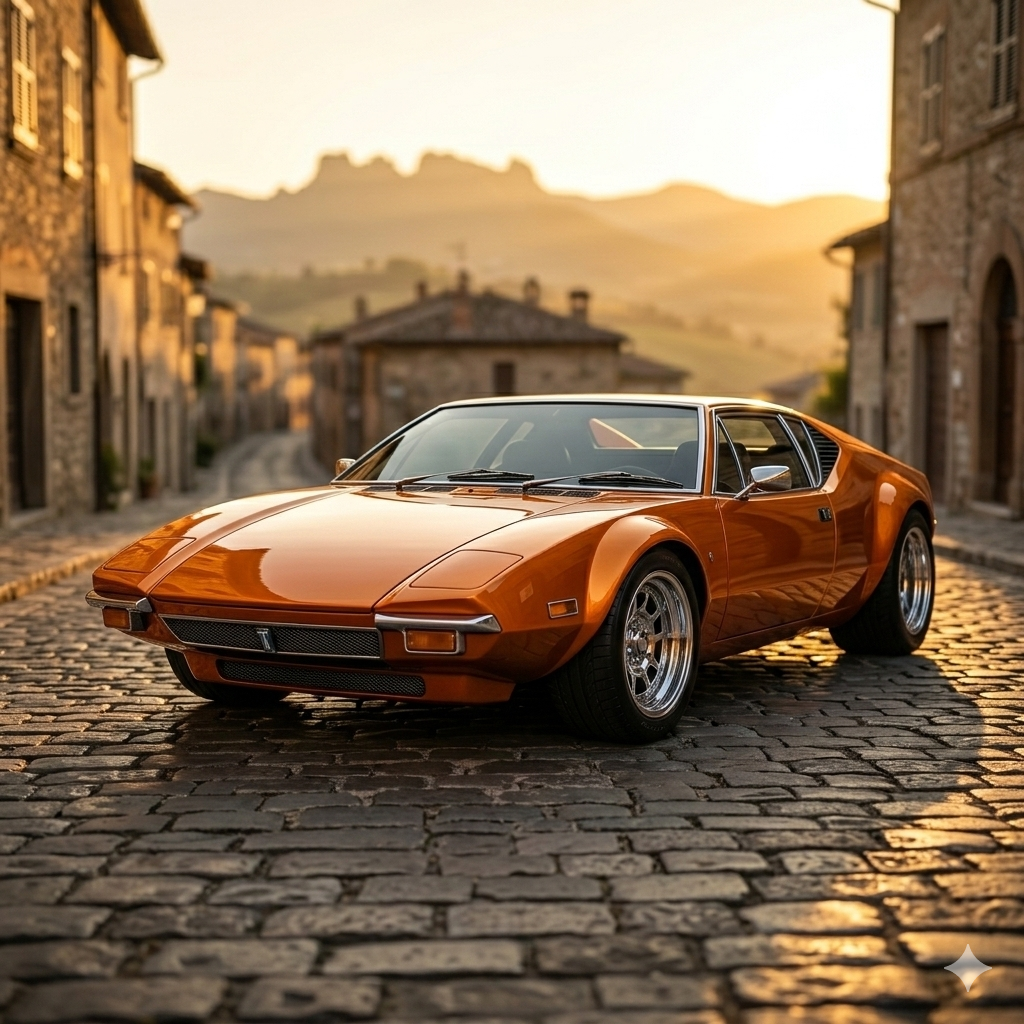
De Tomaso: The Argentine Who Humbled Ferrari with Ford Power
There are brands that are born to last. And there are brands that are born to burn everything down. De Tomaso belongs firmly in the second category. An Italian company founded by an Argentine, bankrolled by Americans, powered by Ford V8s, and blessed by designers who would later become legends. A combination that should never work on paper — and yet it produced some of the most brutal, most beautiful, and most controversial cars in automotive history.
This is not the story of a company that played by the rules. This is the story of a man who rewrote them to suit himself, who allied with giants when it served him, who told them to go to hell when it didn’t, and who built a brand capable of going toe-to-toe with Ferrari and Lamborghini on a fraction of the budget. That man’s name was Alejandro de Tomaso.
The Man Behind the Myth
Alejandro de Tomaso was born in Buenos Aires in 1928. He wasn’t a trained engineer. He didn’t come from a car-manufacturing dynasty. He was a racing driver with outsized ambitions, a sharp eye for business, and an almost supernatural ability to surround himself with the right people at exactly the right moment. In 1955 he arrived in Italy, drawn by the European motorsport scene, and four years later, in 1959, he founded De Tomaso Automobili in Modena — the same city where Ferrari, Maserati, and Lamborghini drew breath.
Choosing Modena was no accident. It was a declaration of war. De Tomaso was going to play in the big leagues from day one.
The early years were all experimentation. Formula prototypes, race cars, projects that started with enthusiasm and were abandoned just as quickly. The 1962 Vallelunga was the first road car with any kind of production: a small sports car with a mid-mounted Ford Cortina engine, built in tiny numbers. Technically interesting, but commercially irrelevant. De Tomaso needed a statement.
The Mangusta: The Car That Wanted to Kill the Cobra
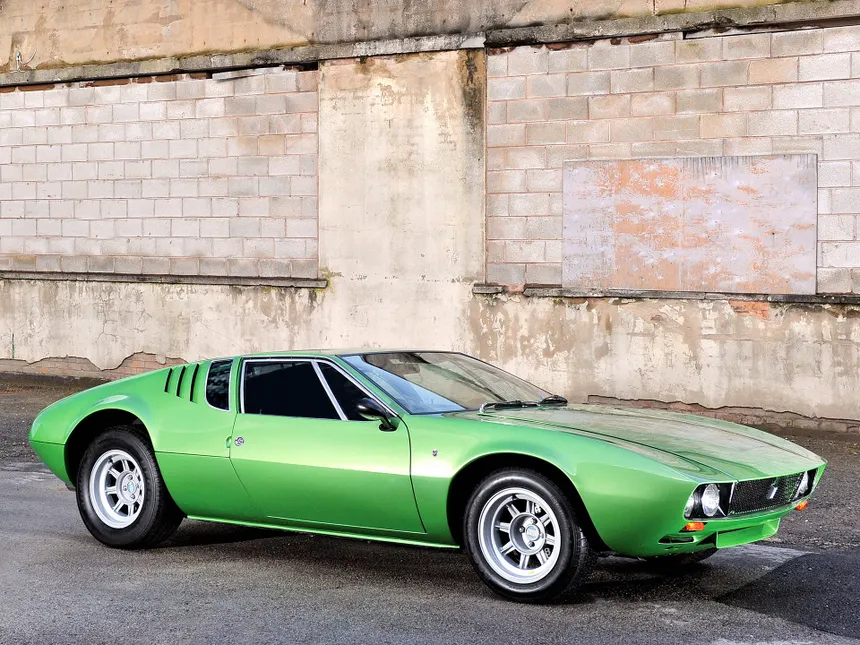
The Mangusta arrived in 1967 and changed everything. The name says it all: mangusta is Italian for mongoose — the animal famous for killing cobras. A direct shot at Carroll Shelby, whose Cobra had dominated the American-European sports car universe. The irony is that Shelby had initially been involved in the P70 project that led to the Mangusta, but the partnership collapsed and De Tomaso pushed forward alone.
The result was a visual masterpiece. Designed by Giorgetto Giugiaro, then 28 years old and working as chief designer at the coachbuilder Ghia, the Mangusta had a low, aggressive body with angular lines that foreshadowed the wedge designs of the following decade. Interestingly, Giugiaro’s design had originally been conceived for a mid-engined Iso that was never built. De Tomaso saw the opportunity and seized it. The car’s most spectacular feature was the engine access: two rear panels hinged at the center that opened like gull wings, exposing the engine and trunk compartment. Pure theater.
Beneath that visual spectacle lay the beating heart of the De Tomaso philosophy: American muscle, Italian suit. Early European versions ran a Ford 289 V8 producing 306 horsepower. The U.S.-spec version got the Ford 302 V8 with 230 horsepower. The chassis was a steel backbone design descended from the P70/Sport 5000 prototype, with independent suspension at all four corners, Girling disc brakes all around, rack-and-pinion steering, and a ZF five-speed transaxle with limited-slip differential. In a nod to luxury unusual for the era, it came equipped with air conditioning and power windows.
The Mangusta’s Achilles’ heel was its weight distribution: 44% front, 56% rear. An imbalance that made the car thrilling to drive — and terrifying at the limit. The cabin was claustrophobic and the ground clearance was minimal. It wasn’t perfect. But it was absolutely glorious.
Of the 401 examples built between 1967 and 1971, 251 were sold in the United States. A commercial success for a company that had come from literally nowhere, and the key that unlocked the most ambitious project in De Tomaso’s history.
The Pantera: When Ford Bet on Modena
Ford Motor Company, in the middle of the muscle car era and with Lee Iacocca driving the company’s North American division, needed a mid-engine exotic that could take on the Corvette from General Motors and challenge the European establishment. De Tomaso, with the Mangusta as his calling card, convinced the Americans to finance mass production of a new model. The deal was straightforward and brilliant: Ford acquired an 84% stake in De Tomaso Automobili, and the new car would be sold in the United States through Lincoln-Mercury dealerships.
Think about that for a second. You could walk into the same dealer that sold your uncle his Town Car and drive out in a mid-engine Italian exotic with a Ford V8. In 1971. For around $10,000 — less than half the price of a Ferrari Dino.
The result was the Pantera — Italian for panther — and it became the most successful model in the company’s history. Designed by American-born Tom Tjaarda at Ghia (which De Tomaso also owned), with engineering by Gian Paolo Dallara — fresh from Lamborghini, where he’d designed the Miura’s chassis — the Pantera was the first De Tomaso built on a steel monocoque, a significant technical leap from the Mangusta’s backbone frame. The heart of the machine: Ford’s legendary 351 Cleveland V8, displacing 5,763 cc (351 cubic inches).
And here’s where you need to pay attention, because the Pantera had many lives and many numbers. The 1971 models produced 330 horsepower with high-compression engines. From 1972, the Lusso version for the American market was detuned to 266 net horsepower to meet federal emissions standards. The European street version held at 296 horsepower. The European GTS — the real performance weapon — pushed 350 horsepower through an 11.0:1 compression ratio, cast aluminum intake manifold, and free-flow exhaust. All versions ran a five-speed ZF transaxle.
Car and Driver tested the 1971 model at 0-60 mph in 5.5 seconds, with a top speed of 160 mph. The European GTS, with its 350-horsepower engine, exceeded 170 mph.
Between 1971 and 1973, De Tomaso produced 6,128 Panteras in Modena — the highest production volume the company ever achieved. But the 1973 oil crisis and growing tensions between Ford and De Tomaso — worsened by serious quality control issues on early American-spec cars, where fit and finish was notoriously inconsistent — led to Ford’s departure in 1974. However, De Tomaso had shrewdly negotiated to retain production rights for the rest of the world, so the Pantera continued to be built by hand, at fewer than 100 units per year. Over its entire lifespan of more than twenty years, total production reached 7,260 units — a number no other De Tomaso model came close to matching.
The Pantera came in flavors for every appetite: the Targa with removable roof panel, the GT5 and GT5-S with polyester flared fenders and competition suspension, and the FIA-homologated Group 3 and Group 4 cars built by Maggiora. Over its lifetime it received a Marcello Gandini facelift, and in 1990 the final version appeared: the 90 Si, with electronic fuel injection and a smaller 4.9-liter Ford engine. Of the 41 units produced, 38 were sold to customers, 2 were crash-tested, and 1 went straight to a museum.
The Pantera also has a story that perfectly captures its relationship with America. In 1974, Elvis Presley bought a used 1971 Pantera for $2,400 as a gift for his girlfriend Linda Thompson. When the car refused to start after an argument with her, The King pulled out a revolver and fired two shots through the door. One bullet ricocheted off the steering wheel and embedded itself in the windshield. The other hit the floor pan. Today, Elvis’s Pantera sits in the Petersen Automotive Museum in Los Angeles, bullet holes intact. It was irresistible. And completely unpredictable.
Beyond the Sports Cars: Deauville and Longchamp
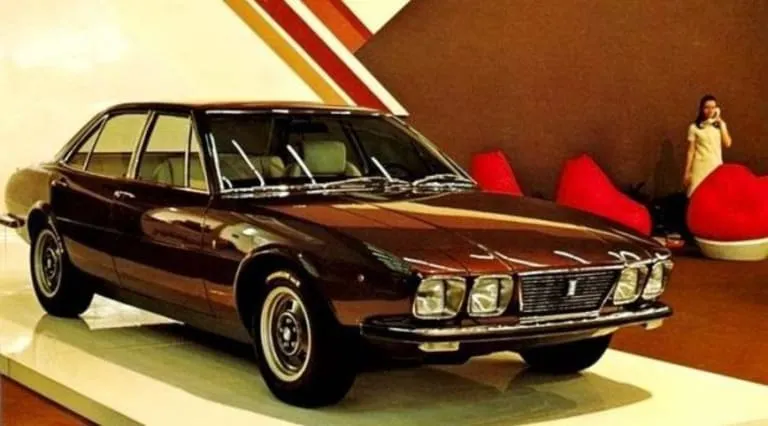
What most people don’t know about De Tomaso is the ambition to build luxury sedans. In 1971, the same year the Pantera launched, the company unveiled the Deauville: a four-door sedan designed by Tom Tjaarda to compete with the Jaguar XJ and Mercedes-Benz S-Class. Engine: the same Ford V8 as the Pantera, but mounted up front. The design was angular and ahead of its time. The problem was build quality — nowhere near German standards.
The Deauville remained in the catalog until 1985, but only 244 were ever built. Enough to prove De Tomaso could think big. Not enough to dent the luxury sedan market.
In 1972, the Longchamp arrived: a two-door grand touring coupé based on a shortened Deauville chassis, with the same V8 and up to 330 horsepower depending on spec. The Longchamp was Italy’s answer to the Mercedes and BMW coupés of the era: elegant, powerful, and built in numbers so small that today it’s an extraordinarily valuable collector’s piece. Just 409 were produced through 1989.
The End of an Era: Guarà and the Collapse
Alejandro de Tomaso never fully gave up. In 1993, when the Pantera was finally retired, he presented the Guarà: a radical sports car with a carbon-Kevlar composite body, designed by Carlo Gaino of Synthesis Design, based on the 1991 Maserati Barchetta Stradale prototype. In an ironic twist, after decades of running Ford power, the Guarà launched with a BMW V8. Not by choice — Ford simply couldn’t deliver its new 4.6-liter modular engine in time. The BMW M60 4.0-liter unit, shared with the 840Ci, produced between 282 and 304 horsepower depending on state of tune. When BMW discontinued the M60 in 1998, De Tomaso finally returned to Ford with the 4.6-liter modular V8 producing 305 horsepower.
The Guarà’s chassis featured race-derived suspension with double-wishbone geometry and inboard-mounted coilover units. Total production hovered around 50 units across coupé, spyder, and barchetta variants. Marginal and sporadic — but proof that De Tomaso could still build a cutting-edge machine.
In the late 1990s, De Tomaso attempted to revive the Mangusta name for a new two-seat convertible designed by Gandini — the Biguà. But the project devolved into a bitter dispute with American partner Qvale, who took the car and rebadged it as the Qvale Mangusta. That car’s mechanicals would eventually form the basis for the MG XPower SV.
Alejandro de Tomaso died on May 21, 2003, at 74. He left behind a company in deep financial trouble, but a legacy that no amount of money can buy. In 2015, the brand was acquired at auction by Hong Kong-based Ideal Team Ventures for €1.5 million. In 2019, the new De Tomaso unveiled the P72: a retro-styled homage to the racing prototypes of the 1960s, powered by a supercharged Ford V8. The circle closes: American, Italian, Argentine. De Tomaso remains impossible to classify.
The Final Argument: De Tomaso Did What Ferrari Wouldn’t
Here’s where I have to say what a lot of people think but few will write: De Tomaso was, for years, more straightforward than Ferrari. More upfront. More brutally transparent. Maranello built myths and sold them at myth prices. In Modena, De Tomaso dropped an American V8 — the most reliable, the easiest to maintain, the most powerful per dollar of its era — into an Italian body designed by the best in the business, and let you enjoy the car without the drama of keeping a high-strung Italian engine alive through winter.
The Pantera wasn’t perfect. It had quality issues, a cabin too cramped for tall drivers, and weight distribution that punished the inexperienced. But it was real. It was direct. It told you exactly what it was: a big-engined, beautifully shaped, hard-riding car with no safety net. Something that today’s brands, hiding behind electronic filters and augmented reality dashboards, have completely forgotten how to build.
Would De Tomaso have survived with better management? Probably. Would it have built more boring cars with that better management? Absolutely. And that, in the end, is what separates the brands that actually matter: the brutal coherence between what they are and what they do. De Tomaso was always exactly what it appeared to be. In a world of cars that lie to you, that’s almost revolutionary.
And now, check you’re still alive.
8 thoughts on “DE TOMASO”