Ford Sierra RS Cosworth: the van engine the DTM legislated out of existence
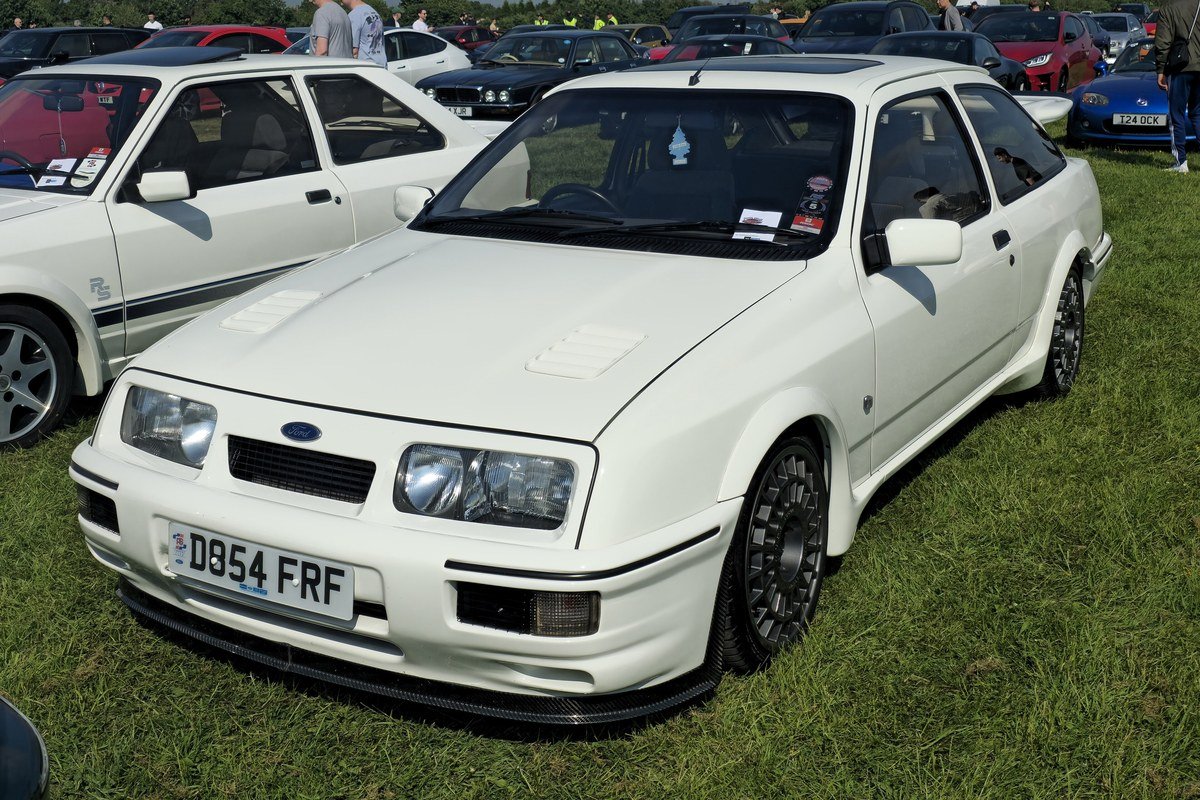
America got the Merkur XR4Ti and a polite handshake. Europe got the Ford Sierra RS Cosworth, a three-door family hatchback with a wing the size of a picnic table, an engine block from a van, and a racing record so lopsided that the Germans eventually rewrote their rulebook to get rid of it. Nobody beat it out of the DTM. They banned turbos for 1990, Ford had nothing ready to replace it, and the most feared touring car of its day was shown the door by a committee.
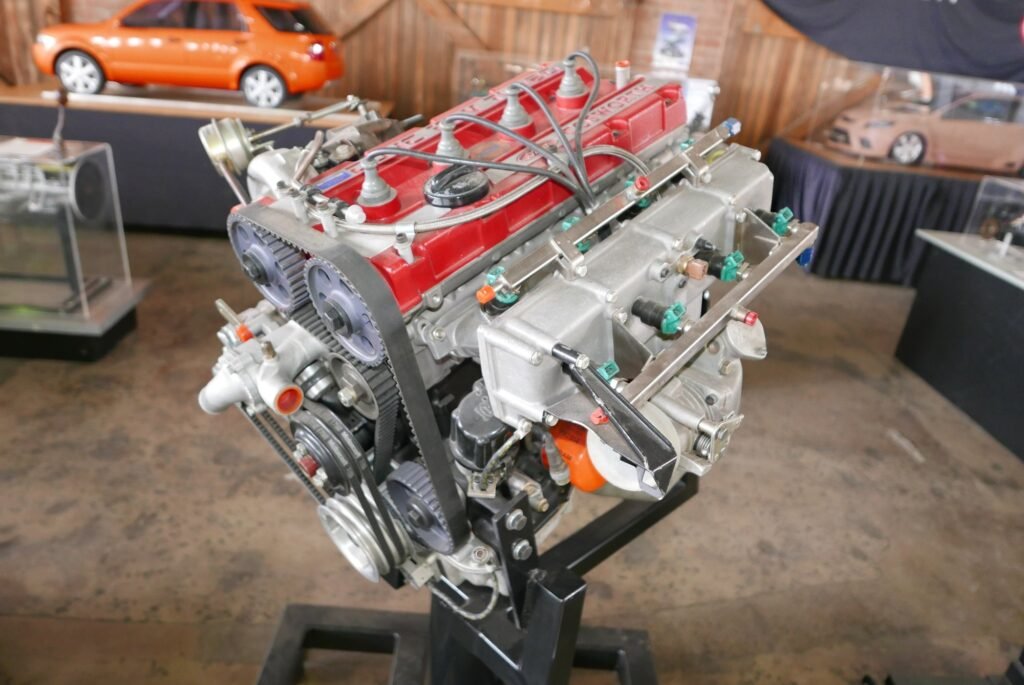
Stay with that for a second, because the engine is the best part. Underneath the red cam cover sat a cast-iron Pinto block, the same humble four-cylinder family that dragged Transit vans and company-car saloons across Europe. The Pinto name will ring a bell for American readers for all the wrong reasons. This is the one time it ended up on top of the podium.
Rovers, Capris and a very bad Sunday
The whole thing starts with Ford getting embarrassed at home. At the 1983 British Grand Prix, in front of the company’s senior management, the touring car support race turned into a Rover SD1 V8 parade. The Ford Capris got pounded; a single Escort saved what little face there was to save. Two men walked out of Silverstone in a foul mood: Stuart Turner, newly appointed boss of Ford Motorsport in Europe, and vice-president Walter Hayes.
Hayes is worth a paragraph of his own. He was the executive who had pushed the GT40 program that ended Ferrari’s Le Mans dynasty in 1966, and the man who signed off on the Cosworth DFV, the V8 that won more than 150 Grands Prix and twelve Formula 1 drivers’ titles. When a guy with that résumé decides Ford needs a winner, you don’t bet against him.
The trap Cosworth laid on the workshop floor
Turner and Hayes went to Cosworth in Northampton, supposedly to look at the company’s next Formula 1 engine. Somewhere along the tour, sitting in plain sight, was a Pinto block wearing a twin-cam, 16-valve aluminum head. The way the people involved told it afterward, that engine was parked there on purpose so Ford’s top brass would trip over it. Call it a sales pitch with a wrench.
Cosworth had been playing with the idea under the codename YAA, a 16-valve conversion for the Pinto, and according to Race Engine Technology the project was led by Mario Illien, who would go on to co-found Ilmor, the outfit that later built Indy and Formula 1 engines with Roger Penske’s money. Turner wanted to know what it was. Then, as the story goes, over a ploughman’s lunch at a pub, he said the line that started everything: turbocharge that thing, put it in a Sierra, and Rover would never win another race.
The engine that came out of it was the Cosworth YB. If the jargon is new, here is the short version. A turbocharger uses exhaust gas, energy that would otherwise just leave through the tailpipe, to spin a turbine. That turbine drives a compressor that crams more air into the cylinders, and more air lets you burn more fuel, so you get more power from the same displacement. Cosworth bolted a Garrett T3 to the Pinto and added an intercooler, a radiator for the intake charge, because compressing air heats it, and cooler air is denser air. Ford’s brief asked for 180 hp on the street and over 300 in race trim. Getting past 200 for the road car turned out to be easy, so that’s where they stopped.
Detroit’s fingerprints on a European legend
Here’s the bit most European histories skip. The Sierra had already been racing in the US, wearing a Merkur badge. Jack Roush ran the Merkur XR4Ti in IMSA, and what his team learned about suspension and aerodynamics fed straight into the Cosworth’s development. The RS Cosworth even carried over some XR4Ti hardware. So when you look at the most famous European touring car of the 1980s, part of what you’re looking at was worked out on American tracks by a guy from Michigan.
The irony is that Americans never got the finished product. Merkur sold the XR4Ti with a 2.3-liter turbo four, a decent sports sedan, but the Cosworth, the RS500 and the later Sapphire 4×4 stayed on the other side of the Atlantic.
A wing that scared the boardroom
Ford showed the Sierra RS Cosworth at the Geneva Motor Show in March 1985. Sales were meant to start that September; they didn’t begin until July 1986, with the cars built at Ford’s plant in Genk, Belgium. The delay had a lot to do with a problem that wasn’t cosmetic at all. At high speed, the regular Sierra body generated lift over the rear axle. In plain English, air got under the tail and tried to raise it, unloading the rear tires right when the driver needed them most. For a car meant to run flat out for hours at Spa or Bathurst, that’s a crash waiting to happen.
The fix came from Lothar Pinske, who spent long hours in the wind tunnel and ran test cars flat out at the Nardò high-speed bowl in southern Italy. His answer was the enormous rear wing everyone now calls the whale tail. Ford’s management hated it on sight, and dealers who saw the first photos weren’t any happier. The development team’s reply was simple: if it wins, it sells. That argument held.
The road car’s 1,993cc engine made 204 hp, enough for about 149 mph and 0-60 in roughly 6.5 seconds. Put that next to what Americans were buying in 1986. A Buick Grand National made 235 hp from its turbo V6, a Corvette made 230 from a 5.7-liter V8, and a Mustang SVO squeezed around 200 out of its own turbo four. The Sierra ran with that crowd using two liters and a hatchback. Europe’s hot hatches, the cars that made the Peugeot 205 GTI and the 16-valve Golf GTI famous, were stuck between 130 and 139 hp. The Cosworth had more than 60 on top of that. In Europe, its natural rival was the BMW M3 E30: another homologation special, more refined, more expensive, better behaved. The Ford was the street fighter of the pair, and nobody at Ford pretended otherwise.
RS500: when a 204 hp car wasn’t nasty enough
Group A rules, the international touring car regulations of the era, let a manufacturer homologate an “evolution” version once a year, as long as it built 500 road cars of that spec. Ford had no intention of wasting the loophole. The Sierra RS500 Cosworth was announced in July 1987 and homologated that August.
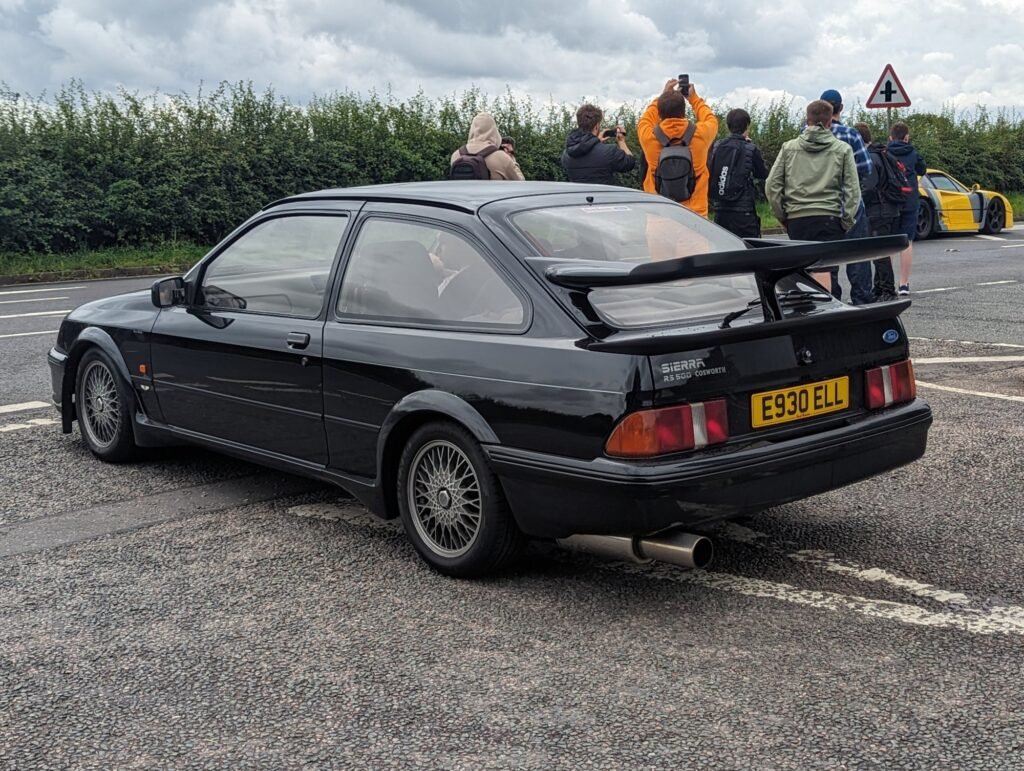
The car’s racing specification was shaped with Ruedi Eggenberger, the Swiss team owner who ran Ford’s works Sierras. Building them was a strange two-step process. Of the 5,545 three-door Cosworths that came off the Genk line, 500 were shipped to Aston Martin Tickford, signed for the job in March 1987, where they were taken apart and rebuilt into RS500s almost by hand.
The engine moved from YBB to YBD spec. The block got thicker walls to survive more boost, the turbo grew to a much larger Garrett T04, the intercooler got bigger, the pistons got oil-jet cooling, and a second set of fuel injectors appeared. On the road car those extra injectors didn’t do anything at all. They were there purely so the race teams could legally use them once the boost went up. Road output rose to 224 hp. On track, the numbers that have circulated over the years talk about roughly 470 hp in 1987, more than 550 later on, and close to 600 from the Australian cars by 1992. No team ever published official dyno sheets, so treat those as paddock figures rather than gospel. Either way, that was coming out of a van block.
Pinske’s aero got sharper too: a second, smaller wing appeared under the whale tail, and the main wing carried a more aggressive Gurney flap, a small vertical lip on the trailing edge that adds downforce for very little drag. All 500 cars were right-hand drive and sold only in the UK. Ford’s plan was to paint them all black. It didn’t quite work out: 56 left in white and 52 in Moonstone Blue.
One point, one Holden and a pair of wheel arches
Britain’s Motor Sport magazine has called the RS500 the most successful road-derived race car ever built, with an 84.6% win rate. It’s a terrific headline, but the magazine doesn’t publish how it counted, which series or which races. So that one belongs to Motor Sport, not to the record books.
What you can check race by race is the end of the 1987 World Touring Car Championship, the first and only season of that series. After homologation came six rounds: Brno, Silverstone, Bathurst, Calder Park, Wellington and Fuji. The Sierra won four. A BMW M3 took Silverstone. Bathurst is the story. The Eggenberger Sierras crossed the line first and second at Mount Panorama and were then disqualified over wheel-arch panel irregularities, which handed the win to the Holden Commodore of Peter McLeod, Peter Brock, David Parsons and Jon Crooke.
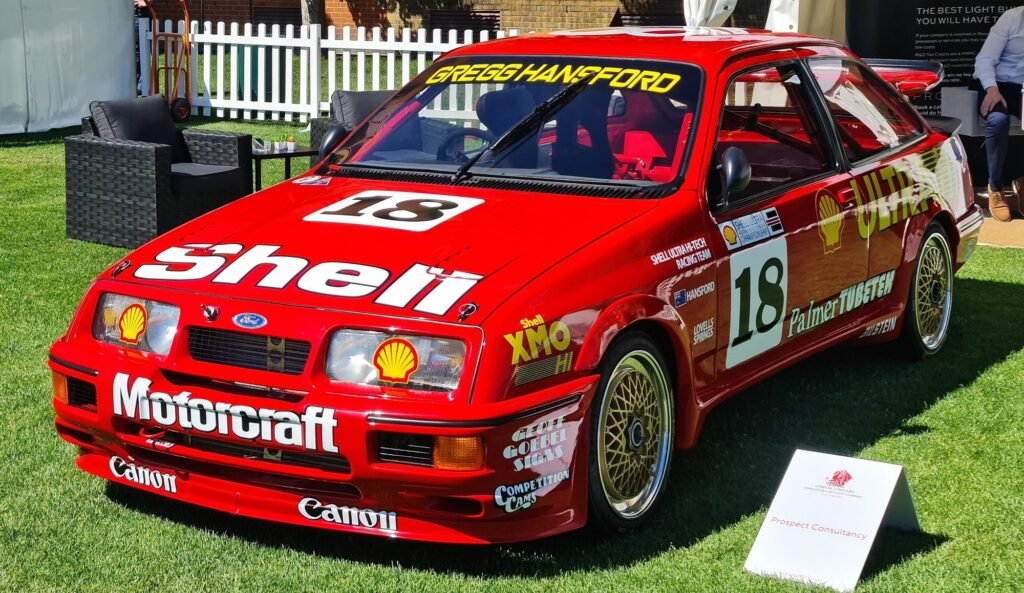
That disqualification had a price far bigger than one race. It cost Klaus Ludwig and Klaus Niedzwiedz the drivers’ title. Roberto Ravaglia won it in a BMW M3 by a single point, 269 to 268. Eggenberger still took the teams’ championship, which tells you how fast the car was even with a race wiped off its record. Ford came back and won Bathurst cleanly in 1988 and again in 1989.
After that, the RS500 rolled over everything it entered: touring car titles in Germany, Britain, Japan and Australia, the 1989 Spa 24 Hours, Fuji’s InterTEC 500. For a car whose engine block started life in commercial vehicles, the list is borderline rude.
The day the DTM changed the rules
Germany is where it ended. Klaus Ludwig won the 1988 DTM title in a Sierra RS500, the payback, in a way, for that point lost in 1987. In 1989 the Fords were reined in with extra weight and boost restrictions, and Ravaglia, in another BMW M3, took the championship. So yes, the Sierra could be beaten on track, by a great driver in a great car with the regulations leaning his way.
What it couldn’t beat was the rulebook. Turbochargers were banned from the DTM at the start of the 1990 season, on cost grounds. Ford had no naturally aspirated replacement ready, so it left the DTM at the end of 1989. Audi showed up in 1990 with a V8 quattro sedan and won the title. The Sierra never lost the war; it just stopped being allowed to fight.
Rallying: brilliant on asphalt, stuck on gravel
When Group B was killed off at the end of 1986 after a season of fatal crashes, the World Rally Championship switched to Group A, and Ford had a problem. The Sierra Cosworth had plenty of power but only drove its rear wheels. On loose surfaces, up against Lancia’s all-wheel-drive Delta, that was a losing fight.
On tarmac it was a different animal. Didier Auriol scored his first World Rally Championship win in a Sierra at the 1988 Tour de Corse. And in Spain, a young driver from Madrid used the car to start a career Americans would later know from Dakar coverage and from his son’s Formula 1 seat. Carlos Sainz won the Spanish Rally Championship in a Sierra RS Cosworth in 1987, with Antonio Boto as co-driver, and won it again in 1988, by then with Luis Moya beside him. Moya stayed in that seat for fifteen years. Ford also gave Sainz his first World Rally Championship starts in 1987, in a Sierra, with a seventh place in Corsica and an eighth on the RAC Rally. Two world titles with Toyota came later, in 1990 and 1992. The first rung on the ladder was a turbocharged Ford with a van block.
Sapphire: four doors and, finally, four driven wheels
In 1988 Ford added a more grown-up Cosworth: the Sierra Sapphire RS Cosworth, built on the four-door sedan body. Same two-liter turbo, no whale tail, a car aimed at autobahn commuting rather than lap times. Roughly 13,140 rear-drive Sapphires were built in 1988 and 1989.
The real step came in 1990 with the Sapphire RS Cosworth 4×4. Ford’s new MT75 gearbox was finally strong enough to pair the Cosworth engine with an all-wheel-drive system. It used a viscous-coupled center differential and sent most of the torque rearward, 34% front and 66% rear, so the car still felt like a Sierra. The engine got a stronger block, revised head and manifolds and a slightly larger turbo to cover the roughly 95 kg the all-wheel-drive hardware added, ending up at 220 hp. ABS was standard, and the hood gained the louvres fans still call gills.
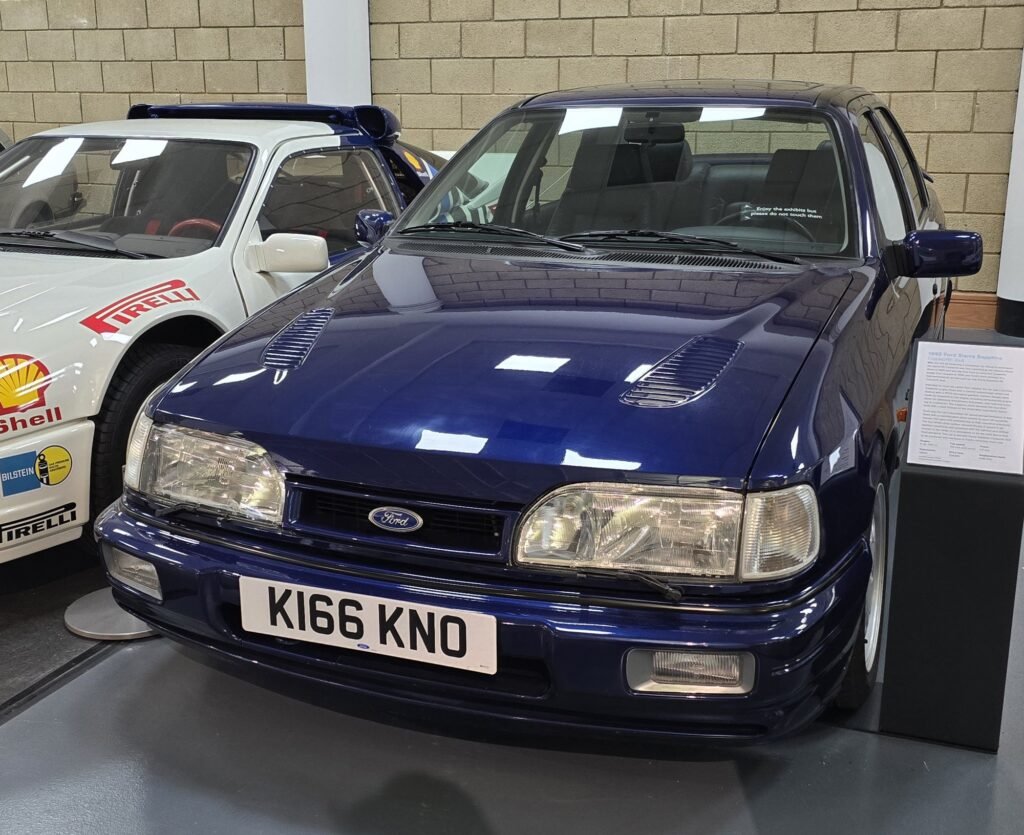
Ford took it back to the WRC. It never owned the stages the way the RS500 owned the circuits, but it had its days: Massimo Biasion finished second at the 1992 Rally of Portugal, behind Juha Kankkunen’s Lancia and ahead of Carlos Sainz, now in a Toyota. Around 12,250 Sapphire 4x4s were built before production ended in 1992, and the Escort RS Cosworth took over.
Why it would never get built today
Look at what this car actually was: a cheap block, a race-shop head, a turbo, a wing that management wanted to bin, and a production run of 500 built so a race team could use injectors that did nothing on the street. Every one of those decisions would die in a modern product meeting. Legal would kill the wing, finance would kill the run, and marketing would ask why the halo car shares an engine with a delivery van.
The Sierra Cosworth happened because a few stubborn people at Ford and Cosworth didn’t ask for permission. It came out of a cylinder head parked on a workshop floor as bait and a boast over pub food. It had no pedigree, no premium badge, just a good engine and a lot of nerve. It won anyway, nearly everywhere it went, until the people writing the rules made it stop.
Peugeot answered the four-door Cosworth with its own turbocharged all-wheel-drive sedan, the Peugeot 405 T16: 220 hp on overboost, a variable-geometry turbo and just 1,046 built.
Check you’re still alive.
Photos: Calreyn88 (CC BY-SA 4.0), OSX (public domain), Calreyn88 (CC BY-SA 4.0), MrWalkr (CC BY-SA 4.0), Calreyn88 (CC BY-SA 4.0).