Mazda 323 GT-R: the rally weapon Mazda built the moment it quit the fight
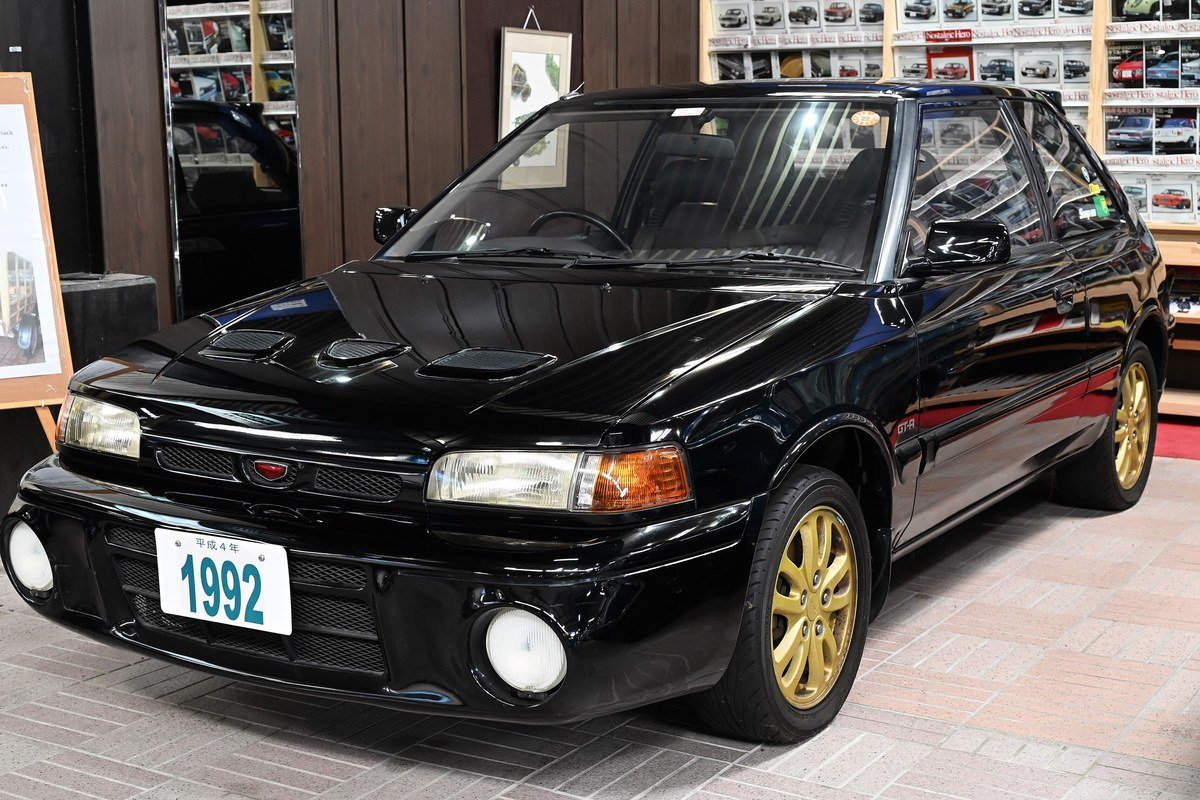
If you grew up in America in the nineties, the Mazda 323 was the hatchback your aunt drove to the grocery store, and its sedan sibling wore a Protegé badge from 1990 on. What you almost certainly did not know is that somewhere in that same family tree sat a 207-horsepower, all-wheel-drive homologation special built to go rallying at the highest level in the world. You didn’t know because you were never allowed to buy it. The Mazda 323 GT-R never officially crossed into the United States, and by the time the 25-year import clock finally ticked over and enthusiasts could legally bring one home, most Americans had never heard the name. The cruel part is that Mazda had already given this country a taste: for 1988 and 1989, U.S. dealers sold the 323 GTX, the previous-generation hatch with a 1.6 turbo, 132 hp and all-wheel drive. Then the new generation landed and the turbo AWD car simply vanished from the American order sheet, right as Japan and Europe got the real thing. This is the story of the best Mazda you couldn’t have.
Thirty years on, that very obscurity is what makes the GT-R such a tantalizing object for the JDM-hungry American collector. A Group A homologation car from the golden era, somewhere between 2,200 and 2,500 built, a turbo engine with serious sports-car numbers, and a competition career cut short by a decision made in a boardroom rather than on a stage. Japan worships it. America is only now finding out it was robbed of it. And in Spain, of all places, it once undercut a Lancia Delta Integrale by more than a million pesetas and ran with it lap for lap.
Your aunt’s hatchback had a secret
To understand the GT-R you have to start with how spectacularly dull its starting point was. The Mazda 323 was one of the most sensible, forgettable compacts money could buy. The car your cousin bought because it wouldn’t break. The definition of an appliance with wheels. Nobody looking at one parked outside a strip mall was thinking about rally stages.
But Mazda had ambitions, and the generation of the 323 known internally as the BG, launched at the tail end of the eighties, became the base for a whole climbing ladder of increasingly serious versions. First came the GT, front-wheel drive with a naturally aspirated 1.8-liter 16-valve four, the entry-level warm hatch. Above it sat the GTX, which was a different animal entirely: permanent all-wheel drive and a 1.8-liter turbo good for roughly 180 to 185 horsepower in Japan, depending on the year, and about 165 in Europe. (A quick untangling, because the internet gets this wrong constantly: the 1.6-liter turbo belonged to the earlier BF-generation GTX. By the BG, the middle rung already used the same 1.8 block that would crown the range.) And at the very top, in 1992, came the version that finished the job: the 323 GT-R.
2,500 cars for a permission slip
Here’s where we need to stop and explain the concept that makes this entire story make sense, because without it nothing does. In top-tier motorsport, manufacturers can’t just show up with any prototype they dream up. To compete in a category like Group A — the premier rally class of that era — the rulebook demanded that the race car be based on a road car built in series, in a minimum quantity. That requirement is called homologation: proving that the thing you’re racing is, in essence, the same car anyone can buy at a dealer.
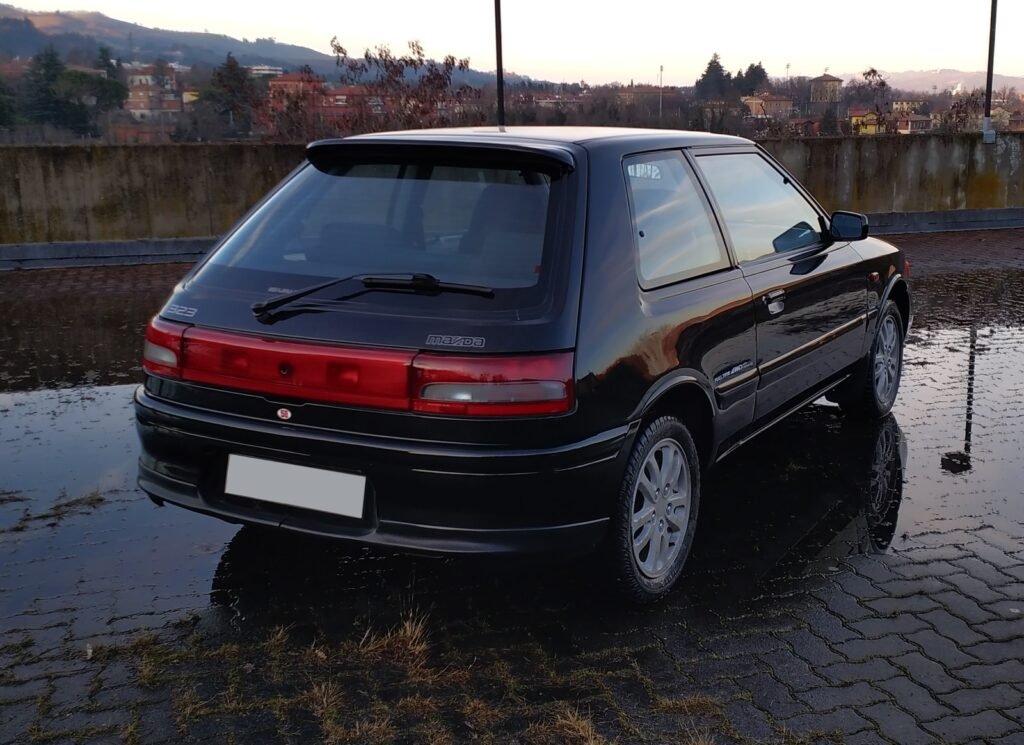
For years the FIA wanted 5,000 cars before it would sign off on a Group A model. In the early nineties it cut the bar in half, to 2,500, and the GT-R was sized to fit that new number exactly. Don’t confuse the rulebook figure with the real count, though. Specialists generally put GT-R sales at around 2,200, with about 220 going to Britain and about 200 to France. Some add roughly 300 examples of a stripped-out, harder-edged variant called the GT-Ae, though that figure is unconfirmed. Do the math: 2,200 plus 300 lands exactly on 2,500. Either the GT-Ae cars were what made the homologation numbers work, or Mazda got through with fewer cars than the rules demanded. Nobody has ever settled it with paperwork. One Italian outlet even quotes 5,000, the old rulebook number. None of these figures is official, but they all describe the same thing: a short run, built to open a regulatory door rather than to fill showrooms. That makes the GT-R what enthusiasts call a homologation special: a race car barely disguised as a road car, built not to make money but to earn the right to compete. The purest, most coveted class there is.
The BP-T: 1.8 liters and an IHI turbo
The heart of the GT-R was a four-cylinder, 1.8-liter engine known by its internal code BP-T, with an 83 mm bore, 85 mm stroke, 16 valves and a water-cooled IHI turbo fed through a side-mounted intercooler. If turbos still sound like black magic, here’s the short version. A turbo is, in essence, an air pump driven by the exhaust gases that would normally be wasted out the tailpipe. Those gases spin a turbine at enormous speed; the turbine is joined by a shaft to a compressor, and it’s that compressor that squeezes the intake air before it enters the engine. More compressed air means more fuel can burn in each explosion, and more fuel burned means more power. It’s how you get big-engine muscle out of a small engine.
And muscle it had. In Japan, Mazda quoted 207 horsepower (210 PS in metric) for that 1.8 turbo — an outrageous figure for an engine that size in the early nineties. The European car was rated at 185 PS, the missing 25 eaten by a catalytic converter and boost capped at 0.65 bar, about 9.4 psi. Either way, that’s more than a lot of two-liter sports cars of the day made, packed into a compact nobody looked at twice. At roughly 2,650 lb (sources range from 1,180 to 1,220 kg), period tests put it at around 7 seconds to 62 mph and a top speed in the 135-137 mph range. Meanwhile, the hottest thing an American Mazda dealer could sell you in that same family was a Protegé with no turbo at all. The GT-R lived in a parallel universe you weren’t invited to.
Spain got invited, briefly. According to the Spanish magazine Autopista, in 1993 the 323 GT-R cost 3,863,480 pesetas, while a Lancia Delta Integrale was north of five million. Autopista took both to an improvised circuit with the TEPESA driving school, and the lap times came out very close: the Mazda had less power but less weight to carry. The catch was the options list. ABS was extra, and air conditioning wasn’t available at any price. Another Spanish magazine, Automóvil, expected about 40 cars to reach the country; that was a forecast at the time, and nobody has confirmed the real number since.
Four driven wheels and a viscous coupling
But the GT-R wasn’t just raw power, and that was the whole point of it against flashier rivals. All that force was fed to the four wheels through a permanent all-wheel-drive system. It’s worth explaining why that matters so much. In a powerful car that only drives the front wheels, flooring it makes those wheels scrabble and fight you through the steering, losing traction exactly when you need it most. Split the force across all four tires and the car plants everything into the ground without drama, becoming devastatingly effective on wet tarmac and loose dirt alike.
The GT-R also ran a viscous-coupling center differential, a device that automatically limits the speed difference between the front and rear axles: when one axle starts spinning faster than the other — because it’s lost grip — the coupling stiffens and reins that difference in, feeding the drive back toward the axle still biting into the ground. In normal running it sent 43 percent of the torque forward and 57 percent rearward, a rear-leaning split meant to let you steer the car on the throttle, not just the wheel. This was the exact recipe that had turned the Lancia Delta Integrale and the Toyota Celica GT-Four into rally legends: compact turbo engine, all-wheel drive, low weight. Mazda took that same winning formula and applied it to its humble 323, with the difference that almost nobody noticed.
1.8 liters that the FIA counted as 3.1
There’s a detail on the GT-R’s official homologation sheet that gives the whole game away, and enthusiasts love it. When the FIA registered the car for Group A, ahead of the 1993 season, its papers carried two displacements. First the real one: 1,839.6 cubic centimeters. And next to it, a second, larger, apparently absurd figure: just over 3,127 cubic centimeters.
Why that strange second number? Because the competition rulebook penalized turbo engines with a correction coefficient. The logic is sound: a forced-induction engine makes far more power than a naturally aspirated one of the same size, so to slot it into the right weight class and keep the fight balanced, the FIA multiplied the real displacement by a factor of 1.7. Run that math on Mazda’s 1.8 and you get those 3,127 “equivalent” cubic centimeters, and that was the number the car competed under for regulatory purposes. It’s a quirk that explains the GT-R’s nature better than anything: a small car that, in the eyes of the sport, was playing in the over-three-liter league. Its entire existence was engineered around the rules of rally.
Mazda shuts the shop as the GT-R arrives
And now we reach the bitterest chapter, the one that makes the GT-R such a particular story. Mazda had spent years fighting in the World Rally Championship with the earlier 323s, with top-flight drivers behind the wheel. Finland’s Timo Salonen, the 1985 world champion, drove for Mazda from 1987 to 1990, and Hannu Mikkola, champion in 1983, from 1988 to 1991. And they won, for the record: Salonen took the 1987 Swedish Rally in the 323 4WD, and Ingvar Carlsson won Sweden and New Zealand in 1989. Three World Championship wins for a family hatchback. But three wins in eight seasons is thin reward when the Lancias, Toyotas and Fords across the service park are splitting the titles between them.

The GT-R project had been pushed since 1988 by Achim Warmbold, the boss of Mazda Rally Team Europe, using the GTX as a base and aiming at both Group A and Group N. In 1992 the team built five Group A cars on the new body. And at the end of that very season, Mazda pulled its factory team out of the World Championship. The brand-new 323 GT-R, the car engineered specifically to win rallies, completed its homologation run for 1993 just as the factory turned off the lights. The ultimate weapon arrived at the battle as its army was already packing up the tents. It’s hard to imagine a greater waste of potential.
The GT-R didn’t vanish from rallying, though. Privateers kept it going from 1993. Its World Championship debut, in Sweden that February with Björn Johansson driving, ended with a broken half-shaft. Group N went better: Alex Fassina won the FIA Production Cup in one.
The big day came on the snow around Karlstad. At the 1994 Swedish Rally, which sat outside the World Championship that year and counted for the FIA 2-Litre Cup, Mats Jonsson took the Kinnarps team’s 323 GT-R to second overall, twelve seconds behind Thomas Rådström’s Toyota Celica and four seconds ahead of Stig Blomqvist in an Escort Cosworth. The detail almost nobody mentions: Jonsson had won that same rally in 1992 and 1993 driving for Toyota. The two-time winner switched to a privateer Mazda and came within twelve seconds of a hat trick. Rumor has it a properly built BP-T could approach 300 horsepower, though no homologated figure backs that up. But the big stage, the World Championship with the factory behind it, was never its own. The GT-R ended up being the finest rally car Mazda never truly got to use.

Why it’s worth real money now
My take, and I’ll say it without hedging, is that the Mazda 323 GT-R is one of the great forgotten cars of the homologation golden age, and that forgotten status is precisely what makes it so appealing now. While the entire world worships the Lancia Delta Integrale and the Subaru Impreza as the rally icons of the nineties, this little Mazda gets relegated to a footnote — when technically it played in the same league and was born from the same winning recipe. It had the bad luck to arrive after its own maker had stopped believing, and it paid for that corporate error with anonymity.
But that same bad luck has made it a genuine rarity, and for the American enthusiast a genuinely attainable one at last. We’re talking about a short-run car, split between Japan and Europe, and under the 25-year rule every one of them is now legal to bring into the U.S. The importers who know what they’re looking at are already doing it. Finding a clean one is a feat, and prices for the good examples have been climbing as the world rediscovers the value of these discreet homologation specials. It never had the Delta’s media charisma or the Impreza’s trophy cabinet, but it had the same blood: a race car dressed as an economy hatch, capable of humiliating sports cars costing twice as much and crossing a dirt stage as if on rails. And when someone actually handed it a proper wheel, like Jonsson that February in Karlstad, it beat Stig Blomqvist and finished twelve seconds off Rådström’s Celica. With its own maker already back home, watching on TV.
Group B left some strange wreckage behind, and none stranger than the Citroën BX 4TC, a rally car its own maker had crushed.
Check you’re still alive.
Photos: TTTNIS (CC0), BG83J (CC BY-SA 4.0), Thesupermat (CC BY-SA 3.0), Kakoula10 (CC BY-SA 4.0).