Mercedes 770K: Hitler’s Armored Grosser and the One Franco Kept

America likes to think it invented the armored presidential limousine. The Beast, the motorcade, the Secret Service agents jogging beside the doors: it all looks like a Washington product. It isn’t. The template was finished in Sindelfingen, outside Stuttgart, in 1938, and its most famous passenger was the worst man of the twentieth century. The Mercedes-Benz 770 Grosser, which collectors call the 770K, was built to put a dictator up high, in the sun, in front of a crowd, with steel and glass between him and anyone who wanted him dead. Several of them ended up in the United States, sold for scrap money, paraded by veterans, dumped in garages and hauled across auction stages. One of them set a world record under a false name.
Start with a confession from Mercedes itself. The “770K” name everyone uses, this headline included, isn’t period-correct. The Mercedes-Benz archive states that the “770 K” designation is of more recent date and not authentic. In the 1930s the car was simply the Typ 770, or the Grosser Mercedes. The K for Kompressor was added later by collectors, borrowed from the 500K and 540K. We use it because that’s what people search for. Now you know.
Two cars wearing one name
Daimler-Benz built the 770 in two very different series between 1930 and 1944. In Germany it was the Grosser Mercedes. The British press called it the Super Mercedes.
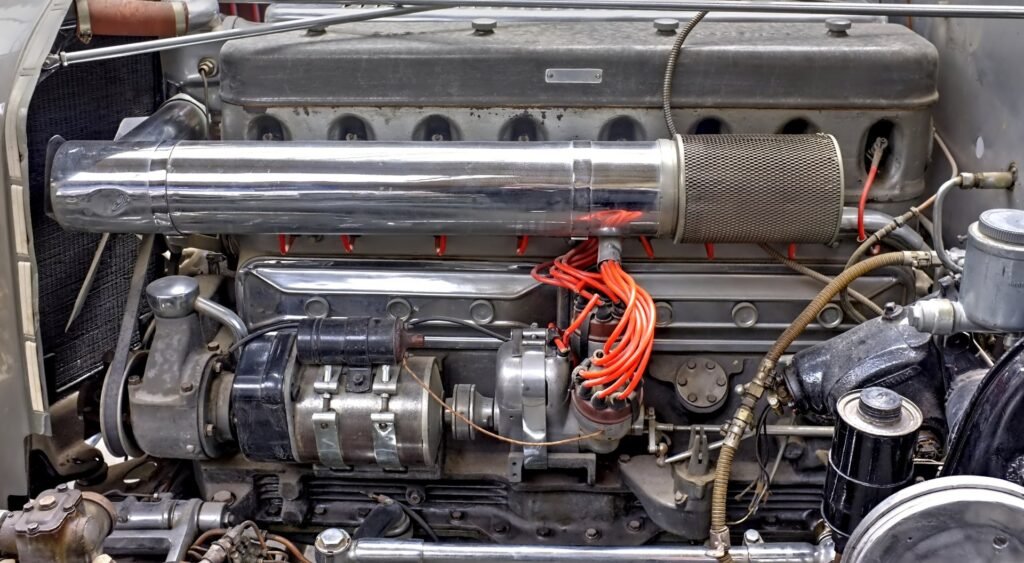
The first series, the W07, arrived in 1930. Its 7.7-liter straight-eight made 150 hp at 2,800 rpm on its own and 200 hp with the Roots supercharger, which only engaged when the driver pushed the pedal to the floor. A Roots blower is a pair of meshing lobes driven off the crankshaft that force-feeds air into the engine; we covered the principle in our chapter on the positive-displacement supercharger. Mercedes clutched it in on demand, which gave these cars their signature scream at full throttle. Four-speed gearbox with a direct third and an overdrive fourth, a boxed ladder frame, leaf springs at both ends, servo-assisted mechanical brakes, and about 100 mph with the blower howling. Mercedes built 117 of them through 1938.
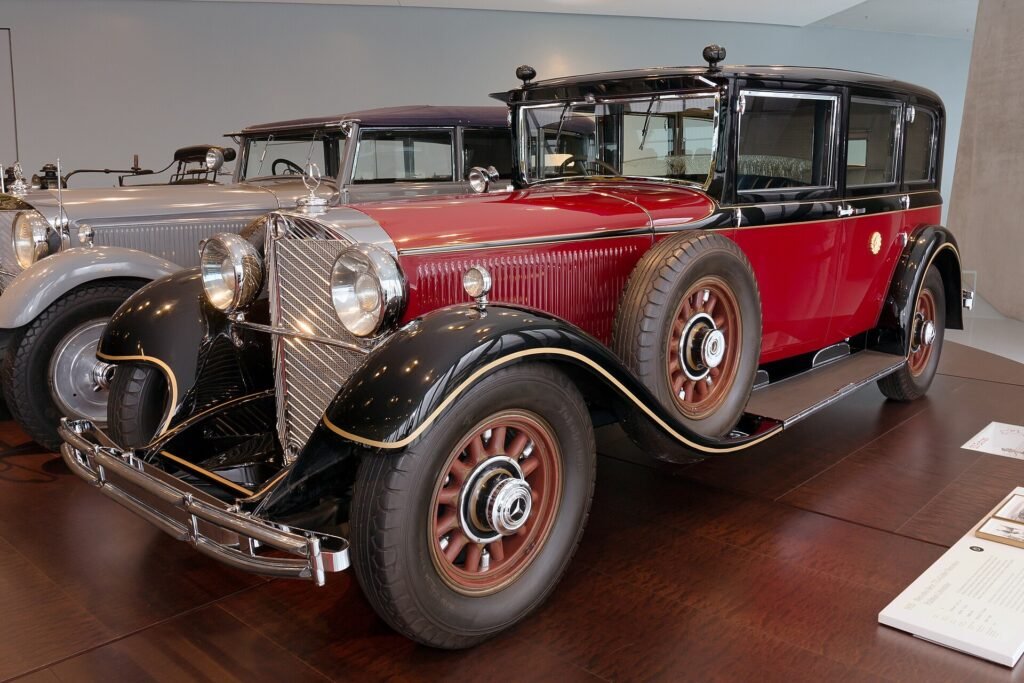
The W07 customer list reads like an interwar summit. Reich President Paul von Hindenburg, Emperor Hirohito and Pope Pius XI were among the buyers, and the exiled Kaiser Wilhelm II had one in the Netherlands. Hitler used a 770 from 1931, two years before he became chancellor. Hirohito ended up with at least seven, built between 1930 and 1938, including a parade cabriolet; an armored Grosser Pullman limousine delivered to him in January 1935 sits in the Mercedes-Benz Museum in Stuttgart today. So the factory-armored 770 existed before Hitler’s parade cars did.
The W150 and the racing chassis under a limousine
The second series, the W150, arrived in 1938. Max Sailer ran the project, Max Wagner was chief designer, and the bodies came out of the Sindelfingen special-vehicle shop under Hermann Ahrens, many of them signed by Friedrich Geiger, the stylist behind the 540K.
The engineering changed completely. The boxed frame gave way to a frame of thin-walled oval tubes, far stiffer for the weight. Up front, independent suspension with two wishbones and a coil spring. At the back, a de Dion axle on coils. If you’ve never met a de Dion: it’s a tube tying the two rear wheels together so they stay parallel, while the differential is bolted to the chassis instead of hanging on the axle. Less unsprung weight, better traction on cobblestones and broken pavement. The brakes went hydraulic.
The engine became the M150: same 7.7 liters, same straight-eight, 230 hp at 3,200 rpm supercharged. Wikipedia also lists 155 hp at 3,000 rpm without the blower, but the Mercedes archive says the W150 was only sold with the supercharged engine, so that number is disputed. Several sources mention a twin-supercharged 400 hp version good for about 118 mph, five built; Mercedes doesn’t list it, so treat it as unconfirmed. Five-speed gearbox with a direct fourth and an overdrive fifth. Top speed: 170 km/h, about 106 mph.
To put 230 hp in context: the 1938 Cadillac Series 90 V-16 made 185 hp from 7.1 liters, and it was the most powerful car Cadillac sold. Mercedes’ own 540K, the most expensive sports car in the range, made 180 hp with the blower engaged. The Rolls-Royce Phantom III’s V12 had 7.3 liters, and Rolls, true to form, never published its output. On paper, the Grosser was the most powerful production car a head of state could buy in 1938. If Berlin agreed to sell him one.
88 cars, almost none for sale
Mercedes built 88 W150s. The archive breaks them down: 46 Offener Tourenwagen open parade cars, 18 Pullman limousines, 10 armored four-door sedans, 7 Cabriolet F, 5 Cabriolet D, one Cabriolet B and one bare chassis. Half of them, 44, were built in 1939. One each in 1940 and 1941. Then 29 in 1942 and 1943, nearly all armored. The war had changed the customer.
The end date is disputed. Mercedes says the last three chassis were built at Untertürkheim in June 1943 and the last car was delivered in July 1944. Wikipedia puts the last bodies and deliveries in March 1944.
Where the steel went
Mercedes built “a few specially armour-plated units” of each body style, then ten more armored sedans for the government from June 1943. The best-documented armored car is the one in the Canadian War Museum in Ottawa: 40 mm glass all round, 18 mm steel plate around the passenger compartment, and an extra plate that could be raised between the driver and the rear. 19-inch armored steel wheels and bullet-resistant tires with 20 separate chambers, so one hit drained one chamber, not the tire. Light-alloy fenders to claw back a little weight. The Sinsheim museum car adds floor armor against mines.
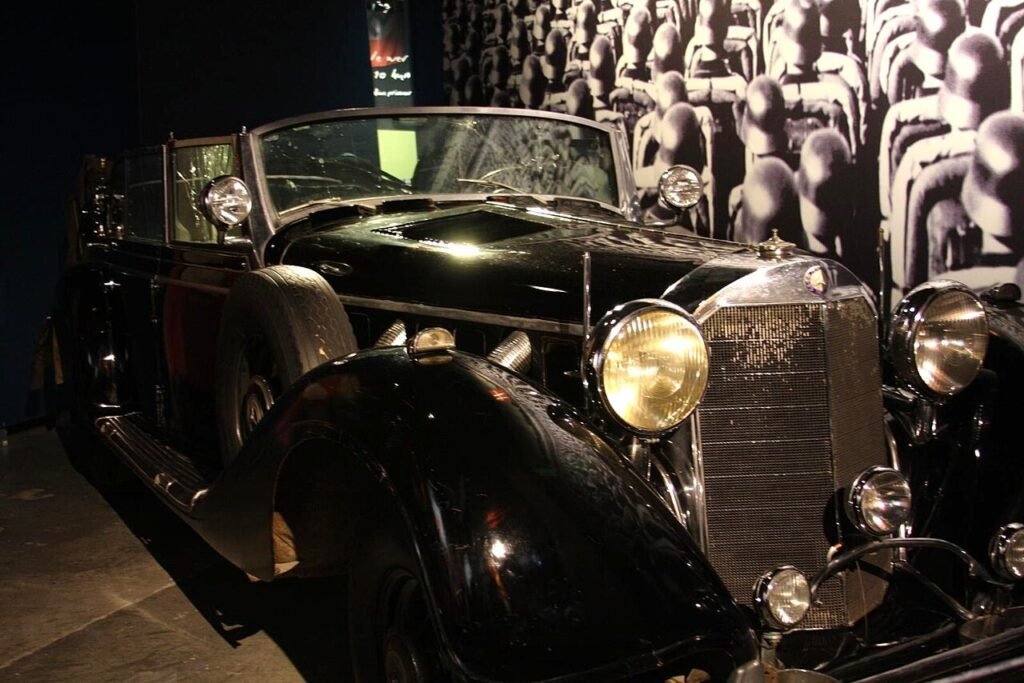
The weight exploded. Mercedes lists a gross vehicle weight of 4,200 kg for a standard W150 and 5,420 kg, almost 12,000 lb, for an armored one. And this is the detail that defined the car: the factory told owners not to exceed 80 km/h, 50 mph, in the armored versions, to keep the tires alive. The 106 mph in the brochure was for the unarmored car. The armored Grosser was built to crawl down wide avenues with its passenger standing in the back.
Outside, though, it didn’t look armored. Long, chromed, with the external exhaust pipes wrapped in flexible metal hose that marked every supercharged Mercedes. The steel sat between the sheet metal and the upholstery. That idea, a hidden capsule under civilian bodywork, is still how presidential cars are built, including the Cadillac the Secret Service drives today, even if the agency won’t say exactly how its car is made. No need to invent a direct lineage. The 1938 answer simply turned out to be the right one.
Roosevelt’s borrowed armor
Washington was years behind. When Pearl Harbor was bombed, the President’s car wasn’t armored. The Lincoln “Sunshine Special”, a 1939 Lincoln K convertible, was only armored in early 1942. Berlin had been building factory-armored Grossers for years by then. There is no evidence Detroit copied Sindelfingen, and we won’t claim it did. The calendar speaks for itself.
The American afterlife of Hitler’s cars
This is where the story turns very American.
The Ottawa car was one of Hitler’s own. Delivered to the Reich Chancellery on July 8, 1940, it was found in May 1945 at Laufen by the U.S. 20th Armored Division. A liberated Dutch forced laborer got it running and swore it was Göring’s. It toured the United States raising money for war bonds, was sold as surplus at Aberdeen Proving Ground in October 1956 for $2,750 to a Montreal businessman, and went to the Canadian War Museum in 1970 as part of a tax settlement. The bullet-damaged glass was left in place.
Field Marshal Mannerheim’s car took a stranger route. His W150 Cabriolet F reached Finland through Vaasa in December 1941 and was handed to him at Mikkeli on December 16. The Mannerheim Foundation points out it was not Hitler’s birthday present: for Mannerheim’s 75th birthday, on June 4, 1942, Hitler gave him three Steyr vehicles. The car was still always linked to Hitler as its donor. Mannerheim sold it to Sweden in 1946, and in 1948 it was sold on to the United States to settle a loan. It played Hitler’s parade car in the 1951 film The Desert Fox with James Mason. In 1973 it was auctioned in Arizona as “Hitler’s Mercedes” for $153,000, then the highest price ever paid for a car at auction. The buyer was a Lancaster, Pennsylvania businessman who owned the Dutch Wonderland amusement park. It wasn’t Hitler’s. Finland’s news agency STT had already said so. The record stood anyway.
Chassis 189744: from parade to VFW post
Then there’s chassis 189744, a 1939 Offener Tourenwagen. A letter dated September 2, 1938 records that it was ordered at the request of Erich Kempka, Hitler’s chauffeur, for the Führer. According to the sale file it was the fourth Führer “guest car”, meant to carry friendly heads of state, and it was built with right-hand drive. It was delivered in Berlin on July 29, 1939 and made its public debut on October 6, 1939.

Documented parades: June 18, 1940, Munich, for Mussolini’s visit; July 6, 1940, Berlin, the victory parade after the fall of France; May 4, 1941, Berlin, celebrating the conquest of Yugoslavia and Greece. On July 15, 1943 it went back to Sindelfingen for maintenance.
After the war, U.S. Army Military Police used it at Le Havre. The owner of the Belgian Belga tobacco company bought it and sold it to Tom N. Austin of the Austin tobacco family in Greeneville, Tennessee (one British account says Greenville, North Carolina). Austin gave it to his local Veterans of Foreign Wars post, which drove it in parades with dignitaries and Gold Star Mothers. Then it rotted in a garage until August 1976, when Steve Munson and Joe Ogden of Pewee Valley, Kentucky bought it with 33,309 km on the clock. It sat in an Illinois museum with a $1 million price tag, went to Earl and Tom Blakely of Georgia in 1978, and on April 7, 1983 to Ralph Engelstad, owner of the Imperial Palace casino in Las Vegas. After Engelstad died in 2002, it was sold in 2004 to a European buyer as part of a 21-car package.
On January 17, 2018, Worldwide Auctioneers offered it in Scottsdale, promising 10% of the price to Holocaust education. The bidding reached $7 million. It didn’t meet reserve.
A month later, an armored Grosser was seen being unloaded from a truck in Medina, Washington, the Seattle suburb where Bill Gates lives. The Drive reported that the auction car had found an anonymous buyer and was headed outside the U.S. The Telegraph says the Medina car, blue with plate IA 148461, was a different 770 entirely. Two sources, two stories. Pick your side.
The Spanish angle: Franco’s Grosser
One W150 never crossed the Atlantic, and the English-language press has barely looked at it. It’s in Madrid.
First, two cars that get mixed up constantly. The six-wheeled Mercedes 540 G4 W31 was a genuine gift from Hitler to Franco, delivered in 1940 at a ceremony in Madrid’s Royal Palace. Franco never liked it, it got stuck on a hunting trip in the El Pardo hills, and it is one of three original G4s left. Mercedes reportedly offered 1,000 million pesetas for it. Spain said no.
The 770 is a W150 Pullman. Spanish sources say it left the factory in 1941 and was registered to the Casa del Caudillo on December 4, 1942, Franco’s birthday. How it got there is disputed. The Spanish blog Coche Antique says the Spanish Army bought two. Most Spanish press calls it another Hitler gift. And Patrimonio Nacional’s own label, quoted by El Debate at a 2023 exhibition, gives a third version: the car had been offered as a gift from Hitler, but the Army Ministry ended up paying an agreed price of 60,000 marks in 1945. The year the Reich ceased to exist. The same label calls it one of the 88 built and one of eight with armored bodywork.
Today it belongs to the Spanish state and lives in the Royal Guard’s historic hall next to the El Pardo palace, where the Guard’s maintenance unit checks the collection twice a year. Franco barely used it: once the war turned, being seen in Hitler’s car stopped being a good look. In June 2023 it left El Pardo, alongside the G4, for “En movimiento”, the first temporary exhibition at Madrid’s Gallery of the Royal Collections. If you want to see an armored W150 without flying to Ottawa, check where it is before you go.
Why the Grosser still matters
The 770 wasn’t the first armored car, or even the first armored Mercedes: Hirohito had his armored W07 in 1935. What the W150 did was turn the armored state car into a catalog product with a clear idea behind it: the leader in plain view, the steel out of sight. It did it with a race-bred chassis and an engine no other limousine could match in 1938.
And it did it for a regime that used it as stage scenery. That’s why nobody quite knows what to do with these cars now. Ottawa shows its car with the bullet-cracked glass. Stuttgart shows Hirohito’s. Madrid keeps one in a barracks. And in Scottsdale, somebody bid $7 million for one and was told it wasn’t enough.
If you like prewar German engineering, the Horch 930 S Stromlinie shows the other side of the same country in the same years: while Sindelfingen was armoring limousines, Zwickau was teaching them to cut through the air. And for where Mercedes itself came from, start with Carl Benz.
Keep reading: Fiat S76 "Beast of Turin": the 28.5-Litre Monster Explained
Check you’re still alive.
Photos: Tony Hisgett (CC BY 2.0), Morio (CC BY-SA 3.0), Thomas Vogt (CC BY 2.0), Derek Hatfield (CC BY 2.0), MarcelBuehner (CC BY 4.0).