Alfa Romeo 155: the front-drive Fiat-era sedan America never saw, and the rally-bred Q4 hiding inside it
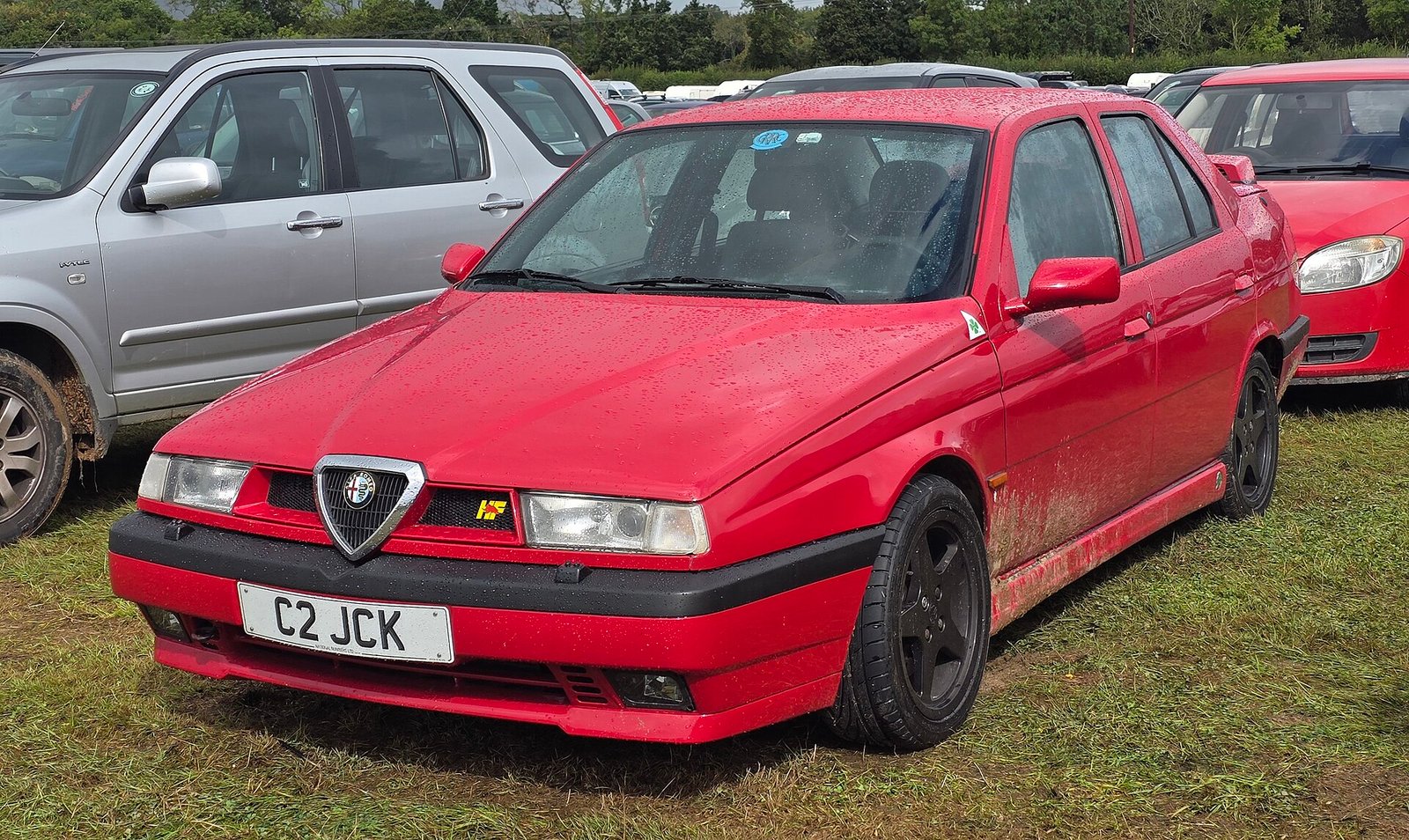
American Alfa fans remember the 75 as the Milano, the last rear-drive Alfa sedan sold in the United States, and they remember the 164 as the car Alfa Romeo left the country with in 1995. The car in between never crossed the Atlantic. It was the Alfa Romeo 155, a boxy, front-wheel-drive sedan built on a Fiat platform, and in Italy it was greeted with something close to contempt. Its own development engineer, Sergio Limone of Abarth, is said to have called it "il brutto anatroccolo", the ugly duckling. And yet one version of it carried the four-wheel-drive hardware of the Lancia Delta Integrale, the most successful rally car of its era, and the racing 155 went to Germany in 1993 and beat Mercedes on home ground. This is the story of the road car, the one that took all the criticism.
In short: the Alfa Romeo 155 (Type 167) was presented in January 1992 as Alfa’s first sedan fully developed under Fiat, on the front-wheel-drive Tipo Tre platform shared with the Fiat Tempra and Lancia Dedra, with I.DE.A styling and a 0.29 Cd. Purists hated it, but the Q4 version carried the four-wheel-drive hardware of the Lancia Delta Integrale, and the racing 155 beat Mercedes in the 1993 DTM.
What Fiat did to Alfa Romeo
Fiat bought Alfa Romeo in 1986, and it very nearly did not. Alfa was then owned by the Italian state through Finmeccanica, and the first serious offer came from Ford, which wanted a European premium brand and was ready to take a stake. Fiat moved in with a counteroffer, the Italian government preferred to keep Alfa Italian, and Ford went home. Had Dearborn won, the 155 would never have existed in this form, and the story of Alfa in the nineties would have been written in Michigan.
Under Fiat, Alfa became one brand among several sharing parts, platforms and factories. The last Alfa developed independently was the 75: rear-wheel drive, transaxle layout with the gearbox at the back for near-perfect weight distribution, a design inherited from the 1972 Alfetta. It was quirky, sometimes fragile, and loved by the people who drove it.
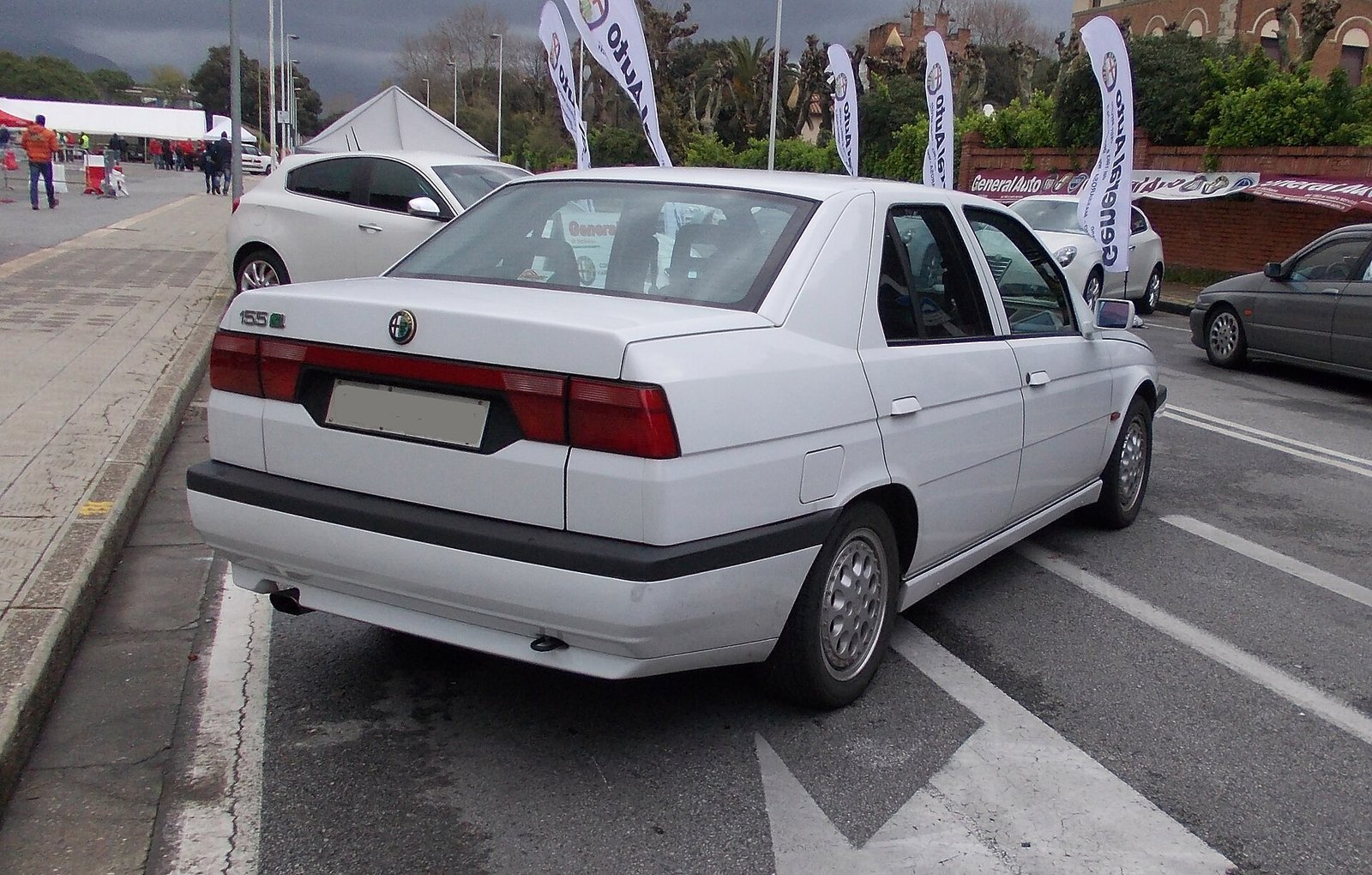
The 155, internal code Type 167, was everything the 75 was not. It was presented to the press in Barcelona in January 1992 and to the public at the Geneva Motor Show that March. It sat on the Fiat Group’s Tipo Tre platform, shared with the Fiat Tempra and the Lancia Dedra. Front-wheel drive, transverse engine, conventional sedan architecture. For the faithful, it was a betrayal.
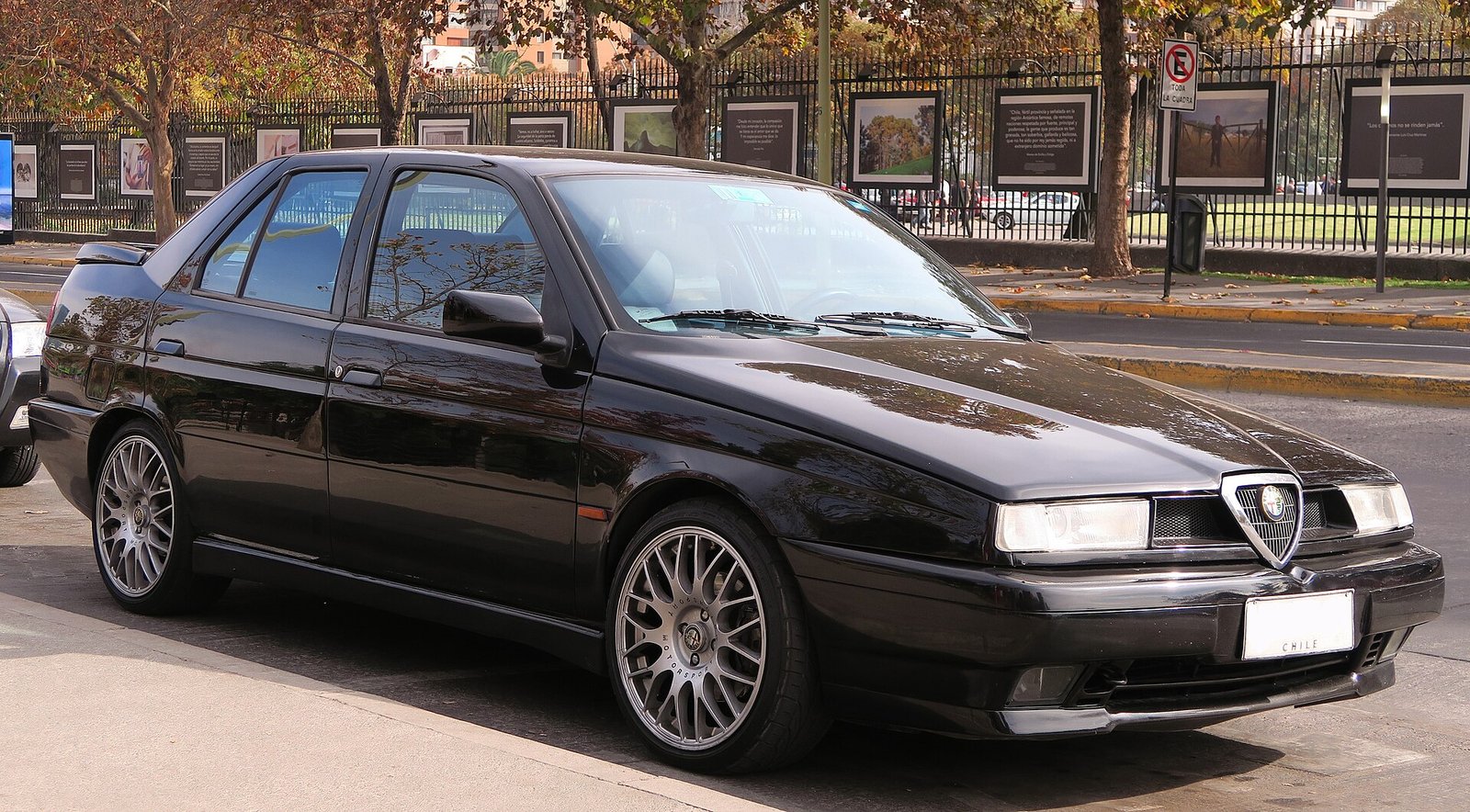
The styling did not help. It came from the I.DE.A Institute in Turin rather than Alfa’s own Centro Stile. The result was angular, clean and slippery, with a drag coefficient of 0.29 that was excellent for the time. The rising waistline gave it a 525-liter trunk, roughly 18.5 cubic feet, which was generous and practical and of no interest whatsoever to the people who buy Alfas. To many of them, the 155 looked like a Fiat with a badge glued on.
The engines
The range started with the Twin Spark four-cylinders, Alfa’s signature design with two spark plugs per cylinder. In the first series there were 8-valve engines of 1.7, 1.8 and 2.0 liters, with chain-driven camshafts; the second series switched to 16-valve units with belt drive, including a 1.6 with 120 PS and a 2.0 with 150 PS. There were also 1.9 and 2.5 turbodiesels in some markets. Competent engines, reliable enough, but not what anyone meant when they said "Alfa".
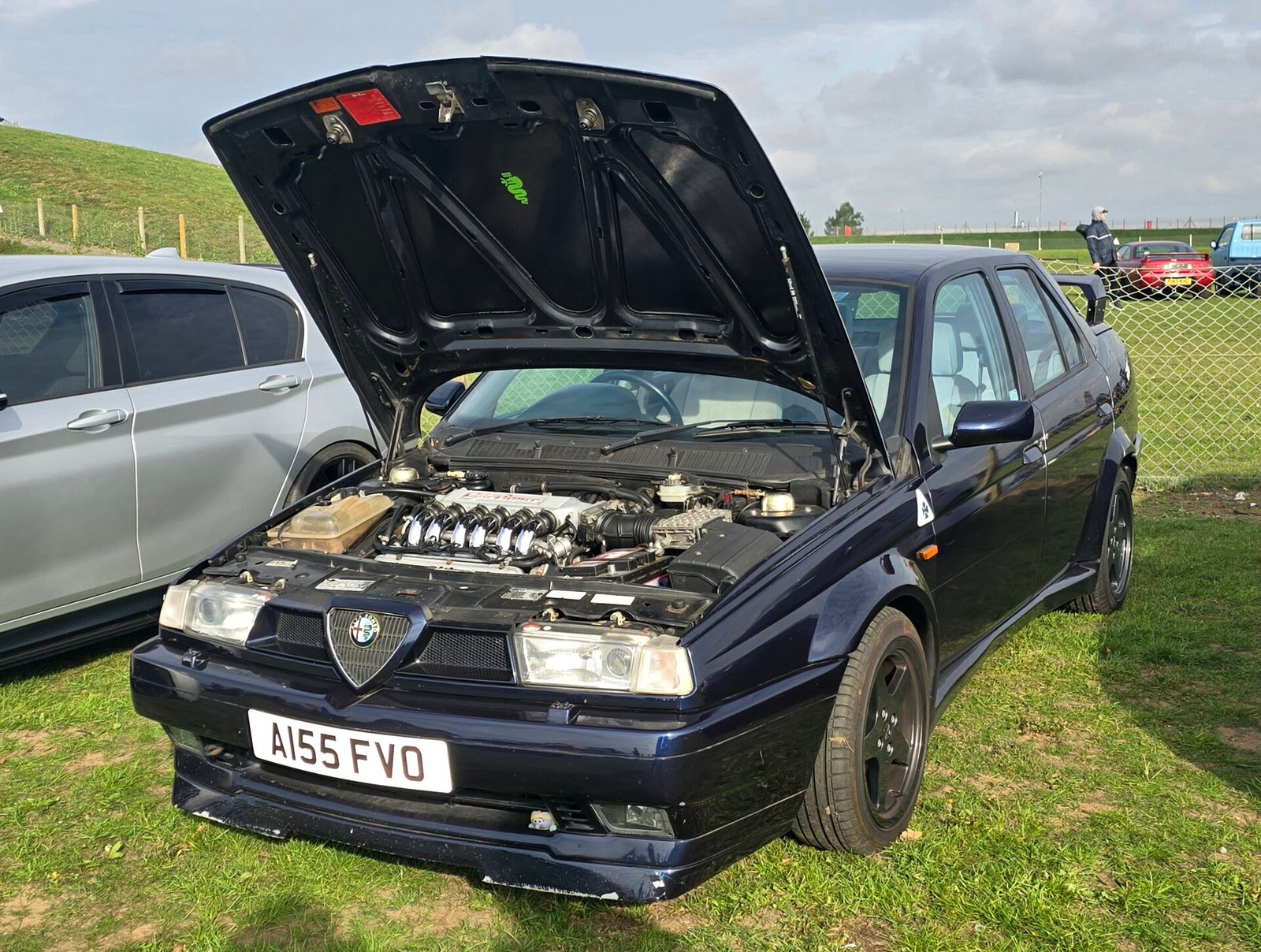
The engine that mattered most was the V6. Giuseppe Busso, an engineer who had worked with Ferrari in the immediate postwar years before spending most of his career at Alfa, designed it in the early seventies, and it reached production in the Alfa 6 sedan of 1979. By the time it reached the 155, it already powered the GTV6, the 75 and the 164, and its chrome intake runners had become one of the most photographed engine bays of the decade.
The heart of the range was the 2.5 V6, a smaller-bore version of the famous Busso V6 that powered the 164. The 2,492 cc engine kept the 60-degree layout and the single-cam-per-bank, two-valve heads, and produced 166 PS at 5,800 rpm. It was not the most powerful version of the Busso, but it gave the 155 the sound it needed. The V6 went from a low hum at idle to a hard metallic howl near the redline, and it was the one thing that reminded owners they were not driving a Tempra.
The Q4: an Integrale in a business suit
Then there was the 155 Q4, the version that turned an unloved family sedan into something serious. Its mechanical package was essentially the Lancia Delta Integrale’s, transplanted into a bigger body. The engine was the 2.0-liter 16-valve turbo four, the Lampredi-designed block that had carried Lancia to six consecutive World Rally Championship manufacturers’ titles. In the 155 it produced 190 PS at 6,000 rpm and 298 Nm, about 220 lb-ft, from 2,500 rpm.
The drivetrain was pure rally car. A five-speed manual fed permanent all-wheel drive with three differentials: an open differential at the front, an epicyclic center differential with a Ferguson viscous coupling, and a Torsen limited-slip unit at the rear. It was the same layout as the Integrale.
For comparison, the Delta HF Integrale 16v of 1989 made 200 PS and the first Evoluzione 210 PS, so the 155 Q4 gave away little in power while offering a real trunk and four proper doors. American readers who remember the early nineties will know the recipe from the other side of the world: the Mitsubishi Eclipse GSX and its twin, the Eagle Talon TSi AWD, also combined a 2.0-liter turbo four of around 195 hp with all-wheel drive. They were coupes for young buyers. The Alfa was the same idea dressed for a company director.
The Q4 weighed 1,390 kg, around 3,060 pounds, and ran 0 to 100 km/h in 7.0 seconds with a top speed of 225 km/h, about 140 mph. It wore 205/50R15 tires, had vented front discs and solid rear discs, and offered electronically adjustable suspension with automatic and sport modes. Only 2,701 were built, which makes it the rarest and most sought-after road-going 155.
It did not drive like an Integrale. It was heavier, longer and calmer, a sports sedan with a rally drivetrain rather than a homologation special with license plates. Torque arrived early, traction was relentless, and on a wet or twisting road it could embarrass cars that looked much faster on paper. It lacked the agility of the BMW M3 of the period. It made up for it with grip that the rear-drive German could not match in the rain.
What the ordinary 155 felt like
The regular front-drive 155 neither thrilled nor offended. The steering was precise but light, and some testers called it numb. The Tipo Tre chassis was competent but did not give the feedback that drivers of the 75 had grown used to. Going from a transaxle Alfa with near-perfect balance to a front-driver was a step down in feel, and the critics were not imagining it.
Where the 155 did well was in everyday life. It was roomier than the 75, easier to park, with a much bigger trunk and lower running costs. Visibility was good and the driving position was right. It did its job as a family sedan without apologizing for not being a sports car. With the V6, it became a car with a voice. With the Q4, it became something else entirely.
The specials: Zagato, Silverstone and the Abarth one-off
Alfa Romeo produced a handful of limited editions around the 155. Zagato built two of them, the TI.Z and the GTAZ, in tiny numbers, and most went to Japan, where the appetite for unusual Alfas seemed bottomless.
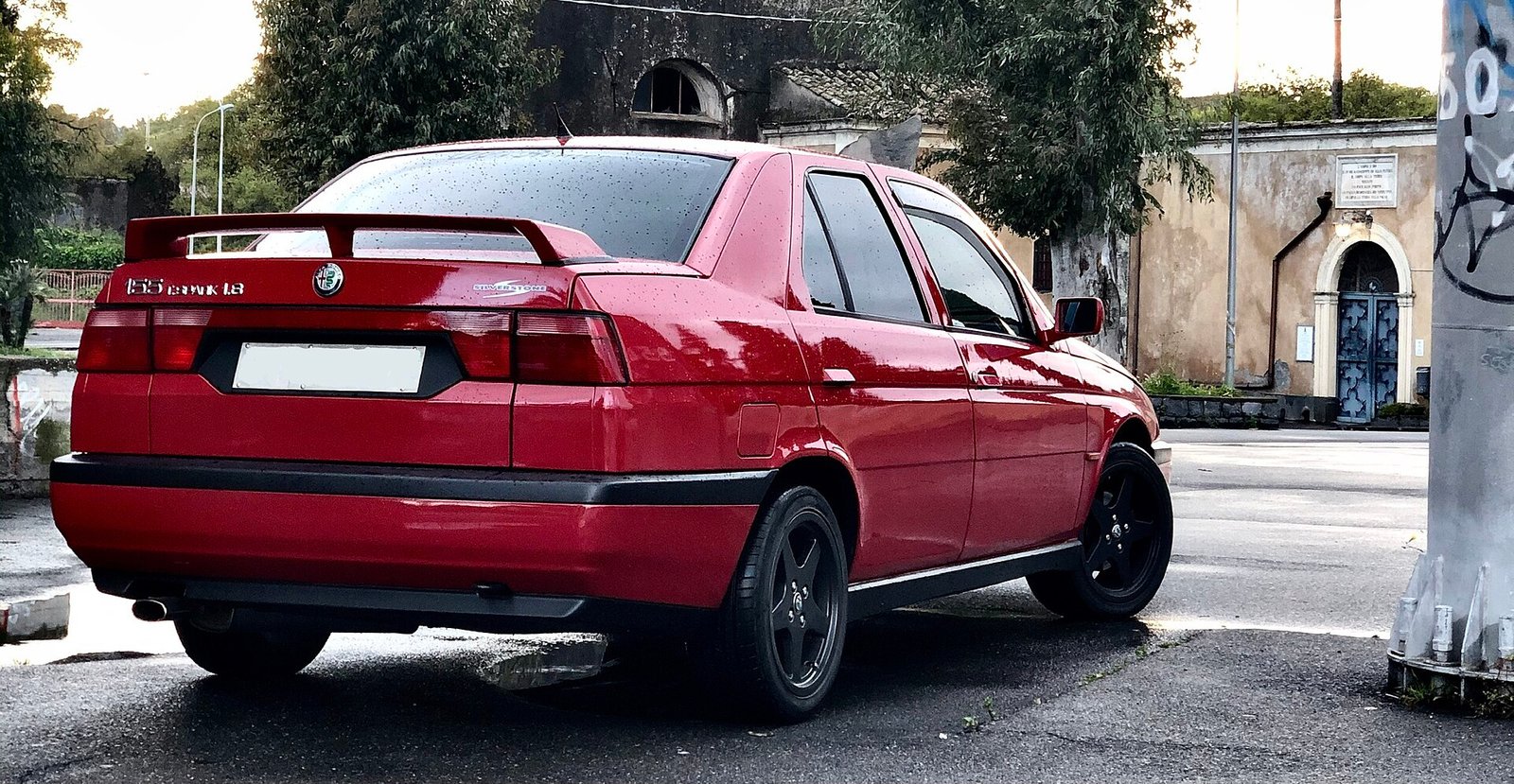
The Silverstone edition, sold in continental Europe under the name Formula, was a homologation special. Alfa needed it to race in the British Touring Car Championship with its own aerodynamic package: special front and rear spoilers, the rear one with an adjustable angle. The rules said the parts had to be on road cars, so Alfa sold them on road cars, which is how a 155 with a race-derived wing ended up in British showrooms. Gabriele Tarquini won the 1994 BTCC title in the racing version. Rivals protested that the adjustable aero kit gave Alfa an unfair advantage, and they had a point: it worked. The rules were changed, the other manufacturers built their own wings, and touring cars in Britain looked different from then on.
The most frustrating special was the 155 Stradale, developed by Sergio Limone at Abarth. Based on the Q4 drivetrain, it had a lightened interior, a race-inspired body kit and a big rear wing. It was meant to be the ultimate road 155. Exactly one was built before the project was cancelled over cost. It is the car that shows what the 155 could have been if Fiat had been willing to spend the money.
The 1995 update: wider, better, and without the Q4
In 1995 the 155 received a substantial update that drew directly on racing experience. The second series got wider tracks and flared front wheel arches, revised steering, better interior materials and the 16-valve engines. Sport packs added body kits, side skirts and 16-inch Speedline wheels, while the Super trim went upmarket with wood inserts. The Q4 was dropped, but the 2.5 V6 continued in the widebody car.
Production ended in 1998 after 195,526 cars, when the 155 was replaced by the 156, a car so much better looking and more convincing that it made its predecessor seem to come from another era.
Germany, 1993
The road 155 matters because of what it made possible. In 1993, Alfa Romeo took the 155 V6 TI to the German Touring Car Championship, the DTM, at a time when BMW had just pulled out and the series belonged to Mercedes-Benz and Opel. The racing car shared its name and silhouette with the road sedan, but under the skin it had four-wheel drive and a 2.5-liter V6 that revved to 11,500 rpm and made around 420 hp. Nicola Larini won the championship in Alfa’s first season, in front of the German manufacturers, in Germany. We tell that story in detail in our Alfa Romeo 155 V6 TI DTM history, and the wider story of the series in our piece on the DTM.
The Q4 showed that four-wheel drive worked for Alfa in competition, the Tipo Tre platform turned out to tolerate radical modification, and the Busso V6, which we cover in our history of the Alfa Romeo Busso V6, became a 420 hp racing engine with one of the best sounds in motorsport.
The verdict
The Alfa Romeo 155 was not a great car. It was a decent one, with good engines at the top of the range and one truly special version in the Q4. It could not escape the shared platform, the corporate styling or the label of "a Fiat with an Alfa badge". In the United States, it is almost unknown: Alfa sold the 164 here until 1995 and then left for more than a decade, and the 155 was never part of the lineup.
Its importance lies elsewhere. Without the road 155, there would have been no DTM 155, no BTCC title, and no proof that Alfa could still win in the nineties. It was the ugly duckling that made the swan possible. The 156 that replaced it, with its hidden rear door handles and its far more confident styling, became one of the most successful Alfas of modern times, and it inherited a racing reputation that the 155 had earned the hard way, on German and British circuits. And if you ever find a Q4 for sale in Europe, you will be looking at the closest thing to a four-door Delta Integrale that Fiat ever sold, wearing the badge that the Integrale’s owners always secretly wanted.
The racing 155 humbled the M3; the road-going payback took a quarter century and it’s called the Alfa Romeo Giulia Quadrifoglio, the 505-hp sedan Alfa built to beat BMW.
The name Larini’s 155 GTA carried came back in 2020 on a road car: the Alfa Romeo Giulia GTAm.
Alfa Romeo 155 FAQ
What platform is the Alfa Romeo 155 based on?
The Fiat Group’s Tipo Tre platform, shared with the Fiat Tempra and the Lancia Dedra: front-wheel drive with a transverse engine, a sharp break from the rear-drive Alfa 75.
What is the Alfa Romeo 155 Q4?
The four-wheel-drive version, which used the drivetrain hardware of the Lancia Delta Integrale with a turbocharged two-litre engine, an Integrale in a business suit.
Why was the Alfa 155 controversial?
Because it was the first Alfa sedan built entirely on shared Fiat hardware, with front-wheel drive and styling from the I.DE.A Institute rather than Alfa’s own Centro Stile. Its own development engineer reportedly called it the ugly duckling.
Check you’re still alive.
Photos: Calreyn88 (CC BY-SA 4.0), RL GNZLZ from Chile (CC BY-SA 2.0), Michigta (CC BY-SA 4.0) and Centocinquantacinque (CC BY-SA 4.0), via Wikimedia Commons.